




Abstract
Introduction:
The nasolabial folds are one of the most recognizable signs of aging in the midface. Acupuncture has been used widely for beauty therapy including facial rejuvenation and is known to be effective and have minimal side effects in reducing wrinkles. The aim of this study was to determine the changes in nasolabial fold after manual acupuncture for facial rejuvenation.
Methods:
This study is designed as a quasi-experimental or also called as one group pretest–posttest design involving 25 participants. Eligible patients will receive the same manual acupuncture therapy three times a week for 2 weeks. Manual acupuncture is performed at ST36. At the face, acupuncture is performed using the penetrating needling technique, from the superior edge of the arcus zygomaticus through ST2 toward LI20, on the zygomaticum through ST3 toward the middle of the nasolabial fold, on the inferior edge of the arcus zygomaticum through SI18 toward ST4, ST7 toward ST4, and at ashi point on the scalp along the temporal hairline at the m. temporoparietal. The outcomes are nasolabial length changes measured in millimeters, changes in the wrinkle severity rating scale (WSRS), and changes in the global aesthetic improvement scale (GAIS). The outcome will be evaluated at baseline, posttherapy, 2-week, and 4-week follow-up posttherapy.
Results:
The length of the nasolabial fold decreased after therapy with a mean change of 37.34%. There was one level of improvement on the WSRS after therapy. On the GAIS, there was an improvement of two to three levels after therapy.
Conclusion:
Nasolabial fold improved after receiving manual acupuncture therapy for facial rejuvenation.
INTRODUCTION
Wrinkles are one of the main clinical symptoms of aging. The aging process of the skin is influenced by intrinsic and extrinsic factors. Intrinsic skin aging is caused by the passage of time and by genetic factors. Extrinsic skin aging mainly results from UV irradiation, which is called photoaging. 1 In chronologically aged skin, the enzymes responsible for collagen degradation increase gradually over time in the skin, and collagen synthesis may also decline. 2 According to data and reports at the Acupuncture Clinic, Dr. Cipto Mangunkusumo General Hospital in 2019, there were 149 patient visits aimed at treating the problem of wrinkles and loose skin out of a total of 3054 visits or 4.9%.
The nasolabial fold is one of the most recognizable signs of aging in the midface. 3 Although nasolabial folds are visible in youth and also when smiling, they can become deeper and longer with age and make the face look tired and saggy. 4 Nasolabial folds according to Merriam-Webster’s dictionary are wrinkles that stretch from the alae nasi to the corner of the mouth from the same side. 5 Nasolabial folds are formed by compartments of the superficial nasolabial fat and traction of the muscles that underlie facial expressions. These imprinted lines become more pronounced with aging because changes occur in the bones of the orbital rim, orbicular’s retaining ligament, zygomatic ligament, orbicularis oculi muscle, and the superficial musculoaponeurotic system. 6 A decrease in dermal elasticity is also known to be involved in the formation of wrinkles. 3
To make it easier to diagnose wrinkles on the face, certain classifications are usually used. Classifications that are widely used include the wrinkle severity rating scale (WSRS), Glogau scale, Fitzpatrick wrinkle scale, modified Fitzpatrick wrinkle scale, and global aesthetic improvement scale (GAIS).
WSRS is a specifically designed scale to measure nasolabial fold. The U.S. Centers for Food and Drug Administration approved the WSRS instrument for use in tool-free investigational studies. Although based on a simple subjective assessment, the WSRS allows a valid and reproducible assessment of the nasolabial fold, thereby allowing the dermatologist or plastic surgeon the opportunity to evaluate, quantitatively, the purely qualitative treatment results. A further advantage of the WSRS, from the clinician’s point of view, is that each class on the scale represents a clinically meaningful change in the severity of nasolabial fold from a bordering value. 7 Assessment of wrinkle severity on the WSRS is based on visual assessment of the length and depth of nasolabial fold without reference to baseline or pretreatment performance. 8 The WSRS can be seen in Table 1.
Wrinkle Severity Rating Scale 7
Source: Day et al. 7
GAIS is a 5-level scale of improvement in global aesthetic appearance, compared with before treatment. GAIS was measured for each nasolabial wrinkle at baseline and during follow-up, with results compared with baseline pretreatment photographs. 9 GAIS is a relative rather than an absolute scale: Researchers assessed overall improvement in each nasolabial wrinkle by comparing the patient’s appearance at follow-up with magnification photographs height taken before treatment. 8 The GAIS can be seen in Table 2.
Global Aesthetic Improvement Scale 8
Source: Narins et al. 8
In the last decade, minimally invasive techniques for wrinkle improvement have been popular because they allow faster processing times, can be performed in the clinic, have fewer postoperative complications, have a minimal recovery period and maximum comfort for the patient, and are much cheaper.10,11
Facial rejuvenation acupuncture was mentioned by Barret in his journal in 2005. In his writings, it was stated that in oriental medicine, facial rejuvenation is achieved by inserting acupuncture needles into acupuncture points to get the desired effect. The benefits of therapy include the elimination of some wrinkles, reduction in the length and depth of wrinkles, reduction in the number of acne breakouts, improved facial muscle tone, improved skin texture with smaller pores, and reduced sagging around the eyes, cheeks, chin, and neck. 12
Facial rejuvenation acupuncture has attracted the attention of several women who want to improve their beauty and health, especially by revitalizing and rejuvenating facial skin. 13 Many younger, established patients require maintenance but do not require major surgery and benefit greatly from noninvasive approaches such as acupuncture. 12
In this study, we will compare the nasolabial fold improvement before and after manual acupuncture treatment and whether the effect will last up to 4 weeks after the therapy is finished.
MATERIALS AND METHODS
The study design was a quasi-experimental study involving 25 participants who met the inclusion criteria and did not meet the exclusion criteria. We include participants from both genders, male and female, aged 30–50 years, WSRS scores 3–4, willing to participate in the study until completion and not undergo aesthetic medical procedures (Botox injections, filler injections and/other implants, light therapy, microdermabrasion, facial procedures, peeling, and thread embedding therapy) during the research, and signing informed consent. Participants with facial muscle paralysis disorders, history of filler injections and/or other implants, light therapy, microdermabrasion, peeling, and botulinum toxin therapy within the last 6 months, history of keloids and/or hypertrophic scars, tumors, infection or inflammation at the acupuncture point area, allergies to stainless steel, allergies to lidocaine topical anesthetic, pregnant women, taking anticoagulants or antiplatelets, current blood sugar levels ≥200 mg/dL, or body temperature >38°C were excluded from the study. All participants finished the study.
The research was conducted at the Acupuncture Clinic in Dr. Cipto Mangunkusumo Hospital, Jakarta, from November to December 2020. All research subjects received the same treatment.
The main data collected in the study were the length of the nasolabial folds. Facial documentation will be carried out before therapy, after the end of therapy, 2 weeks after the end of therapy, and 4 weeks after the end of therapy. Secondary data collected were WSRS and GAIS scores, as well as side effects of acupuncture procedures.
Patients will receive manual acupuncture on the face and body with disposable needles 0.25 × 25 mm and 0.25 × 50 mm lengths (DB108C; Dongbang Medical Co., Boryung-si, South Korea). On the face, an acupuncture needle is inserted at a 15° angle from the superior edge of the zygomatic arch through ST2 toward LI20, second needle is from the zygomatic bone through ST3 toward the middle of the nasolabial fold, the third needle is from the inferior edge of the zygomatic arch through SI18 toward ST4, fourth is from ST7 toward ST4, and at the point on the temporal skin head along the edge of the hairline on the m. temporoparietal, with twisting manipulation. All the acupuncture was done bilaterally on the face and body. Every 10 min, the needle is manipulated again by twisting it. After 30 min, the twisting manipulation is carried out one last time, then the needle is removed. Acupuncture is performed in six therapy sessions, three times a week for 2 weeks. Acupuncture on the face is shown in Figure 1.

Insertion of acupuncture needles at the face.
Acupuncture on the body is performed at the ST36, which is inserted perpendicularly with an insertion angle of 90° and rotating manipulation with a rotation angle of 180°−270° to cause a needling sensation, and the needle is left for 30 min and then removed.
Acupuncture was done by a practitioner from the Medical Acupuncture Specialist Program Faculty of Medicine Universitas Indonesia with more than 2 years of experience in practicing acupuncture.
The length of the nasolabial fold is the distance measured from the upper end to the lower end of the nasolabial fold by the research assistant using a digital Vernier caliper. Measurements were taken before starting therapy, after completing therapy, 2 weeks after the last therapy, and 4 weeks after the last therapy. The response to therapy is a decrease in the length of the nasolabial fold. The author assumes that the difference in mean length of the nasolabial fold of 8% is significant in the study. WSRS and GAIS are measured by research assistants before starting therapy, after completing therapy, 2 weeks after last therapy, and 4 weeks after last therapy. The therapeutic response is an improvement of one level to the initial value.
Statistical analysis was done by independent statisticians using the SPSS 20.0 program. All numerical data were tested for data normality with Shapiro–Wilk. The comparative hypothesis test of numerical variables with a normal distribution of two paired groups (for within-group analysis) using the paired t-test, if the distribution is not normal, the Wilcoxon test will be used. The hypothesis test for paired categorical variables was carried out using the McNemar test. p < 0.05 indicates a statistically significant difference between the variables.
RESULTS
This study was participated by 25 subjects who met the inclusion criteria and did not meet the exclusion criteria. Sampling was carried out from November to December 2020. All research subjects followed the study to completion. This research was carried out after obtaining approval from the medical research ethics committee of FKUI-RSCM with the number KET-1149/UN2.F1/ETIK/PPM.00.02/2020 on October 5, 2020.
Baseline Characteristic
The baseline characteristics assessed in this study are shown in Table 3. The table shows most of the subjects were female (n = 22). The age of the study population ranged from 30 to 49 years old with a mean age of 40.84 years. All participating female subjects had not experienced menopause.
Baseline Characteristics
BMI, body mass index; SD, standard deviation; WSRS, wrinkle severity rating scale.
Changes in Average Length of Nasolabial Fold
Changes in the average length of nasolabial fold can be seen in Figures 2 and 3. The mean length of nasolabial fold before therapy was 36.47 (standard deviation [SD] 7.12); after therapy, the mean length of nasolabial fold was 22.82 (SD 5.22); at follow-up 2 weeks after the end of therapy, the mean length of nasolabial fold was 24.40 (SD 5.65); and at follow-up 4 weeks after the end of therapy, the average length of the nasolabial fold was 22.84 (SD 5.49).
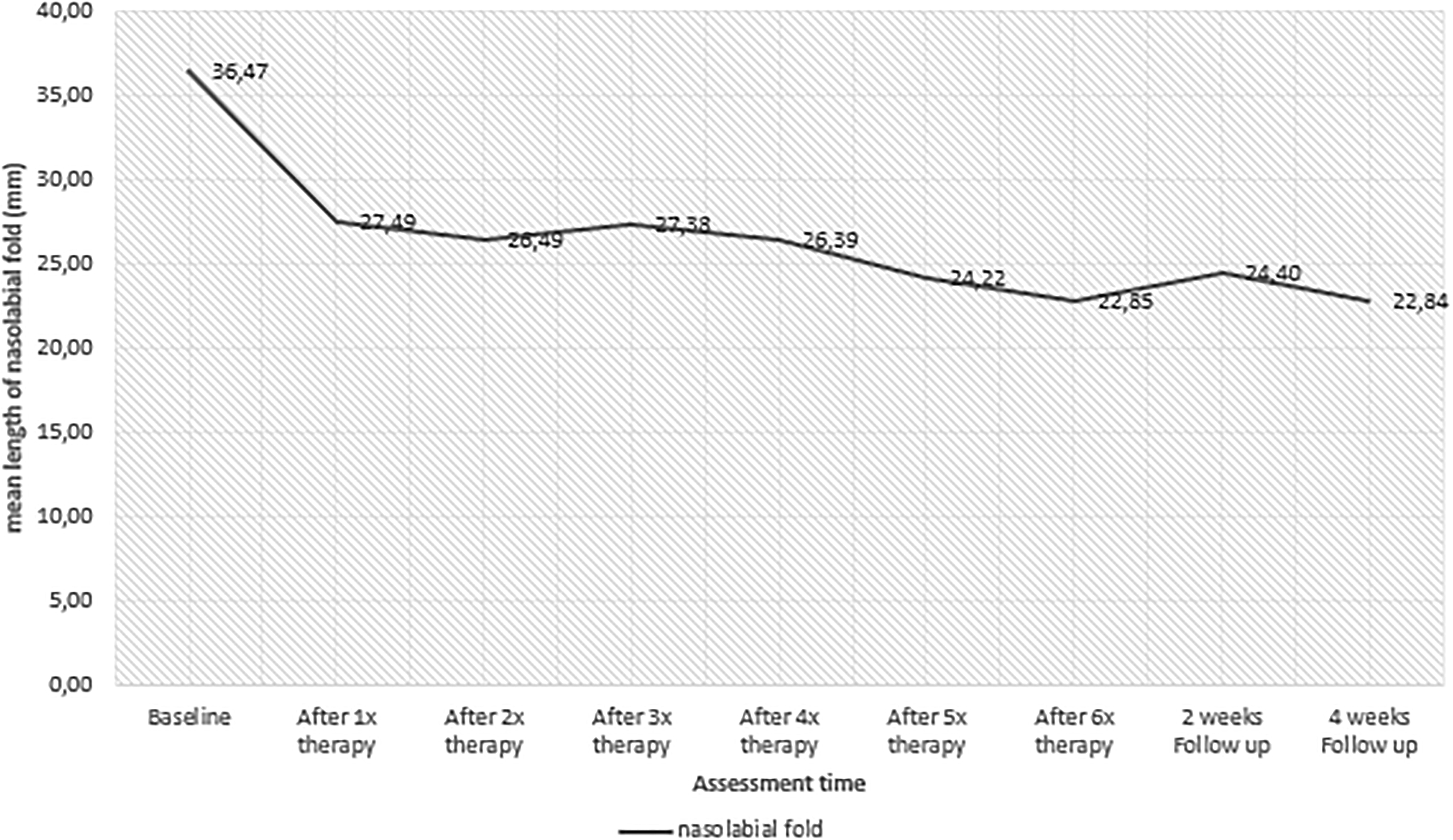
Nasolabial fold mean length changes chart. A paired t-test (p-value <0.001).a,b,c
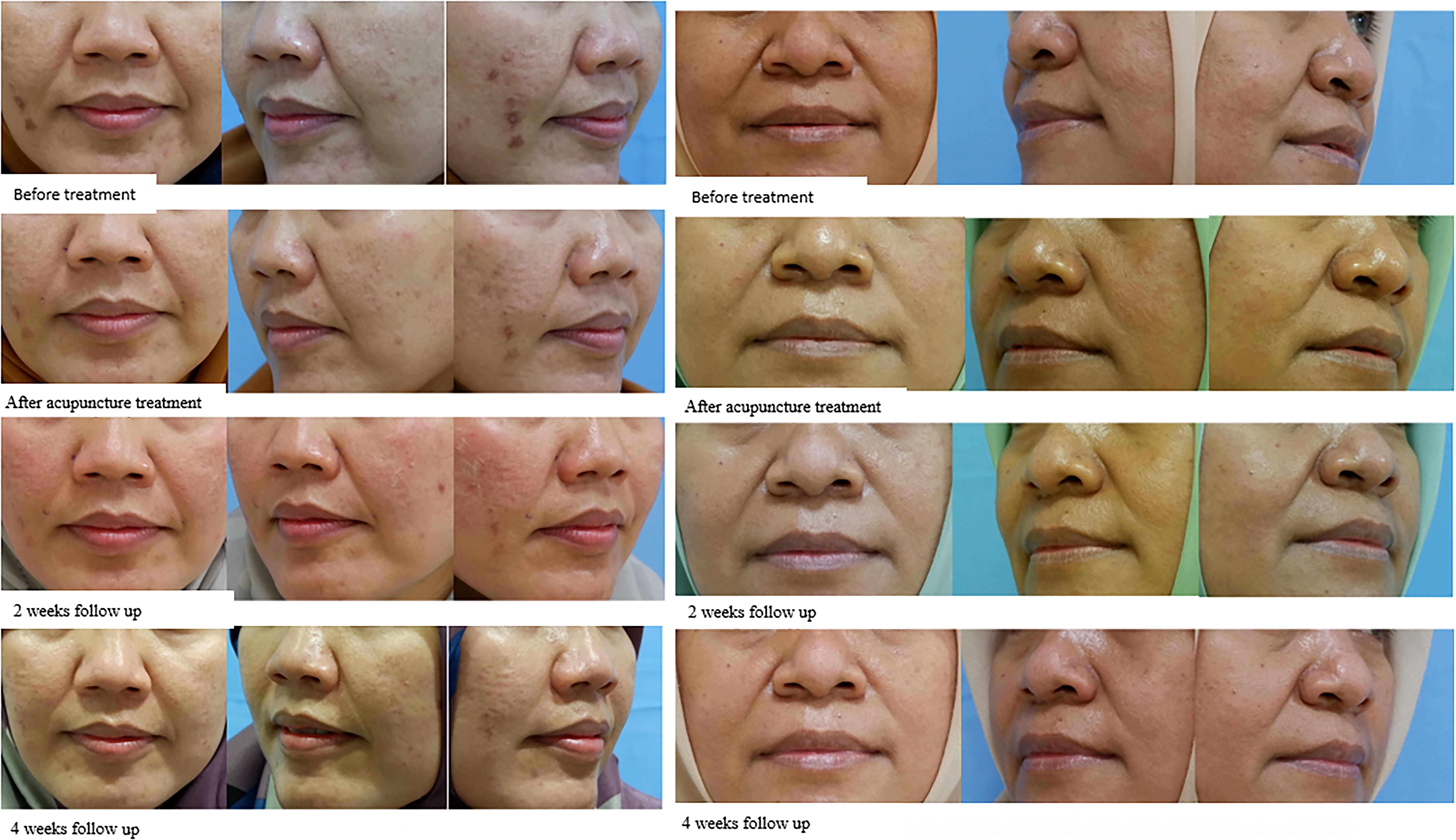
Changes of nasolabial fold in research subjects.
Changes in WSRS Score
At the initial/baseline value, the severity of nasolabial fold according to the WSRS scale was assessed by investigators as grade 3 (moderate) in 14 subjects and grade 4 (severe) in 11 subjects. Changes in the WSRS scale can be seen in Figure 4.
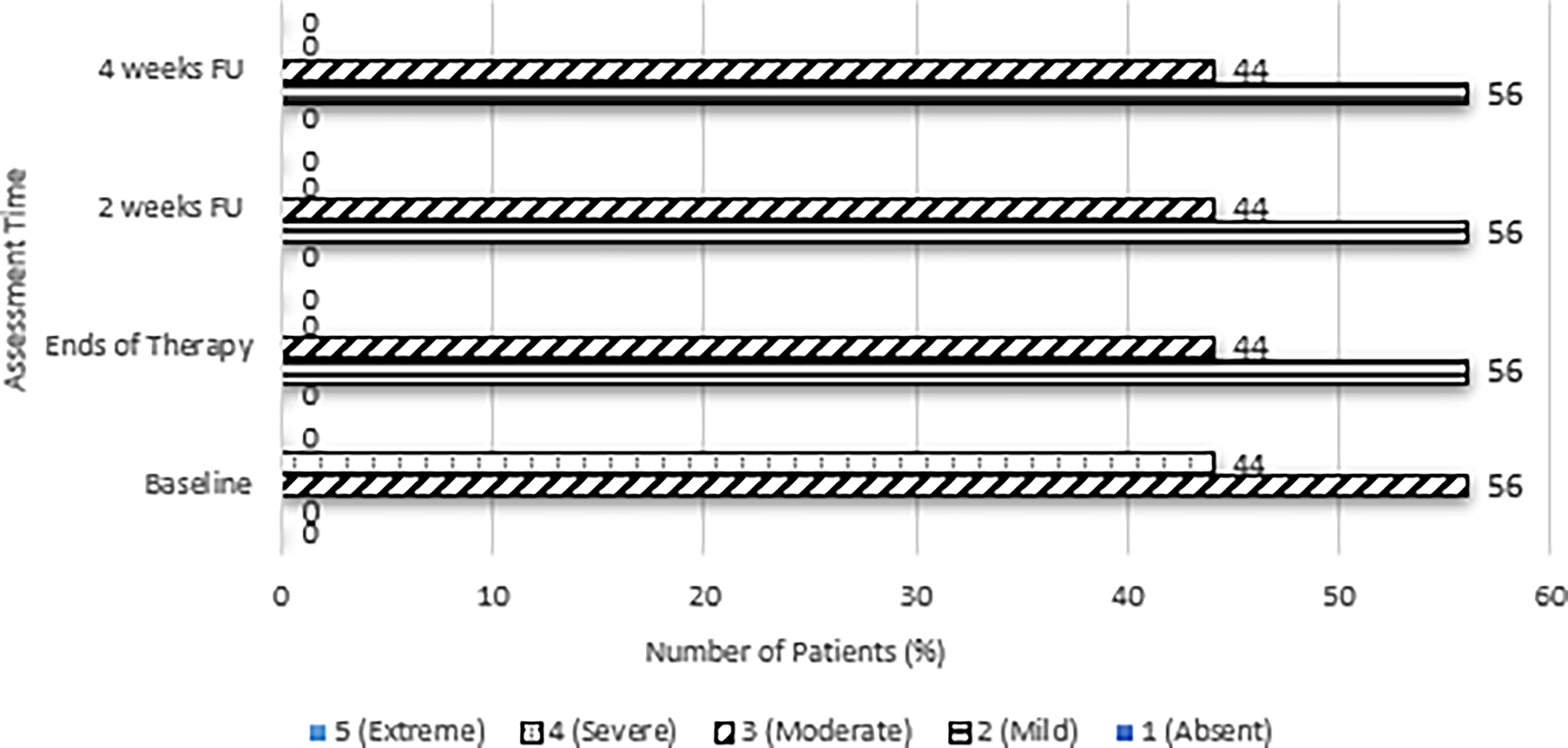
Changes in WSRS.
Changes in GAIS Scale
Based on the degree of GAIS evaluated by the investigators, the appearance of the nasolabial fold had improved in 100% of subjects by the end of therapy. For the majority of subjects (n = 17), researchers rated the appearance of nasolabial fold based on GAIS as “much improved” at the end of the visit compared with baseline and “very much improved” in the remainder (n = 8). Changes in the GAIS can be seen in Table 4.
Changes in GAIS
GAIS, global aesthetic improvement scale.
Side Effects
In this study, no significant side effects were found. There were no emergencies caused by the acupuncture procedure. Two participants reported blueness or hematoma at the puncture site in the facial area. The rest did not experience any side effects.
DISCUSSION
This is the first research in Indonesia regarding the effect of manual acupuncture on facial wrinkles, especially the nasolabial fold. This study aims to find out how the changes in nasolabial fold appearance after receiving manual acupuncture therapy and also assess whether the effect will last up to 4 weeks after the therapy is finished.
The acupuncture method chosen in this study was manual acupuncture because manual acupuncture is an alternative to noninvasive aesthetic procedures, the processing time is fast, side effects are minimal, and tools and materials are easier to obtain and more affordable. In manual acupuncture, the needle is retained for 30 min and then removed.
The results of this study showed that there was a change in the average length of the nasolabial fold at the end of therapy when compared with initial data.
Significant improvement in nasolabial length measurements using a digital caliper compared with baseline data in almost all subjects, consistent with a significant reduction in the severity of nasolabial fold based on the WSRS scale. The therapeutic effect persisted throughout the duration of the study, with improvements in the length of the nasolabial fold measured using a digital caliper, there was a shortening of the nasolabial fold from baseline. Further research is still needed to find out how long the effects of manual acupuncture last.
Needling through acupuncture points gives a mechanical effect at the site and also provides advantages from the characteristics of the acupuncture points. Recent studies have shown that acupuncture points show a different biomechanical response to needling compared with nonacupuncture points and that this biomechanical response involves connective tissue. Several researchers have stated that the collagen content in connective tissue also provides electrical conductive properties. 13
Stimulation of the ST36 is reported to reduce oxidative stress, reduce the secretion of IL-6, IL-10, TNF-α, IFN-γ, so that NF-κB activation is inhibited and there is no increase in matrix metalloproteinase (MMP) which in turn will reduce collagen degradation. 14 Puncturing ST36 will increase superoxide dismutase, which is an antioxidant enzyme that is important in breaking down reactive oxygen species (ROS). 15 Decreased ROS will result in no activation of the mitogen-activated protein kinase pathway and decreased activator protein 1, which causes a decrease in MMP so that collagen degradation decreases. 16 Decreases collagen degradation will help reduce the appearance of wrinkles on the skin.
In the face and head area, acupuncture is carried out by inserting penetrating needles. Penetrating needling is chosen because local penetrating needlework will cause more fibroblasts to be exposed to the needle and stimulated mechanically so that collagen production will increase. 2 The needling in this study had a depth of >5 mm because it was also directed to stimulate the affected muscles below the acupuncture point. Needling the acupuncture points on the face will increase local vascularization, nitric oxide, and the number and activity of fibroblasts. This causes an increase in collagen and elastin. The anti-inflammatory effect provided by acupuncture also reduces the production and activity of MMP so that collagen degradation can be reduced. 17
After microneedling, three phases will occur: (1) The first phase is the inflammatory phase which begins shortly after injury occurs, and it takes up to 7 days; (2) the second phase, the proliferation phase, begins on the second day after injury and takes up to 20 days; and (3) the final phase is the remodeling phase which lasts months after the initial injury, in this phase collagen is formed in the upper dermis layer over a period of 1 year or longer.18,19 Collagen III is the main collagen formed in the wound healing phase beginning. It is gradually replaced by collagen I over a year or more resulting in continued tissue formation for months after injury. Collagenase and matrix proteinase are involved in the gradual conversion of collagen III to collagen I, which remains in the area for 5–7 years. Collagen also appears to grow under normal conditions in a parallel pattern rather than in bundles, as is usually seen in scar tissue. 18 In the Deka study, the highest collagen formation occurred after days 12–25, which is important to observe in scar formation. 20 This can explain why the average length of nasolabial fold at the end of therapy, 2-week follow-up, and 4-week follow-up is different, because of the long distance of collagen formation. In this study, it can be seen that the average length of wrinkles can last up to 4 weeks after the end of therapy. From this, it can be seen that manual acupuncture can affect changing nasolabial fold by repairing collagen and elastin fibers.
This study has several limitations. Due to limited funds, advance markers such as tropoelastin and collagen were not performed. Second, however, the GAIS scale is a relative scale and not an absolute scale because it really depends on the researcher’s perception at the time.
CONCLUSIONS
Manual acupuncture at face and body has the potential to be effective in the improvement of nasolabial fold appearance.
Further research is needed to determine the effectiveness of manual acupuncture for nasolabial fold when compared with other acupuncture modalities.
Footnotes
AUTHORS’ CONTRIBUTIONS
V.N. led the research conceptualization, research methodology, and writing of the original article draft. I.N. and A.A.J. supported the research conceptualization and statistical analysis of the data.
AUTHOR DISCLOSURE STATEMENT
No conflicts of interest exist.
FUNDING INFORMATION
The researcher received no financial support for this research.