




Abstract
This article will attempt to discuss acupuncture training for dentists. The use of acupuncture by dentists is regulated by each individual state within the United States, and outside of the U.S., acupuncture is usually regulated by countries. Acupuncture training for dentists can be safely and effectively accomplished in 25 hours.
This article will attempt to discuss acupuncture training for dentists. The use of acupuncture by dentists is regulated by each individual state within the United States, and outside of the U.S., acupuncture is usually regulated by countries. Some states and countries do not require dentists to be formally trained in acupuncture in order to apply acupuncture-related techniques in their practices. This article will focus on the state of California, where the Dental Board requires 80 hours of training for California-licensed dentists to be able to use acupuncture within the scope of their dental license. Since each state is separately regulated, requirements vary. A search of the internet and PubMed found no references to state regulations. The American Dental Association was contacted, and Anita M. Mark, Informationist, ADA Library and Archives, gave the following response: The ADA does not have any policies related to acupuncture, nor do we have any basic information on the topic.
Dry Needling Versus Acupuncture Needling
Trigger point pain referral image showing common referral patterns for orofacial pain (Fig. 1).
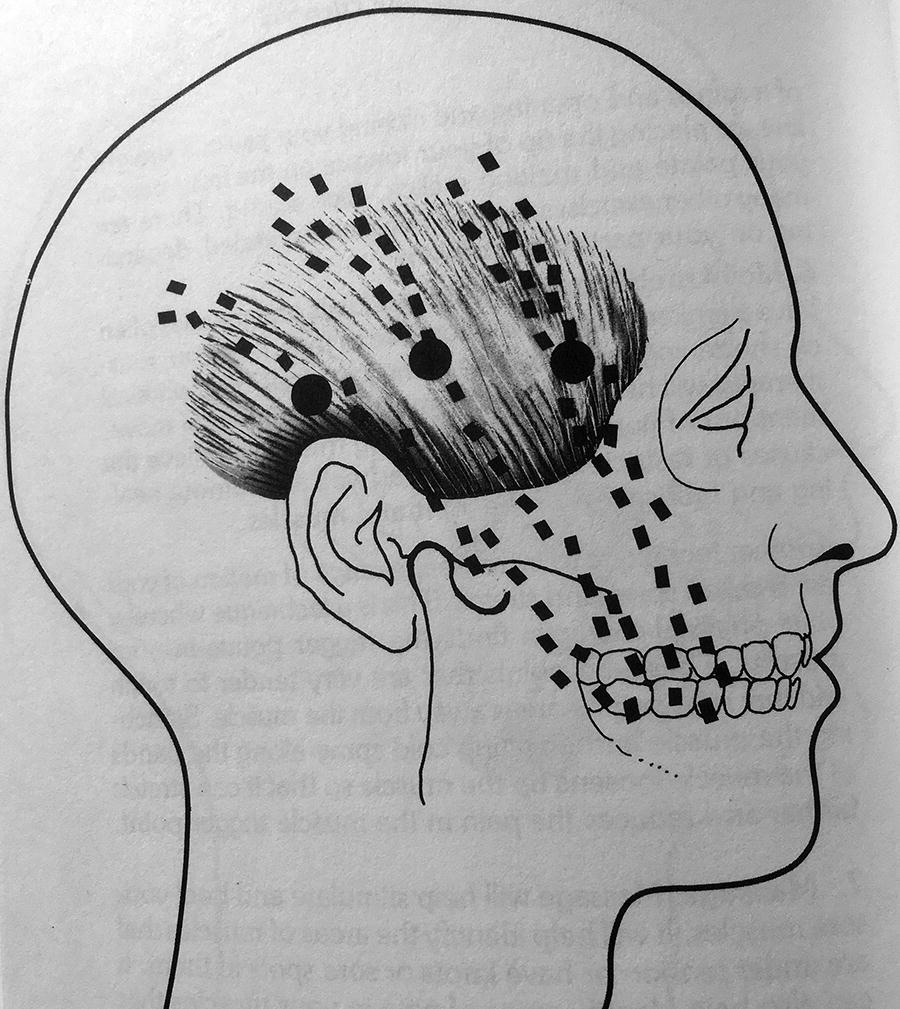
Trigger point pain referral.
Dentists can legally use acupuncture needles for dry needling without any additional training in most states when treating conditions within the scope of their license; that means dentists can treat musculoskeletal problems of the head and neck. Acupuncture is more inclusive, and dry needling is one type of acupuncture when acupuncture needles are used. Both dry needling and acupuncture share needles, target points, action mechanisms, and therapeutic effects, and could be used to treat musculoskeletal disease effectively. The term target points means points or spots where dry needling and acupuncture practitioners put needles. The target points would be called trigger points or myofascial trigger points in dry needling and acupoints or Ashi points in acupuncture. 1
Dentists in all states can use dry needling. Some acupuncturists might question and/or be unfamiliar with the use of dry needling by dentists. Dentists have a long history of using dry needling and trigger point injections, going back to the time of Janet Travell.2,3
Stomach meridian acupuncture points on the face used for orofacial pain (Fig. 2).
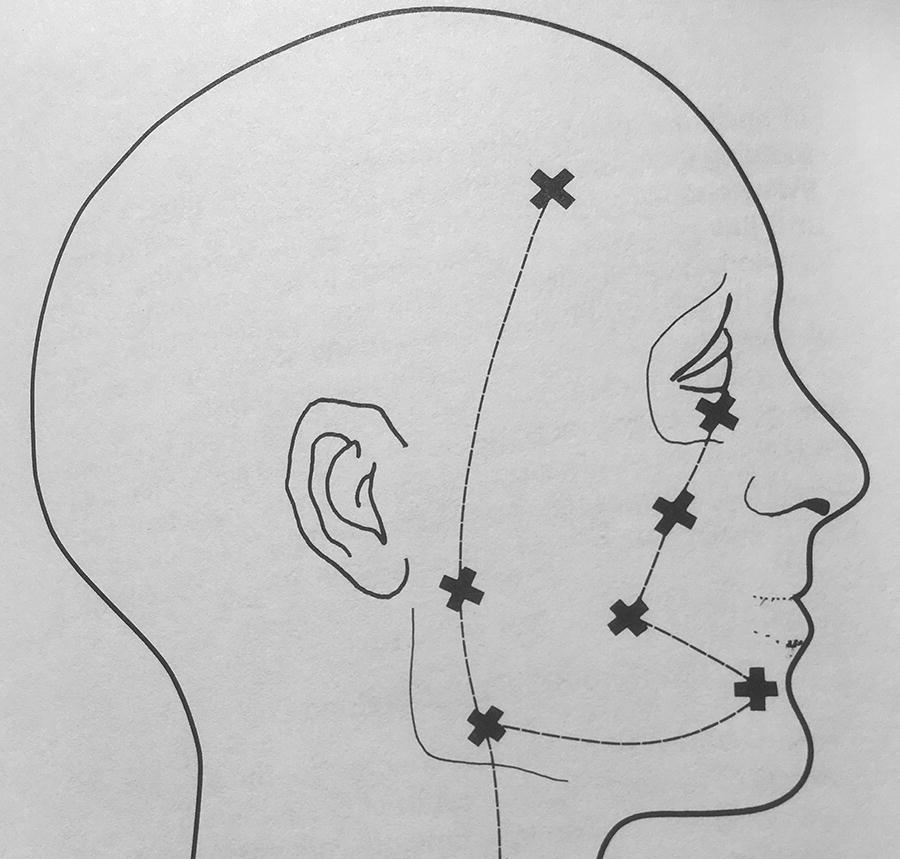
Stomach meridian on face.
There is a need for greater cooperation between dentists and acupuncturists. Dentists need to refer their patients to acupuncturists for the treatment of many conditions that are outside the scope of their dental license, which is to treat dental conditions and orofacial pain, including musculoskeletal problems of the head and neck. It is to be expected that dentists who know and use acupuncture will be more likely to refer their patients for acupuncture.
Dentists typically have 4 years of postgraduate education, with extensive training in anatomy, physiology, neuroscience, and pathology. They also have extensive clinical training in the safe use of needles, giving hundreds of injections in areas with veins, arteries, and nerves. Few other medical professionals are as skilled and/or as well trained in the use of needles as dentists. Dental students are not introduced to acupuncture in their undergraduate programs.
In the past few years, the University of California at Los Angeles has provided acupuncture classes that meet their states requirements for dentists to utilize acupuncture in their practice.
The UCLA course consists of 50 hours of didactic and 30 hours of clinical training, including instruction on the following subjects:
Theoretical foundation of acupuncture, with emphasis on current physiological concepts as they relate to traditional Chinese medicine Acupuncture anatomy and physiology Acupuncture techniques, including instruction in the use of needling techniques; moxibustion, electroacupuncture, and other noninvasive techniques for stimulating acupuncture points, such as acupressure and laser; precautions (e.g., sterilization of needles): contraindications and complications, including adverse systemic effects Application of acupuncture to the practice of dentistry
Training programs for dentists in California have been few and far between, largely due to the cost of an 80-hour program and the 80 hours of time off from a practice. There are no prerequisites for taking the certification course in acupuncture.
The benefits of dentists utilizing acupuncture are that they can help their patients with pain issues, relaxation, and gagging. Dentists may use acupuncture to facilitate peri-procedural relaxation, reduce peri-procedural gagging, and/or postprocedural pain. Acupuncture can also be used for orofacial pain conditions such as temporomandibular disorders, myofascial pain of the masticatory and cervical muscles, problems with the facial and trigeminal nerves, headaches, and burning mouth syndrome. 4 Dentists can educate their patients about the benefits of acupuncture and refer them to acupuncturists for help with medical conditions that are outside the scope of a dentist’s expertise.
In order to overcome the problem of excessive time off of a dentists’ practice, there needs to be a new approach that teaches dentists to safely use a small number of commonly used acupuncture points. In dentistry, the most commonly used acupuncture points and their indications are LI-4, ST-36, ST-44, and LV-3, for pain. P-6 and Ren-24 for gagging. ST-6, 7, and 8, GB-12 and 20, for muscle pain in the face and neck. GV-20 for relaxation and Ashi points of the head and neck for localized pain in those areas. 4
All these points are in anatomically safe areas. This short training is based on the accumulated scientific evidence that the Western style of acupuncture, based on acupuncture needles activating the many neurotransmitters, both peripheral and central, can effectively reduce pain and anxiety.5,6
Physical therapists, who have little experience with needles compared with dentists, in many states and countries safely utilize dry needling/acupuncture in their practice. Physiotherapists practice various forms of acupuncture worldwide, but no international consensus exists as to the appropriate duration of related training programs. Physical therapists who practiced predominantly Western medical acupuncture, dry needling, or both had completed acupuncture-related training programs ranging from <25 to ≥300 hours. 7
It is the authors opinion that acupuncture training for dentists can be safely and effectively accomplished in 25 hours, 15 hours of practical, and 10 hours of didactic, including the latest scientific evidence. One author has taught acupuncture courses for dentists in Chile, Uruguay, and Italy with a 15-hour technique course utilizing the above-listed most common acupuncture points. The trained dentists were able to safely and effectively utilize acupuncture for their dental patients.
There is a need for standardized training for dentists in all states.
Footnotes
AUTHOR DISCLOSURE STATEMENT
No competing financial interests exist.
FUNDING INFORMATION
No funding was received for this article.