




Abstract
Recently unearthed Tinhui Medical Slips, dating back to 2nd century BCE, demonstrates the 12th meridian in Chinese medicine as an anatomy-based discovery. This is equivalent to the persistent median artery, which was later incorporated into Neijing meridian theory and set the foundation for traditional acupuncture today.
The persistent median artery has been proposed as the anatomical basis of the 12th meridian of Hand Jue Yin in Chinese medicine.1–4 The evidence support this hypothesis includes that the anatomy, pathology, clinical symptoms, as well as pulse spots in the forearms of the 12th meridian are all closely related to that of median artery. 5 More interestingly, the 12th meridian was discovered much later than other major meridians, probably due to its rareness and presents in only 10–30% of the normal population. Similarly, the structure of median artery in Western anatomy was first described in 1846, 200 years later than the discovery of blood circulation by William Harvey. Although the 12th meridian was described in the Meridian Chapter of Neijing, the exact time of its discovery remains unclear since the publication date of Neijing is controversial. At present time, it is unclear when the 12th meridian was first discovered and how it was incorporated into the meridian theory of Neijing.
The discovery of the Tianhui bamboo slips, buried in 2nd century BCE, provides new evidence to resolve these questions. 6 A string of Chinese characters written vertically on a single bamboo slip, describes the anatomy, physiology, and pathology of the 12th meridian. Its original name was very different from classic nomenclature and prior to being incorporated into the Neijing meridian system it appears to be an independent meridian initially for the heart.
FROM 11 TO 12 MERIDIANS
There are multiple versions of medical notes called the Mai Book (meridian book), unearthed in China in the1970s or later, which mainly focused on the description of major meridians/channels in humans. 7 These books were written either on bamboo slips or silk sheets and usually found with a variety of burial items in tombs dating back to the Western Han dynasty (202–8 BCE). They are recognized as one of the earliest anatomical records in history. 8 These meridian texts all describe 11 major meridians while the classical Neijing (dated later) is known to include a 12th meridian. For nearly 2000 years, the 12-meridian theory has been the dominant principle in Chinese medicine and acupuncture, but its scientific origins have remained a mystery.9,10
It has been of particular interest for acupuncture practitioners, researchers, and the broader scientific community to understand when, how and why the 12th meridian was added. The evolution from an 11 to 12 meridian system serves as a window into the maturation of meridian theory.
The Tianhui bamboo slips were first unearthed in 2012 in a Han tomb in Tianhui town, Chengdu, China. These slips were assembled and formally published in 2023. It is the first meridian text containing the 12th meridian.
Relative to estimated burial times (Fig. 1), the Tianhui Medical Slips are more recent compared to the tombs of Mawangdui and Zhangjiashan, where several meridian books with 11 meridians were discovered. The Tianhui Medical Slips are clearly older than the Neijing, in which the 12 major meridians and meridian theory were described in detail. Although Neijing is widely recognized as the most influential book in Chinese medicine today, the exact time of its publication remains in dispute. It seems that the Tianhui Medical Slips are a transitional version of early meridian books in the Western Han Dynasty to Neijing, and as such, could provide valuable insight into how a new meridian was discovered and subsequently established in Neijing.
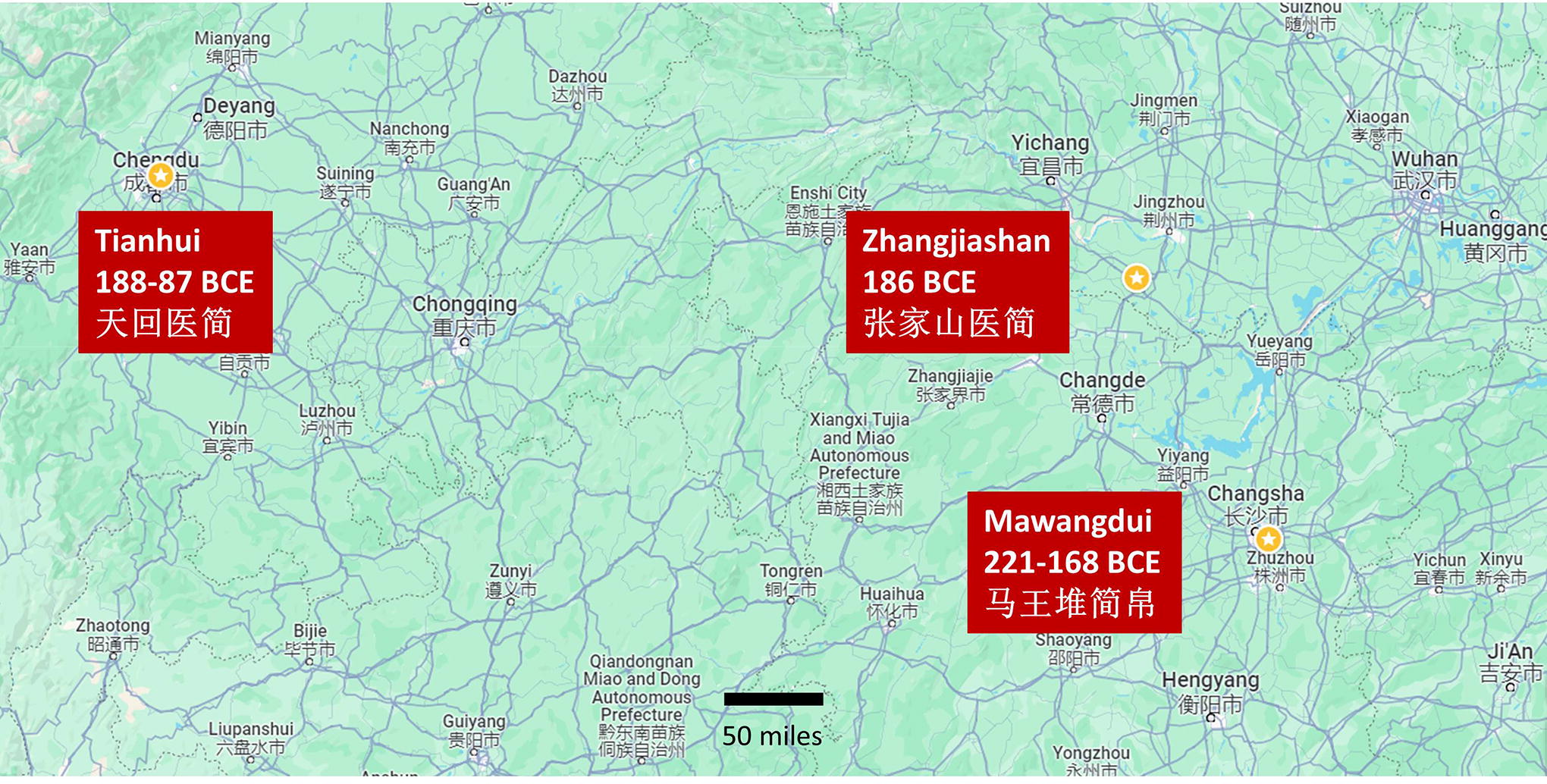
Map of unearthed meridian (mai) books from three burial sites (Google map), distant from each other, but all dating back to 2nd century BCE of Western Han Dynasty.
THE FIRST 12TH MERIDIAN
Ancient Chinese characters on #613 bamboo slip of Tianhui Medical Slips (Fig. 2) are interpreted into modern Chinese text as follows: 6
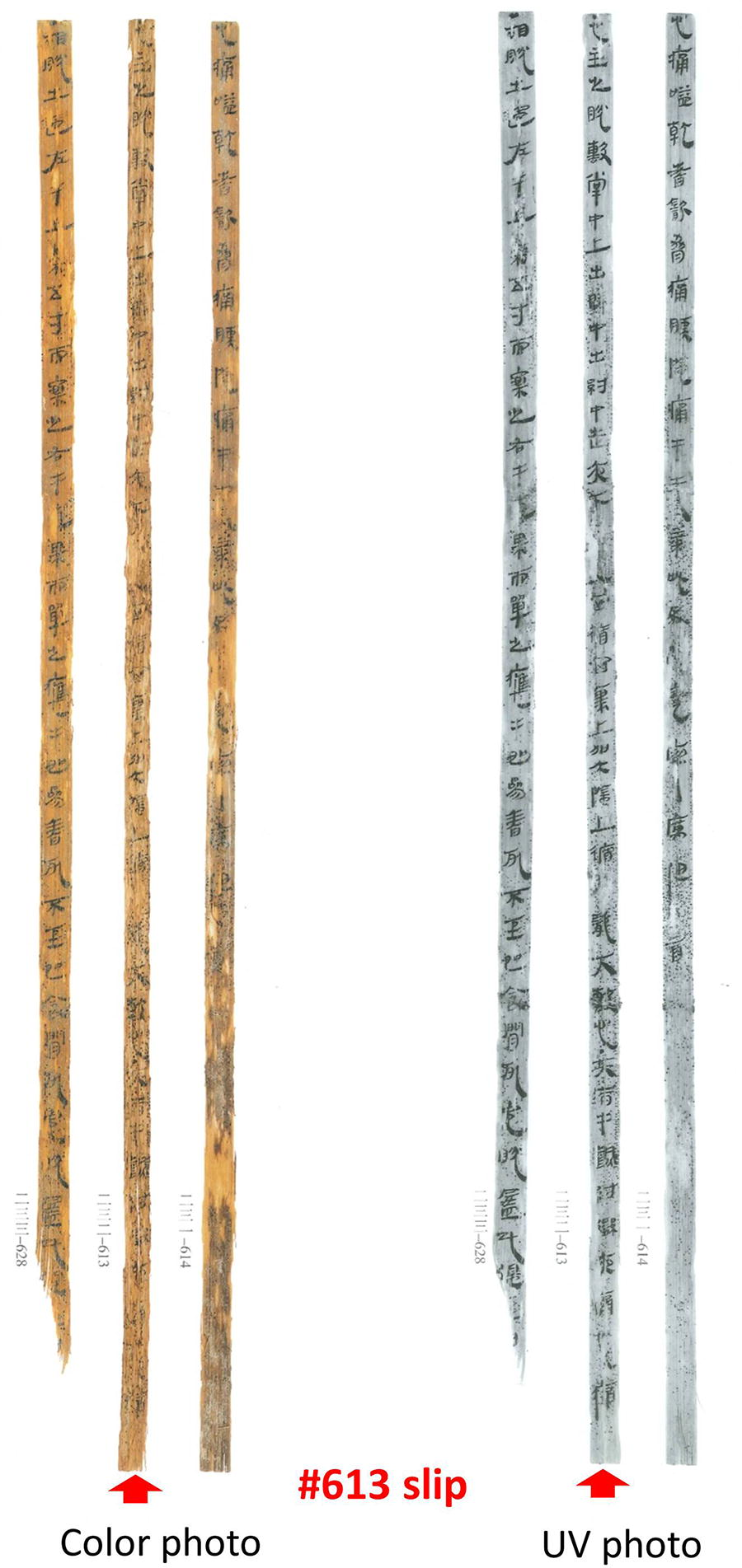
Photos of #619 bamboo slip (arrow) among 930 slips from Tianhui tomb describe the 12th meridian of Heart Master (from Tianhui Medical Slips).
“心主之脉, 系掌中, 上出臂中, 出肘中, 走腋, 下胁, 入胸, 循胸里, 上加大阴, 上循喉咙, 下系心。其病:手热, 肘挛, 腋痛, 心痛。”
The English translation of the 44 Chinese characters engraved on #613 bamboo slip states:
“The heart ruling channel river (Heart Master mai) joins to the center of the palms. It ascends to emerge within the midline of forearm and gets into the center of the elbow. It goes to the axilla, descends along the flanks and then enters the chest. Following along the interior of the chest, it ascends to join the tai yin pathway. It then ascends to a pass along the throat. Below it joins with the heart. Its illnesses are these: there is heat in the hands, spasms of the elbow, pain in the axilla and pain in the heart.”
The text begins with the name of the meridian as “Heart Master” (Fig. 2), which describes the function or physiology of this meridian, followed by its anatomical distribution. It is initiated from the inner palm, which differs from the Neijing version where the same meridian starts in the tip of the middle finger. The origin of this meridian, and its course along the middle line of the inner side of the upper arm, corresponds exactly to the median artery. It proceeds up into the elbow, which is the extension of the median artery, and connects to the brachial artery. The meridian of Heart Master passes through the armpit, enters the chest, and finally terminates in the heart. The entire route is completely consistent with the anatomy of the median artery and its extensions. Based on the description of its locations and connections, the meridian of Heart Master is closer to the anatomical structure of the median artery than the meridian of Hand Jue Yin in Neijing (Fig. 3).
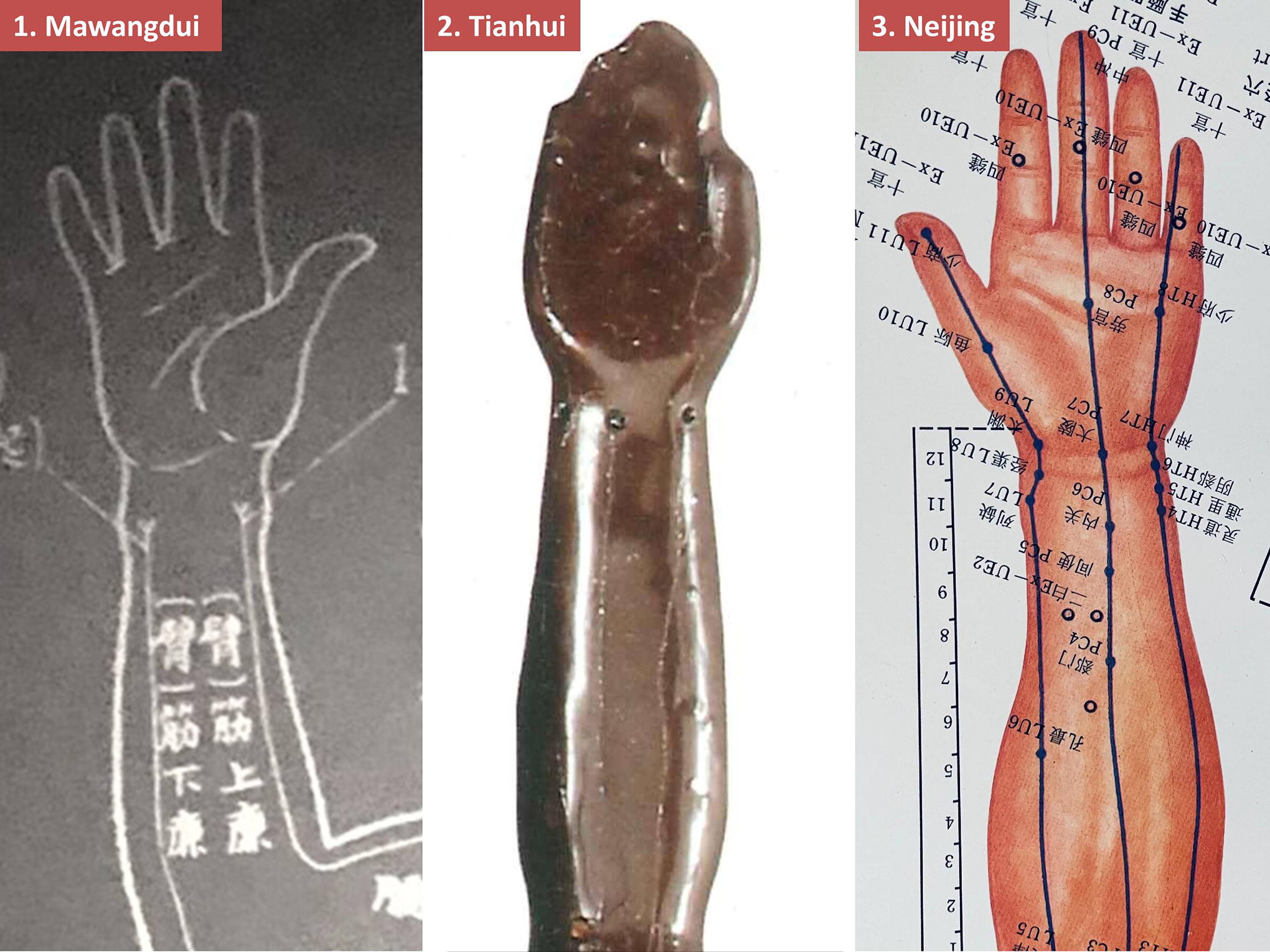
From 11 to 12 meridians: No 12th meridian was described in Mawangdui meridian book (left, Hunan Museum); The 12th meridian was added in the middle of inner forearm in Tianhui meridian book starting at wrist (middle, Tianhui Medical Slips.); and the 12th meridian of Hand Jue Yin extended to the tip of middle finger in Neijing (right, Acupuncture Chart). The middle photo was taken from the painted meridian figure that was unearthed from the same tomb where Tianhui bamboo slips were uncovered.
Related diseases or pathology of the meridian of Heart Master are described within the text. The symptoms include hot hand, elbow spasm, axillary pain, and heartache, which are very consistent with the pathological changes of the median artery, brachial artery, and manifestations of cardiovascular diseases.
Descriptions in the Tianhui Medical Slips confirms that the median artery was first discovered by ancient Chinese physicians around the 2nd century BCE. It was named as the meridian of Heart Master and was the last of the 12 major meridian system recognized today.
However, the 12th meridian in the Tianhui Medical Slips was initially quite different from Neijing in terms of nomenclature, pathway and clinical manifestations. Heart Master apparently was an important recognition of the functional role of the 12th meridian. Interestingly, the artery at the cubital fossa, where the meridian of Heart Master passes, is the most common location being utilized in modern medicine to measure blood pressure and heart rate.
TWO PHASES OF MERIDIAN THEORY
It is possible that after the discovery of the 12th meridian, a new meridian theory was contemporaneously emerging and ultimately finalized in Neijing. Since then, Neijing meridian theory remains the foundation of Chinese medicine today.
Comparing the text in Neijing, in which the meridian of Heart Master was renamed as the meridian of Hand Jue Yin Pericardium, it is obvious that the 12th meridian in the Tianhui Medical Slips had not yet been classified as yin/yang meridian nor had it been attributed to a specific internal organ. In addition, similar to the other 11 meridians in earlier Han meridian books, the meridian of Heart Master runs independently without any connection to other meridians. In contrast, all 12 meridians in Neijing are connected in a defined sequential order and are attributed to their own respective organs. Lastly, qi (vital energy) and blood are supposed to circulate within 12 meridians in a specific sequence and speed according to Neijing meridian theory. None of these features were described in the Tianhui Medical Slips.
The evidence from the Tianhui Medical Slips supports two phases of meridian development in ancient times. The first phase appears to be anatomy-based discovery, including meridian’s structures, physiology, and pathology. These findings established the anatomical basis of early meridian theory for Chinese medicine. Comparative studies have revealed that the 6 Yin meridians represent the 6 major arteries in the arms and legs and the 6 Yang meridians are similar to the 6 major nerves in the arms and legs. 5
In earlier meridian books dating back to 2nd BCE and Neijing, most acupoints with pulses belong to Yin meridians, while almost no acupoints in Yang meridians have identifiable pulses. Further comparison of the modern charts of pulse sites and acupoints show that all sites for taking pulses on human body surface recommended by American Heart Association have specific names of acupoints. By no surprise, they are all on Yin meridians in today’s acupuncture chart. Therefore, acupoints with pulses provides strong evidence that Yin meridians were initially described based on arterial system (Fig. 4). 11

The chart of pulse sites and acupoints. Sites for taking pulse recommended by American Heart Association (green), the 9-pulse points (blue) and additional pulse feeling sites in Neijing are overlapped in all locations. Most of them are on Yin meridians. The chart is from author’s previous publication with permission. 11
The second phase sought to establish a new theory to explain everything observed clinically and guide the practice of acupuncture and other external interventions and remedies. Ancient philosophy and cultural beliefs were introduced into Chinese medicine to establish a theoretical network of meridians, called Neijing meridian theory. The theory classified all major meridians into yin or yang and hand or foot, attributed each meridian to a specific organ, and connected them each other in a defined sequence to form the 12-meridian circle for blood and qi movement.
Current evidence suggests that during this second phase, the theory of meridian circulation evolved beyond solely on anatomical findings. Factors like a physician’s clinical observations, patients’ feelings, predictions, internal visions under meditation, and imaginations may all play a role in establishing the network of Neijing meridian theory. This can explain why the anatomical basis of many meridian connections in Neijing cannot be confirmed in real dissection. Therefore it is no surprise to see that pattern of qi and blood circulation in Neijing meridian theory is quite different from the anatomy-based blood circulation in modern medicine. However, the concept of blood circulation and association of major meridians with supporting anatomical structures is correct in Neijing. These facts make the meridian theory continuously useful in directing the practice of Chinese medicine over the past 2000 years and counting.
From both the scientific and philosophical points of view, the discovery of the 12th meridian was essential for the completion of Neijing meridian theory. An additional meridian enabled a symmetrical balance of 6 meridians in the upper or lower parts of the body, as well as the right and left side of the body. It also equalizes the number of yin and yang meridians as 3 yin and 3 yang in each extremity. This naturally balanced system corresponds to ancient Chinese philosophy and fits well with philosophic concepts like yin and yang, earth and heaven, 12 major rivers in China, and ancient views of universe, among others.
SUMMARY
As a transitional meridian book in the 2nd century BCE, the Tianhui Medical Slips provide clear evidence that the 12th meridian was discovered based on the anatomical discovery of the persistent meridian artery. The addition of the 12th meridian promoted the emergence of a new meridian theory which appeared in Neijing. Initially, all major meridians were discovered based on anatomical structures and the 12 meridians are closely correlated with major arteries and nerves in the extremities. During the times of Neijing, a new meridian theory was extended into a virtual network of circulating channels to carry blood and qi. Current meridian theory in Chinese medicine is not solely anatomy-based science but comingled with philosophical principles enabling clinical practice.
Footnotes
AUTHOR DISCLOSURE STATEMENT
No competing financial interests exist.
FUNDING INFORMATION
No funding was received for this article.