




Abstract
Background:
Early exposure to medical acupuncture and traditional Chinese medicine (TCM) in medical education fosters a well-rounded understanding of integrative medicine. For over two decades, Stanford University has offered acupuncture and TCM education in its curriculum, aiming to enhance students’ understanding of acupuncture’s scientific and traditional foundations and its clinical applications.
Methods:
We describe two courses and their learning goals and curricula: 1) a medical acupuncture course for medical students launched in 1997 and 2) a foundation of TCM course for undergraduates launched in 2002. These courses are housed within the Department of Anesthesiology, Perioperative, and Pain Medicine at Stanford University’s School of Medicine.
Results:
The medical acupuncture course encompasses theoretical and practical aspects of acupuncture, including principles of TCM, meridian theory, and evidence-based applications. Students engage in practical skill development, research analysis, and final paper presentations to consolidate their learning. The course integrates hands-on workshops, lectures, and discussions, with evolving content to reflect contemporary research. The TCM foundations course covers essential elements of TCM, including its historical evolution, meridian theory, and the five elements theory. These foundational concepts are contextualized within cultural, philosophical, and lifestyle factors to provide a holistic understanding of TCM and its study using modern biomedical techniques. Both courses have had annual enrollments of 10–30 students and continue to receive outstanding feedback from participants.
Conclusions:
Integrating acupuncture into the medical education context broadens students' understanding of treatment options, enabling them to deliver more holistic patient care. Stanford University remains committed to cultivating future healthcare leaders equipped to incorporate acupuncture and related complementary therapies into modern clinical practice.
INTRODUCTION
The traditional apprenticeship model and modern educational approaches both play essential and complementary roles in enhancing the teaching of traditional Chinese medicine and acupuncture, creating a more well-rounded and enriching educational experience. 1 In recent years, there has been a significant increase in the number of articles in the literature detailing the basic science of acupuncture as well as its clinical applications. 2 Introducing the fundamentals of acupuncture theory and practice to undergraduate, premedical, and medical students at Stanford University as part of a well-rounded education is a crucial initiative. Providing early exposure enables trainees to familiarize themselves with this discipline and enhances their ability to integrate it rationally and appropriately into their future medical practice in an evidence-based manner. We share our experiences in organizing traditional Chinese medicine and acupuncture medicine education within the undergraduate, premedical, and medical school curricula.
METHODS
The medical acupuncture course at the Stanford University School of Medicine was officially launched during the 1997–1998 academic year. It was offered as an elective course in the spring semester, 3 providing students with one credit upon completion. By 1999, the course evolved to offer an in-depth exploration of acupuncture’s theoretical foundations for treating various diseases, alleviating pain, and addressing other symptoms, such as nausea and anxiety. The main purpose of acupuncture education is to provide a foundational understanding of traditional Chinese medicine and acupuncture within the context of general medical education. It is hoped that this in-depth introduction to an alternative medical system with a long history and a tremendous evidence base helps to broaden student perspectives and understanding of both the human body and its complexity, as well as the sociocultural and philosophical elements that contribute to the formulation of a medical theoretical foundation. In this way, students will be able to consider patients’ explanatory models of illness and be able to consider alternative explanations and theories in formulating and designing their treatment plans. It also allows students interested in pursuing more advanced studies in acupuncture or those who would like to integrate acupuncture into their medical careers to have a solid foundation of understanding as they pursue future clinical and research endeavors.
The course examines how acupuncture is practiced and how it is rationally integrated into modern health care systems in an evidence-based manner. Its practical, hands-on sessions are a key component of the course, complemented by 10 h of lectures, discussions, and workshops (Figs. 1 and 2). Hands-on workshop sessions that accompany the lectures involve incremental skills training (e.g., manual and device-based point identification, acupressure, needle handling, deployment, and needling technique on fruit). We have enhanced the curriculum by continuing to integrate the latest evidence-based literature in acupuncture medicine. This ensures that our educational content reflects the most current research and clinical practices, providing medical students with a more comprehensive and up-to-date learning experience.
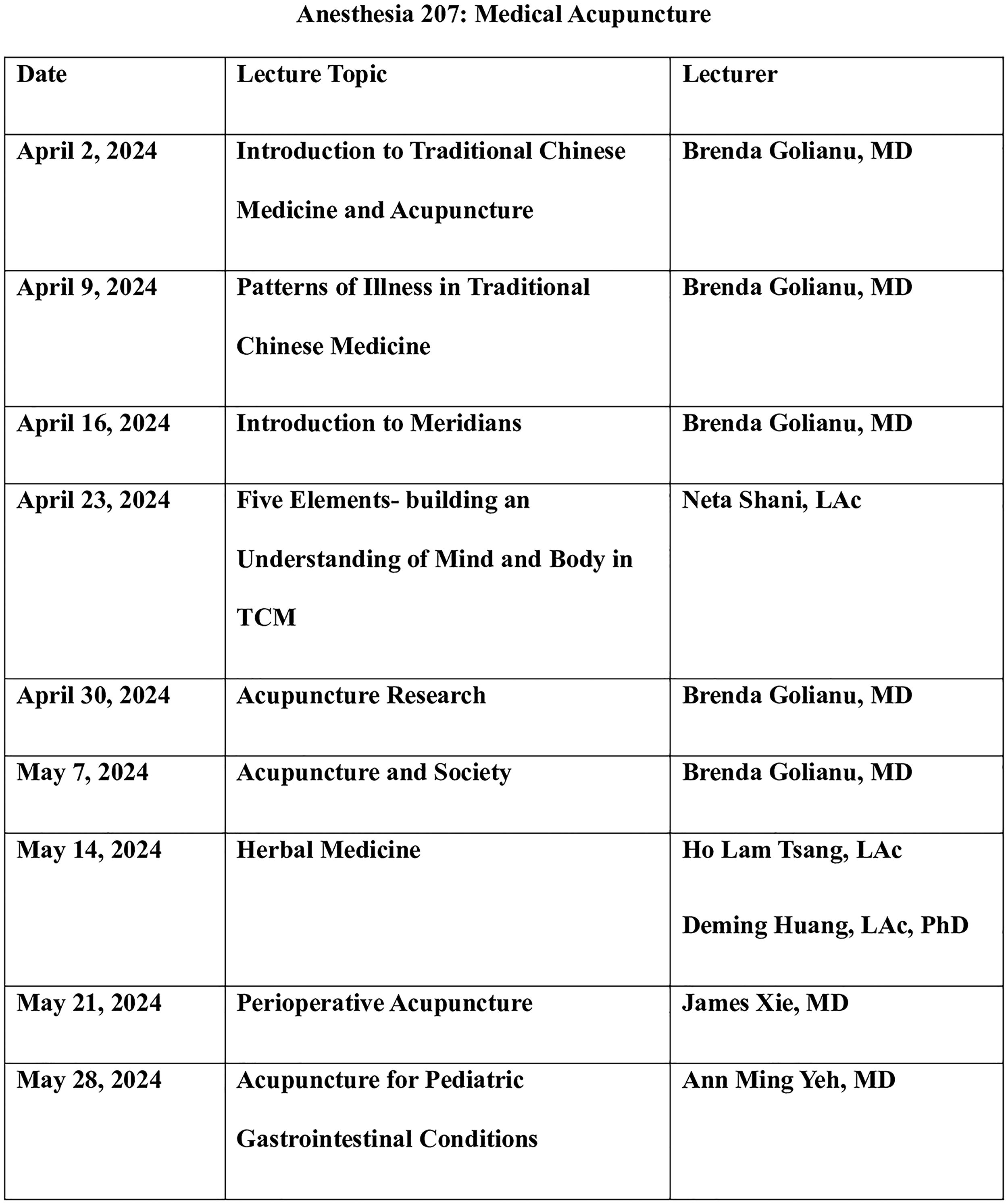
The course schedule for academic year 2023–2024.
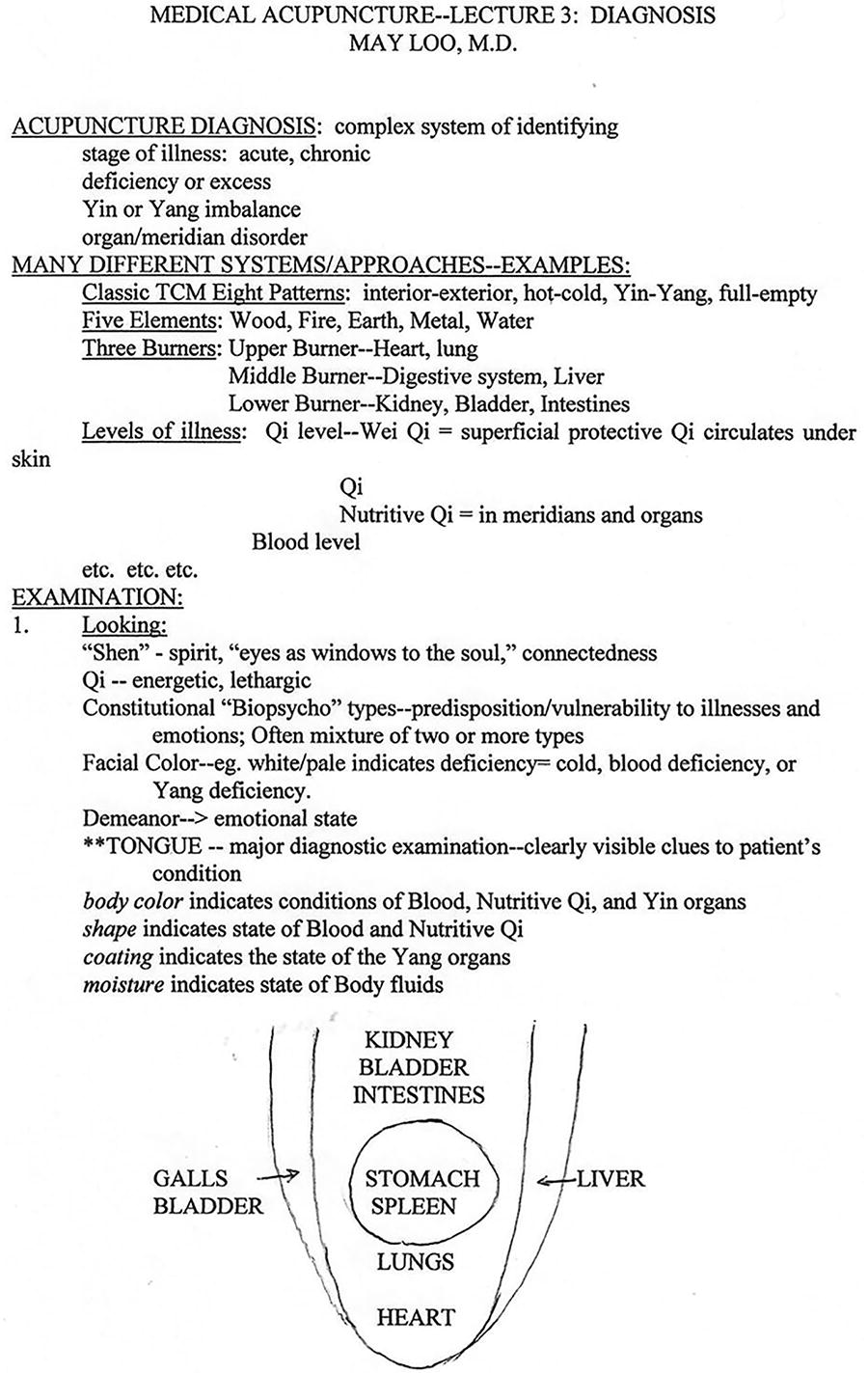
A sample of Dr. May Loo’s handout on medical acupuncture diagnosis.
The course selection and arrangement are designed to provide an effective education in traditional Chinese medicine and acupuncture. Initially, foundational concepts are covered to build a solid base within the framework of traditional Chinese medicine itself. These include discussions of foundational concepts of Taoism, Chi, meridian, and five elements, as well as the location of traditional Chinese medicine concepts within cultural, philosophical, and lifestyle factors. The discussion then proceeds to reviewing the current scientific understanding of acupuncture and herbal therapy, including rigorous analysis of basic science and clinical research. It highlights applications of research findings in clinical practice guidelines. The schedule is tailored to fit students’ needs and carefully integrated with their concurrent core courses to optimize learning. This approach ensures a comprehensive and practical education in medical acupuncture that enables students to engage with topics of interest in medical acupuncture through theoretical, social, traditional, and scientific viewpoints. The course focuses on providing a foundation in acupuncture medicine and includes guest speakers from outside the Stanford faculty. Students were initially provided a comprehensive 168-page printed coursebook. These resources are now incorporated into their learning through an electronic format. In 2005, the laboratory component was increased, giving medical students a total of 22 h of instruction. A final paper on a topic of each student’s choosing consolidates their understanding through literature review and in-depth analysis. Selected papers are presented by the students to the class for further discussion.
In 2002, the Stanford Department of Human Biology began offering a one-credit undergraduate course in traditional Chinese medicine as part of the premedical curriculum at Stanford University taught by Dr. Golianu. It provides a comprehensive introduction to medical acupuncture and traditional Chinese medicine. As of 2024, the curriculum includes the following topics: history of Chinese medicine, meridian theory, five elements theory, basic science studies of the molecular basis of acupuncture action, the relationship between acupuncture and functional magnetic resonance imaging, and clinical research methodology in acupuncture, such as randomized controlled studies studying acupuncture in the treatment of nausea and vomiting, pain management, gastrointestinal issues, and perioperative care. The course also includes demonstrations and student paper presentations.
RESULTS
The medical acupuncture course for medical students and the traditional Chinese medicine course for undergraduate students are both housed within the Department of Anesthesiology, Perioperative and Pain Medicine at the Stanford University School of Medicine. They have consistently enrolled between 10 and 30 students annually. The medical school course has been running successfully for 28 years and continues to accumulate exceptionally positive feedback from its participants.
DISCUSSION
Since its inception, the medical acupuncture education program for students at Stanford University and its partner undergraduate course in traditional Chinese medicine have garnered enthusiastic participation, with consistent enrollment and positive feedback from students. Our course structure includes instruction and hands-on training, ensuring that students not only grasp the theoretical foundations but also gain practical experience in applying acupuncture techniques. We appreciate the dedication of Stanford faculty and expert guest speakers who have contributed their wisdom to guide our undergraduate and medical students. In the context of Soliman and Bilstza’s recent scoping review on teaching complementary and alternative medicine in undergraduate medical education, 4 the curriculum we have designed stands out as an elective that provides foundational teaching on the roots of traditional Chinese medicine along with practical skills. By providing earlier exposure to this foundational understanding, students will be better able to appreciate the origins of this practice while also contextualizing its role in the world of allopathic biomedicine.
CONCLUSION
The integration of acupuncture into our medical education framework aims to broaden students’ perspectives on treatment options and enhance their ability to provide comprehensive care to patients. By offering this educational opportunity, Stanford University has demonstrated a commitment to nurturing future health care leaders who are well-prepared to incorporate acupuncture and other complementary therapies into their clinical practice paradigms.
Footnotes
ACKNOWLEDGMENTS
The authors thank Ms. Jennani Durai for her thoughtful review of this article.
AUTHOR DISCLOSURE STATEMENT
The authors have no conflicts of interest to declare.
FUNDING INFORMATION
No funding received for this article.