




Abstract
Background:
Two huge earthquakes struck Kumamoto, Japan, in April 2016, forcing residents to evacuate. Some disaster-related symptoms can be expected to improve with acupuncture and moxibustion treatment. However, there are a few reports on the main symptoms of acupuncture and moxibustion users during disasters.
Objective:
To evaluate the symptom trends among evacuees who sought acupuncture and moxibustion treatment at medical clinics in shelters located at the epicenter of the 2016 Kumamoto earthquakes.
Design:
Descriptive epidemiological study.
Setting:
Acupuncture and moxibustion facilities attached to three medical clinics at the epicenter of the 2016 Kumamoto earthquakes.
Patients:
Five hundred forty-seven evacuees who visited the acupuncture and moxibustion facilities attached to three medical clinics at evacuation centers in the epicenter of the 2016 Kumamoto earthquakes.
Intervention:
Acupuncture and moxibustion treatments were carried out at three facilities from May 25, 2016, to August 11, 2016.
Main Outcome Measures:
We reviewed a questionnaire completed by acupuncture and moxibustion users and conducted descriptive analyses.
Results:
About half of the participants were aged 60 years or older and received treatment 3 weeks after the disaster. Musculoskeletal symptoms accounted for more than half of all reported symptoms across all age groups. The prevalence of fatigue and frequent urination increased between weeks 3 and 4 after the disaster.
Conclusions:
The results show the symptoms for which victims of the 2016 Kumamoto earthquakes sought acupuncture and moxibustion treatment. The results also suggest what symptoms health care workers should prepare for when providing acupuncture and moxibustion treatment during disasters.
INTRODUCTION
Earthquakes are life-threatening disasters that lead to medical complications among survivors such as renal failure, musculoskeletal injuries, cardiovascular system disorders, infectious diseases, and mental health problems.1,2 There are also reports that earthquakes are linked to the onset of low back pain3,4 and reports of fatigue due to the disaster response. 5 Furthermore, one in four survivors may develop post-traumatic stress disorder after an earthquake. 6 In the subacute phase (from 8th to 30th day after the earthquake), the most common disaster-related symptom is respiratory disease (27.79%), followed by other common diseases (22.90%) and wounds/injuries (12.49%). 7
Some of these disaster-related symptoms are expected to improve with acupuncture and moxibustion treatment. A Cochrane Database of Systematic Reviews provided evidence for the effectiveness of acupuncture in the treatment of depression, prevention of migraine attacks, and treatment of tension-type headache, neck disorders, low back pain, and endometriosis pain.8–14 However, the only studies that have evaluated acupuncture and moxibustion treatment during disasters are reports on post-traumatic stress disorder15–17 and reports from the Great East Japan Earthquake on March 11, 2011.18,19
On April 14, 2016, at 21:26, a 6.5-magnitude earthquake with a maximum seismic intensity of 7 occurred in the Kumamoto region of Kumamoto Prefecture (the foreshock). Then, at 01:25 on April 16, 2016, a 7.3-magnitude earthquake with a maximum seismic intensity of 7 occurred in the same region (the main shock). These two earthquakes are collectively referred to as the 2016 Kumamoto earthquakes. In terms of human casualties, there were 211 fatalities, 1,142 seriously injured individuals, and 1,604 slightly injured individuals. Regarding building damage, approximately 8,000 buildings were destroyed, and 34,000 were partially destroyed. The number of evacuees due to the 2016 Kumamoto earthquakes reached a maximum of 180,000 within Kumamoto Prefecture. 20
In this study, we evaluated the trends in the symptoms of people who used the acupuncture and moxibustion facilities setup in evacuation shelters after the 2016 Kumamoto earthquakes. The results of this study provide important implications for the need to setup acupuncture and moxibustion facilities in evacuation shelters in the event of future earthquake disasters.
METHODS
Study Design
We used a descriptive epidemiological study design.
Study Area and Participants
As mentioned above, two huge earthquakes struck Kumamoto Prefecture in southwest Japan in April 2016. The epicenter of both earthquakes was Mashiki, which is located approximately at the center of Kumamoto Prefecture, close to the prefectural capital city of Kumamoto. Mashiki serves as a commuter town for people working in Kumamoto. According to the 2015 census, the population of Mashiki was 33,611, with a population density of 511.7/km2 and 11,477 households. The earthquakes in Mashiki caused 27 deaths, over 140 injuries, and damaged more than 5,700 buildings. 21
An international, nongovernmental, nonprofit organization called the Association of Medical Doctors of Asia (AMDA) set up a medical clinic in Hiroyasu Elementary School on April 15, 2016 (one day after the foreshock), and set up a tent village medical clinic at the Mashiki General Sports Park Ground on April 24, 2016 (10 days after the foreshock). In addition, a welfare evacuation shelter for those who had evacuated to Hiroyasu Elementary School and required nursing care was set up at Silverpia Sakuragi Special Nursing Home for the elderly on May 4, 2016 (20 days after the foreshock). At Hiroyasu Elementary School, approximately 300 people took refuge in the school building and another 500 people took refuge in their cars. A maximum of 156 households (571 people) took refuge in the tent village, and a maximum of 10 people took refuge in Silverpia Sakuragi.
Since the Great East Japan Earthquake, the AMDA has incorporated acupuncture and moxibustion into disaster medicine. Following the 2016 Kumamoto earthquakes, they began providing acupuncture and moxibustion treatment at Hiroyasu Elementary School on April 25, 2016, at the tent village on May 5, 2016, and Silverpia Sakuragi on May 14, 2016 (Fig. 1).
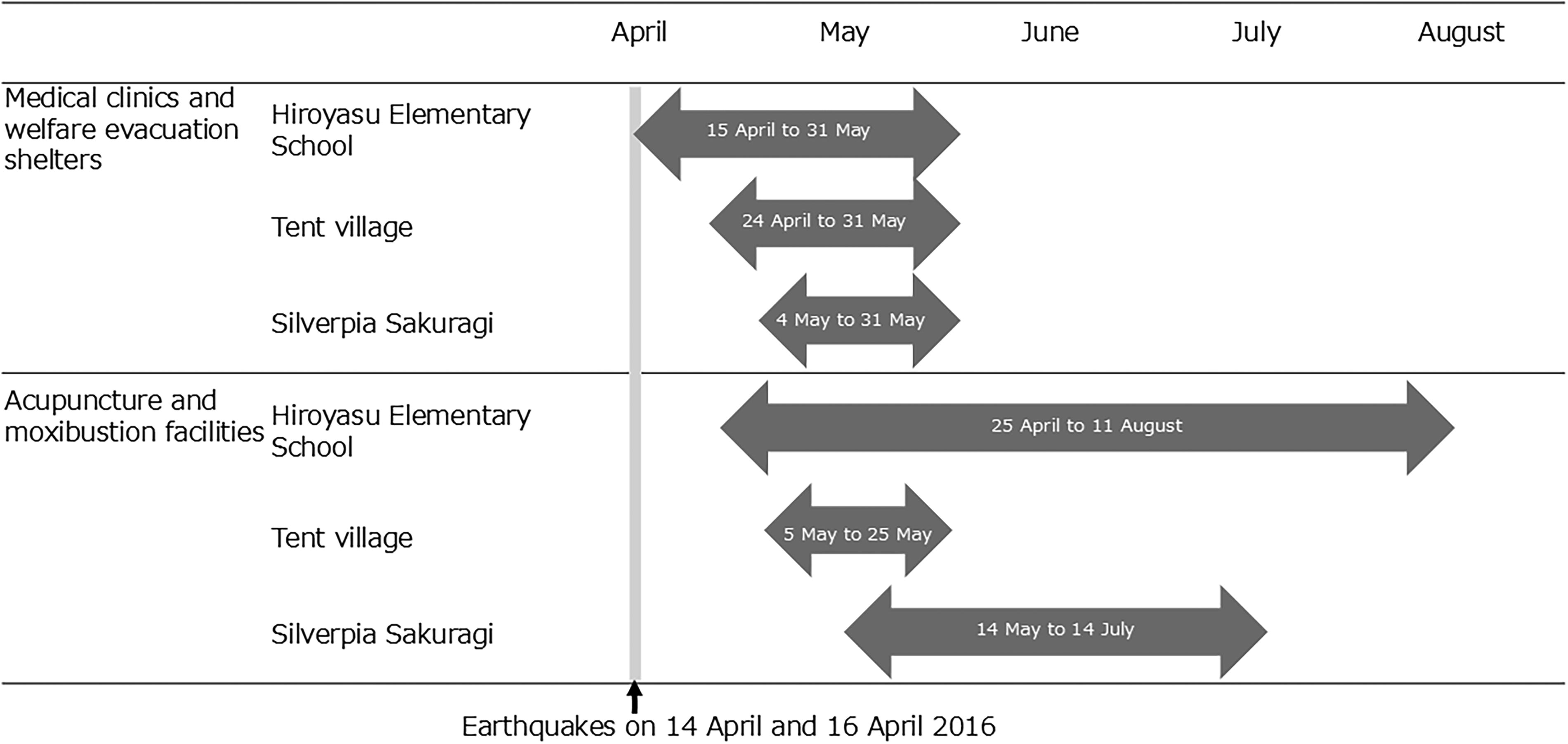
Duration of activities in medical clinics and acupuncture and moxibustion facilities after the 2016 Kumamoto earthquakes.
Setting of Acupuncture and Moxibustion Support
Acupuncture and moxibustion treatment was carried out by six acupuncturists living in Kumamoto City who were locally employed by the AMDA, and 29 acupuncturists who were dispatched to Kumamoto City from all over Japan. Acupuncturists from all over Japan provided treatment until May 25, 2016, after which the acupuncturists living in Kumamoto City continued to provide treatment until the end of support for each facility when all evacuation centers in Mashiki Town had closed. It has already been reported that a total of 1,734 people used acupuncture and moxibustion treatment at the three locations: Hiroyasu Elementary School until August 11, 2016 (1,617 people), the tent village until May 25, 2016 (64 people), and Silverpia Sakuragi until July 14, 2016 (53 people) (Fig. 1). 22
Data Collection
We reviewed the questionnaires filled in by acupuncture and moxibustion treatment users. The questionnaires asked the respondents to provide their treatment date, name, age, medical history, symptoms (multiple selections possible), Face Rating Scale score (before and after treatment), and visual analog scale score. 23 The Face Rating Scale is an 8-point scale where 0 indicates no pain and 7 indicates the worst pain, while the visual analog scale is a 10-cm horizontal line where the left end indicates no pain and the right end indicates the worst pain.24,25 In this survey, the visual analog scale was used to evaluate the intensity of the symptoms as well as pain. The questionnaire did not ask about sex; therefore, we predicted the sex of each patient based on their name and entered the sex into the dataset. Because studies have shown that native Japanese speakers can determine the sex based on names with considerable accuracy,26,27 we believe that serious misclassification was unlikely to occur with this method.
Analysis
We conducted descriptive analyses. First, we examined the distribution of symptoms in the total cohort and by age category. Second, the distribution of symptoms was divided into three categories: 3 weeks after the earthquakes, 4 weeks after the earthquakes, and from 4 weeks onwards; this information was used to evaluate the changes in symptoms over time. Finally, we evaluated the difference in the Face Rating Scale before and after treatment for symptoms that can be expected to show an immediate effect. Almost no respondents provided their medical history and visual analog scale ratings, so these variables were excluded from the analysis. All statistical analyses were performed using Stata version 18 (StataCorp LLC, College Station, TX, USA).
RESULTS
In total, 547 participants who responded to the questionnaire were included in the analysis. The dates of the acupuncture and moxibustion treatments ranged from April 29, 2016, to July 14, 2016. Because the questionnaire did not distinguish between first time and repeat visits, the total number of participants was counted.
The most common acupuncture and moxibustion treatment location was Hiroyasu Elementary School, at which 454 people were treated. More than half of the patients were female, about half of the patients were aged over 60 years, and about half of the patients were treated 3 weeks after the disaster (Table 1).
Demographic Characteristics of Patients Who Sought Acupuncture and Moxibustion Treatments in Evacuation Shelters in Mashiki, Kumamoto, Japan (the Epicenter of the 2016 Kumamoto Earthquakes)
Table 2 shows the distribution of symptoms in the total cohort and by age category. Musculoskeletal and connective tissue symptoms accounted for more than half of all symptoms in all age groups. The most common symptom by age category was stiff shoulders (43.48%) among those aged 30 years and under, low back pain (35.22%) among those aged 30 years and over, and low back pain (34.21%) among those aged 60 years and over. The prevalence of systemic symptoms (including insomnia, fatigue, headache, and dizziness) was greatest in those aged 30 years and over (15.09%), while the prevalence of frequent urination was greatest in those aged 60 years and over (12.03%).
Distribution of Symptoms Treated with Acupuncture and Moxibustion in the Total Cohort and by Age (n = 547)
The questionnaire allowed multiple selection of symptoms.
Changes in the distribution of symptoms over time are shown in Figure 2. Musculoskeletal symptoms were the main reason for acupuncture and moxibustion treatment in any week. The proportions of patients who sought acupuncture and moxibustion treatment for fatigue and frequent urination increased from the third to the fourth week (from 2.1% to 4.5% for fatigue, and from 3.9% to 9.0% for frequent urination); however, these proportions decreased from the fourth week onwards.
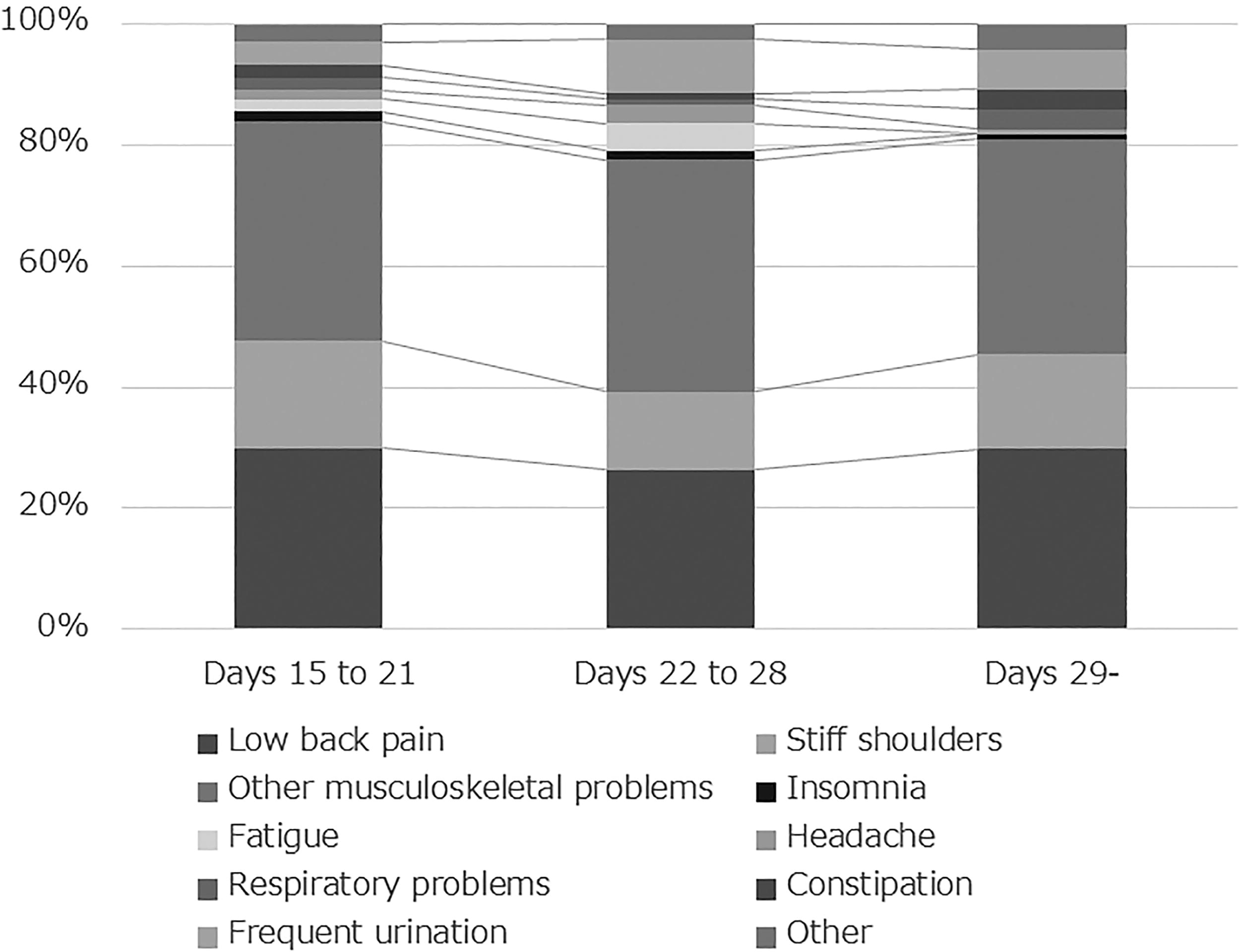
Distribution of symptoms treated at acupuncture and moxibustion facilities over time.
Table 3 shows the difference in the Face Rating Scale scores before and after treatment. For all symptoms for which we could observe an immediate effect, the Face Rating Scale scores showed improvement after treatment compared with before treatment. The average score of the Face Rating Scale was smaller after treatment than before treatment.
Changes in the Face Rating Scale Before Versus After Acupuncture and Moxibustion Treatment for Each Symptom
SD, standard deviation.
DISCUSSION
In this study, we evaluated the symptoms of evacuees who visited the acupuncture and moxibustion treatment facilities setup in shelters located at the epicenter of the 2016 Kumamoto earthquakes. Of the 547 people surveyed, many received acupuncture and moxibustion treatment at Hiroyasu Elementary School, and about half of them were over 60 years old and had received acupuncture and moxibustion treatment 3 weeks after the disaster. The most common symptom treated by acupuncture and moxibustion after the 2016 Kumamoto earthquakes was low back pain (35.1%), followed by stiff shoulders (19.2%) and leg pain/numbness (15.0%). The most common conditions were symptoms of musculoskeletal pain, which is consistent with the findings of a previous study. 18
Frequent urination was the reason for acupuncture and moxibustion treatment in 12.0% of respondents aged 60 years and over. Because evacuation centers are equipped with temporary toilets, improving the frequency of urination may contribute greatly to improving the quality of life of evacuees. Acupuncture is used to treat frequent urination due to prostate enlargement and an overactive bladder.28–31 Therefore, when providing acupuncture and moxibustion treatments during disasters, it may be beneficial to deploy acupuncturists who have studied these conditions.
A previous study of treatments provided at medical clinics after the 2016 Kumamoto earthquakes showed that the proportion of musculoskeletal problems increased from the first to the third week after the disaster. 21 In the present study, 84.9% of the symptoms treated by acupuncture and moxibustion in the third week were musculoskeletal problems (Fig. 2), and the third week also had the greatest number of people using the acupuncture and moxibustion clinics (Table 1). The previous study reported that most evacuees had to sleep on the floor in the shelter, which partly explains the increase in the proportion of musculoskeletal problems. 21 This may also be the reason for the high proportion of musculoskeletal problems among the respondents in the present study. In addition, this finding may indicate that it was appropriate to start providing acupuncture and moxibustion treatment at 3 weeks after the earthquake. The increase in fatigue in the fourth week may be due to the effects of the disaster response, as shown in a previous study. 5 The effects of the disaster response may also have caused the increase in acupuncture and moxibustion treatments for headaches in the fourth week after the disaster in the present study.
Based on the Face Rating Scale, all symptoms that could be expected to show an immediate effect showed improvement after acupuncture and moxibustion treatment (Table 3). This was consistent with the results of a previous study. 19
This is the first study to investigate the symptoms for which acupuncture and moxibustion treatment is sought after an earthquake disaster. Because the survey was conducted at acupuncture and moxibustion facilities attached to medical clinics, we were able to ascertain what symptoms users were hoping to improve through acupuncture and moxibustion treatment in a situation where they could have received treatment at a medical clinic. This is a strength of this study. The results of this research indicate what symptoms should be expected after such a disaster and may contribute to the standardization of acupuncture and moxibustion treatment that should be provided in the event of a disaster. This will make it possible to provide high-quality acupuncture and moxibustion treatment to disaster victims and contribute to improving their quality of life.
The present study also had several limitations. First, because the questionnaire used in this study did not include information on sex, we guessed the sex based on each patient’s name. Therefore, there is a possibility of misclassification for sex. Second, there were many missing values. In particular, 18.1% of the age data and 18.3% of the symptom data were missing. These data were classified as missing not at random. Although missing values are common in situations such as disasters, there is a possibility that the results were distorted. Third, this study did not distinguish between first and follow-up visits. Therefore, people whose symptoms did not improve may have received treatment multiple times, which may mean that certain symptoms were counted more times than they should have been. Finally, although the questionnaire in this study allowed respondents to report multiple symptoms, the Face Rating Scale was not used to evaluate each symptom individually. Therefore, although the results show that some of the respondents’ symptoms improved to some extent, it was not possible to evaluate changes in specific symptoms. In addition, because the respondents were answering the questions in front of the therapists, it is possible that they did not answer truthfully. Therefore, care is needed when interpreting these results.
CONCLUSIONS
This study identified the symptoms for which evacuees forced to spend a prolonged period in makeshift shelters after an earthquake sought acupuncture and moxibustion treatment. Many people sought acupuncture and moxibustion treatment for musculoskeletal symptoms, and this trend did not change throughout the study period. In addition, elderly people sought acupuncture and moxibustion treatment for frequent urination. All acupuncture and moxibustion users reported improvement after the treatment. Establishing the provision of appropriate acupuncture and moxibustion treatments in evacuation shelters may reduce the symptoms of the victims of future earthquakes.
Footnotes
ACKNOWLEDGMENTS
The authors appreciate the valuable support provided by Takushi Sato, AMDA Chairperson; Tae Namba, AMDA Vice Chairperson; Kenji Imai, representative of the AMDA disaster acupuncture and moxibustion network; and all the acupuncturists who provided treatment during the Kumamoto earthquakes. They also thank Kelly Zammit, BVSc, from Edanz ( ) for editing a draft of this article.
AUTHORS’ CONTRIBUTIONS
N.M.: Conceptualization, formal analysis, data curation, and writing—original draft. T.K.: Writing—review and editing. T.Y.: Writing—review and editing and project administration.
ETHICAL CONSIDERATIONS
This study was approved by the institutional review board of Okayama University Graduate School of Medicine, Dentistry, and Pharmaceutical Sciences (approval no. K2407-007). Informed consent was obtained in the form of an opt-out option on the website.
AUTHOR DISCLOSURE STATEMENT
No competing financial interests exist.
FUNDING INFORMATION
This study did not receive any specific funding.