




Abstract
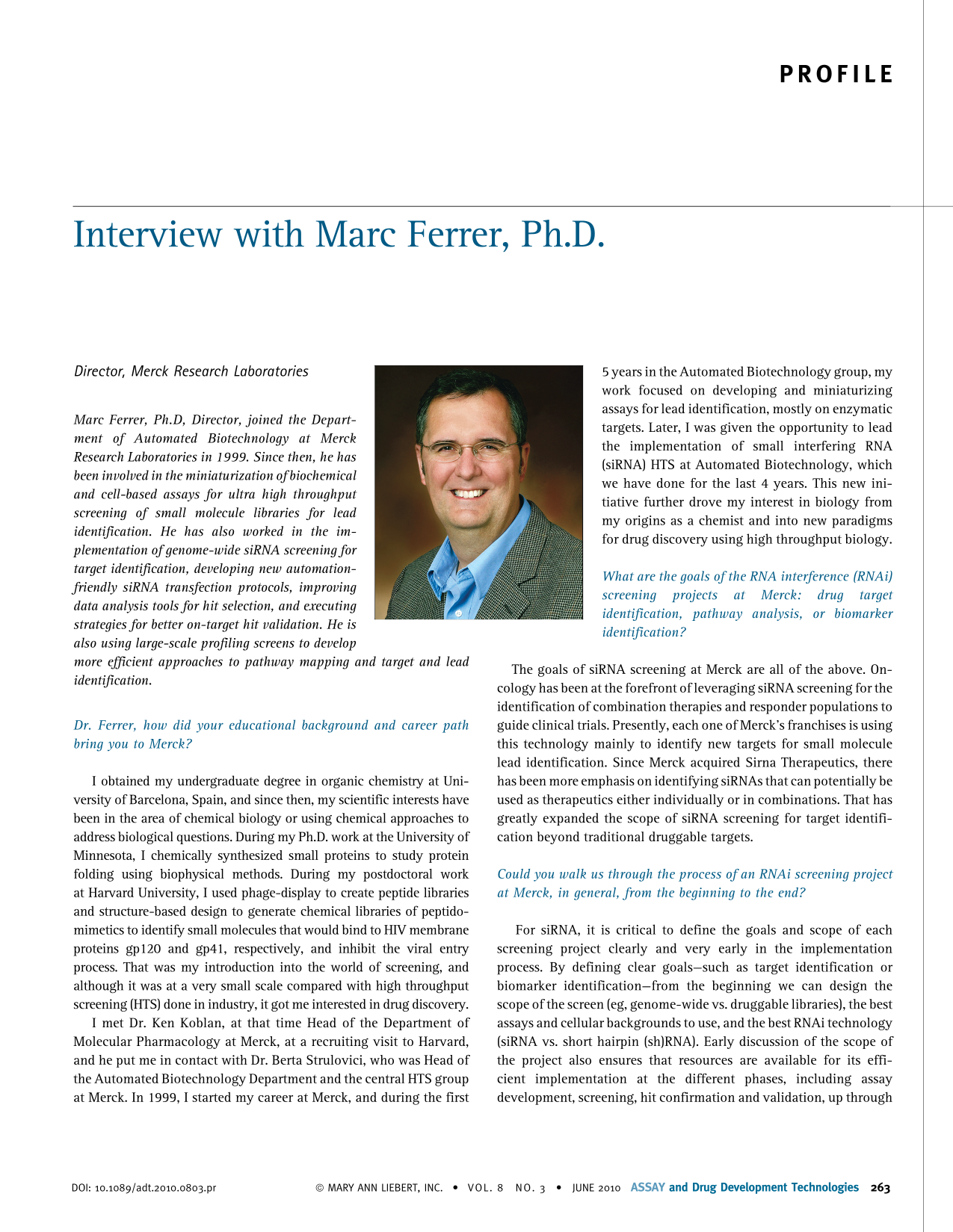

Director, Merck Research Laboratories
Marc Ferrer, Ph.D, Director, joined the Department of Automated Biotechnology at Merck Research Laboratories in 1999. Since then, he has been involved in the miniaturization of biochemical and cell-based assays for ultra high throughput screening of small molecule libraries for lead identification. He has also worked in the implementation of genome-wide siRNA screening for target identification, developing new automation friendly siRNA transfection protocols, improving data analysis tools for hit selection, and executing strategies for better on-target hit validation. He is also using large-scale profiling screens to develop more efficient approaches to pathway mapping and target and lead identification.
Dr. Ferrer, how did your educational background and career path bring you to Merck?
I obtained my undergraduate degree in organic chemistry at University of Barcelona, Spain, and since then, my scientific interests have been in the area of chemical biology or using chemical approaches to address biological questions. During my Ph.D. work at the University of Minnesota, I chemically synthesized small proteins to study protein folding using biophysical methods. During my postdoctoral work at Harvard University, I used phage-display to create peptide libraries and structure-based design to generate chemical libraries of peptido-mimetics to identify small molecules that would bind to HIV membrane proteins gp120 and gp41, respectively, and inhibit the viral entry process. That was my introduction into the world of screening, and although it was at a very small scale compared with high throughput screening (HTS) done in industry, it got me interested in drug discovery.
I met Dr. Ken Koblan, at that time Head of the Department of Molecular Pharmacology at Merck, at a recruiting visit to Harvard, and he put me in contact with Dr. Berta Strulovici, who was Head of the Automated Biotechnology Department and the central HTS group at Merck. In 1999, I started my career at Merck, and during the first 5 years in the Automated Biotechnology group, my work focused on developing and miniaturizing assays for lead identification, mostly on enzymatic targets. Later, I was given the opportunity to lead the implementation of small interfering RNA (siRNA) HTS at Automated Biotechnology, which we have done for the last 4 years. This new initiative further drove my interest in biology from my origins as a chemist and into new paradigms for drug discovery using high throughput biology.
What are the goals of the RNA interference (RNAi) screening projects at Merck: drug target identification, pathway analysis, or biomarker identification?
The goals of siRNA screening at Merck are all of the above. Oncology has been at the forefront of leveraging siRNA screening for the identification of combination therapies and responder populations to guide clinical trials. Presently, each one of Merck's franchises is using this technology mainly to identify new targets for small molecule lead identification. Since Merck acquired Sirna Therapeutics, there has been more emphasis on identifying siRNAs that can potentially be used as therapeutics either individually or in combinations. That has greatly expanded the scope of siRNA screening for target identification beyond traditional druggable targets.
Could you walk us through the process of an RNAi screening project at Merck, in general, from the beginning to the end?
For siRNA, it is critical to define the goals and scope of each screening project clearly and very early in the implementation process. By defining clear goals—such as target identification or biomarker identification—from the beginning we can design the scope of the screen (eg, genome-wide vs. druggable libraries), the best assays and cellular backgrounds to use, and the best RNAi technology (siRNA vs. short hairpin (sh)RNA). Early discussion of the scope of the project also ensures that resources are available for its efficient implementation at the different phases, including assay development, screening, hit confirmation and validation, up through target nomination. Once the initial scope and objectives have been defined, we start working on assay development. In many cases, several assay readouts are tested in several cellular backgrounds to determine the most robust assay. Additionally, different transfection methods are tried to produce the highest knock-down efficiency with the least toxicity. Having good positive controls is important in developing the assays, and although we normally have good controls for measuring transfection efficiencies, we do not always have good biological positive controls that help us assess how sensitive the assay is to biological perturbations.
Assay development for siRNA is fairly time consuming, normally taking at least 6 months, whereas the screen normally takes about a month, and that includes replicate and reschedules, when necessary. At the hit confirmation phase, we test at least seven siRNA duplexes in singles to determine whether a hit is potentially due to off-target effects. We normally pursue hits that have confirmed activity for at least two of seven singles. Real time-quantitative polymerase chain reaction (RT-qPCR) is then carried out for these higher confidence hits to ensure that the mRNA is present and is knocked down by the siRNA. This completes the HTS hit confirmation process, which might take an additional 2 months after the screen. To further validate a hit as a potential target, other in vitro assays are used on the confirmed hits to probe the biological mode of action. The number of additional assays depends on the project and what tools are available to validate even further the hits in vivo using genetically engineered mice, siRNA, or pharmacologically with existing small molecules. Because these in vivo experiments are lower throughput assays, we might need to do more in vitro validation upfront to reduce the number of hits to a minimum (less than 10).
How would you describe the primary differences between RNAi and small molecule screens?
The biggest difference is the fact that we are probing biology, which translates into the higher complexity of the biological assays used for siRNA and of the interpretation of the results obtained. Furthermore, RNAi is a new technology that is evolving and improving, so the reagents are not fully validated, which introduces another level of complexity to the results obtained.
From a technical perspective, siRNA assays are very challenging to implement in an HTS format. In siRNA screening, the trend is to use cellular systems that mimic the in vivo system as closely as possible—real translational assays. As a result, the assay windows for hit detection are much smaller than for engineered cell systems. In terms of automation, the ability to implement siRNA screens in ultra-HTS format is limited because assays are of longer duration to enable good siRNA knock-down and they include steps involving media exchanges that can be very challenging to implement in automated systems and to miniaturize. The transfection step in the assays adds an extra element of complexity not found in small molecule assays. Transfection methods need to be optimized to be both nontoxic and to have high efficiency, and this can be quite challenging for some disease-relevant cells. Therefore, finding good balance between keeping the cells happy and obtaining good transfections to yield a sufficient measurable assay signal can be difficult to achieve.
Once the screens are completed, the hit selection process for RNAi leads is also quite different compared to small molecules. As mentioned previously, the assay windows—the separation between positive and negative controls—is smaller and the number of hits is higher. The methods used for siRNA HTS lead identification are more similar to those used for gene expression profiling than for small molecules and rely heavily on robust statistical methods.
The follow-up assays for siRNA are also unique. In small molecule HTS, follow-up assays focus on eliminating assay artifacts and verifying compound selectivity, but for siRNA, the focus is on identifying off-target effects and verifying biological relevance by using assays that investigate mechanism of action. Ideally, functional rescue of siRNA knock-down with over-expression of a gene using cDNA will confirm the involvement of a gene in a biological process; however, this is complex biology as well, and at the moment the most practical method is to test additional siRNA duplexes.
Finally, the interpretation and mining of the results are not straightforward. Pathway analysis tools are only as good as the information in the databases, and the tools used are still being developed and upgraded. The fact that new biology is being probed makes the results difficult to interpret, but that is why RNAi screening is also exciting—new biology is continually being discovered.
What are the essential follow-up steps for an RNAi screen?
As explained above, most of the follow-up steps for siRNA HTS are dedicated to eliminating off-target effects and proving the functional involvement of a gene in the biological process being studied in the assays. To identify off-target effects, many single siRNA duplexes to the same gene are tested. If only one of the siRNA duplexes has an effect, chances are high that the effect is due to off-target activity. It is also a good idea to check mRNA expression levels and knock-down effects of the siRNA hits using RT-qPCR. Undetectable levels of a siRNA target gene or lack of significant knock-down further suggests possible off-target effects. Ideally, the best confirmation of the involvement of a gene in an assay is by rescue with cDNA over-expression. At the moment, this is very complex to integrate into the follow-up workflow and is only done for a few genes.
As in small molecule screening, a hit is not a lead, so in siRNA screening an on-target siRNA is not a new target for drug development. Functional validation through mode of action and translational assays helps determine the value of a siRNA hit as a new target.
What are the pros and cons of genome-scale vs. target-class RNAi screens? When most pharmas/biotechs are only interested in kinases, GPCRs, NHRs, etc., as drug targets, what would be the purpose of screening at the genome-scale?
Whether we screen a genome-scale vs. a target-class library depends on the goal of the screen. If the therapeutic area group is looking for new targets for drug development, we use focused libraries. If the therapeutic area is amenable to a siRNA therapeutic—for example, if liver targets are a possibility—we might consider doing a genome-wide screen, since for siRNA therapeutics the aspect of druggability is not as critical. If a therapeutic area is looking for biomarkers, such as responder populations, or pathways that might lead to disease biomarkers, we carry out genome-wide screens because we are really looking at genes or gene signatures as measurable markers.
What are the advantages and disadvantages of siRNA vs. shRNA screens? Which does Merck use more often? Why?
At the moment, siRNA technology is more developed; the designs are better, producing better knock-down than shRNA. siRNAs are chemically synthesized and therefore easier to manipulate for screening with the current automation infrastructure. Lipid-based methods for siRNA transfection are also easier from the point of view of screening because they require chemical reagents that are commercially available and can be easily manipulated using current automated liquid handling instruments. Because of the ease of manipulation in the lab, the siRNA technology has been developed further than shRNA. shRNAs are normally delivered using viral vectors, lentivirus in most cases, which introduces another layer of complexity because of safety concerns and the technical issues related to use of live viruses, including production, storage, and manipulation using liquid handling instruments. Because in general lentiviruses are not commonly used by most scientists, the technology has not been as well developed as siRNA. Most of the RNAi screens at Merck are done using siRNA, although we have the capability and we have done a few screens using shRNA with lentiviral delivery.
How does Merck deal with potential off-target effects?
No magic solution: designing assays that are less susceptible to off-target effects and spending time during follow-up to remove hits that appear to be off-target, as explained above.
RNAi screens can be done with siRNA pools (three to four duplexes per well) or singles (one oligo duplex per well). What are the pros and cons of these two approaches? What are the practices at Merck?
We are currently screening siRNA pools of three duplexes to the same gene per well. The reason for that is twofold: studies a few years back indicated that by using three duplexes to the same gene as a pool the possible off-targets effects from each single were “diluted” while the on-target effect remained. Some data now available indicate that this dilution effect might not be that significant. The truth is that we still get a lot of hits that are off-target by screening pools. Another line of thinking related to pooling three duplexes proposes that since each duplex in a collection has not been validated for knock-down, that would ensure that at least one of them would produce an effect, without having to test the three sequences separately, which would require a lot more resources (triple the size of the collection).
Ideally, you would only like to test one siRNA duplex that produces good knock-down and has no off-target effect, but we are not there yet, so pooling is the most practical option. We have been working on higher throughput methods (for example, 1536 plates), which significantly enhances the number of wells we can practically test for a siRNA screen. Higher throughput opens the possibility of screening three or more singles individually for each screen. That way you could have the necessary redundancy and immediately identify possible off-target effects.
Your group demonstrated a powerful approach to siRNA screening in a 1536-well format in a recent paper. What were the benefits of the increased throughput? Can this approach be adopted beyond simple luciferase assays? Does it represent the future of siRNA screening?
The benefits of 1536 siRNA are several fold: as for small molecule screens, by miniaturizing to 1536, we save on reagents cost, speed-up screening and, therefore, minimize result variation due to cell batch-to-batch variation and reagent stability. For siRNA, the size of the library is such that by miniaturizing to 1536 we can easily do replicates of a genome-wide library, thereby increasing the statistical robustness of our hit selection process. In addition, and as I explained above, we can now consider screening several siRNA duplexes in singles to identify off-target effects more readily from a primary screen, and possibly do the primary screens in several cellular backgrounds. It is important for siRNA HTS to have the cleanest primary data possible because many biologically relevant genes are weak hits (due to biological redundancy, feedback loops, and other reasons) and, therefore, we need to be able to reduce the noise (both of measurement as well as biology) to be able to identify the hits.
Unfortunately, as you indicate, not many siRNA assays are amenable to 1536 miniaturization because as I explained, the trend is to use more physiologically relevant systems. Gene reporter assays are especially amenable, as well as high content imaging assays, as long as you have a statistically significant number of cells that are of interest. In some instances, the biology does not reproduce in 1536, as miniaturization might introduce additional stress on the cells. This is definitely an area for which we are very interested in developing the next technologies.
How do you view the role of alternative RNAi delivery technologies, such as Accell siRNA (Dharmacon), Amaxa nucleofection, and Cellectricon, now and into the future? Are they going to compete with or replace lentiviral shRNA technology?
Unfortunately, we do not have a universal way of transfecting any cell type for any type of assay. There are many lipid-based methods to transfect cells and, in our experience, it is possible to find a transfection reagent for most cell lines out of the available repertoire. The duration of the siRNA knock-down really depends of the doubling of the cells during the duration of the assay, but in general, it is probably safe to say that it is good for 5 days. Some primary cells are notoriously difficult to transfect using lipid-based methods, including primary neurons. For these types of cells, electroporation is an alternative that we have used and continue to explore. It is more expensive and lower throughput, but with the new instruments, we hope to at least increase the flexibility (suspension vs. adherent cells), cost, and throughput. Lentiviral shRNA is another alternative, especially for primary cells and long duration assays in which cells are dividing, since the shRNA is integrated in the cellular genome, but as I explained above it has its own issues. It is not clear in the long run which technology will prevail, but at the moment, siRNA is really better established and is our first choice.
Would you advocate for multiplexed assay readout or high-content assays for RNAi screens at a significantly higher cost? Why or why not? What percentage of Merck's RNAi screens is done in this manner?
The biology should really dictate what the ideal assays will be, then you need to think about how technically feasible they are, consider their cost, and decide which one is practically the best assay to implement for primary screen or follow-up. In many cases, we have to do proof-of-concept for a few assay types before we decide which one to use. As you indicate, multiplexed and high content assays are very powerful and particularly well suited for genomic screening because they allow us to explore relevant biology in nonengineered cells, and because hits can be selected based on activity signatures. In our hands, selecting hits based on activity signatures has been a more robust method to reduce the number of false positives due to off-target effects than using a single readout. However, and as you point out, multiplexed assays can be expensive, so you have to reserve them for use when there is a clear advantage for the hit selection process. Likewise, for imaging assays, image and data analysis can be very time consuming and resource intense, so we use them when we think they will produce a clear advantage. When using high content screening, you have to have a very clear data analysis to avoid getting buried in data and losing the power of multiplexing. At Merck, we have invested significantly in high content screening, and last year greater than 50% of our genomics screens were multiplexed, including high content screening.
RNAi screening data tend to be highly variable and poorly reproducible. How do you deal with this problem?
Primary screens are done in replicate, by either screening focused sets or miniaturization. Robust statistical methods are used for hit selection, and we rely on multiplex type assays that allow for hit selection based on relevant activity signatures and are more robust to off-target effects.
How would you measure success of an RNAi screening project? What are the quantifiable metrics?
From the perspective of a pharmaceutical company, the success of a siRNA screen is measured by the number of genes that are identified and validated enough to merit the initiation of a small molecule discovery program, a siRNA therapeutic program, a biomarker hypothesis, or a combination hypothesis to test in the clinic. Those are pretty high standards, especially for a fairly new technology like RNAi that is still being developed. The validation process for the hits identified from screens is not straightforward and is dependent on each disease area. It takes time and resources, and it might take at least a year to have a measurable impact from a screen. At Merck, we already have metrics that indicate that we are having substantial success in the three areas described above, but the numbers show we can do better, by making the process more efficient and thereby reducing cycle times for assay development, screening, and follow-up, as well as producing higher quality hits that the scientists in the therapeutic areas feel more confident pursuing.
What are the greatest challenges facing the RNAi screening business in general? What do you anticipate will be the next great advances in the RNAi screening field?
As I mentioned before, after 4 years of screening, we have already seen many successes from the siRNA screens that we have done at Merck. We have targets identified from siRNA that are now being pursued as novel targets for drug development; we have hits being validated in vivo using Sirna technology; and we have contributed to gene expression signatures now being validated in clinical studies. In some cases, even though the genes might not have been of interest from the point of view of drug targets, they have provided important insights into understanding important disease-relevant biology, and many of those genes we have published for the scientific community to pursue. I think this is fairly good progress for a new technology and a new HTS initiative, but I think we can do even better.
I think one the greatest challenges of siRNA screening is the high expectations the siRNA technology has generated. It sparked excitement that it would quickly generate new insights into pathways, and as a consequence it would be the engine that would identify new drug targets of the future. However, as I mentioned, probing biology is complex, so the results from siRNA screens are not straightforward to validate, especially at the scale they are generated.
In addition to the high expectations, we are still facing the technical challenges that I explained above. Technically, for the purpose of screening, we spend a significant amount of time developing physiologically relevant assays that are very challenging to implement in HTS mode, as well as removing false positives due to off-target effects. We do not fully understand the effects that cell background, assay design (including readout and time), siRNA reagent, and off-target effects can have on the results of a siRNA screen. These are probably the biggest technical challenges that we face as we choose the right assay for a siRNA screen. Bioinformatics tools for better mining of the results from siRNA screens now exist and are helping us understand the results. We are starting to realize that the overlap between siRNA hits from different screens measuring the same biology is better when we compare pathways and protein complexes than when we compare individual genes. In spite of the challenges, siRNA screening has made significant contributions to understanding the molecular biology of important diseases and will remain a key technology to explore biology.
At the moment, I really do not see a major breakthrough in siRNA technology for in vitro screening. There will hopefully be better libraries soon, designed to have fewer off-target effects. We are very excited about work being done to predict off-target effects, which would make the process of siRNA HTS much more efficient. The challenge of using primary cell systems in an HTS format will also need to be addressed with better sources or the use of stem cells, as well as better matrices for culturing cells in microplate-based formats. More broadly, breakthroughs will also come from new ways of leveraging these types of genomic screens, including the use of combination type screens siRNA/siRNA or siRNA/compound that might provide better mapping of critical rate-limiting nodes in disease-relevant pathways.