




Abstract
The canonical transient receptor potential channel subfamily (TRPC3, TRPC6, and TRPC7) contains Ca2+ permeable non-selective cation channels that are widely expressed in a variety of tissues. There is increasing evidence implicating TRPC channels, particularly TRPC3 and 6, in physiological and pathophysiological processes, eliciting interest in these channels as novel drug targets. Electrophysiology remains a benchmark technique for measuring ion channel function and accurately determining the pharmacological effects of compounds. In this report we describe the development of TRPC inhibitor assays on 2 automated planar patch clamp platforms—the IonWorks® Quattro™ and QPatch® systems. To enable activation of TRPC channels by carbachol, Chinese Hamster Ovary-K1 cells stably expressing the muscarinic M3 receptor were transduced with human TRPC3, TRPC6, or TRPC7 using BacMam viruses. TRPC3, 6, and 7 currents could be recorded on both platforms. However, the design of each platform limits which assay parameters can be recorded. Due to its continuous recording capabilities, the QPatch can capture both the activation and decay of the response. However, the transient nature of TRPC channels, the inability to reactivate and the large variation in peak currents limits the ability to develop assays for compound screening. The IonWorks Quattro, due to its discontinuous sampling, did not fully capture the peak of TRPC currents. However, due to the ability of the IonWorks Quattro to record from 64 cells per well, the variation from well to well was sufficiently reduced allowing for the development of medium-throughput screening assays.
Introduction
The transient receptor potential (TRP) channel family comprises 28 members, which are divided into several subfamilies. 1 –3 The TRP canonical (TRPC) family are Ca2+-permeable non-selective cation channels that can be expressed as either homo or heteromultimeric channels. 4 –6 The TRPC family consists of 7 members (C1–C7), with TRPC3, 6, and 7 forming a distinct subfamily. 7 This subfamily of TRPC channels are receptor operated ion channels and are activated via Galphaq coupled G-protein-coupled receptors (GPCRs). 4 –6,8 Upon GPCR activation, PIP2 is converted by phospholipase C into diacylglycerol (DAG) and IP3. 9,10 DAG, which remains associated with the membrane, directly interacts with TRPC channels, and produces channel opening leading to an influx of Na+ and Ca2+ into the cell. 11
TRPC channels may represent potential new drug targets due to their association with different diseases. 12 –14 For instance, it has been shown that TRPC3 channel expression levels are upregulated in hypertensive rats, in rodent models of cardiac hypertrophy, and in patients with malignant hypertension. 15 –18 For TRPC6, several gain-of-function mutations, resulting in increased protein expression or altered channel kinetics, have been found in patients with the renal disease, focal segmental glomerular sclerosis. 19 –22 Furthermore, TRPC6 mRNA and protein levels were also reported to be upregulated in idiopathic pulmonary arterial hypertension. 23,24 At present little is known about a possible role for TRPC7 channels in disease states.
TRP channel pharmacology remains in its infancy and to date there are few reported selective TRPC channel inhibitors. 12,13,25,26 This may in part be due to the lack of high-throughput, high-fidelity screening assays able to identify effective channel inhibitors. Traditional methods for screening of compounds against ion channels include indirect methods such as membrane potential- and calcium-sensitive fluorescent dye-based assays and radiometric and nonradiometric ion flux assays. 8,27 –29 While these assays certainly have a high-throughput, fluorescence-based assays are prone to generating false positives and false negatives due to assay interference by compounds that are either fluorescent or quench the fluophore. 29 –31 Conventional patch clamp electrophysiology, while generating high quality data, lacks the necessary throughput for frontline screening. As a result, high-throughput screens against ion channels have employed the indirect outputs with electrophysiological studies being used at a later stage in hit confirmation. Over the last decade, there has been significant progress in the field of automated electrophysiology with the release of several planar patch clamp platforms that are capable of making detailed electrophysiological recordings on a much higher throughput than those achievable with conventional patch clamp electrophysiology. 32 –37
In this study, we describe the development of TRPC3, 6, and 7 electrophysiology assays using the QPatch® (Sophion Bioscience) and IonWorks® Quattro™ (Molecular Devices) automated planar patch clamp platforms. The QPatch, with its continuous add and read capability, can be used to measure TRPC3, 6, and 7 currents and provide temporal information regarding current activation and deactivation. The known limitations of the IonWorks Quattro in the recording of fast desensitizing ligand-gated channels due to discontinuous voltage clamp and recording (pausing data acquisition during compound administration), 38,39 limited the development of a TRPC7 inhibitor assay, however, it is possible to develop TRPC3 and TRPC6 assays.
Materials and Methods
Cell Culture and Transfection
Maintenance of cells
Experiments were performed using a Chinese Hamster Ovary (CHO)-K1 cell line stably expressing human M3 muscarinic acetylcholine (CHO-M3), which was a kind gift from Professor S.R Nahorski. 40 We chose to activate the TRPC channels indirectly through a Galphaq-coupled muscarinic receptor pathway as we were unable to establish robust TRPC currents by direct activation of the channels using the membrane permeable analogue 1-oleoyl-2-acetyl-sn-glycerol (OAG) (data not shown). Cells were maintained in Ham's F12 medium (Gibco) supplemented with 10% fetal bovine serum (Gibco) and 100 U/mL penicillin/streptomycin (Gibco) in a 5% CO2, 95% air incubator at 37°C. The cells were passaged every 2–3 days using Trypsin (Gibco) and seeded in T162 flasks at a cell density of 3×10⁶ cells/flask for routine culture.
Expression of TRPC3, 6, and 7
CHO-M3 cells were transduced using the BacMam virus technology. 41,42 The human TRPC3, TRPC6, and TRPC7 clones were obtained from Trueclone®. For BacMam generation, all 3 coding regions were subcloned into the pMamBac-1 vector. All inserts were sequence verified and found to be identical to their respective GenBank accession numbers; NM_003305 (TRPC3-transcript variant 2), NM_004621 (TRPC6), and NM_020389 (TRPC7-transcript variant 1).
Bacmid DNA was generated using competent DH10Bac Escherichia coli cells (Invitrogen) transformed with the recombinant pMamBac-1 plasmids described as per protocol (Invitrogen Cat No. 10361-012). Bacmid DNA was isolated using a combined Qiagen Maxi Kit P1-P3 lysis/supernatant-isopropanol DNA preparation. Transfection of the bacmid DNA into SF9 insect cells (Invitrogen) occurred within 2 h after DNA preparation. The P1 viral stock was obtained by transfection of adherent SF9 cells using Cellfectin II reagents (Invitrogen). Subsequent P2 and P3 viral stocks were produced using suspension SF9 cells. The final P3 stocks were filtered (0.22 μm) and stored at 4°C in the dark. Virus titres were determined by Oxford Expression Technologies.
For BacMam transfection CHO-M3 cells were seeded into T162 flasks at a density of 4×10⁶ cells/flask and incubated for 24 h. On the day of transfection, a 20 mL transfection medium was prepared containing culture medium and BacMam virus (final virus concentration for all 3 TRPC channels in the transfection medium was 4.4×10⁶ pfu/mL). The culture medium was removed and replaced with the transfection medium. The cells were incubated at room temperature for 90 min, after which the transfection medium was removed and replaced with normal culture medium containing 1.5 μM Trichostatin A (Sigma). The flasks were returned to the 37°C incubator overnight and used for experiments the following day.
Cell Preparations
Immediately prior to an experiment, the culture medium was removed and the cells were gently washed once with Dulbecco's phosphate buffered saline. Then 2mL of trypsin were added to the flask and the cells were returned to the incubator at 37°C for 3–4 min until the cells “rounded up” and could be easily detached with mild agitation of the flask.
For IonWorks Quattro experiments, 8 mL of normal culture medium was added to the flask and the cells were gently resuspended by trituration 2–3 times. The cells were spun at 1,200 rpm for 3 min, the culture medium was removed and the cells were resuspended in extracellular solution at a final cell density of 2×10⁶ cells/mL. The cells were then transferred to the IonWorks Quattro and used immediately.
For QPatch experiments, 3 mL of a QPatch medium (CHO-S-SFM-II medium supplemented with 25 mM HEPES and 1 mg/mL Soybean trypsin inhibitor) were added to the flask to neutralize the trypsin. The cells were resuspended by trituration 2–3 times and the cell density was adjusted to 3×10⁶ cells/mL. The cells were then transferred to the QPatch and used immediately.
Electrophysiology
Solutions and chemicals
The extracellular solution contained (in mM) 140 NaCl, 4 KCl, 1 MgCl2, 0.02 CaCl2, 2 BaCl2, 5 glucose, and 10 HEPES (pH 7.4 with NaOH), osmolarity adjusted to 315 mOsm with sucrose. All chemicals used in this study were purchased from Sigma-Aldrich. The intracellular solution contained (in mM) 145 CsCl, 2 MgCl2, 0.3 CaCl2, 10 EGTA, and 10 HEPES (pH 7.2 with CsOH), osmolarity 315 mOsm. For experiments on the QPatch, 2 mM Na2ATP and 0.3 mM NaGTP were added to the intracellular solution on the day of experimentation and the pH readjusted to 7.2 with CsOH.
The dimethyl sulfoxide (DMSO) concentration used in the experiments was limited to 0.5% v/v. Carbachol (Sigma) was prepared in MilliQ water at 100 mM. Test compounds were prepared as 10 mM stock solutions in 100% v/v DMSO. Compound additions in IonWorks Quattro experiments are additive and so compound inhibitor plates were prepared at 3× the final test concentration required. For the final addition of the agonist, carbachol was prepared in the compound plate at 400 μM, which would give a final concentration of 100 μM. The EC50 value for Carbachol activation (as exemplified by TRPC6 current activation) was 362±187 nM, a supra-maximal concentration of 100 μM was used for all 3 TRPC channels to minimize the risk of variation in the response. Compound additions on the QPatch involve the complete exchange of the extracellular solution; therefore, compounds and carbachol solutions were prepared at the final working concentrations required.
IonWorks Quattro recordings
TRPC currents were recorded on the IonWorks Quattro platform using population patch clamp (PPC) plates. The details of the IonWorks Quattro “scanning mode” protocols used in this study are given in Table 1. After obtaining electrical access, a 200 ms voltage ramp from −120 to +120 mV followed by a return to a holding potential of −80 mV was applied throughout all compound addition periods to measure TRPC current. For analysis, the current amplitudes measured at +120 mV were used. The seal resistances on the IonWorks Quattro PPC Patch Plates ranged from 12.3 to 169 MΩ, with an average of 35±11.2 MΩ. To improve data quality we introduced minimum and maximum seal resistance filter criteria. Based on our experience of different assays on the IonWorks Quattro, which is a loose seal system, we introduced a minimum seal resistance filter of 25 MΩ, and as we typically find that resistances above 140 MΩ represent blocked holes we applied a maximum seal resistance filter of 140 MΩ. Applying these criteria resulted in 91% successful recordings. The number of voltage scans applied during the experiment was dependent on scanning mode used and are detailed in Table 1.
IonWorks Quattro Scanning Modes
a5 μg amphotericin dissolved in 180 μL DMSO before dissolving in ICS buffer.
DMSO, dimethyl sulfoxide; QAO, quarter-at-once.
QPatch recordings
TRPC currents were recorded in whole-cell patch clamp mode on the QPatch using both the single-hole HT and multi-hole HTX QPlates; details of the QPatch protocols are outlined in Table 2. After the whole-cell conformation was obtained, a 200 ms voltage ramp from −120 to +120 mV followed by a return to a holding potential of −80 mV was applied throughout all compound addition periods to measure TRPC current. The voltage protocol was applied every 15 s (0.067 Hz) during the experimental recording period. Current amplitudes measured at +120 mV were used in analysis. The seal resistances on the QPatch HT ranged from 9.2 to 4,840 MΩ, with an average of 933±2,000 MΩ, and on the QPatch HTX these ranged from 1.5 to 51.7 MΩ, with an average of 9.7±6.5 MΩ. Taking into account built in QPatch criteria (such as plate priming, successful cell positioning, and whole-cell conformation), and criteria set by the experimenter (minimum seal resistance of 100 MΩ (QPatch HT) and 10 MΩ (QPatch HTX), completion of recording), the overall success rate was 45% and 42% on QPatch HT and HTX respectively.
QPatch Protocol
WC, whole cell.
Data Analysis
Data were analyzed using Excel, Graphpad Prism (v6), and QPatch analysis software. Data that did not meet the criteria for the individual platforms were excluded from analysis. TRPC currents were defined as being 3 times larger than the standard deviation (SD) of precompound current. The data are presented as the mean±SD.
For all experiments on the IonWorks Quattro, the peak currents were subtracted from the leak current recorded during the precompound voltage scans.
The time decay of TRPC3, TRPC6, and TRPC7 currents following the peak carbachol response were fitted with a bi-exponential fit function available in the QPatch assay software:
To determine IC50 values for compounds tested on the IonWorks Quattro, cells were incubated with a single concentration of test compound for 5 min after which time a voltage ramp protocol was applied. The cells were exposed to 100 μM carbachol and the voltage ramp protocol was applied to measure the TRPC currents. The data from each concentration of test compound were then pooled to generate a concentration response curve from which IC50 values were determined. Control wells, where cells were given DMSO only or carbachol, were used to determine the magnitude of the assay window and calculate the level of inhibition by test compounds. The IC50 values were obtained by fitting data with a Hill fit curve using the least square variable slope (4 parameter) fit method in GraphPad with bottom constrained to 0 and the top constrained to 1.
The Z′ factor, which is an assessment of the quality of the assay based on mean and SD of positive and negative controls, was calculated using the formula:
where σp is SD of carbachol control wells, σn is SD of DMSO control wells, μp is mean of carbachol control wells, and μn is mean of DMSO control wells.
Results and Discussion
Profile of TRPC Currents Recorded on the QPatch in Single-Hole (HT) Mode
By virtue of its design, the QPatch can add and read concurrently, that is, voltage protocol execution and current recording can be performed continuously during compound application. This makes the QPatch ideally suited for measuring transient responses to ligand-gated ion channel activation as seen with the TRPC channels. TRPC3, TRPC6, and TRPC7 channel currents elicited by carbachol, recorded using the QPatch platform in single-hole HT mode are shown in Figure 1A. Prior to carbachol addition, only small outwardly rectifying currents could be recorded. The addition of 100 μM carbachol resulted in activation of significantly larger currents, which reversed close to 0 mV and displayed an “S” shape rectification profile characteristic of TRPC channels (Fig. 1Ai–iii). In separate experiments, carbachol was applied to non-transfected CHO-M3 cells with no evidence of TRPC currents (data not shown).
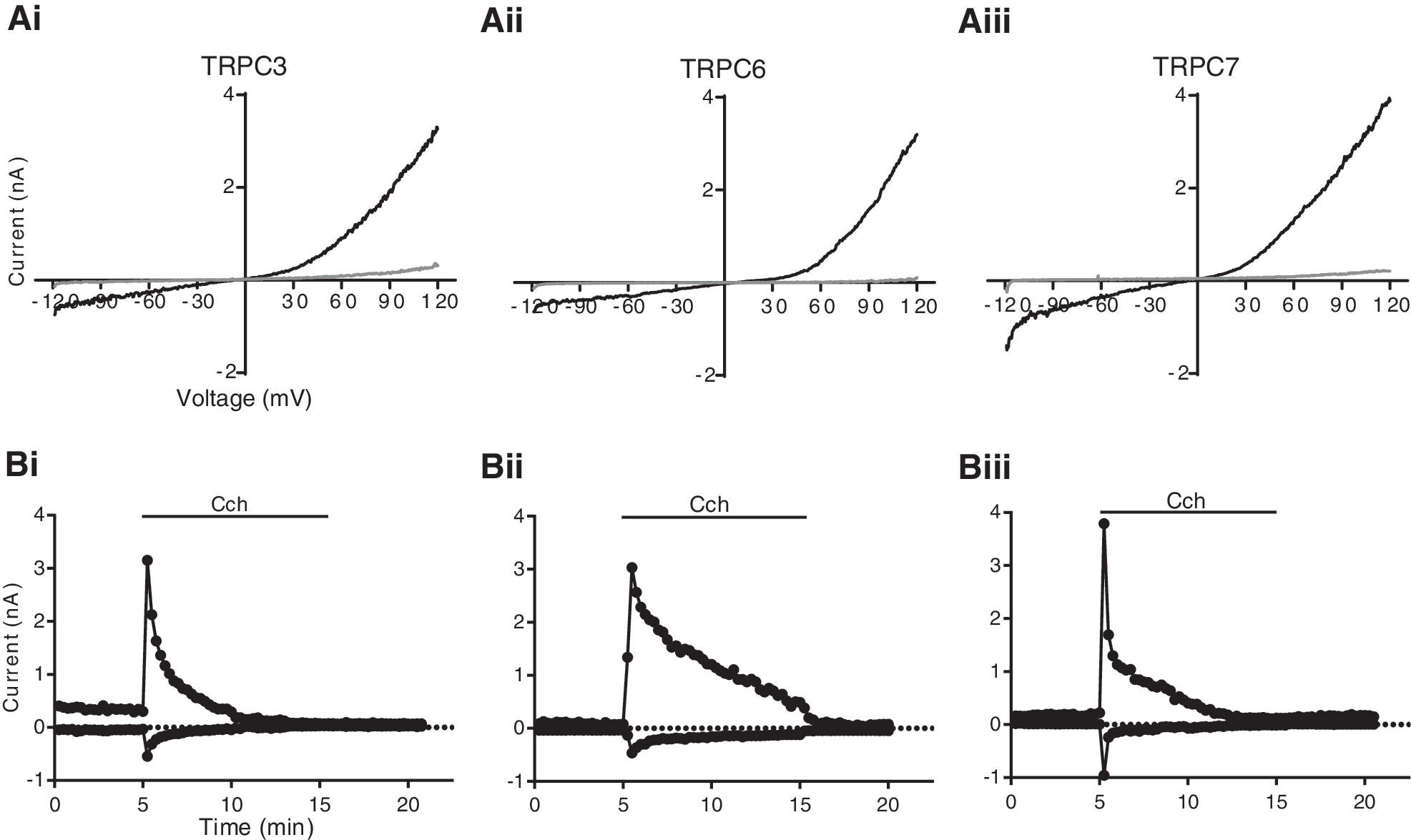
TRPC currents recorded on the QPatch.
Figure 1B shows example current–time plots for inward and outward TRPC3, TRPC6, and TRPC7 currents. Prior to carbachol addition, there was little evidence of TRPC3, TRPC6, and TRPC7 currents. The addition of 100 μM carbachol resulted in the rapid activation of TRPC currents that peaked within 30 s of addition and then decayed with time. The addition of 30 μM of the non-selective TRP channel blocker, SKF96365 at the end of the experiment inhibited any remaining TRPC6 current, as TRPC3 and TRPC7 had already full decayed. The decay of the TRPC currents on the QPatch were fitted with a bi-exponential fit to generate fast and slow time constants. Fitting with a bi-exponential fit resulted in a better goodness of fit (r 2 ) as compared with a mono-exponential. The fast time constants were 34.9±25.1 s (TRPC3, n=16 cells), 57.7±23.2 s (TRPC6, n=14 cells), and 19.0±15.0 s (TRPC7; n=12 cells). The slow time constants were 169.9±49.4 s (TRPC3, n=16 cells), 211.3±41.5 s (TRPC6, n=14 cells), and 154.8±28.8 s (TRPC7; n=12 cells).
The results show that it is possible to record the activation and decay of TRPC currents from cells that expressed TRPC channels.
Distribution of TRPC Currents on QPatch
The transient nature of TRPC currents recorded on the QPatch and the inability to reactivate the channels with repeated carbachol additions (data not shown) means that it is not feasible to perform additions of agonist and test compound on a single cell. A common assay configuration to overcome this issue is to normalize to agonist controls from separate wells. However, for this approach to be feasible with an acceptable number of replicates it is important that the variation of the peak TRPC currents from well to well within an experiment is minimal.
The distribution of peak TRPC currents from multiple recordings was investigated using QPatch HT (Fig. 2A) QPlates. In HT QPlates, there was a large variation in the peak currents recorded for all 3 TRPC channels with ∼20% of cells not responding to carbachol addition. The average TRPC responses (excluding non-responders) recorded on HT QPlates at +120 mV were 3.8±1.9 nA (TRPC3, n=15 cells), 4.1±2.6 nA (TRPC6, n=10 cells), and 5.7±1.7 nA (TRPC7, n=13 cells).
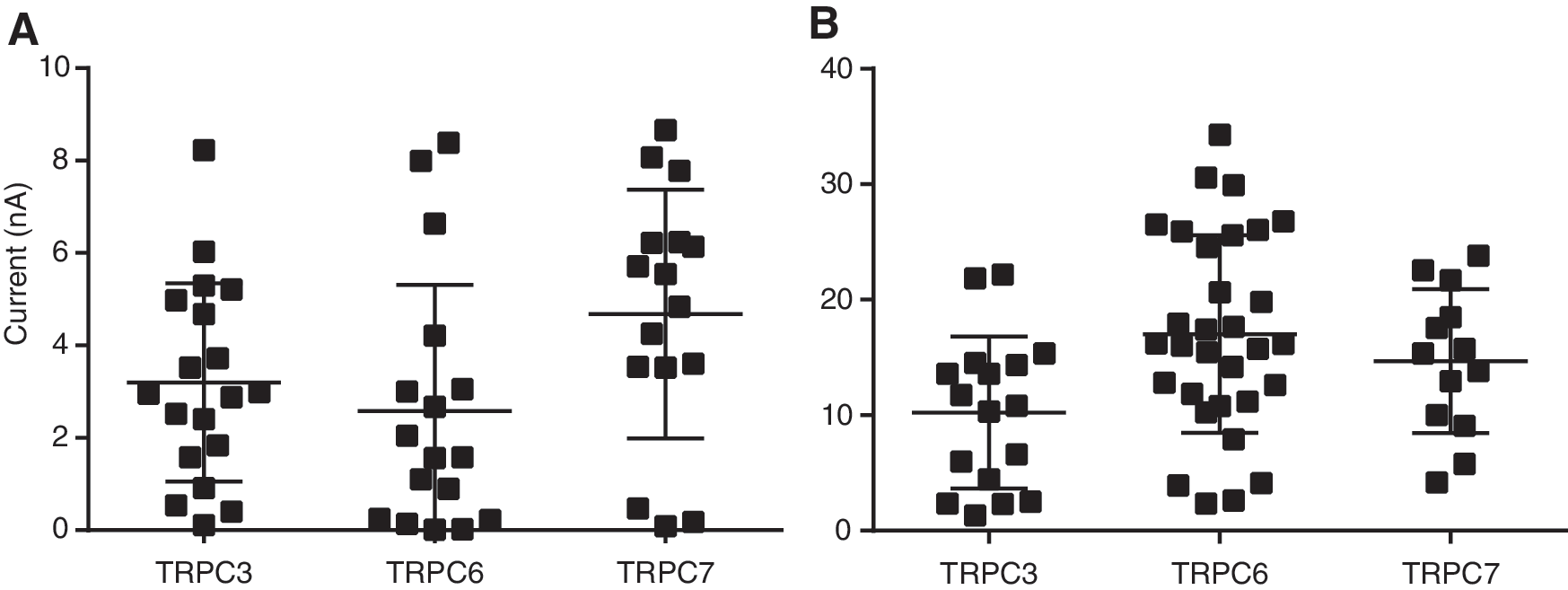
TRPC currents recorded on QPatch HT and HTX QPlates.
Next, we tested the performance of these cells on HTX QPlates (Fig. 2B). These plates permit recording from a small population of cells (10 cells per well), which may help to normalize the distribution of peak TRPC currents recorded. Using HTX QPlates it was possible to record TRPC currents in all 48 wells of the QPlate but there was still a large variation in the peak currents recorded for all 3 channels (Fig. 2B). The average TRPC currents recorded on HTX QPlates at +120 mV were 10.2±6.6 nA (TRPC3, n=17 wells), 17.0±8.5 nA (TRPC6, n=31 wells), and 14.7±6.2 nA (TRPC7, n=13 wells). The size of the ensemble currents recorded on the QPatch HTX was not 10 times the average HT currents, but rather only 3–5 times larger. Based on the success rates on QPatch HT (45%) and the number of cells expressing TRPC current (80%), this is an expected number. However, it is not enough to suppress the variation that is observed possibly because in the ensemble current the success rate and the non-responders are also included and therefore add to the variation.
In conclusion, the transient nature of TRPC3, 6, and 7 (when stimulated by M3 receptor activation), the inability to reactivate these TRPC channels in this setting and the large variation of peak currents would require large numbers of assessments to determine pharmacology of TRPC inhibitors. We feel that this would render it a less than ideal compound screening platform for these channels. However, although we have not studied this in great detail, we suggest that the QPatch could be used to assess effects of compounds on the kinetics of these channels as it captures both the rise and decay of the response.
Profile of TRPC Currents Recorded on IonWorks Quattro During Repetitive Voltage Scans
For the IonWorks Quattro 2 types of assay Patch Plates are available, HT plates with a single hole per well and PPC plates with 64 holes per well. The higher number of cells per well of the PPC plates has been shown to normalize the well to well current distribution. 43,44 We investigated whether this feature would make it possible to use the IonWorks Quattro platform for developing TRPC screening assays. However, unlike the QPatch, which is a continuous add and read system, the IonWorks Quattro is a discontinuous system. Both the recording electronics head (E-head) and fluidics head (F-head) of the IonWorks Quattro access the extracellular side of the planar Patch Plate—this means that the E-head can only apply voltage protocols and record currents after the F-head has completed all the liquid additions to the Patch Plate. The result is a delay between the addition of compound to each well and the application of a voltage scan, the extent of the delay is dependent on the plate scanning protocol being used but this typically ranges from 12 to 199 s.
The profile of TRPC3, TRPC6, and TRPC7 currents were investigated on the IonWorks Quattro using a repetitive scan protocol, which had a minimum delay of 12 s between carbachol addition and subsequent voltage scan. The addition of 100 μM carbachol resulted in the activation of TRPC currents with the characteristic TRPC rectification profiles as shown in the current–voltage traces in Figure 3A. The current–time plots for TRPC currents recorded on the IonWorks Quattro are shown in Figure 3B. There was no evidence of TRPC currents in control (DMSO) wells (Fig. 3B) contrasting those with carbachol addition. Furthermore, there was no evidence of baseline TRPC currents as the addition of a TRPC antagonist (compound A, see Pharmacology of TRPC Channels on IonWorks Quattro section) did not produce a reduction in the current (data not shown). For TRPC3 (Fig. 3Bi), maximum currents of 2.3±0.3 nA (n=15 wells) were recorded during the first voltage scan, with the currents decaying during the remaining voltage scans. For TRPC6, the currents were seen to develop with time, reaching a maximum current of 3.5±0.5 nA (n=8 wells) after the second voltage scan (Fig. 3Bii). After this point TRPC6 currents continued to decay during the remainder of the voltage scans. For TRPC7 (Fig. 3Biii), the maximum current of 1.4±0.2 nA (n=15 wells) was recorded during the first voltage scan, with the currents decaying during the remaining voltage scans.
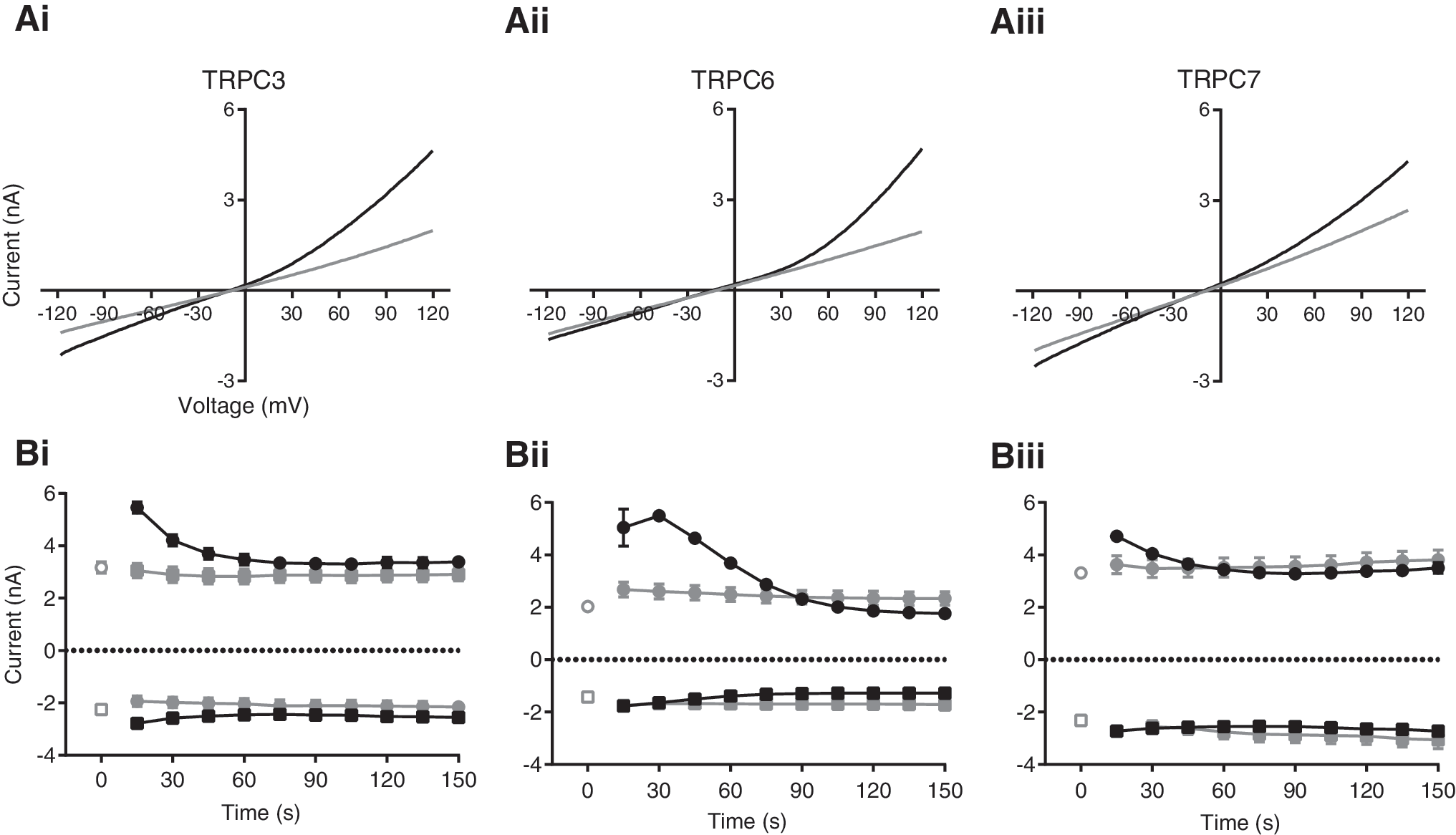
TRPC currents recorded on the IonWorks Quattro during repetitive scans.
While it was possible to record the activation and decay of TRPC6 currents on the IonWorks Quattro using the repetitive scan mode, it was only possible to record the decay of TRPC3 and TRPC7 currents. Based on the current decay kinetics measured by the QPatch, it is plausible to conclude that this is due to the faster decay of TRPC3 and TRPC7. In the time between carbachol addition and the first voltage scan these currents have reached their maximum and have started to decay, affecting the assay window.
Distribution of TRPC Currents on IonWorks Quattro
Based on the results from repetitive scans reported in Figure 3, the quarter-at-once (QAO) mode was selected for further experiments. This plate scanning protocol divides the PPC plate into 4 quarters, which are recorded sequentially with a delay of 43 s.
Figure 4 shows the current–voltage traces for TRPC3, TRPC6, and TRPC7 channels using the QAO protocol. For TRPC3 (Fig. 4Ai) and TRPC6 (Fig. 4Aii), there was evidence of outward rectifying TRPC currents in the presence of carbachol. The recorded TRPC7 currents (Fig. 4Aiii) during carbachol addition were smaller with less evidence of outward rectifying current.

TRPC currents recorded on the IonWorks Quattro during quarter-at-once mode.
Figure 4B shows the distribution of the maximal outward currents recorded from control (DMSO), TRPC3, TRPC6, and TRPC7 cells obtained from multiple wells within a single experiment. The average currents recorded were −0.003±0.1 nA (control, n=12 wells), 1.5±0.2 nA (TRPC3, n=11 wells), 2.0±0.2 nA (TRPC6, n=9 wells), and 0.6±0.2 nA (TRPC7, n=6 wells). The calculated Z′ factor for each TRPC channel assay was 0.42 (TRPC3), 0.54 (TRPC6), and −0.78 (TRPC7).
The results show that by using the PPC plates on the IonWorks Quattro it is possible to reduce the variation of TRPC current size from well to well. The recording from a higher number of cells per well and the higher success rate for obtaining a recording from a single cell, which is 60%–80% on single cell per well HT Patch Plates (IonWorks Quattro), 45 both help to suppress the well to well variation of the recording on the IonWorks Quattro PPC. The tighter well to well distribution of TRPC currents reduces the number of repeats required within an experiment and improves the robustness of screening assays as compared to the data from QPatch described above. However, the assay window for TRPC7 currents recorded on the IonWorks Quattro was small, undermining assay robustness as evidenced by a negative Z′ factor.
Changes in TRPC Window Size During Experiment
By using the QAO mode, it was possible to analyze the assay window for each quarter of the Patch Plate that make up a single experiment. Figure 5A shows how the IonWorks Quattro PPC Patch Plate is divided into sections when running in QAO mode. Figure 5Bi shows that there was a decrease in the size of the carbachol activated TRPC currents with each subsequent quarter of the Patch Plate within a single experiment. The average TRPC6 currents were 3.1±0.2 nA (n=6 wells) in Quarter 1, 2.6±0.5 nA (n=6 wells) in Quarter 2, 2.7±0.5 nA (n=6 wells) in Quarter 3, and 1.3±0.4 nA (n=3 wells) in Quarter 4, which represents a 60% decrease in the assay window. There was also an increase in the level of current between pre and post-compound additions in control wells during the experiment, going from −0.01±0.03 nA (n=6 wells) in Quarter 1, to 0.63±0.75 nA (n=3 wells) in Quarter 4. The decreased carbachol response and the increased baseline currents resulted in the assay window Z′ factor decreasing from 0.74 in Quarter 1, to 0.35 in Quarter 2, 0.14 in Quarter 3, and −4.5 in Quarter 4. This indicates that for Quarter 1 there is a sufficient assay window to reliably separate positive control responses from the negative control responses, whereas in Quarters 2, 3, and 4 of the Patch Plate there is no such separation.
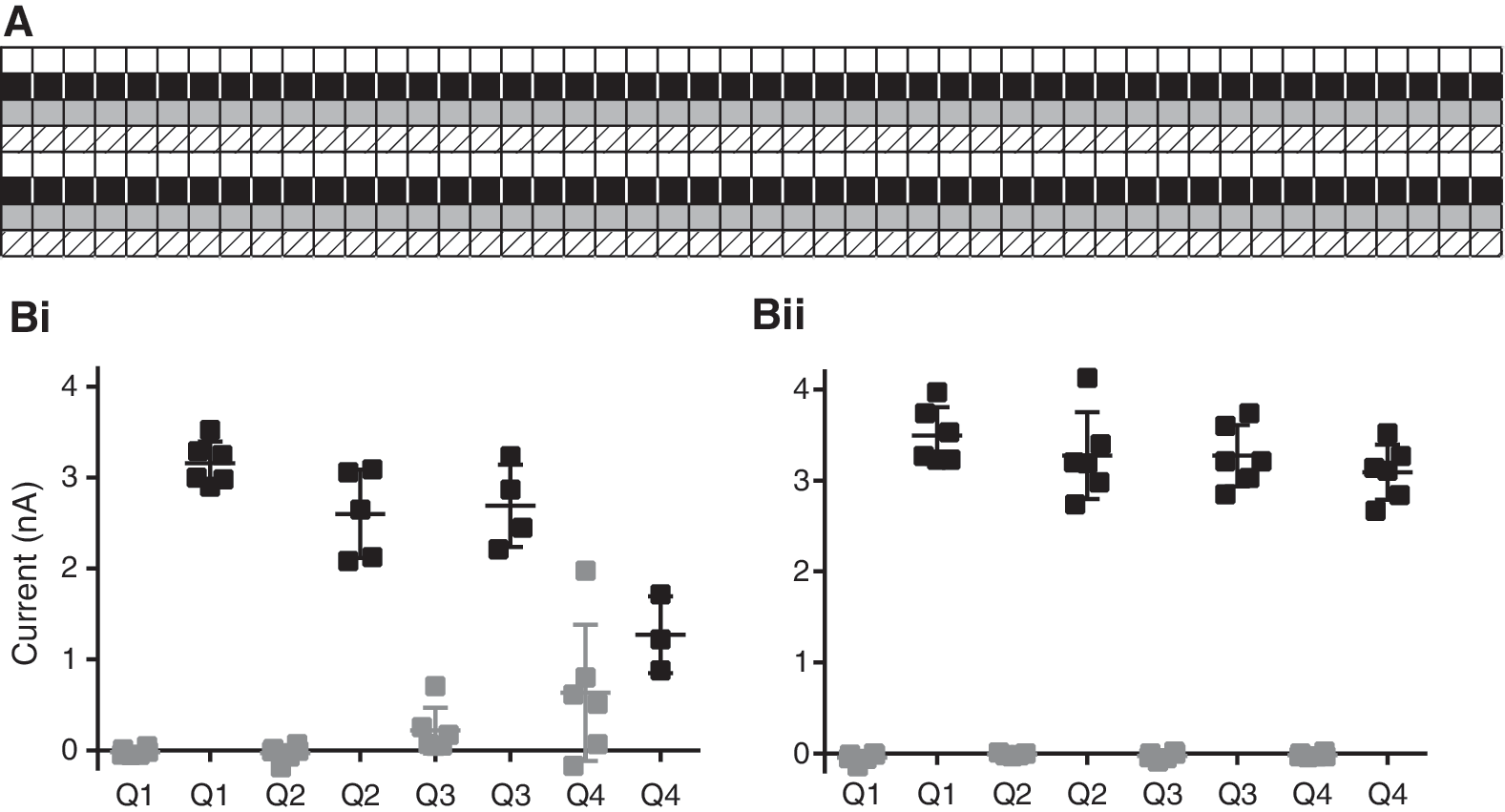
Effect of IonWorks Quattro Patch Plate usage on size of TRPC6 assay window.
At the start of the experiment, cells are added to all wells of the Patch Plate and electrical access is obtained by membrane perforation with amphotericin. When using the QAO mode, the cells in each quarter of the plate were tested at different time points. The result of using the QAO mode is that cells in Quarter 1 of the Patch Plate are tested 12 min after the experiment starts while cells in Quarter 4 of the Patch Plate are tested 35 min after the experiment begins. To assess whether the length of the experiment was contributing to the decrease in the assay window, experiments were performed with only half the Patch Plate being used in a single experiment. Running the assay in this mode also resulted in a shorter duration for each step during a recording. Upon completion of the first experiment, a fresh cell preparation was made and the second half of the Patch Plate was then used in the second experiment. Figure 5Bii shows the size of the TRPC assay window recorded in each quarter of the Patch Plate used over 2 separate experiments. The carbachol activated TRPC currents were 3.5±0.3 nA (n=6 wells) in Quarter 1, 3.3±0.5 nA (n=6 wells) in Quarter 2, 3.3±0.3 nA (n=6 wells) in Quarter 3, and 3.1±0.3 nA (n=6 wells) in Quarter 4, representing a 11% decrease in the assay window. There was no change in the level of leak current in control wells during the experiments, going from −0.05±0.05 nA (n=6 wells) in Quarter 1 to −0.02±0.02 nA (n=6 wells) in Quarter 4. The assay Z′ factor was 0.69 in Quarter 1 and in Quarter 4 was 0.68 showing that the assay window was maintained in each quarter of the Patch Plate when used over 2 separate experiments.
The results in Figure 5Bi suggest that the stability and response of the cells decreases with time and that using the Patch Plate over 2 experiments with fresh cell preparations for each experiment resolves this issue, as shown in Figure 5Bii. By using the Patch Plate over 2 experiments, rather than in 1 experiment, it is possible to maximize the amount of data generated from a single Patch Plate.
Pharmacology of TRPC Channels on IonWorks Quattro
To date, there are relatively few compounds reported to inhibit TRPC channels. The widely used non-selective TRP channel antagonist SKF96365 was tested in the assay and gave pIC50 values of 4.99 and 4.68 against TRPC3 and TRPC6 respectively, which agrees well with literature data. 46 –48 More recently, 2 patents and 2 articles have been published on the identification of compounds that can inhibit TRPC3 and TRPC6 channels. 25,26,49,50 Two compounds, exemplified by these patents were used to assess the pharmacological sensitivity of the TRPC assays on the IonWorks Quattro (Fig. 6A, B).
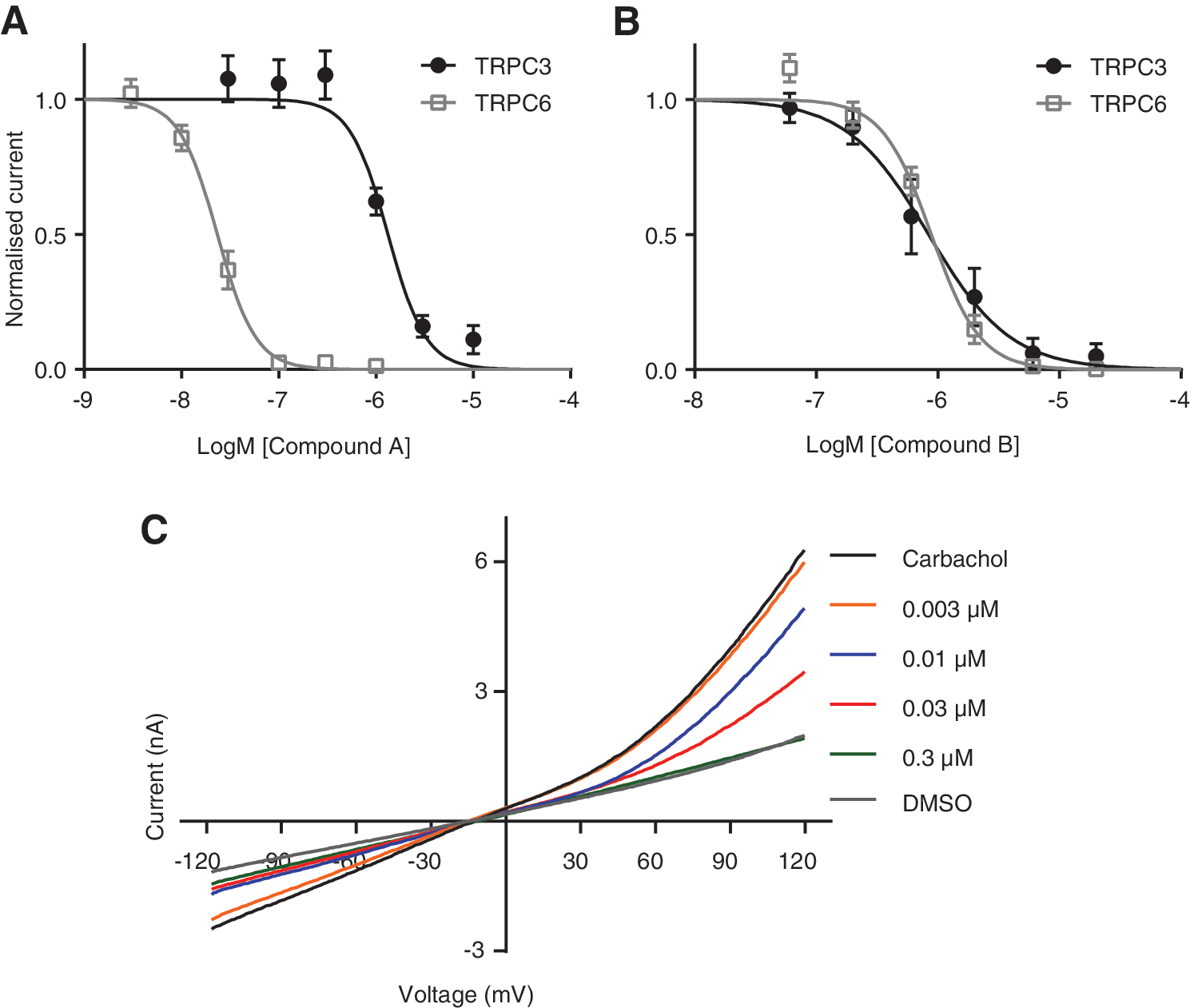
Pharmacology of TRPC3 and TRPC6 channels on IonWorks Quattro.
Compound A inhibited TRPC3 and TRPC6 currents with respective pIC50 values (±standard error) of 5.9±0.057 and 7.6±0.031 (n=4–5 individual experiments; Fig. 6A). Our findings are in good agreement with the reported IC50 value against TRPC6 of 12 nM (pIC50 7.92) for this compound, 49 the patent does not report an IC50 for TRPC3. These data also show that the assay is sensitive over the nM and μM range.
In contrast to compound A, compound B was not selective for either TRPC channel, the respective pIC50 values for TRPC3 and TRPC6 were 6.1±0.081 μM and 6.1±0.036 μM (n=3 individual experiments; Fig. 6B). Our findings are in good agreement with the reported IC50 value of this compound against TRPC3 and TRPC6. 25,50
Summary
In this report we have shown that it is possible to capture the response kinetics of TRPC3, TRPC6, and TRPC7 on the QPatch, whereas with the IonWorks Quattro it was possible to develop TRPC3 and TRPC6 ion channel inhibitor assays. TRPC3 and TRPC6 channels have good assay windows and showed pharmacological sensitivity to test compounds.
The limitations of the IonWorks Quattro design and the kinetics of the TRPC channels investigated here impact on the size of the peak currents recorded and have a strong impact on experimental protocol design. The IonWorks Barracuda, which is the next generation of the IonWorks Quattro platform, allows for 384 concurrent add and read recordings during the experiment. 51,52 This could potentially improve the performance of the TRPC assays due to the ability to record the peak TRPC current during carbachol addition and therefore a TRPC7 assay could perhaps be developed. The recording of 384 wells simultaneously would also lead to a shorter total experiment time that could result in an increased assay throughput.
Footnotes
Disclosure Statement
The authors, all of whom are employees of Novartis, had complete access to all the data that support this publication and declare that no financial or other conflict of interest exists in relation to the content of the article. The funders had no role in study design, data collection and analysis, decision to publish, or preparation of the article.