




Abstract
Infections caused by Mycobacterium tuberculosis and other mycobacteria are major challenges for global public health. Particularly worrisome are infections caused by multidrug-resistant bacteria, which are increasingly difficult to treat because of the loss of efficacy of the current antibacterial agents, a problem that continues to escalate worldwide. There has been a limited interest and investment on the development of new antibacterial agents in the past decades. This has led to the current situation, in which there is an urgent demand for innovative therapeutic alternatives to fight infections caused by multidrug-resistant pathogens, such as multidrug-resistant tuberculosis. The identification of compounds that can act as adjuvants in antimycobacterial therapeutic regimens is an appealing strategy to restore the efficacy lost by some of the antibiotics currently used and shorten the duration of the therapeutic regimen. In this work, by setting Mycobacterium smegmatis as a model organism, we have developed a methodological strategy to identify, in a fast and simple approach, compounds with antimycobacterial activity or with potential adjuvant properties, by either inhibition of efflux or other unrelated mechanisms. Such an approach may increase the rate of identification of promising molecules, to be further explored in pathogenic models for their potential use either as antimicrobials or as adjuvants, in combination with available therapeutic regimens for the treatment of mycobacterial infections. This method allowed us to identify a new molecule that shows promising activity as an efflux inhibitor in M. smegmatis.
Introduction
Antimicrobial resistance is currently recognized as a global public health threat. Nowadays, an alarming number of common bacterial pathogens display phenotypes of multidrug resistance, for which the existing therapeutic options are limited, more toxic, and associated with higher costs for public health services. 1
Bacterial resistance to antimicrobials can be mediated by several mechanisms, such as antibiotic inactivation/degradation, alteration of the cell target(s), and reduction of the antimicrobial intracellular concentration by changes in the membrane permeability and/or through the activity of efflux systems. 2 Efflux pumps are present in all bacteria, contributing to the extrusion of diverse molecules, including toxins, secondary metabolites, and antimicrobials. 3 Several recent studies have shown that efflux plays a crucial role in the early stages of development of antimicrobial resistance in the major pathogen Mycobacterium tuberculosis. 4 –9
One strategy to overcome antimicrobial resistance is to use a combined therapy by which an antibiotic is administered together with an adjuvant molecule that inhibits its efflux, thus keeping its intracellular concentration within a lethal interval, which prevents the emergence of resistant strains. 10 Therefore, multiple efforts have been made toward the identification of such molecules and to test their efficacy against clinically relevant pathogens, such as mycobacteria. 11 –18
In this work, we present a methodological approach to rapidly identify molecules with antimicrobial and/or efflux inhibitory properties against mycobacteria, using Mycobacterium smegmatis as an experimental model. This species, rather than the more expensive and slow-growing M. tuberculosis, has already been established as a useful surrogate to study mycobacterial efflux activity, 19 –21 the effect of efflux inhibitors, 13,22 –26 or even mycobacterial outer membrane components. 27 M. smegmatis has also been used successfully in the screening of molecules with antituberculosis activity. 22,28,29
The methodological approach proposed consists in a step-wise selective process, in which a candidate compound is sequentially evaluated and classified in one of the following four possible categories: (a) potential antimycobacterial, (b) potential adjuvant by inhibition of efflux, (c) potential adjuvant by mechanism(s) other than efflux inhibition, or (d) with no relevant biological activity. To study efflux activity, we have used the fluorescent dye ethidium bromide (EtBr) as a marker. The properties of this molecule as a common substrate of efflux pumps and a fluorochrome have been widely explored in studies on efflux activity in several bacteria. 19,26,30 –32 The methodological model was validated with three compounds whose effect on mycobacteria has been well established, namely the phenothiazines thioridazine and chlorpromazine, and the ion channel blocker verapamil. 4,6,19,33 –36 To further corroborate the efficacy of the presented algorithm, two compounds belonging to the class of the 2-aminothiazoles were tested to evaluate and categorize their antimycobacterial properties.
We have deeply investigated the structure–activity relationship of substituted 2-aminothiazoles with regard to their antitubercular activity. 12,14 In this work, reasoning on the versatility of this scaffold, which has been found to be the central core of many bioactive compounds, we have also investigated its potential as an inhibitor of efflux in mycobacteria. To avoid biases because of the intrinsic activity of the tested molecules, we selected a substituted 4-phenyl-2-aminothiazole [N-(3,5-dichlorophenyl)-4-(2-fluoro-5-trifluoromethylphenyl)thiazol-2-amine, UPAR-109] with a medium-low activity toward M. tuberculosis (minimum inhibitory concentration [MIC] = 15 μM) 12 and a 4-(isoxazol-5-yl)thiazol-2-amine (N-adamantan-1-yl)-5-(2-(3,5-dichlorophenylamino)thiazol-4-yl)isoxazole-3-carboxamide, UPAR-331), showing no activity against the same strain (MIC = >128 μM, article under preparation) (Fig. 1). The latter compound possesses an adamantane moiety, which, along with the 2-aminothiazole, is a widely distributed feature in medicinal chemistry, especially with regard to inhibition of transporters. 37 –40

Structure of compounds UPAR-109 and UPAR-331 tested in this work.
Materials and Methods
Reagents
(a) Commercially available compounds
EtBr, chlorpromazine (CPZ), thioridazine (TZ), verapamil (VP), erythromycin (ERY), clarithromycin (CLR), ofloxacin (OFX), rifampicin (RIF), ethambutol (EMB), streptomycin (STR), and isoniazid (INH) were purchased from Sigma-Aldrich (St. Louis, MO). Ciprofloxacin (CIP) was purchased from Fluka Chemie GmbH (Buchs, Switzerland). All solutions were prepared on the day of the experiment in deionized water, except for ERY, CLR, and RIF, prepared in dimethyl sulfoxide (DMSO).
(b) Synthesis of compounds UPAR-109 and UPAR-331
The synthesis of compound UPAR-109 has already been described in detail.
12
Compound UPAR-331 was prepared according to a straightforward protocol reported in detail in the Supplementary Data (see Experimental Section, Supplementary Fig. S1; Supplementary Data are available online at
M. smegmatis growth conditions
The reference strain M. smegmatis mc2155 (ATCC® 700084™) was used in this study. The strain was grown at 37°C, 180 rpm, in Middlebrook 7H9 (Becton, Dickinson and Company, Sparks, MD) supplemented with 10% (v/v) of oleic acid–albumin–dextrose–catalase (OADC, Becton, Dickinson and Company) and 0.05% (v/v) Tween 80 (Sigma, for fluorometric assays only).
MIC determination
MICs for EtBr, antibiotics, and compounds were determined by the twofold broth microdilution method. 41 An inoculum equivalent to McFarland 0.5 standard was prepared from a midexponential culture (optical density [OD]600 of 0.8) in 7H9. A final inoculum was then prepared by diluting 1:100 the cellular suspension in 7H9 plus 10% (v/v) OADC. Aliquots of 0.1 mL were transferred to each well of a 96-well plate containing 0.1 mL of twofold serial dilutions of each antimicrobial in 7H9 plus 10% (v/v) OADC. The MIC values were registered as the lowest concentration of antimicrobial that inhibited visible growth after an incubation of 72 hs at 37°C.
Evaluation of Efflux Inhibitory Activity
MIC determination in the presence of compounds
To evaluate the effect of compounds on the MICs of antibiotics and EtBr, MICs were redetermined in the presence of the compounds at one-fourth their MIC, a concentration by which their direct antimicrobial activity is residual and guarantees cell viability. MICs were determined as described above with an additional step consisting in the transfer of an aliquot of 0.01 mL of each compound to the wells of the microplate already containing twofold serial dilutions of each antimicrobial. Plates were inoculated and the MICs were registered as described above. MIC reductions equal or higher than fourfold were considered indicative of the presence of efflux inhibitory activity. 4,6
Synergism testing by “checkerboard assays”
The combination assays between antibiotics/EtBr and compounds were prepared in 96-well plates containing in the x-axis 0.05 mL of twofold dilutions of an antimicrobial ranging from 2 × up to 1/256× the MIC and in the y-axis 0.05 mL of twofold dilutions of a compound ranging from the 1× to 1/32× the MIC. The dilutions of the antimicrobials and compounds were prepared in 7H9 medium. For each assay, controls were included consisting in the testing of each antimicrobial and compound alone. The plates were inoculated with an inoculum equivalent to the one used for MIC determination. The combination results were registered visually after incubation at 37°C for 72 h. The effect of each compound was evaluated by determination of the fractional inhibitory concentration (FIC) calculated by the following formula: FICantimicrobial = MICantimicrobial in combination/MICantimicrobial alone. Values of FIC ≤0.25 were considered as synergy, FIC ≥2 as antagonism, and FIC = 0.5–1.0 as indifference. 4,13,23,42
Real-time fluorometry
The accumulation/efflux of EtBr was assessed in a Rotor-Gene™ 3000 (Corbett Research, Sydney, Australia) using real-time software analysis, as previously described by Viveiros et al. 32 The assays were conducted at 37°C and the fluorescence of EtBr was measured using 530 and 585 nm as excitation and detection wavelengths, respectively. The EtBr accumulation and efflux assays were performed as previously described. 19,35
(i) EtBr accumulation assays
Cultures were grown to midexponential growth phase (OD600 of 0.8) and the cells were collected by centrifugation, washed in phosphate-buffered saline pH7.4 (PBS, Sigma), and resuspended in PBS to achieve a cellular suspension with an OD600 of 0.8. Several reactions were prepared in 0.1 mL (final volume) containing 0.05 mL of the cellular suspension (final OD600 of 0.4) plus 0.05 mL of (i) PBS, (ii) 2 × EtBr solution, and (iii) 2 × EtBr solution plus 2× compound solution. All solutions were prepared in PBS and the final concentrations of the compounds were equal to one-fourth their MIC. The EtBr concentration used, 0.125 mg/L, corresponds to steady-state equilibrium, in which EtBr efflux equals EtBr influx. 19 If necessary, the accumulation assays can also be carried out with glucose as source of energy, as described previously. 32,43 The EtBr fluorescence was measured each minute for a total period of 60 min. The activity of the compounds on EtBr accumulation was evaluated according to the relative final fluorescence (RFF) values, calculated by the formula: RFF = (Fplus compound–Fno compound)/Fno compound, where Fplus compound and Fno compound correspond to the fluorescence at the last time point (min 60) of the EtBr accumulation curve obtained in the presence of a compound and in its absence, respectively. 23 These accumulation assays, and consequently the RFF parameter, allow differentiating intraassay and interassay the relative strength of several compounds.
(ii) EtBr efflux assays
Cultures were grown in the same conditions and a cellular suspension was prepared similarly but adjusted to an OD600 of 0.4. EtBr-loaded cells were prepared by incubating the cellular suspension in the presence of the EtBr steady-state concentration (0.125 mg/L) and the most efficient efflux inhibitor (VP) at 200 mg/L (one-fourth the MIC) for 1 h at room temperature to reach maximum EtBr loading. Cells were then collected by centrifugation and resuspended in PBS to achieve an OD600 of 0.8. Several tubes were prepared in 0.1 mL containing 0.05 mL of cellular suspension and 0.05 mL of (i) PBS, (ii) glucose 0.8%, (iii) 2× VP solution, (iv) 2× VP solution plus glucose 0.8%, (v) 2× compound solution, and (vi) 2× compound solution plus glucose 0.8%. All solutions were prepared in PBS and the final concentrations of compounds were equal to one-fourth their MIC. The tube with glucose (ii) corresponds to the maximum efflux condition, whereas the tube with VP (iii) corresponds to the minimum efflux condition. The EtBr fluorescence was measured each 30 s for a total period of 30 min. The raw data obtained were normalized against the data of non-effluxing cells (control with VP only) at each time point; these time points correspond to the maximum fluorescence values that can be achieved during the assay. Thus, the relative fluorescence corresponds to the ratio of fluorescence that remains per unit of time relative to the EtBr-loaded cells. For each efflux assay, we considered that the assay run in the presence of glucose only corresponded to the conditions of maximum efflux, whereas the assays run in the presence of VP only corresponded to minimum efflux. 32,43 The efflux assays confirm the responsiveness of the efflux systems and provide an insight into the inhibitory strength of a compound relative to a strong efflux inhibitor—VP.
Results and Discussion
The aim of this study was to design and validate a methodological approach to enable the rapid screening and identification of potential antimycobacterial agents or adjuvants that can be used to potentiate the chemotherapy toward infections caused by mycobacteria (Table 1 and Fig. 2).

Algorithm designed for the rapid screening of new compounds with potential applications against mycobacteria.
Protocol Design for the Identification of Potential Antimycobacterial Adjuvants
1. An MICc <20 μM indicates a potential antimycobacterial.
2. An MICantibiotic or MICEtBr reduction by, at least, fourfold is indicative of a potential adjuvant.
3. An RFF >1 and MICEtBr reduction by at least fourfold indicate a potential adjuvant by efflux inhibition.
4. An FIC ≤0.25 indicates synergy between antibiotic/EtBr and the potential adjuvant.
5. Confirms an activity of EtBr efflux inhibition.
FIC, fractional inhibitory concentration; MIC, minimum inhibitory concentration; RFF, relative final fluorescence.
Rationale of the Methodological Model
In general, the synthesis of a given compound or set of compounds follows a rationale to achieve a specific functional goal, such as antimicrobial activity or inhibition of efflux. In our experience, a pre-established functional classification of a compound often does not reflect the biological outcome, potentially originating confusion in the attribution of a given potential use to a compound, namely as an antibacterial, adjuvant, and/or efflux inhibitor. These are very important functional characteristics that display some overlapping properties. For example, a compound may demonstrate a good adjuvant effect with established antibacterial agents through the inhibition of efflux pumps or by other unrelated mechanisms. However, this same compound at concentrations near its MIC will act as an antibacterial itself.
The methodological flowchart presented here proposes an approach in which the different biological effects of a given compound are evaluated in successive but nonexclusive steps, yielding maximum functional information for that molecule and its potential use. This approach allows optimizing several resources associated with the evaluation of a new molecule, such as time, laboratorial costs, and amount of the compound available for biological testing.
The design of this flowchart was based on establishing cutoff values for classifying compounds in different categories: antimycobacterial agents, adjuvants by inhibition of efflux activity, adjuvants by an unrelated mechanism, and compounds with no biological interest (Fig. 2). The cutoff values considered were already described in the literature or arbitrarily defined in this work. A compound is classified as a potential antimycobacterial agent when displaying an MIC lower than 20 μM, a value adapted from previous studies; 22 this cutoff value allows identifying either a molecule with significant antibacterial properties or a lead molecule to be exploited for further development. Compounds that do not meet this criterion, but are able to reduce by at least fourfold the MIC values of either EtBr or established antimycobacterial agents, are considered as potential adjuvants. If this fourfold MIC reduction is observed for EtBr, together with significant intracellular accumulation of EtBr in fluorometric assays (arbitrarily defined as RFF values higher than 1), then the adjuvant properties of the compound are attributable to inhibition of efflux. In contrast, if the compound promotes reduction of antimycobacterial MICs, shows an RFF value less than 1, and an FIC equivalent to or less than 0.25, then it is classified as a non efflux inhibitor adjuvant.
Therefore, steps 1 to 3 of the proposed flowchart allow the classification of compounds in the established functional categories and the exclusion of compounds with no relevant effect (Fig. 2). The following steps, 4 and 5, will then confirm this classification and further explore the molecule's biological effect(s). Compounds displaying relevant biological properties will be selected for further studies in pathogenic mycobacteria, to be complemented with detailed mechanistic studies, assaying, for example, cytotoxicity, mutagenicity, enhancement of killing activity in human macrophages, and pK/pD studies in light of their potential future clinical use. 13,25,34,44
Validation of the Methodological Model
To validate the methodological flowchart, three compounds known to work as efflux inhibitors were analyzed according to the established process: the phenothiazines TZ and CPZ, and VP. Phenothiazines have long been recognized as presenting moderate antibacterial effects as well as moderate efflux inhibitory capacity against mycobacteria, whereas VP is considered a potent efflux inhibitor although without antibacterial effect per se. 6,8,15,34 –36,45
After validating the algorithm (Fig. 2), the compounds were first evaluated by determination of their MICs against the M. smegmatis strain in study (step 1)—Table 2. These MIC values will also define the concentration of compound to be used in subsequent steps—equivalent to one-fourth the MIC—to guarantee no effect upon cell viability during the time frame of the experiments. The phenothiazines CPZ and TZ showed MICs lower than MICs of VP, as expected (Table 2). However, taking into consideration the cutoff value established (20 μM), none of the compounds would be classified as a potential antibacterial.
MIC Values (mg/L and μM) of the Five Compounds Tested for M. smegmatis mc2155
TZ, thioridazine; CPZ, chlorpromazine; VP, verapamil.
Next, the three compounds were evaluated according to their potential (at one-fourth the MIC) to reduce the MIC values of relevant antibiotics and/or EtBr (step 2) or to promote intracellular accumulation of EtBr (step 3). Reduction of the MIC value of an antibacterial agent by at least fourfold is considered significant to attribute a potential adjuvant property to a given compound. 4,6 Overall, in step 2, the three compounds showed similar effects, except for EtBr whose MIC was most affected by VP (16-fold reduction vs. 4-fold decrease with TZ or CPZ) and STR, which was significantly affected only by TZ (Table 3). The MICs for the macrolides CLR and ERY were equally affected by the three compounds. The capacity of the three compounds to promote EtBr accumulation was tested by fluorometric assays (step 3)—Figure 3. As expected from the literature and the previous results of step 2, VP demonstrated a higher ability to promote EtBr accumulation than TZ or CPZ. This graphic observation is supported by the RFF values determined for each compound (Table 4), with VP presenting RFF values higher than 1, in opposition to TZ and CPZ.
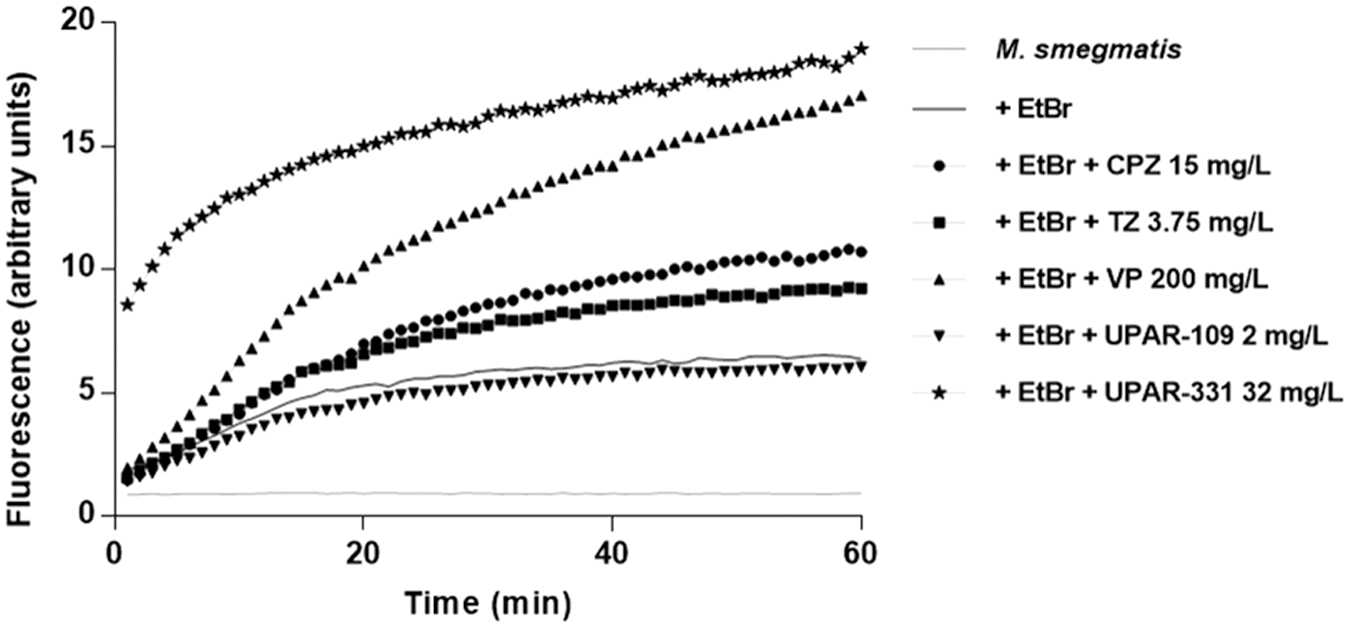
Effect of the five compounds, at one-fourth their minimum inhibitory concentration, on the accumulation of EtBr [0.125 mg/L] for M. smegmatis mc2155.
Effect of the Compounds Tested on the MIC Values (mg/L) of Selected Antibacterial Agents for M. smegmatis mc2155
The compounds were used at one-fourth their MIC values: TZ: 3.75 mg/L (9.25 μM); CPZ: 15 mg/L (42.3 μM); VP: 200 mg/L (408 μM); UPAR-109: 2 mg/L (4.9 μM); UPAR-331: 32 mg/L (65.4 μM), assuming an MIC of, at least, 128 mg/L (261.6 μM). ↓: n-fold MIC reduction; ↑: n-fold MIC increase; (-) no change in MIC value. Values in bold type correspond to reductions in MIC values ≥fourfold.
EtBr was tested as a marker for efflux activity.
EtBr, ethidium bromide; CIP, ciprofloxacin; OFX, ofloxacin; CLR, clarithromycin; ERY, erythromycin; STR, streptomycin; RIF, rifampicin; INH, isoniazid; EMB, ethambutol; TZ, thioridazine; CPZ, chlorpromazine; VP, verapamil.
RFF Values for the Five Compounds Tested Against M. smegmatis mc2155
The compounds were used at one-fourth their MIC values: TZ: 3.75 mg/L (9.25 μM); CPZ: 15 mg/L (42.3 μM); VP: 200 mg/L (408 μM); UPAR-109: 2 mg/L (4.9 μM); and UPAR-331: 32 mg/L (65.4 μM), assuming an MIC of at least 128 mg/L (261.6 μM).
TZ, thioridazine; CPZ, chlorpromazine; VP, verapamil.
At this point, the three compounds were categorized according to the established model (Fig. 2). VP was clearly classified as an efflux inhibitor according to proposed criteria, showing an MIC value more than 20 μM, a capacity to reduce by 16-fold the MIC of EtBr, and presenting RFF values more than 1 (1.69 ± 0.02). Conversely, TZ and CPZ displayed MIC values more than 20 μM, a moderate capacity to reduce MICs of antibiotics and EtBr, presenting RFF values less than 1 (mild efflux inhibitory activity), being putatively classified as potential adjuvants by a mechanism not only/other than efflux inhibition. This classification befits the class of phenothiazines, for which different functional roles have been described in the literature. 18,46 In fact, they have been described as inhibitors of the enzyme type-II NADH-menaquinone dehydrogenase, essential in the M. tuberculosis respiratory chain, 47 as inhibitors of calcium–calmodulin binding, 48 and as inhibitors of mycobacterial efflux pumps. 6,19,34,35 In addition, phenothiazines have also been described as causing changes in the mycobacterial cell membrane fluidity and homogeneity 49,50 and affecting DNA replication and repair processes. 51,52 The results obtained reflect this hybrid effect, particularly for TZ, because, despite its relatively low MIC (37 μM), it is able to reduce by fourfold the MIC of EtBr as well as other effluxable antibiotics, although showing an RFF less than 1 (0.44 ± 0.01).
The assessment of a synergistic effect between these three compounds and antibacterial agents was performed by checkerboard assays (step 4). Confirming our previous classification, VP showed to be effective in reducing the MICs of EtBr, presenting FIC values of 0.25 or less at concentrations as low as 1/32 of the MIC (Supplementary Fig. S2, Table 5 and Supplementary Table S1). VP also presented significant synergy with ERY, an effluxable antibiotic. 53 CPZ and TZ presented a similar synergistic effect with ERY, but no significant effect with EtBr. No synergistic effect was observed with other antibiotics (Supplementary Fig. S2 and Supplementary Table S1). These results highlight the adjuvant properties of all three compounds. Fluorometric EtBr efflux assays (step 5) confirmed the high efflux inhibitory activity of VP in comparison with the two phenothiazines—Figure 4.
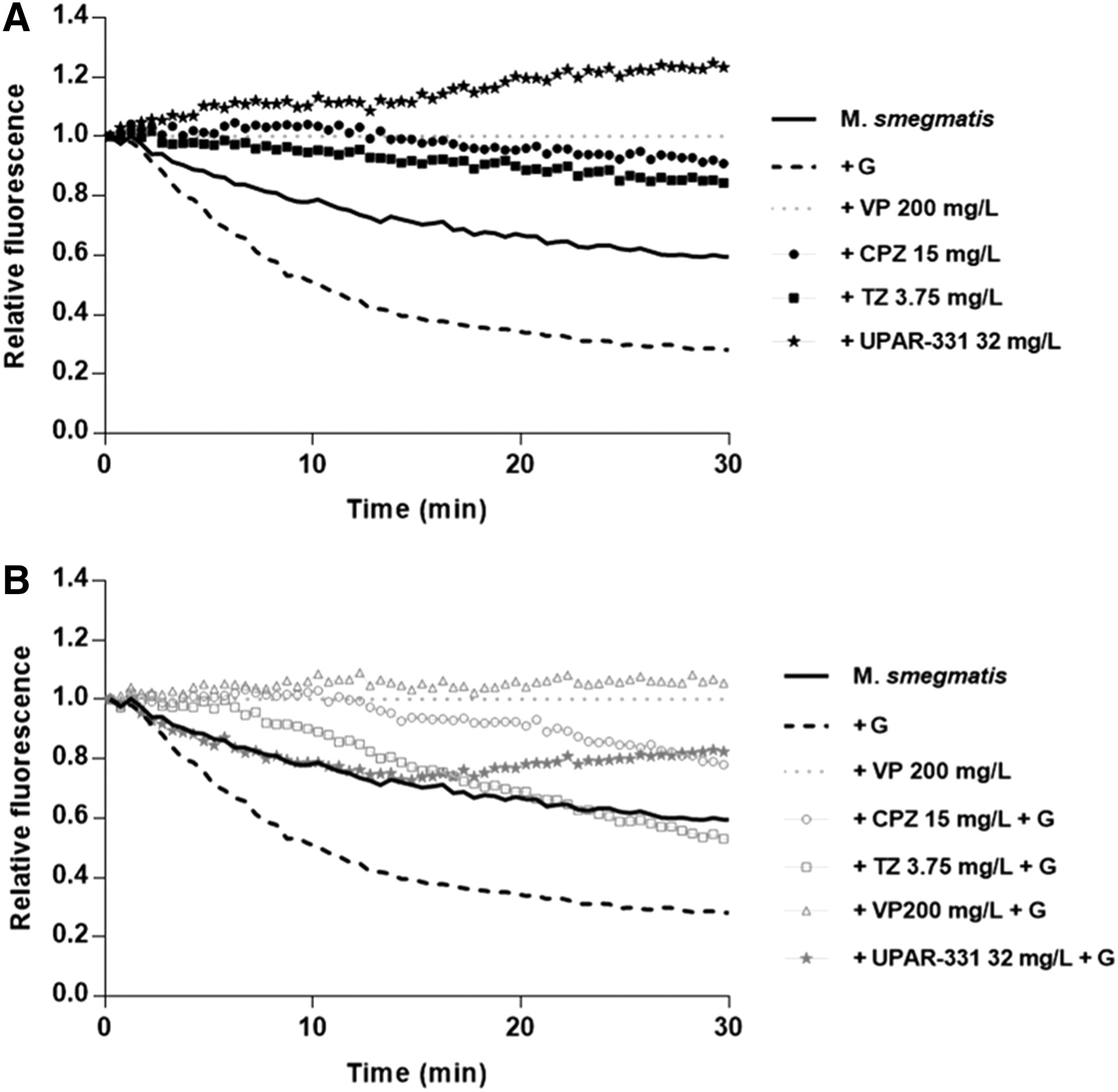
Effect of the compounds on the efflux of EtBr of M. smegmatis mc2155 strain in the absence
FIC Values Corresponding to the Effect of Thioridazine, Chlorpromazine, Verapamil, and UPAR-331 on the MIC Values of Macrolides and EtBr for M. smegmatis mc2155
Values in bold type are indicative of a synergistic effect (FIC ≤0.25) between the compound and the antibacterial agent.
ERY, erythromycin; TZ, thioridazine; CPZ, chlorpromazine; VP, verapamil; —, FIC value could not be determined.
Application of the Model to New Compounds
We also applied the methodological model developed to two new molecules of the 2-aminothiazoles group, a substituted 4-phenyl-2-aminothiazole (UPAR-109), 14 and a (thiazol-4-yl)isoxazole-3-carboxamide (UPAR-331). Following the rationale established, the first step of the evaluation process was the determination of the MIC of compounds against M. smegmatis mc2155 (step 1)—Table 2. UPAR-331 showed no antimycobacterial activity (MIC more than 130 μM), whereas UPAR-109 presented mild antimycobacterial activity (MIC = 19.5 μM), therefore, it was preliminarily classified as a potential antimycobacterial. The compounds were then evaluated regarding their ability to reduce the MICs of antibiotics and EtBr (step 2)—Table 3. UPAR-109 failed to show any interesting synergistic activity, whereas UPAR-331 decreased the MIC of EtBr as well as the MICs of ERY and STR by at least eightfold and fourfold, respectively. The evaluation of the capability to promote intracellular accumulation of EtBr (step 3) revealed distinct effects for the two molecules—Figure 3 and Table 4. The data obtained highlights the ability of UPAR-331 to augment significantly EtBr accumulation inside the mycobacterial cells. Interestingly, this effect was higher than that displayed by VP and was shown to be concentration dependent (Supplementary Fig. S3 and Supplementary Table S2). To further explore the relative strength of the compounds in promoting intracellular accumulation of EtBr, all compounds were tested at equivalent concentrations, 10 μM (data not shown) and 20 μM (Fig. 5). At both concentrations tested, UPAR-331 demonstrated a higher effect than VP, TZ, or CPZ. Molecule UPAR-109 showed no effect upon intracellular accumulation of EtBr.

Effect of thioridazine, chlorpromazine, verapamil, and UPAR-331, at 20 μM, on the accumulation of EtBr [0.125 mg/L] for M. smegmatis mc2155 strain.
In summary, the model developed allowed us to establish that compound UPAR-109 is a potential antimycobacterial agent with no efflux inhibitory activity. This is in agreement with the data already reported for this compound and the related series, 12 supporting the categorization proposed with our methodological model. In contrast, compound UPAR-331 is a potential adjuvant that exerts its activity by inhibition of efflux. Synergy testing by checkerboard synergy assays (step 4) was performed for UPAR-331 and EtBr, revealing that this molecule is able to reduce the MIC of EtBr (FIC ≤0.25) at concentrations as low as 1/32 its MIC (Table 5). Synergy testing by checkerboard assays (step 4) was not performed for UPAR-109 because of the lack of effect in step 2. The efflux inhibition properties of the thiazoisoxazole were confirmed in fluorometric EtBr efflux assays (step 5). Indeed, compound UPAR-331 demonstrated, at one-fourth the MIC, a remarkable efflux inhibitory activity, higher than that of VP, as evaluated visually and by the RFF value (1.90 ± 0.10) (Fig. 4 and Table 4). This effect confirmed the highest activity of UPAR-331 observed when both molecules were tested at the same concentration (20 μM) in an EtBr accumulation assay (Fig. 5).
Conclusions
In this work we describe a novel methodological approach to test and screen new molecules aimed at identifying new agents either endowed with antimycobacterial or with adjuvant properties. The results obtained with known compounds contributed to validate the algorithm that was, therefore, successfully applied to newly designed molecules, so as to corroborate this approach as an effective strategy to aid in the rapid screening of compounds that hold promise in antimycobacterial therapy. The methodologies applied are simple, time-effective, and cost-effective, when compared with the direct evaluation of compounds on pathogenic species such as M. tuberculosis, which have higher requirements in terms of biosafety, quantity of compounds, and time consumption. Genetic analyses have indicated that M. smegmatis and M. tuberculosis share many efflux systems, including 8 out of 12 M. tuberculosis ABC transporters, 4 out of 8 MFS transporters, and 6 out of 7 RND transporters. 54 Nevertheless, the efflux systems present in the two species are not completely superimposable and, together with differences in the cellular envelope, require some caution in the transposition of the results to M. tuberculosis. Once a compound is selected for further assays, it can be tested in M. tuberculosis or other species of interest by following the same experimental rationale, now adjusted for the new species, by using appropriate cutoff values and control strains. The advantages of the model were highlighted in the evaluation and categorization of a set of new compounds, enabling a simple decision-making process that leads to the identification of a potential antimycobacterial agent and a new potential adjuvant molecule with efflux inhibitory activity, even when the quantity of compound available is limited. These compounds may be interesting lead molecules and set the basis for the rational design of new molecules with improved properties. 13
Footnotes
Acknowledgments
This work has been partially supported by Fundação para a Ciência e a Tecnologia (FCT), Portugal, through projects PTDC/BIA-MIC/121859/2010 and UID/Multi/04413/2013. S.S.C. and D.M. were supported by grants SFRH/BPD/97508/2013 and SFRH/BPD/100688/2014, respectively, from FCT. The Centro Interdipartimentale Misure “G. Casnati” is kindly thanked for the analytical determination of the molecules synthesized.
Disclosure statement
No competing financial interests exist.