




Abstract
Methotrexate (MTX) is the first line of choice for the management of rheumatoid arthritis (RA) and has been reported for its low bioavailability and side effects. Combination therapy has been widely investigated to overcome bioavailability issues and to reduce adverse effects associated with monotherapy. Various phytoconstituents such as resveratrol (RSV) and curcumin have been found to possess potent anti-inflammatory activity via downregulating the signaling of cytokines (interleukin [IL]-1, IL-6, and tumor necrosis factor alpha) and nuclear factor kappa B signaling. The prime objective of this study was to develop transdermal gel containing MTX–RSV loaded nanoemulsions (NEs) to overcome bioavailability issues and adverse effects of RA monotherapy. The NEs optimized by using Box–Behnken Design were incorporated within gel, and an in vitro skin permeation study performed on rat skin by using vertical Franz diffusion cells exhibited controlled drug release up to 48 h. Subsequently, anti-inflammatory and potential anti-arthritic activities of the combination in nanocarrier were assessed in rats and showed 78.76 ± 4.16% inhibition in inflammation and better anti-arthritic effects. Consequently, integration of dual delivery with nanotechnology can hopefully produce successful therapeutic options for rheumatic diseases.
Introduction
Rheumatoid arthritis (RA) leads to aggressive degeneration of cartilage and bone that results in swelling of the joint capsule, affecting 1%–2% of the population globally. 1 It is characterized by the critical inflammation of the joints membrane lining, where the promotion of pro-inflammatory cytokines such as tumor necrosis factor alpha (TNF-α), interleukin (IL)-6, IL-1, IL-1β, and C-reactive protein is 3–100 times more. 2 Steroidal and non-steroidal anti-inflammatory drugs (NSAIDs), such as diclofenac, aspirin, celecoxib, and glucocorticoids, are the first line of medication to provide symptomatic relief but they fail to control the pathogenic progression of RA.
The disease-modifying anti-rheumatic drugs (DMARDs) such as methotrexate (MTX), sulfasalazine, and etanercept avert the disease evolution and stop consequent articular impairment. 3,4 The DMARDs are used individually or in conjunction/combination with NSAIDs to suppress the disease progression. The MTX is an effective antimetabolite drug having immunomodulating potential, which acts by multiple mechanisms such as inhibiting purine metabolism and methyl transferase activity; suppression of T cell activation; downregulation of B cells, etc. 5,6 Though highly promising, various limitations of MTX treatment include short biological half-life, systemic toxicity, hepatotoxicity, dizziness, nausea, diarrhea, and mouth ulcers. 7
The combination therapy is finding wide application for enhancing the bioavailability and therapeutic effects of the individual drugs. 8 For instance, simultaneous delivery of teriflunomide and MTX within hydroxyapatite nanoparticles confirmed the maximum therapeutic effectiveness in the arthritis model. 9 Dexamethasone-loaded microcapsules dispersed inside MTX-containing hyaluronic acid hydrogel depicted faster and more significant RA repair in male Lewis rats compared with MTX-hyaluronic acid hydrogel alone. 10 Sun et al. analyzed the combination of sinomenine and MTX and demonstrated that the combinatorial effect decreased inflammation and joint damage by modulating osteoclast-related cytokines in rats. 11
The phytol derivatives such as resveratrol (RSV) (3, 4, 5-trihydroxy-trans-stilbene) present in various common foods such as grapes, berries, peanuts, are potent anti-inflammatory and antioxidant agents that activate the NAD-dependent deacetylase sirtuin 1 (Sirt1), which downregulates and inhibits the transcription activity of adipogenic factors such as PPARγ and C/EBPα. 12 Downregulation of SIRT1 in RA patients was found to reduce the expression of inflammatory mediators such as cytokines. 13 This plays a considerable role in controlling the progression of the disease. Dietary supplementation of RSV was found to lower the level of TNF-α, IL-1β, IL-6, and soluble receptor activator of nuclear factor kappa B ligand in the arthritis-induced mice model. RSV is known to reduce swelling and bone destruction in collagen-induced arthritis in the murine model. 14 The culture studies on RA patient-derived fibroblasts such as synoviocytes showed apoptotic cell death (via caspase 8a) on treatment with RSV. 15 Randomized controlled clinical trials were conducted on 100 RA patients, who were given RSV capsule (1 g) with the DMARDs for about 3 months. It was observed that the clinical and biochemical markers for 28 joints were significantly reduced in the RSV-treated patients. 16 The RSV with potent anti-arthritic potential could be an ideal choice for combination therapy with DMARDs.
To our knowledge, the combination of RSV and MTX loaded in a transdermal delivery system for treatment of RA has not been reported. Transdermal delivery using nanoemulsions (NEs), which are thermodynamically and kinetically stable isotropic dispersions of oil in water, is a widely preferred choice among different nanocarriers, owing to its high drug-loading capacity and ease of fabrication. 17,18
In this study, Box–Behnken Design (BBD) was exploited for the development of stable NEs of MTX and RSV, with optimum particle size and high percent entrapment efficiency (%EE). The MTX–RSV-loaded NEs were further characterized and analyzed for transdermal permeation. Subsequently, the anti-inflammatory and potential anti-arthritic activity of the combination in nanocarriers was assessed in Wistar albino rats as a possible therapeutic option in the treatment of RA.
Materials
MTX was a generous gift from Belco Pharma Pvt. Ltd., India. RSV (98%) was procured from Biotivia LLC. Acrysol K 150, sefsol-218, labrafaclipophile WL 1349, and eucalyptus oil were obtained from Correl Pharma Pvt. Ltd., India; Nikko Chemicals Co. Ltd., Japan; and Gattefosse, France and Natural Aroma Products Pvt. Ltd, India, respectively. Transcutol P was purchased from GSK Health Care, India. Castor oil, span 20, span 80, tween 20, and tween 80 were obtained from Nice Chemicals, India. Isopropyl myristate was purchased from Sigma-Aldrich. Various high-performance liquid chromatography (HPLC) grade solvents, that is, methanol, acetonitrile, and water, were bought from Spectrochem Pvt. Ltd., India.
Methods
Chromatographic Conditions
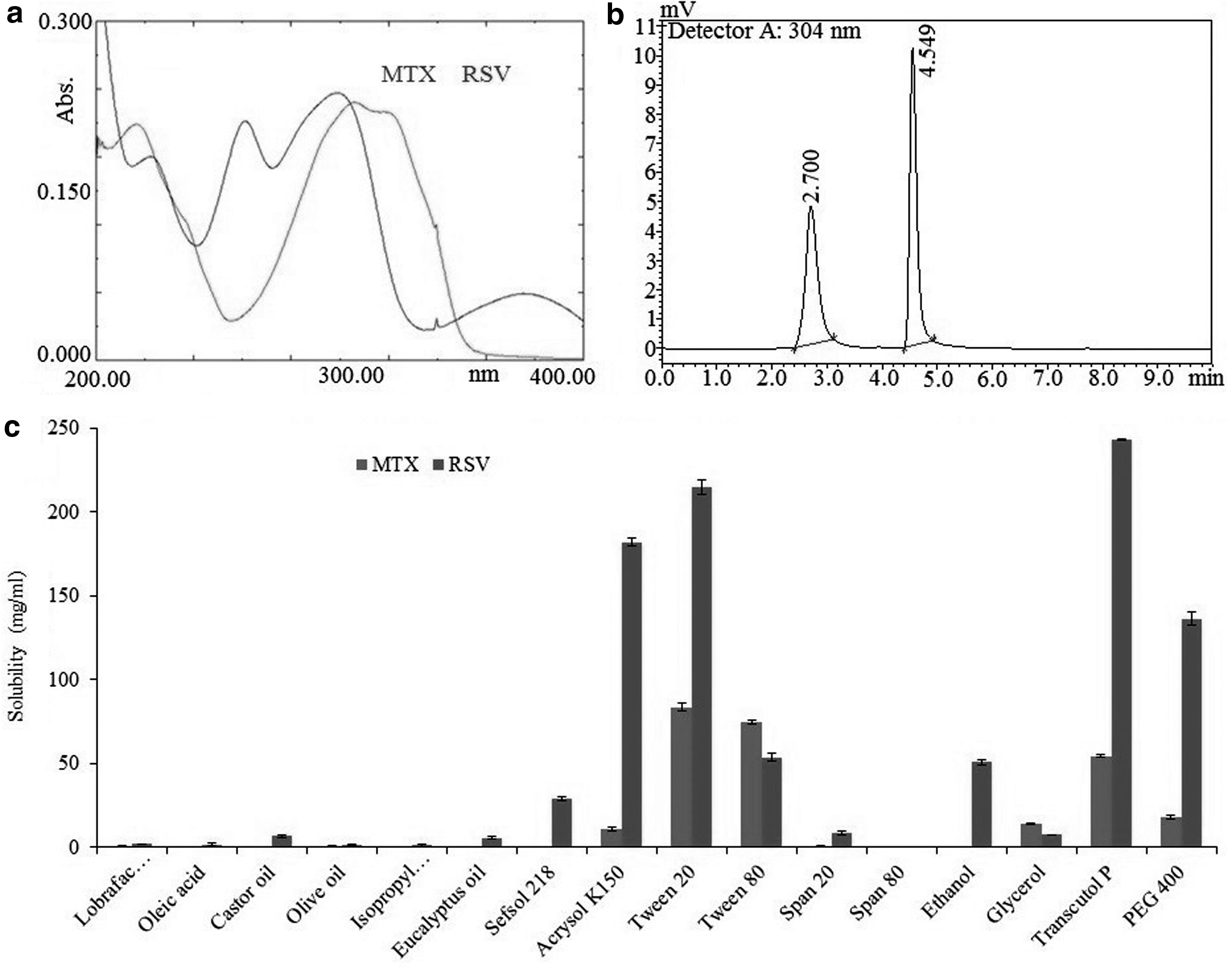
The HPLC system (LC-2010C HT; Shimadzu, Japan) consisting of an LC-20AT pump, SIL-20AC HT autosampler, and SPD-20A UV/Vis detector was utilized for the simultaneous estimation of MTX and RSV. 19 The separation was performed on a phenomenex reverse-phase C18 column (5 μm, 250 × 4.60 mm) by using acetonitrile:water (75:25, v/v) as mobile phase, delivered at a flow rate of 0.6 mL/min. Estimation of both the drugs was carried out at their isobestic point, that is, 304 nm with a retention time of 2.7 and 4.5 min for MTX and RSV (Fig. 1a), respectively. For comparison, the drugs were separately run at their corresponding λ max, that is, 302 and 306 nm for MTX and RSV, respectively.
Selection of NEs Components
The components of NEs were selected based on the solubility of MTX and RSV in oil, surfactant, and co-surfactant. The solubility of both the drugs was measured by using a previously described shake flask method. 20 Briefly, the surfeit amounts of MTX and RSV were added to 2 mL of different oil phases (castor oil, olive oil, oleic acid, isopropyl myristate, lobarofac 319, acrysol K 150, and sefsol 218), surfactants (tween 80, tween 20, span 80, and span 20), and co-surfactants (ethanol, glycerol, transcutol P, and PEG 400) in vials and were vortexed for definite time intervals. All homogenized mixtures were incubated in a shaker water bath at 37°C, with shaking at 50 strokes/min for 72 h to achieve equilibrium. The resultant blends were centrifuged for 15 min at 1600 × g, and the content of MTX and RSV present within the supernatant was further analyzed by the HPLC method.
Construction of Ternary Phase Diagrams
On the basis of the screening studies, selected oil, surfactant, and co-surfactant were used to construct ternary diagrams employing the water titration method, as reported elsewhere. 21 The surfactant and co-surfactant were assorted in different proportions to obtain various S mix ratios of 1:1, 1:2, 1:3, 2:1, 3:1, 1:4, and 4:1 to fulfill the hydrophilic lipophilic balance value requirement for development of transparent oil in water emulsion. A concatenation of oil/S mix mixtures was prepared in different weight ratios (1:9, 2:8 [1:4], 3:7 [1:2.3], 4:6 [1:1.5], 5:5 [1:1], 1:7, 1:6, 1:5, 1:3, 1:2, 6:4 [1:0.7], 7:3 [1:0.43], 8:2 [1:0.25], and 9:1 [1:0.1]), to describe the boundaries of phases more precisely. Further, each mixture of oil and S mix was slowly titrated with water and samples were stirred properly after each addition. Simultaneously, samples were examined for transparency and the total water consumed (w/w) was determined to construct the pseudoternary phase diagrams by using the PCP triangular software. The wider region of shaded area (NEs area) in the phase diagram indicated better nanoemulsifying efficiency. All the studies were done in triplicate.
Thermodynamic Stability Assay
The NEs containing a sufficient amount of oil to solubilize both the drugs, that is, MTX (7.5 mg) and RSV (12.5 mg) along with a minimum requirement of S mix were selected from the phase diagrams for a further thermodynamic stability test. 22 In this test, the formulations were subjected to six heating (45°C) and cooling (4°C) cycles with a 48 h storage at each temperature. The formulations showing no sign of physical changes pronounced as stable were taken for a centrifugation test, that is, centrifugation at 1600 × g for 30 min. Further, the stable and robust formulations with no visible signs of precipitation or phase separation were put through freeze-thaw cycle analysis between −21°C and 25°C with a 48 h storage at each temperature. All these experiments were performed in triplicate.
Optimization of NEs
A three-level three-factor BBD was employed to statistically optimize the formulation variables to synthesize MTX- and RSV-loaded NEs with desired characteristics (Table 1). Establishment and interpretation of the experimental design were executed by using Design Expert software (version 10.1). The effect of the amount of oil (X 1), S mix (X 2), and water (X 3) was assessed on %EE (Y 1) and particle size (Y 2); the lower (−1), medium (0), and higher values (+1) of each factor were selected on the basis of preliminary studies (Table 2); and the generated polynomial equation was statistically authenticated by analysis of variance (ANOVA), via statistical significance of coefficients and r 2 values.
Composition and Observed Response of Various Nanoemulsions Formulations Based on Box–Behnken Design
Each value represents mean ± SD, n = 3.
SD, standard deviation; %EE, percent entrapment efficiency.
Variables in the Box–Behnken Design for Nanoemulsions Formulations
Characterization of NEs Formulation
The polydispersity index, particle size, and zeta potential of the developed NEs were determined by using zetasizer Nano-ZS90 (Malvern Instruments, United Kingdom). The sample was diluted with water, and measurements were carried out at an angle of 90° at 25°C. The morphology of optimized NEs was elucidated by transmission electron microscopy (TECNAI; FEI, Netherland, Europe). The sample was positioned on the copper grid, air dried after negative staining with phosphotungstic acid, and subsequently visualized under a microscope at 200 kV. Further, the viscosity and refractive index of the NEs were determined without dilution by a digital viscometer (LMDV 60 cone and plate rheometer) by using spindle #CPE 40 at 25 ± 0.5°C and Abbe's refractrometer, respectively.
The amount of drug entrapped in NEs was determined as reported by Narala et al.
23
Briefly, the formulation was centrifuged at 5590 × g for 20 min in Amicon® Ultra-4 Centrifugal filter tubes (Millipore; Carrigtwohill Co., Cork, Ireland); the supernatants were diluted with acetonitrile, and the amount of MTX and RSV was measured by using HPLC. All the measurements were done in triplicate, and %EE was calculated by using the following equation:
Stability Studies
The physical stability of the drug-loaded optimized NEs was assessed for 90 days. The NEs were enclosed within amber-colored glass vials: refrigerated conditions (4 ± 2°C), room temperature [25 ± 2°C/60 ± 5% relative humility (RH)], and 40 ± 2°C/75 ± 5% RH. The influence of different storage conditions on particle size and % drug content of drug-loaded NEs was observed after 30, 60, and 90 days and the results were evaluated by using one-way ANOVA with post-Dunnett's multiple-comparison test.
Preparation of NEs-Loaded Gel
The optimized NEs formulation was incorporated in 1% carbopol 940 (w/w) to enhance ease in superficial application of the drug, designated as NEF-6 gel. 24 In a similar manner, pure MTX and RSV were also dispersed into gel and were designated as MTX–RSV gel.
Ex vivo Drug Permeation Analysis
Wistar rats weighing 100–150 g were purchased from the Lala Lajpat Rai University of Veterinary and Animal Sciences, Hisar, India. The study procedure was duly approved by Institutional Animal Ethics Committee, Jan Nayak Chaudhary Devi Lal Memorial College of Pharmacy, India (approval no.:
Franz diffusion cell with a cell volume of 25 mL and 2.26 cm2 effective diffusion area was utilized for drug permeation analysis. 25 The rat skin was carefully placed between the two chambers of the Franz cell, with the horny layer facing upward toward the donor chamber. The receptor chamber was filled with a mixture of ethanol and phosphate buffer (pH 7.4) in a ratio of 3:7 v/v. The medium was magnetically stirred at 100 rpm, and the temperature was maintained at 37 ± 5°C. The MTX–RSV gel and NEF-6 gel were homogenously placed on the donor compartment in direct contact with the skin. One milliliter each of the sample was removed from the receptor medium; replenished with fresh medium each time at various sampling intervals, that is, 0, 0.25. 0.5, 1, 2, 4, 8, 16, 24, and 48 h; and subjected to drug analysis by HPLC. The study was repeated thrice, and the obtained results were employed to determine the transdermal flux (Jss, μg/cm2/h) by dividing the amount of drug permeated with time and area; apparent permeability coefficient (Kp, cm/h) was calculated by dividing transdermal flux with the drug amount in the donor chamber; and enhancement ratio (Er) across the rat skin was assessed by dividing transdermal flux of formulation with free drug dispersion.
Anti-Inflammatory Activity
The anti-inflammatory action of the MTX–RSV gel and NEF-6 gel was evaluated in Wistar rats by using the carrageenan-induced hind paw edema model.
26
Before the experiments, the animals were grouped (n = 6) as follows: Group A was treated as control without drug treatment; in the animals of groups B and C, MTX–RSV gel and NEF-6 gel were applied, respectively, on the shaved dorsal region and the animals had free access to water. Subsequently, after half an hour of the treatment, all the animals received 0.1 mL subplantar injection of 1% suspension of carrageenan in their right paws. The increase in paw volume was recorded by using a plethysmometer (UgoBasile 7140, Italy) at 1, 3, and 6 h post-carrageenan administration and the anti-inflammatory activity was determined by using the following equation:
wherein A and B represent the mean paw volume after the administration of carrageenan at time t in treatment and control groups, respectively; x and y represent the paw volume before the administration of carrageenan in treatment and control groups, respectively.
Anti-Arthritic Activity
The anti-arthritic potential of the developed formulations was assessed in Wistar rats. 27 The rats were arbitrarily divided into three different groups (n = 6): group A animals treated as arthritic control, that is, no drug treatment; MTX–RSV gel and NEF-6 gel were applied daily on the left hind paw of the animals of groups B and C, respectively, for a period of 10 days. Consequently, arthritis was induced by injecting 0.1 mL of formaldehyde (2% v/v in normal saline) to the subplantar region of the left hind paw of all animals on days 1 and 3. Drug treatment was started from the initial day of induction of arthritis, that is, day 0 and the increase in joint diameter of the injected paw was measured on days 8, 9, and 10, 30 min after application of the respective treatments with a micrometer screw gauge.
Results and Discussion
It is imperative to develop new and effective formulation for drugs depicting low aqueous solubility, eventually resulting in their poor availability at the target site, such that it delivers the drugs at the site of action and acts as a template for such categories of drugs. 28 –30 MTX and RSV elicit multiple pharmacological actions in biological systems, but poor water solubility of these drugs has led to poor bioavailability problems in their biomedical applications. 7,14 In this study, an NEs-based carrier system that could overcome these issues was successfully developed; the components of NEs were selected based on the solubility of both drugs in different excipients to achieve high entrapment efficiency.
Selection of NEs Components
Before the design and fabrication of NEs formulation, the selection of excipients was carried out and the most appropriate constituents for the drug to be encapsulated in the NEs were determined. The important considerations for choice of excipients includes those that are pharmaceutically acceptable, nonirritating, and non-sensitizing to the skin. In addition, the screening of pharmaceutically acceptable oils, surfactants, and co-surfactants for providing the highest solubilizing capacity is very significant to accomplish optimal drug encapsulation without drug precipitation and to minimize the amount of drug product essential to carry out an optimal therapeutic dose of a drug in emulsified form. 31 The solubility of MTX and RSV as per obtained results in various oils was of the order: acrysol K 150 > olive oil > castor oil > lobrafac WL 1349 > oleic acid > isopropyl myristate > eucalyptus oil > sefsol 218, and acrysol K 150 > sefsol 218 > castor oil > eucalyptus oil > lobrafac WL1349 > oleic acid > olive oil > isopropyl myristate, respectively. MTX and RSV exhibited maximum solubility, that is, 11.106 ± 1.2 mg/mL and 182.073 ± 2.5 mg/mL in acrysol K 150, which was consequently chosen as the oil phase for the synthesis of NEs.
Stabilization of the NEs by a surface active agent is another significant criterion. As the excess amount of surface active agents causes skin irritation/toxicity, nonionic surfactants are considered as safer than ionic surfactants, with their good ability to enhance permeability of drugs across the skin being investigated in the present work. To obtain NEs over a wide range of configurations, transient negative interfacial tension (rarely achieved by use of a single surfactant) needs to be attained with addition of a co-surfactant. Subsequently, pharmaceutically acceptable co-surfactants were assessed to obtain NEs with low surfactant concentrations that are facilitated by using a blend of surfactant and co-surfactant. The solubility of MTX and RSV was found to be the highest in tween 20 and transcutol P, which were thus selected for the preparation of NEs. Figure 1b shows the results of components screening.
Construction of Pseudo-Ternary Phase Diagrams
Pseudo-ternary phase diagram identifies the NE regions that were constructed separately for each S mix ratio with the help of CHEMIX school 3.6 software. In these phase diagrams, oil, S mix, and water individually represent an apex of triangle (Fig. 2). When surfactant alone was employed for the fabrication of NEs, that is, in case of S mix 1:0, high NEs region area was obtained and the maximum amount of acrysol K150 that could be solubilized by using 50% w/w of surfactant was around 25% w/w. However, when surfactant and co-surfactant were employed in equal proportion (S mix 1:1), double surfactant proportion to co-surfactant (S mix 2:1) and triple surfactant proportion to co-surfactant (S mix 3:1), the NEs region was found to increase compared with S mix 1:0. This kind of phenomenon was observed owing to the presence of co-surfactant, in addition to the surfactant that promoted fluidity in the interfacial film via decreasing interfacial tension and leading to a decrease in entropy of the nanosystem. 32 The NEs formulated using the S mix ratio 3:1 depicted the highest NEs region, but use of the S mix ratio 4:1 for fabrication of NEs led to a decrease in area. The ternary diagrams illustrated that the entropy of the NEs system can be contemplated to rely on the degree to which the surfactant reduces the tension between two phases.

Pseudo-ternary phase diagrams showing the oil in water nanoemulsion regions of Acrysol K 150 (oil), Tween-20 (surfactant), and Transcutol-P (co-surfactant) at different S
mix ratios:
Thermodynamic Stability Assay
The thermodynamic stability test differentiates NEs from conventional emulsions, as the former are kinetically stable systems and are formed at a specific concentration of different excipients. It also confers a long shelf life of the developed NEs. Accordingly, with a perspective of excluding the metastable formulations, a few representative compositions were subjected to the thermodynamic analysis and results depicted that the formulations with an S mix ratio of 3:1 survived all dispersion stability tests with no signs of physical instability. The formulations with other S mix ratios were dropped for further experiments (Table 3).
Thermodynamic Stability Assay of Randomly Selected Nanoemulsions Formulations
All formulations consisted of 7.5 mg MTX and 12.5 mg RSV.
MTX, methotrexate; RSV, resveratrol.
BBD to Optimize NEs Formulations
Optimization of NEs formulation using the design of experiments helps in developing an “optimized” system in a rational and scientific way with minimum utilization of resources. 33,34 The observed responses, that is, globule size and %EE of the developed formulations, varied greatly between 55.43–119.9 nm and 38.96%–76.5%, respectively (Table 1).
The second-order polynomial equations for the %EE and globule size are described as follows:
where Y 1 = %EE; Y 2 = globule size (nm); X 1 = concentration of oil; X 2 = concentration of S mix; and X 3 = concentration of water.
From the equation describing the effect of different variables on response Y 1, that is, %EE, it was evident that the model F value of 19.33 implied the estimated model to be significant and therefore may be used as a response surface for %EE (Table 4). In this case, X 1, X 2, X 3, X 1 X 2, X 1 X 3, and X 1 2 were significant model terms. It was evident that the model F value of 13.20 implied the estimated model to be significant and therefore may be used as a response surface for globule size. In case of globule size, X 1, X 2, X 3, X 1 X 2, X 2 X 3, X 1 2 , and X 3 2 were significant model terms. Three-dimensional plots obtained on data interpretation for responses Y 1 and Y 2 depict the interaction effects of the investigated factors on the responses (Fig. 3). On the basis of obtained results, NEF-6 with a minimum droplet size and highest %EE was selected for further characterization.
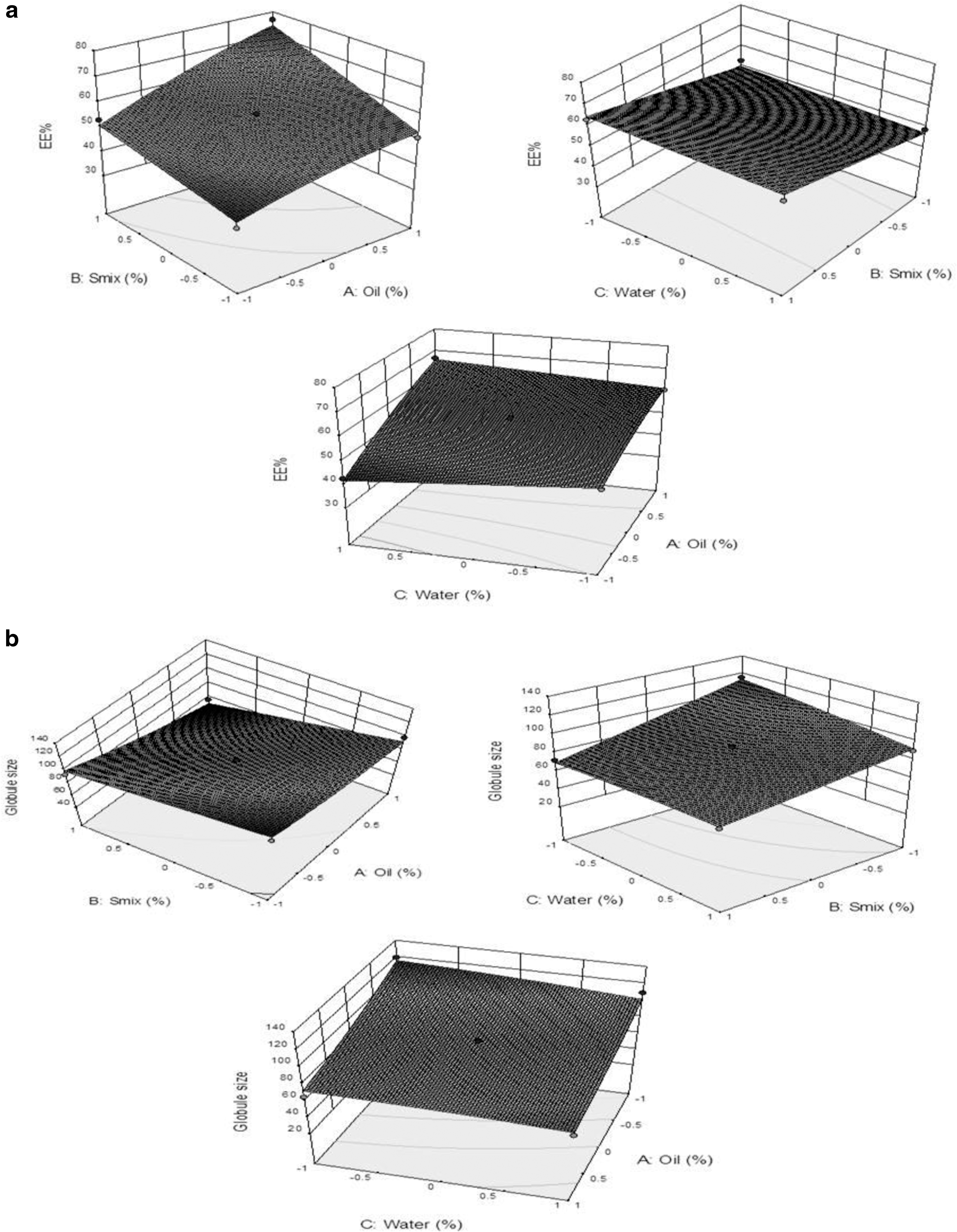
Three-dimensional response surface plots:
Summary of Results of Regression Analysis of the Fitted Quadratic Model
p < 0.05.
Characterization of NEs Formulation
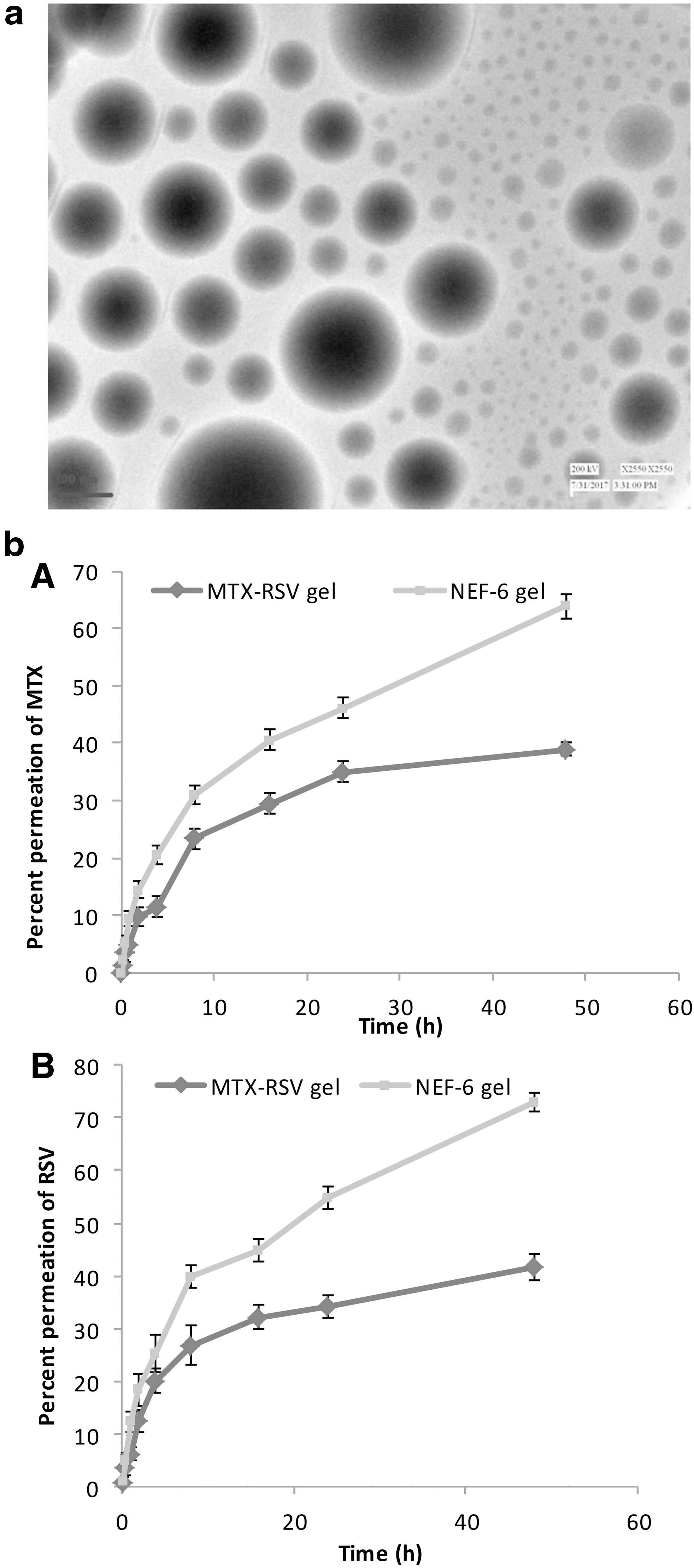
The light-scattering results presented that the mean globule size of blank NEs and NEF-6 was 34.68 ± 0.63 and 55.43 ± 046 nm, respectively, with narrow poly dispersity index values. The transmission electron microscopic images showed that NEs droplets were spherical with a uniform size distribution of globules (Fig. 4a). Zeta potential results depicted a negative surface charge, that is, −24 ± 2.45 and −26 ± 3.51 mV for blank NEs and NEF-6, respectively. The viscosity of NEF-6 was found to be 1,256 ± 12.63 centipoise. Smaller globule size and lesser viscosity facilitate higher interaction of nanovesicles and stratum corneum, resulting in augmentation of percutaneous uptake of encapsulated bioactives. No change in refractive index values of blank NEs and drug-loaded NEs indicated chemical stability of the drug, with no interaction between the excipients used and drugs.
Stability Studies
Stability studies of NEF-6 formulations performed at different storage conditions depicted that the storage of the NEs at higher temperature conditions, that is, 40 ± 2°C/75 ± 5% RH led to the agglomeration of globules; however, the formulations were stable at 4 ± 2°C and 25 ± 2°C/60 ± 5% RH for the period studied.
Ex vivo Drug Permeation Analysis
The ex vivo drug permeation studies were carried out for MTX–RSV gel and NEF-6 gel, and the cumulative amount of MTX and RSV permeated across the rat skin was plotted (Fig. 4b). The MTX–RSV gel depicted 39.16% and 42.38% of MTX and RSV permeation, respectively, in 48 h. However, the developed formulation, that is, NEF-6 gel led to higher permeation of MTX and RSV, that is, 64.54% and 73.91%, respectively, in 48 h across the skin. Table 5 presents the various permeation parameters determined. The obtained results depicted that the amount of drug permeated across the rat skin from the NEF-6 gel (p < 0.05) was statistically higher compared with the MTX–RSV gels, showing high Er values of 1.63 ± 0.097 and 1.75 ± 0.078 for MTX and RSV, respectively. Also, the enhancement in transdermal flux and skin permeation coefficient of drugs observed in NEF-6 gel depicts higher penetration ability of the developed formulation to deliver the drugs into the rat skin. The enhancement effect might be due to small particle size and larger surface area of the NEs. Moreover, the presence of surfactants such as transcutol P and tween 20 also promotes drug permeation across the skin. 35 In a previous study, a higher rate of drug permeation was observed from ketoprofen-loaded NEs gel formulations compared with ketoprofen solution and its marketed formulation. 36 Similarly, ferulic acid-loaded nanogel formulation also exhibited an improved permeation profile compared with conventional gel. 37
Permeation Parameters of Methotrexate and Resveratrol from Methotrexate–Resveratrol Gel and NEF-6 Nano-Emulgel
Jss, transdermal flux; Kp, apparent permeability coefficient was calculated; Er, enhancement ratio.
Anti-Inflammatory Studies
The carrageenan-induced paw edema model is considered to be a highly reliable and predictive model for evaluating anti-inflammatory activity of the developed formulations. 38 In this study, paw edema was developed via introducing carrageenan into the hind paws of all animals and the anti-inflammatory potential of developed formulations was assessed. The edema in the right hind paw was observed at the first, third, and sixth hour after administration of carrageenan and remained noticeable until the end of the observation period in the rats of the control group. However, topical treatments with MTX–RSV gel and NEF-6 gel inhibited paw edema; the inflammation decreased to 36.31 ± 2.24% in case of animals treated with MTX–RSV gels; and significant inhibition of edema, that is, a 69.61 ± 3.12% reduction in inflammation was observed in rats treated with NEF-6 gel at 3 h after administration of inflammatory stimulus. Also, the percent anti-inflammatory activity of drug-loaded NEF-6 gel showed significant (p < 0.05) inhibition, that is, 78.76 ± 4.16% at 6 h compared with MTX–RSV gel (Fig. 5a). The nanoencapsulation of both drugs led to augmentation in the anti-inflammatory activity of MTX and RSV, and the significant inhibitory effect of the developed formulation might be attributed to the high release rate and improved drug permeation across the skin. Thus, the results of this study suggest that the delivery of drugs within NEF-6 gel led to augmentation of anti-inflammatory activity pertaining to the enhancement in penetration of drugs from the formulation as compared with drug dispersion, thus providing the preliminary proof of concept of their latent appliance in inflammatory diseases.
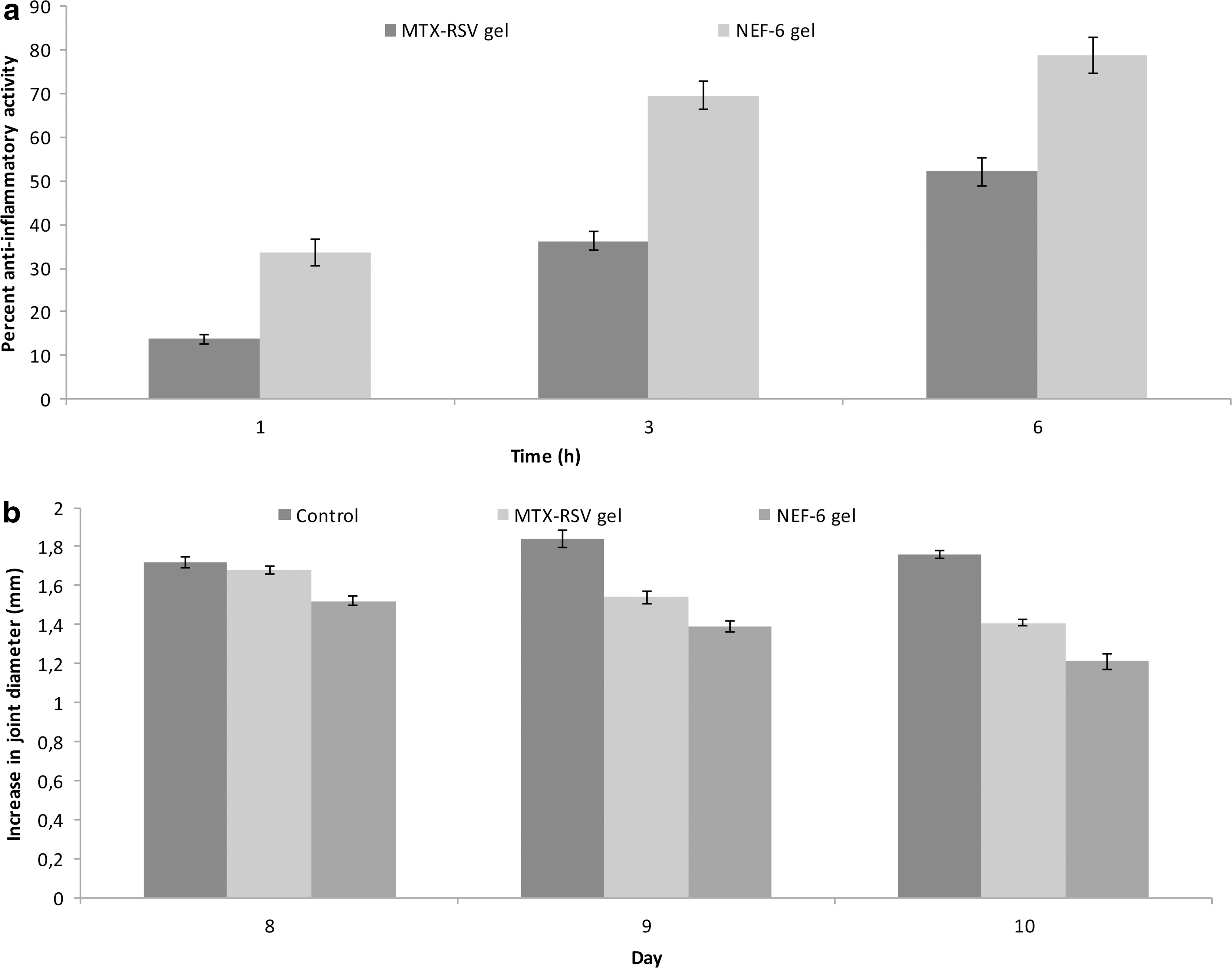
Pharmacodynamic evaluation of developed formulation:
Anti-Arthritic Activity
The formaldehyde-induced arthritis model was used in this study, and the anti-arthritic potential of the developed formulation was determined in comparison with that of MTX–RSV gel after topical administration to Wistar rats. Administration of formaldehyde leads to an induction of arthritis, possibly via release of various inflammatory mediators, that is, histamine, serotonin, prostaglandins etc., causing hypersensitivity at the site of injection and an increase in joint diameter was observed in all the animals. 39 The anti-arthritic potential of MTX and RSV was assessed at different time intervals (8th and 10th day) by measuring joint diameter. When analogized to the arthritic control group, the animal groups treated with MTX–RSV gel and NEs gel depicted a reduction in joint swelling (Fig. 5b). Higher inhibition of swelling was observed in the group treated with NEF-6 gel (p < 0.05). Moreover, the anti-arthritic analyses corroborate paw edema results, demonstrating that the NEF-6 gel formulation was able to attenuate RA more effectively. Alike present results, Coradini et al. demonstrated improved the anti-arthritic potential of co-encapsulated RSV and curcumin within lipid-core nanocapsules compared with drug dispersions. 40 An improved anti-arthritic potential of curcumin and MTX combination has also been reported, with minimal hepatotoxicity in animals. 41 Considering the merits of dual delivery, the present investigation was undertaken to explore the combination of MTX and RSV, either dispersed in gel in free form or loaded within NEs in treatment of RA, and the results illustrated the promising anti-arthritic potential of this novel combination loaded in NE as the delivery vehicle. Based on the results obtained from this study, it could be hypothesized that the loading of drugs within nanocarriers promotes their skin permeation, leading to higher availability to the target site. However, future studies are needed to be focused on determining the phenomenon underlying the improvement in anti-arthritic potential.
Conclusion
In this study, the combination therapy utilizing MTX with the food component in the transdermal delivery system was investigated and evaluated for its anti-inflammatory and anti-arthritic potential. A three-level three-factor BBD was employed to statistically optimize the formulation variables for preparing dual drug-loaded NEs with desired characteristics. The optimized NEs formulations had small particle size, high %EE, and satisfactory permeation parameters across the rat skin. Also, a significant enhancement in anti-inflammatory and anti-arthritic potential was observed for NEF-6 gel formulations compared with MTX-RSV gel in in vivo models. The encouraging results of this study suggest that integration of dual delivery with nanotechnology can hopefully produce successful therapeutic options for rheumatic diseases and thus future preclinical studies are warranted for moving this novel treatment modality from bench to bedside.
Footnotes
Acknowledgments
The authors would like to thank Belco Pharma Pvt. Ltd., India for providing them with the gift sample of methotrexate for the study. They are thankful to the Department of Pharmaceutical Sciences, Guru Jambheshwar University of Science and Technology, Hisar, India and All India Institute of Medical Sciences, New Delhi, India for sample analysis support.
Disclosure Statement
No competing financial interests exist.
Funding Information
The authors received no financial support for the research, authorship, and/or publication of this article.