




Abstract
An alternative to oral administration for the delivery of therapeutic substances is the topical route, which frequently has comparable efficacy but may have a better tolerability profile. Gamma scintigraphy is a noninvasive technique that involves the application of radioactive substances to conduct biodistribution studies of therapeutic substances delivered through various routes. Nimesulide (NSD) was radiolabeled with technetium pertechnetate (Technetium99m [99mTc]) and this radiolabeled drug complex (99mTc-NSD) was used to prepare a topical gel formulation. The permeation of the radiolabeled drug from the topical gel was determined by gamma scintigraphy on human volunteers. The region of interest was calculated for the quantification of permeated radiolabeled drugs. This was observed that the mean percentage permeation of 99mTc-NSD was found to be 0.32 ± 0.22 to 36.37 ± 2.86 at 5 and 240 min. It was demonstrated that gamma scintigraphy may be a noninvasive and reliable technique for the determination of drug permeation through topical routes.
INTRODUCTION
Gamma scintigraphy is the technique primarily used in the nuclear medicine domain that provides images of the biodistribution of radiopharmaceutical and associated vectors (drug or formulation). To quantify the biodistribution of the formulation and the drug release kinetics from innovative carrier systems, gamma scintigraphy may be used. 1 The quantitative nature of scintigraphic images is the strength of this technology. No other technique can exactly locate the formulations in the gastrointestinal tract or even the depth to which a nebulized solution penetrates the lungs. This technique may determine the length of time a drug remains on the cornea with comparatively good accuracy. 2 Scintigraphic methods also enable correlation between the specific site of delivery and the reported pharmacological effects, aiding drug-targeting research. A radioactive material, such as technetium- or indium-labeled radiopharmaceutical, is frequently incorporated into the formulation to achieve radiolabeling.
The ideal way to label dosage forms, such as enteric-coated pills, is to add a nonradioactive tracer, such as samarium-152 oxide, and then activate the finished product using neutrons. Various types of systems have been explored, including metered dosage inhalers and nebulizers, nasal sprays and drops, enemas, suppositories, tablets, and multiparticulates, for oral administration using gamma scintigraphy. 3,4
One of the largest and most accessible organs is the skin, which plays an imperative role in the permeation and penetration of drugs. It protects the body from microbial invasion and acts as a defense against chemical and physical assaults. The stratum corneum, the skin's outermost layer, is the barrier to drug permeation. The stratum corneum is essentially a 10–15-μm-thick matrix of coenocytes or dead dehydrated keratinocytes embedded in a matrix of lipids. The dermis and epidermis are the two important skin layers. The epidermis, which is the layer closest to the surface and has no blood flow, is around 100–150 μm thick. The capillary network that carries blood throughout the body is found in the dermis, which lies beneath the epidermis. 5
It is necessary to understand the mechanism of skin barriers to overcome this for successful delivery through the skin. The tight junctions in the epidermis, the stratum corneum, and the hair follicles serve as mechanical barriers in the skin. In addition, there may be mechanical barriers in the blood vessels, glands, and the basement membrane at the dermal–epidermal interface. 6
It is recommended to target skin diseases with several available skin formulations to ensure minimal systemic absorption. While designing these formulations, it is crucial to assess the drug's percutaneous penetration at the site of action. 7 Gamma scintigraphy and radiometry techniques used in skin formulations ascertain the localization of drugs in various layers of human skin. This technique also helps to predict the contact time between the formulation and the skin, the amount of drug that is not absorbed, the rate at which the drug enters the bloodstream, the amount of drug that is absorbed into the dermis, and the amount of drug that remains in the stratum corneum. It is also used to compare the efficacy of cutaneous treatments, determine the impact of the application site on drug permeability, and assess the effectiveness of transdermal patches and microneedle arrays. 8
The current study envisioned evaluating the permeation study of nimesulide (NSD) formulation using the gamma scintigraphy technique. The formulation was radiolabeled with radioactive material and the permeation effect was assessed in healthy human volunteers. To the best of our knowledge, this is the first reported method for the quantification of drugs through a topical route using gamma scintigraphy.
MATERIALS AND METHODS
Materials
NSD was obtained from Dr. Reddy's Laboratory, Hyderabad, India. Thiomersal, monobasic potassium phosphate, polyethylene glycol 400, and butylated hydroxyl anisole were procured from Merck, India. For the radiolabeling purpose, technetium99m (99mTc) was procured from BARC, Mumbai, India. All the chemicals were of analytical grade and procured from SD fine, India.
Method
Radiolabeling of NSD
NSD was radiolabeled with 99mTc in the presence of stannous chloride (SnCl2) as a reducing agent. The labeling was done in accordance with improved methodology. The radiocomplex of NSD (99mTc-NSD) obtained was then checked for labeling efficiency tagged molecule using instant thin-layer chromatography (ITLC). 9 Furthermore, 2 − 3 μL of the radiocomplex was placed at ITLC-SG strip ∼1 cm above the base. The strip (stationary phase) was then dipped into the mobile phase and allowed to run to a level of ∼75% height of the strip. A gamma counter (Caprac® -t wipe test/well counter; Capintech) was used to record counts for each section of the strip after it had been sliced in the ratio of 70:30 (bottom: top).
The formula shown below was used to calculate the activities of both free and bound 99mTc. Using ethanol:ammonia:water = 3:2:5 as a mobile phase for ITLC, the standard approach was used to calculate the percentage of labeling in solution. It was determined and optimized how pH (4.0, 6.0, 7.0, and 8.0) and different temperatures (25, 30, and 60°C) affected the stability of 99mTc-NSD.
10
Radio complex stability studies
Saline stability
To conduct an in vitro stability analysis of the 99mTc-NSD, 100 μL of the complex and 900 μL of saline were combined; the mixture was vortexed for even mixing and stored at room temperature. Aliquots were taken at various intervals up to 24 h, and the stability of 99mTc-NSD was assessed using the mobile phase and the established ITLC method. To assess the stability of the 99mTc-pertechnetate-NSD complex, the strips were sliced in a 70:30 ratio, and radioactivity in each segment was measured. 10
Serum stability
To test the stability of 99mTc-NSD in serum, 100 μL of the 99mTc-NSD complex was combined with 900 μL of serum. It was vortexed and let to stand at room temperature. Small aliquots of the mixture (2–3 L) were taken out and applied 1 cm above the bottom end of the ITLC–SG strip (stationary phase), where they were left to run for roughly 10 cm in the mobile phase. To determine the drug's serum stability, the chromatogram was then split in half, 70:30 (bottom: top), and radioactivity in each segment was measured. This technique was repeated up to 24 h later at various times. 10
Preparation of NSD gel
The gel was prepared using the conventional method, where solution A was prepared by dissolving thiomersal and monobasic potassium phosphate in purified water followed by the addition of polyethylene glycol 400. Later to this, a separately prepared solution of butylated hydroxy anisole in propylene glycol was added and stirred till a uniform solution was obtained. For preparing solution B, an accurately weighed quantity of 99mTc-NSD as an API was added to N-methyl 2 pyrrolidone followed by continuous stirring to obtain a clear transparent yellow-colored solution. This solution B was added to solution A under stirring to obtain a homogenous solution. Finally, carbomer 940 (gelling agent) was slowly added to the above step in a smaller portion under stirring to avoid lump formation and to get a uniform gel containing 99mTc-NSD.
Finally, the prepared 99mTc-NSD-loaded gel was characterized for different parameters such as pH and viscosity (Brookfield Engineering Laboratories, at 50 rpm).
Permeation study on human volunteers
Study protocol
Six healthy, nonsmoking, adult male volunteers who were between the ages of 20 and 30 were recruited for the study after the ethics committee gave its clearance (GSER/2022/BMR-AP/071). Following a clinical (hematological, biochemistry, and urinary analysis) and physical examination, the volunteers were screened for the study. A registered medical practitioner certified each subject to be normal and healthy. The clinical trial was carried out at the department of nuclear medicine after written patient permission and ethics committee clearance. From the start of the trial through the end, all subjects abstained from using cigarettes or alcohol. The volunteers were only allowed to have breakfast before the initiation of the clinical study. The permeation study on human was performed; first, the marking of spots was done on the back of the human volunteers.
A total of six spots of 5 × 5 cm were marked and each spot corresponds to each time interval. The volunteers had applied 500 mg of NSD gel containing 300 μci of 99mTc at each spot marked previously on the back in the presence of an investigator. At 5, 30, 60, 120, 180, and 240 min, each spot was wiped using soap water in a circular motion to remove the formulation from the skin. Furthermore, the quantity of permeated gel was measured by capturing static images (60 s/image) using a dual-head gamma camera (Siemens gamma camera). The subjects were moderately active during the investigation, and all images were taken in a prone posture with the gamma camera. The images were captured and analyzed by drawing a region of interest (ROI) on the volunteer application site.
RESULTS
Gel characterization
NSD topical gel was prepared as per the method described in the above section. Furthermore, the topical gel was characterized for the different parameters. This was a homogenous, transparent, yellow-colored gel of pH 5.3 ± 0.063. The viscosity of the formulation was found to be 2,588 ± 182 cp.
Radiolabeling efficiency of 99mTc-NSD
Radiolabeling efficiency of the 99mTc-NSD complex was optimized by changing the various conditions such as temperature and the pH of the solvent. The highest radiolabeling was found at 30°C and pH 7 (Table 1).
Radiolabeling Efficiency of Technetium99m-Nimesulide at Different Temperatures and pH
99mTc, Technetium99m; NSD, nimesulide.
Saline and serum stability of 99mTc-NSD
In vitro saline and serum stability study of 99mTc-NSD complex was performed till 24 h, and the obtained data are depicted in Figure 1. The data indicate that the 99mTc-NSD showed 92.95% ± 1.09% and 91.49% ± 2.58% labeling efficiency in saline and serum, respectively, after 24 h of incubation.

Percentage labeling efficiency of 99mTc-NSD in saline and serum. 99mTc, technetium99m; NSD, nimesulide.
Gamma scintigraphy-based permeation study
99mTc-NSD-based topical gel was applied on the back of the human volunteers as per the study protocol mentioned in the Method section. The gamma scintigraphy instrument was used to determine the ROI and further the corresponding quantity of the permeated drug. The obtained results are depicted in Table 2 and Figure 2. The data indicate that the mean percentage permeation of 99mTc-NSD from the skin was found to be from 0.32 ± 0.22 to 36.37 ± 2.86 at 5 and 240 min, respectively. Figure 2 illustrates that with time the permeation in the skin increases as on wiping the gel from the site of application at different time points, and the percentage of drug that has reached inside the skin is shown as a bright spot in the image.
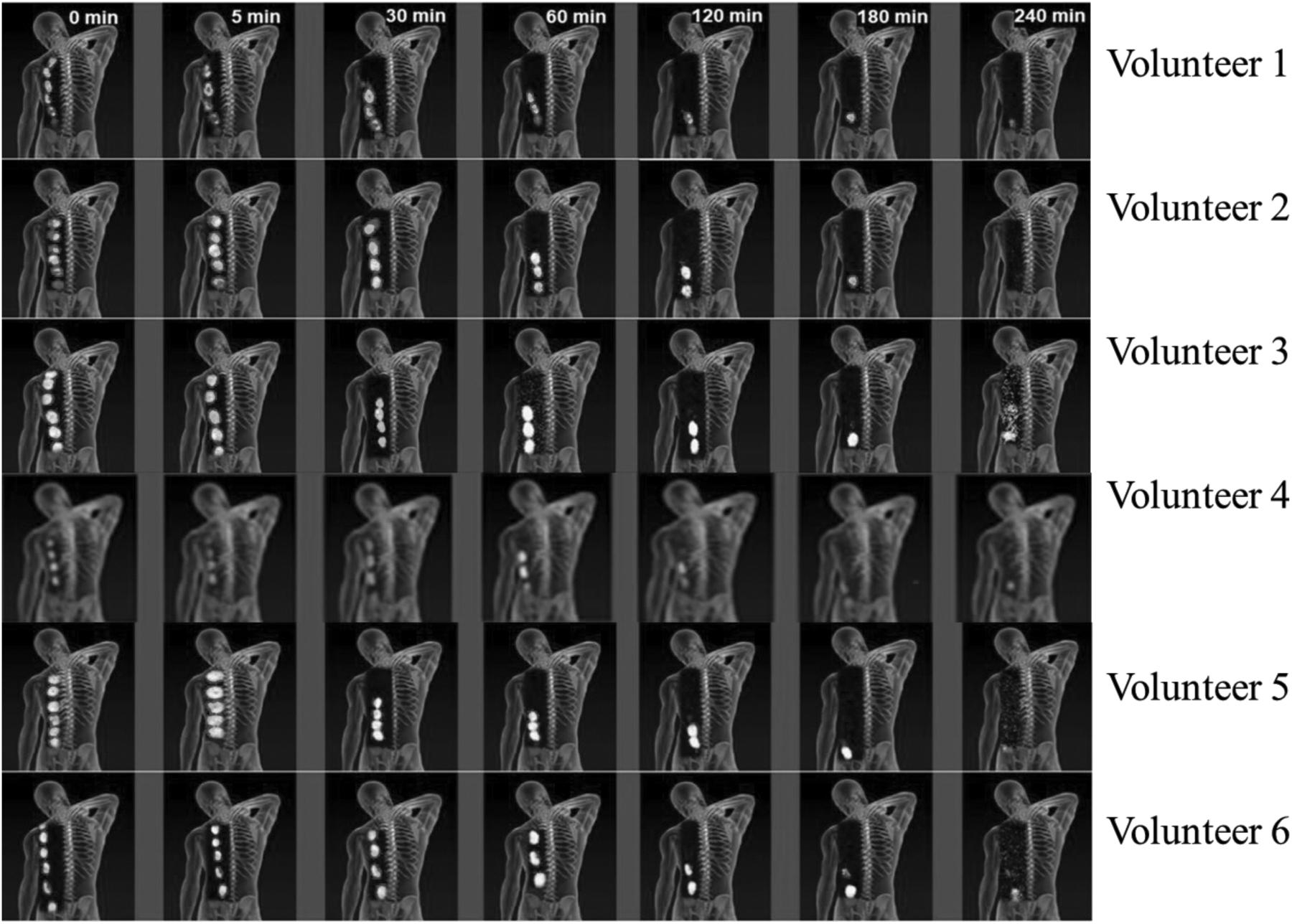
Gamma scintigraphy images indicating the ROI emitted by the applied radiolabeled topical gel formulation (99mTc-NSD) on the back of human volunteers (n = 6) at different times. ROI, region of interest.
Percentage Permeation of Technetium99m-Nimesulide Estimated by Gamma Scintigraphy at Different Time Intervals from the Skin of Healthy Human Volunteers
SD, standard deviation.
DISCUSSION
Although topical delivery has several advantages over other administration methods, the skin's natural barrier function poses a significant challenge for many therapeutics that are given into and through it. Topical formulations are capable of delivering many kinds of therapeutics at different targeting sites of the skin. As per the literature, ∼96 drugs are being used for topical application through different types of formulations, including ointment, gel, solution, and liniment. 11 For successful topical drug delivery, a therapeutic substance must be capable of penetrating the stratum corneum, which possesses barrier characteristics that could prevent topical products from being absorbed by the skin.
However, several strategies have been investigated so far, demonstrating enhanced penetration by overcoming the barrier resistance. Therefore, it is essential to perform an extensive evaluation of topical products to ensure the penetration of therapeutic substance through the stratum corneum and thus permeation into much deeper parts of the skin for therapeutic values. This article describes the gamma scintigraphy-based drug permeation study of prepared gel in human volunteers. 12
The topical gel was prepared by using 99mTc-NSD as a tracer molecule and carbomer 940 as a gelling agent. The pH of the prepared gel was found slightly acidic (5.3 ± 0.063), which is in agreement with the pH requirements for the topical products. The obtained data on pH revealed that the prepared formulation will be nonirritant to the skin after the application and will help to maintain the microbiome, integrity, and health of the skin. 13 Similarly, the viscosity of the prepared gel was also found optimum.
Determination of permeation data is very essential while developing a topical formulation. However, the in vitro permeation data may be compromised due to several factors such as ethical and economic factors causing major problems. Loss of tissue viability and enzymatic activity may further worsen the condition. Therefore, the in vivo methods are gaining more attention as they provide accurate permeation data. Despite the applications, these methods are also inconvenient to human participants due to the involvement of invasive methods for the collection of blood samples. 14 Gamma scintigraphy involves the application of radiopharmaceuticals for the purpose of medical imaging and disease diagnosis. The literature revealed that gamma scintigraphy is also being used for the assessment of many pharmaceutical products such as oral, ocular, pulmonary, and many others. 3,15 With the same objective, the permeation study of 99mTc-NSD gel formulation was conducted in healthy human volunteers by gamma scintigraphy.
Radiolabeling of any product involves the formation of a strong bond between the sample and radioactive material. Generally, 99mTc (as pertechnetate) is used as radioactive material since it has a very low biological half-life (6.06 h), thus eliminating it from the body. 16 The sample to be radiolabeled required to be reduced with the help of SnCl2. In this case, the heptavalent oxidation state of pertechnetate reduces by the SnCl2. However, the amount of SnCl2 as a reducing agent must be optimized for stable radiolabeling, as fewer amounts may cause inefficient labeling, while excess amounts may cause the formation of colloids. 17 The stability study of 99mTc-NSD in saline and serum was determined by ITLC till 24 h of incubation (Table 1). There was a minimum effect of saline- and serum-related factors on the labeling efficiency of 99mTc-NSD, and therefore, the current labeling method may be considered stable for further analysis.
To determine the permeation study of the radiolabeled 99mTc-NSD, gamma scintigraphy was used. To the best of our knowledge, this is the first type of study using gamma scintigraphy for the determination of skin permeation of topical gel formulation. This technique allows the movement to be monitored and quantified. The gamma images and further activity counts from the ROI provided information of permeated drugs after a particular time period. The serial gamma images and activity count of the 99mTc-NSD before and after the application were recorded, and furthermore, the permeated amount was calculated (Fig. 2 and Table 2).
The obtained data revealed time-dependent permeation from 0.32 ± 0.22 to 36.37 ± 2.86%w/w of 99mTc-NSD. The permeation of the radiolabeled drug may be attributed due to the weekly acidic characters (pKa = 6.5) of the NSD. The lipophilic characteristics (partition coefficient: 2.60 and aqueous solubility: 0.01 mg/mL) of the drug make it a suitable candidate for skin permeation.
CONCLUSION
Gamma scintigraphy is a noninvasive tool that involves the radiolabeling of active pharmaceutical ingredients and thus tracking movements after administration/application. This article revealed the application of gamma scintigraphy in the permeation study of topically applied radiolabeled NSD in human volunteers. The study confirms very little effects of saline- and serum-related factors on the labeling efficiency of 99mTc-NSD. Furthermore, 99mTc-NSD showed time-dependent permeation through the human skin. This study concludes that gamma scintigraphy may be a good alternative to traditional in vivo permeation studies, with improved patient compliance.
Footnotes
ACKNOWLEDGMENTS
The authors are thankful to the formulation R&D team, clinical strategy team, and medical team of Dr. Reddy's Laboratory, Hyderabad, India, for providing us with the funds and facilities to carry out this research work.
AUTHORs' CONTRIBUTIONS
N.S.: methodology, investigation, and writing—original draft. K.K.: funding acquisition, conceptualization, supervision, and project administration. N.K.: investigation, formal analysis, and supervision. R.K.: writing—original draft and formal analysis. A.K.J.: software and writing—review and editing. M.S.R.: writing—review and editing and visualization.
DISCLOSURE STATEMENT
No competing financial interests exist.
FUNDING INFORMATION
This project work was supported by DR. REDDY'S LABORATORIES LIMITED Hyderabad, Telangana, India [grant number 1000_2022_90494].