




Abstract
The skin is a dynamic tissue that consists of different layers such as stratum corneum, the site for keratinocyte development and maturation for the natural changeover of skin. In psoriasis, this natural development of keratinocytes gets disturbed and aggregation of nucleated keratinocytes takes place in the epidermis of the skin, leading to the presence of scaly skin, which makes the patient physically, socially, and psychologically ill. Various natural, semisynthetic, and synthetic treatments are available. Still, semisynthetic or synthetic are mainly used to treat psoriasis with side effects on different parts of the body, which is life threatening. Various molecular target sites are getting upregulated such as Janus kinase/Signal transducer and activator of transcription (JAK/STATs), phosphodiesterase 4 (PDE4), mitogen-activated protein kinase (MAPK), platelet selectin (Pan Selectin), Tumor Necrosis Factor Alpha (TNF-α), Interleukin-23 (IL-23), Interleukin-17 (IL-17), and Tyrosine Kinase 2 (Tyk2) in psoriasis. Plants and their bioactive compounds of flavonoids, alkaloids, resins, tannins, glycosides, and terpenoids category are used in the treatment of psoriasis as topical, oral, and biological forms. Using a computational approach, the inhibition of these molecular targets can be studied and potential molecules can be identified. This research article aims to find out the potential molecules that can inhibit the molecular sites and are effective than synthetic ones.
INTRODUCTION
Psoriasis is a deliberating disease that affects nearly 0.5%–1.5% (2.5 million) of the Indian population according to the World Psoriasis Day consortium. It is a chronic skin disease with a significant impact on the different parts or organs of the body such as the gastrointestinal tract, kidney, and eyes are inflamed. 1 It makes the person physically, socially, and psychologically ill. The person affected with psoriasis has low self-esteem and is unable to communicate with society due to their appearance. Recent advancements suggest that immune dysregulation contributes to the inflammation in psoriasis, leading to redness, swelling, pruritis, and scaly skin on the body. Various approaches are used in the treatment of disease but not effective as needed. The inhibition of JAK/STATs, PDE4, MAPK, Pan Selectin, TNF-α, IL-23, IL-17, IL-7, Tyk2, and IL-1 receptors will lead to slow down the upregulated inflammatory molecules to settle down. Topical therapy, ultraviolet (UV)-light treatment, and systemic medication are available for the prevention of disease. Calcineurin inhibitors, retinoids, corticosteroids, vitamin D, anthralin, salicylic acid, coal tar, and moisturizers are the first line of topical therapy in the prevention of acute or initially started psoriasis. Excessive use of vitamin D analogs leads to skin irritation and an increase in inflammation rate. UV-A&B light or both simultaneously are used in the therapy, but long-term therapy causes skin cancer in persons. Corticosteroids may cause bone deformation in the body, whereas systemic medication such as immunosuppressants (cyclosporin, methotrexate) have liver and pancreatic cancer as side effects. 2,3 All these treatments have shown limitations on various parts of the body. So, there is a need for herbal plants or their bioactive compounds in treating psoriasis, as more potent and effective in inhibition of molecular targets. The inflammatory molecules such as TNF-α, IL-23, IL-17, Tyk2, and MAPK get actuated due to the triggered JAK/STAT pathway, and these inflammatory molecules initiated the arachidonic acid pathway, leading to an increased rate of inflammation simultaneously. Several studies have reported the role of numerous plants with biological activity in treating skin diseases such as Pithecellobium dulce (daidzein), Veratrum grandiflorum (resveratrol), Hypericum perforatum (hypericin), Camellia sinensis (chlorogenic acid), Reseda luteal (luteolin), Wrightia tinctoria (Lupeol), Citrus paradisi (naringin), and Salvia miltiorrhiza (salvianolic acid) 4 –11 (Fig. 1.). Furthermore, these phytoconstituents exhibit anti-inflammatory, antioxidant, antibacterial, and antiviral activity. The in silico approach toward the receptors involved in the activation of inflammatory mediators has allowed finding the best chemical entity that sparks off the target molecule more effectively and pharmacologically. Computational analysis of molecular targets and ligands shows the interactions, affinity, and best conformation of binding at the protein site as it is less time-consuming and cost-effective. 12 Docking allows researchers to screen large libraries of compounds quickly, identifying those most likely to bind effectively to the target, which is more efficient than experimental methods. It assists in predicting the behavior of compounds in biological systems, aiding in the development of safer and more effective therapeutics. This research study aims to find whether the various bioactive molecules such as flavonoids, alkaloids, tannins, resins, and the like have the property to inhibit the inflammatory pathway and other responses that prevent psoriasis. Nowadays, the World Health Organization is also promoting herbal drugs that are beneficial, safe, and may be used in the prevention of psoriasis.

Structures of phytochemical compounds:
Pathophysiology
Psoriasis is an immune-mediated inflammation that leads to excessive keratinocyte production and the formation of psoriatic plague. It is still unclear what triggers the immune dysregulation, but the process is now clear to understand that it involves the participation of T lymphocytes and several specific cytokines expressed. 13 To become activated, the T cell undergoes a multistep process that includes interaction with other cell types. The inflammatory process is thought to begin when an antigen-presenting cell such as a dendritic cell (DC) is activated by an antigen present in the skin. The DCs travel to the lymph nodes, where they interact with new T cells and a process that involves antigen presentation as well as necessary coast inflammatory signals. 14 The process results in the transformation of T cells into activated memory T cells because it remembers the T-cell antigens to which it is exposed. Next, phagocytic cell proliferation and migration of T cells through the circulation to the site of inflammation in the skin happen. 15 During this phase, migration and trafficking of the cell to the bloodstream involve additional molecules such as ICAM-1, following T-cell extravasations into the skin. Other immune molecules such as cytokines play an important role in the inflammatory cascade. The chemical messenger TNF-α and IFN-γ are secreted by memory T cells leading to hyperproliferation and subsequent formation of psoriatic plague. In addition, JAK/STATS are phosphorylated and the process of transcription starts, which perpetuate the inflammatory process 16 (Fig. 2).
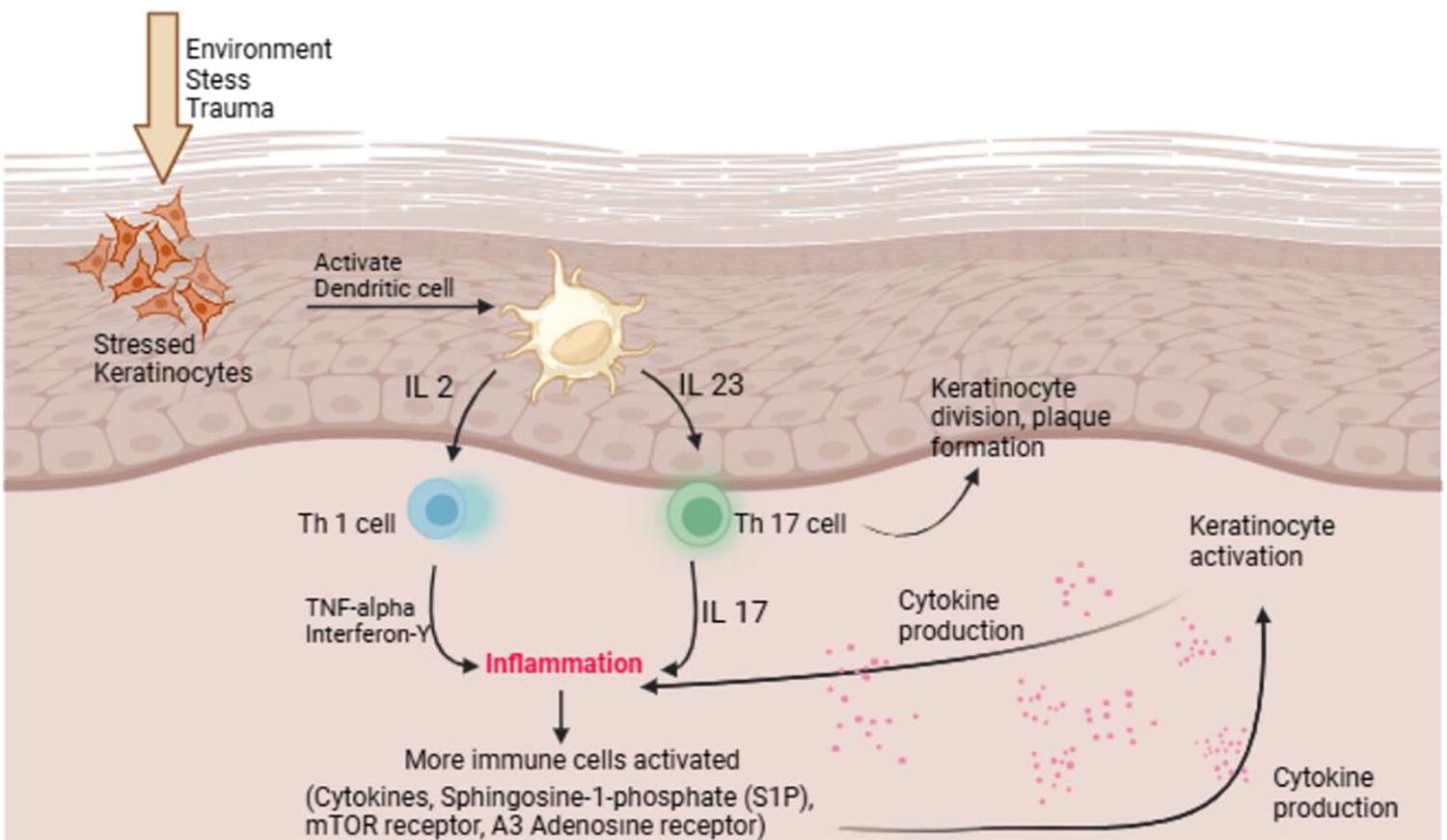
Pathophysiology of psoriasis showing stressed keratinocytes activation with cytokine production resulting in redness, swelling, pruritis, and scaly skin.
Molecular Targets
JAKs are typically associated with type I and II cytokine receptors. When a cytokine binds to its receptor, it induces receptor dimerization, allowing JAKs to phosphorylate each other and activate downstream signaling pathways and activators of transcription (STAT) pathway, which then translocate to the nucleus to regulate gene expression. The JAK family consists of four members: JAK1, JAK2, JAK3, and Tyk2 17 (Fig. 3). Each kinase has a distinct but overlapping role in mediating signal transduction. Inhibition of these targets decreases the rate of inflammation, as well as the recovery process is initiated. Other receptors such as A3 adenosine receptors also play a vital role in downregulation of NF-κB signaling pathway and pro-inflammatory cytokines such as TNF-α, IL-23, and IL-17. 18,19 mTOR receptor is a regulator of epidermal homeostasis role in the innate and adaptive immunity. 20 Increased expression of mTORC1 increased proliferation of keratinocytes and decreased differentiation of cells. 21 Sphingosine-1-phosphate (S1P) is involved in cell proliferation, survival, migration, inflammation, and angiogenesis. S1P inhibits the keratinocyte proliferation and increases cell differentiation. 22 These receptors get triggered due to the upregulation of JAK/STAT mechanism (Fig. 2). Table 1 presents bioactivity scores of molecules that suggest that targeting these receptors inhibits the inflammatory pathways. The bioactivity scores of the compounds help to analyze the drug-binding ability to various human receptors. The bioactivity scores of the selected 10 compounds were predicted by Molinspiration tool. The predicted scores of the compounds against several receptors are shown in Table 1, indicating that the scores were in the range of −5 to 0.0 showing the moderate activity of these compounds against the receptors. Some compounds showed scores close to 0, indicating good activity against the receptors. The analysis revealed that the selected compounds have the properties of lead compounds.

Molecular targets of IL-6, IL-23, and IL-17 with upregulated receptors on activation of JAK/STATS pathway.
Predicted Bioactivity Scores of the Selected Compounds Against Different Human Receptors
MATERIALS AND METHODS
Molecular Docking
Docking is an automated computer algorithm that determines how a compound will bind in the active site of the protein. This includes the orientation of the compound, its conformational geometry, and the scoring. Every docking algorithm automatically tries to put a compound in many different orientations and conformations in the active site and then computes a score for each.
Protein optimization and minimization
Crystal structures of proteins JAK1, JAK2, JAK3, PDE4, MAPK, IL-17, IL-23, Tyk2, and TNF-α (PDB ID: 5HX8; 3UGC; 4HVD; 6INK; 5EKO; 7AMA; 3D85; 3LXP; 2AZ5) were taken with a resolution of 1.3–2.5 Å and Homo sapiens as the organism from protein data bank (PDB) (Table 2 and Fig. 4). The following process was default such as selecting the option to assign bond order, using the CCD database, adding hydrogens, creating zero-order bonds to metals, creating selenomethionines to methionine, deleting water beyond 5.00 Å from hetero groups and generating het states using Epik pH: 7.0 ± 2.0 (Using Schrodinger Suite 2022–3). 23 After selecting these processes, the protein was selected for pre-processing and modification option; optimization of the protein is done by PROPKA followed by energy minimization using forcefield OPLS4.
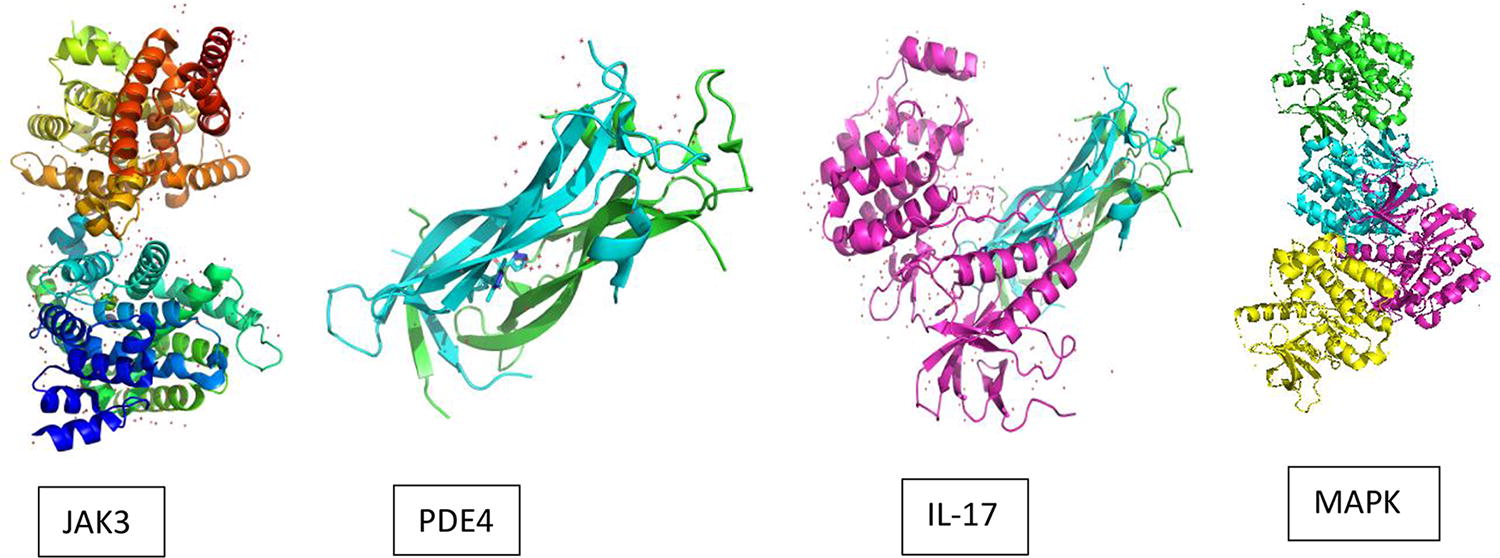
Overview of 3D structures of proteins retrieved from protein data bank (JAK3, PDE4, IL-17, MAPK with PDB ID: 4HVD, 6INK, 7AMA, 5EKO).
Protein IDs Targeting Receptors
Ligand preparation
The compounds were retrieved in sdf format from the PubChem database (Database, 2024) to prepare the ligands salvianolic acid PubChem CID:5281793; hypericin PubChem CID:3663; luteolin PubChem ID:5280445; naringin PubChem ID:442428; resveratrol PubChem ID:445154; daidzein PubChem ID:5281708; chlorogenic acid PubChem ID:1794427; rottlerin PubChem ID:5281847; lupeol PubChem ID:259846; and tofacitinib PubChem ID:9926791 (Fig. 1) for ADMET and docking studies. They were converted from 2D to 3D structures by including stereochemical, ionization, and tautomeric variations, as well as energy minimization, and were optimized for their geometry, desalted, and corrected for their chirality and missing hydrogen atoms. The bonds’ orders of these ligands were fixed and the charged groups were neutralized. The ionization and tautomeric states were generated between a pH of 6.8 and 7.2 using the Epik module. 24 In the final stage of LigPrep, compounds were minimized.
Active site generation
The 3D structure of protein has been complexed with inhibitor at PDB database. The database provides the active site amino acid of the receptor protein with the complex inhibitor attached with the protein. If there is no complex inhibitor binding to the protein, then a sitemap analysis is done to determine the active site at protein. In this study, a structure-based method was used to determine the active sites. 25
Site mapping
If the protein molecule is not bound to any other complex at the active site, there is a need to analyze the active site on protein using site map analysis. Site map analysis provides fast, accurate, and intuitive binding site identification. It helps to visualize binding sites easily; identify regions within the binding site suitable for occupancy by hydrophobic groups or by ligand hydrogen-bond donors, acceptors, or metal-binding functionality; and distinguish different binding site subregions, which allows for ready assessment of a ligand’s complementarity (Fig. 5).

Schematic representation of site mapping at protein for active site analysis of TNF-α protein (2AZ5).
Receptor grid generation
After the preparation of the protein and ligand, the grid is generated at the active site of the protein. In receptor grid generation, the option of picking to identify the active site present already or developed by site mapping is selected, and the process to run starts for the generation of the grid. The processed structure was subjected for grid generation by selecting the predicted binding site residues. The X, Y, and Z coordinates of generated grid were 24.03, 2.80, and −25.75, respectively. Grid generation prepares the protein structure with appropriate bond order and formal charges 26 (Fig. 6).

Representation of grid generation at protein for binding pocket attachment of ligand.
Receptor docking analysis
Before the docking analysis of bioactives, several parameters/properties were investigated (using SwissADME, a web tool); for instance, whether it follows Lipinski’s rule of five (Table 1). All proteins were docked against salvianolic acid, hypericin, luteolin, naringin, resveratrol, daidzein, chlorogenic acid, rottlerin, lupeol, and tofacitinib to find out the binding affinity and type of interaction among them. Docked score and glide scores of bioactives represent the binding energy as well as amino acid residue bound with protein moiety (Figs. 6 and 7). 27,28
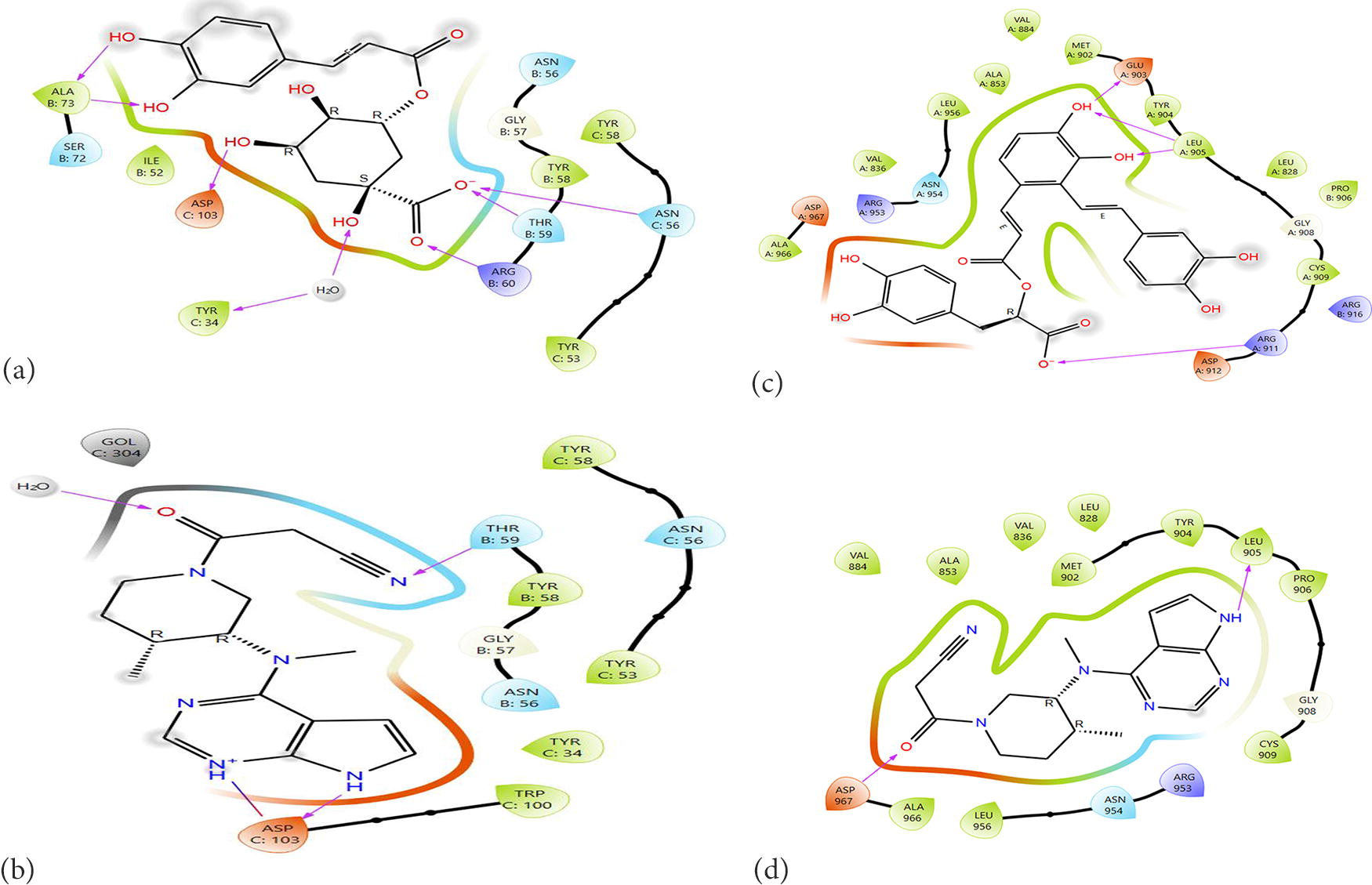
2D molecular interaction of phytochemicals
Phytochemical retrieval
Phytomolecules are taken from Pubchem, and other evaluations such as Lipinski’s rule of five (molecular weight, log P, HBA, HBD, and molar refractivity) of molecules were evaluated using SwissADME software (Table 3): Molecular weight <500 Da; hydrogen bond donors: donor HB <5; acceptor HB <10; and predicted octanol–water partition coefficient: QPlogPo/w <5), with observed violations. 29 Drug candidates exhibit poor absorption when their topological polar surface area (TPSA) is higher than 140 Å, which is benchmarked for marketed drugs. TPSA has a positive correlation with mass, and the molecules with a mass higher than 500 g/mol were observed to have TPSA beyond the range of 0–140 30 (Table 1). The log p-value and Abbott bioavailability score of >0 indicate that the phytochemicals have a substantial bioavailability and cross the cell membrane efficiently. It is important to investigate the interaction between the transporter protein and the drug molecule. It limits cellular uptake and metabolism of compounds by acting as a unidirectional efflux pump to extrude its substrate from inside to outside of cells. From Table 2, it can be seen that all of the phytochemicals except hypericin, rottlerin, and naringin were not substrate, demonstrating their desirable properties as potential therapeutic agents.
Drug Likeness Properties of Phytochemicals
TPSA, topological polar surface area.
RESULTS AND DISCUSSION
Docking of the phytoconstituents against JAK/STATs protein has strong binding affinity of −9.587 kcal/mol, and upregulated receptors PDE4, TNF-α, MAPK, IL-17, TYK2, and IL-23 were also inhibited by bioactives with a binding energy of −8.556, −8.511, −4.821, −7.652, −7.524, −6.544, and −5.304 kcal/mol, respectively (Table 4). Among them, luteolin generates 3-hydrogen (H) bonds leu959, glu957, and glu966; salvianolic acid forms 4-H bonds gly1020, glu957, arg879, and pro960; tofacitinib has 1-H bond glu957 (Fig. 8d); daidzein has 1-H bond leu959; resveratrol generates 2-H bonds pro960 and glu957 (Fig. 8c); chlorogenic acid has 5-H bond interactions arg879, leu881, leu959, glu957, and lys870; naringin forms 2-H bonds arg1007 and arg87; and rottlerin also has 2-H bond interactions arg879 and pro960 with JAK1 protein. With JAK2 protein, daidzein forms 3-H bonds gln553 (Fig. 8b), val629, and gol903; salvianolic acid has 4-H bonds glu627, gln553, leu551, and glu549; resveratrol, hypericin, and luteolin generate 2-H bonds gln553 and val629; naringin forms 5-H bonds glu627, ser550, leu551, phe631, and ser633; chlorogenic acid forms 4-H bonds gln553, leu551, glu627, and val629; rottlerin forms 1-H bond val629; and tofacitinib generates 2-H bonds glu627 and val629. With JAK3 protein, salvianolic acid generates 3-H bonds glu903, leu905, and arg911 (Fig. 7c); hypericin has 2-H bonds leu905 and arg916; luteolin and resveratrol form 1-H bond leu905; naringin has 3-H bonds asp967, asn954, and asp912; daidzein has 2-H bonds glu903 and leu905; chlorogenic acid generates 6-H bonds glu903, leu905, arg916, arg911, arg953, and arg912; and tofacitinib forms 2-H bonds leu905 and asp967 (Fig. 7d). Furthermore, with PDE4 protein, salvianolic acid, daidzein, naringin, and rottlerin generate only 1-H bond gln369 and asn321; luteolin has 2-H bonds gln369 and asn321; resveratrol has 1-H bond asn321; hypericin forms 1-H bond met273; tofacitinib and chlorogenic acid have 1-H bond gln369; and lupeol has 1-H bond met102. And with IL-23 protein, naringin generates 2-H bonds gln184 and ser183; daidzein has 1-H bond tyr114; resveratrol has 2-H bonds tyr114 and ala180; rottlerin and lupeol form 1-H bond ser183; luteolin generates 3-H bonds gln53, glu173, and cyc177; salvianolic acid forms 7-H bonds gln53, tyr114, arg159, ala152, arg208, leu184, and gln144; hypericin has 3-H bonds glu181, glu173, and ser175; and tofacitinib forms 3-H bonds gln181, ser183, and gln144. With MAPK protein, salvianolic acid generates 4-H bonds pro108, met110, ser53, and asp168; daidzein, luteolin, and resveratrol form 1-H bond phe169; chlorogenic acid has 2-H bonds lys54 and phe169; naringin forms 2-H bonds asp168 and lys54; and rottlerin and tofacitinib have 1-H bond asp168. Furthermore, with IL-17 protein, salvianolic acid forms 2-H bonds ile115 and trp67; chlorogenic acid and resveratrol have 1-H bond leu97 (Fig. 8a); luteolin and daidzein form 1-H bond with ile115 and trp67; naringin generates 2-H bonds lys114 and glu95; rottlerin and tofacitinib form 2-H bonds with trp67, lys114, and leu97. With TYK2 protein, luteolin has 4-H bonds arg182, ala100, ser52, and asn54; resveratrol forms 3-H bonds arg179, gln183, and asp53; naringin generates 5-H bonds arg56, asp55, asn54, ser52, and arg30; salvianolic acid forms 5-H bonds arg182, arg179, ala100, asp55, and ser52; daidzein has 2-H bonds arg179 and asn54; chlorogenic acid forms 3-H bonds arg182, asp93, and arg30; tofacitinib also forms 3-H bonds asn182, ser52, and asn54; hypericin has 3-H bonds met104, asp55, and arg179; and rottlerin forms 2-H bonds gly103 and arg179. At last with TNF-α, salvianolic acid forms 3-H bonds asp103, asn56, and tyr53; resveratrol, daidzein, and lupeol form 1-H bond with tyr34, tyr23, and thr59; luteolin has 3-H bonds asp103, tyr53, and asn56; chlorogenic acid forms 6-H bonds asn56, thr59, arg60, tyr34, asp103, and ala73 (Fig. 6a); tofacitinib and naringin form 2,3-H bonds with thr59, asp103 and thr59, and asp32 and asp103 (Fig. 7b); tofacitinib, a Food and Drug Administration–approved drug widely used in treatment of psoriasis with binding amino acid residue glu957, glu627, val629, leu905, a sp967, gln369, gln181, ser183, gln144, asp168, leu97, lys114, asn182, ser52, asn54 and thr59, asp103 against JAK1, JAK2, JAK3, PDE4, IL-23, MAPK, IL-17, Tyk2, and TNF-α receptors. The above bioactives have also shown binding with the same amino acid residue that confirms their potency and effectiveness toward receptors. The phytoconstituents have shown precise interaction with the target site than tofacitinib (more number of H bonds). From this study, the JAK/STAT pathogenesis and inflammatory mediators upregulated were inhibited at the target site, so the rate of pruritis, redness, and scaly skin should be prevented further. Herbal bioactive compounds have affinity and potency to prevent psoriasis. More derivatives of these bioactives can be derived and studied for various formulations followed by a clinical analysis for prevention and treatment of psoriasis.

3D molecular interaction of phytochemicals
Docking Study of Phytochemicals with JAK3, Tyk2, IL-17, JAK-2, JAK-1, PDE4, IL-23, MAPK, and TNF-α Receptor
ADMET Analysis
The primary goals of ADMET properties are to minimize attrition during the last stage of compound design and to maximize screening by identifying the most promising compound. A molecule is deemed good if its absorbance is >30%, and it is termed low permeability if its permeability is >2.5. Drugs that target the central nervous system must penetrate the blood–brain barrier in order to reach their target molecules. The brain is less likely to distribute molecules with logBB <−1 than those with logBB >0.3. 31 Drug clearance is mostly caused by a mixture of hepatic clearance and is quantified by proportion constant CLot. The anticipated overall excretion of a substance expressed in log(mL/min/kg). When developing new drugs, one of the main concerns is drug-induced liver toxicity. 32 A molecule is expected to cause liver toxicity if it contains at least one severe liver dysfunction. 33 During clinical phase I, the recommended starting dose should not exceed 0.477 log (mg/kg/day) as the maximum tolerated dose. The goal of long-term research is to determine the minimum concentration of a substance required to cause an observed side effect. The estimated log lowest observed adverse effect level for a particular chemical will be produced in log (mg/kg _ bw/day) 34 (Table 5).
ADMET of Molecule Pertaining to Skin Absorption, Intestinal Absorption and Excretion Rate from the Body
The ADMET analysis suggests tofacitinib to have an intestinal absorption rate of 93.56% but poor first pass metabolism as well as hepatotoxicity. Tofacitinib also has maximum tolerated dose in much high concentration, that is, −0.331 log mg/kg/day. 35 In contrast, chlorogenic acid, salvianolic acid, daidzein, resveratrol, and luteolin have good absorption rate with no toxicity to liver. Toxic dose threshold of chemicals in human range: MRTD ≤0.477 is considered low; if ≥0.477, it should be high, that is, bioactives are the least toxic as well 36 (Table 5).
CONCLUSION
From the present study, it was seen that the bioactive compounds chlorogenic acid, salvianolic acid, daidzein, resveratrol, and luteolin are potent and have shown much effectiveness in inhibiting the JAK/STATs pathway. The molecules such as hypericin, naringin, and rottlerin have shown strong binding with the receptor but do not follow the Lipinski’s rule of five; therefore, they may or may not be able to show the same interaction with the target as shown. Screening of such types of molecules is necessary to prohibit further study. Other biological compounds can be initialized for further study based on the docking study performed. In silico ADMET study of the following compound illustrate, their potency as well as least toxicity. The above molecules have no hepatotoxicity, and the intestinal absorption rate is mild to moderate in range, which gives an idea about their oral route administration but poor skin permeability rate (cannot be given topically). These bioactive compounds can be further studied for in vitro analysis, as well as many potent compounds can be designed from these herbal bioactive compounds, which can be a prototype in the prevention of psoriasis.
Footnotes
AUTHORS’ CONTRIBUTIONS
L.S.R.: Conceptualization, resource, visualization, and writing work—original draft. D. Sahu: Methodology, investigation docking approach, and software-based data validation. M.S.: Writing—supervision, reviewing and editing. D. Singh: Supervision, validation, writing—reviewing and editing, and visualization.
DISCLOSURE STATEMENT
The authors have no conflict of interest.
Funding INFORMATION
No funding was received for this article.