




Abstract
To optimize the formulation of docetaxel–zedoary oil magnetic solid lipid nanoparticles (DTX-ZTO-MSLN) using central composite design-response surface methodology. First, the formulation and preparation process of DTX-ZTO-MSLN were optimized via design-response surface methodology. The appearance, particle size, thermogravimetric, pH, iron content, magnetic strength, and in vitro drug release of DTX-ZTO-MSLN were subsequently examined. Finally, the antitumor effect of DTX-ZTO-MSLN on MCF-7 breast cancer cells was measured via the 3-[4,5-dimethylthiazol-2-yl]-2,5 diphenyl tetrazolium bromide (MTT) assay. The optimized formulation was as follows: the mass ratio of soybean phospholipid to poloxamer 188 was 0.34, the mass ratio of DTX-ZTO to glycerol monostearate was 3.23, and 29.42 mL of water was used. The DTX-ZTO-MSLN prepared by the optimized method was clear and transparent, with good stability, with an iron content of 7.38%, and a saturation magnetization intensity of 7.05 A·m2·kg−1. The in vitro drug release was consistent with the Weibull model (R2 = 0.9992). Compared with zedoary turmeric oil and docetaxel, DTX-ZTO-MSLN had a much greater inhibitory effect on MCF-7 cells (p < 0.05). The optimized DTX-ZTO-MSLN meets the quality requirements for nanoemulsions. This study provides a theoretical basis for developing and applying DTX-ZTO-MSLN.

INTRODUCTION
Breast cancer is the most prevalent malignant tumor in women. It has the second highest incidence rate in the world, 1 and it accounts for 15% of mortality from female cancers, seriously threatening the lives and health of women and dramatically affecting the economy, society, and families. Current drug options are still dominated by traditional chemotherapeutic agents such as paclitaxel. Paclitaxel analogs constitute the cornerstone of breast cancer treatment, and docetaxel (DTX) is a second-generation paclitaxel analog. 2 DTX currently plays a vital role in the comprehensive treatment of breast cancer: 3 it inhibits the proliferation and differentiation of tumor cells by promoting the polymerization of tubules into stable microtubules, reducing the number of tubules, and destroying the structure of the microtubule network of tumor cells. 4 Thus, it is an M-cycle-specific drug with a wide range of antitumor effects, and it is used for the treatment of breast cancer, ovarian cancer, gastric cancer, lung cancer, and other tumors. 5 However, DTX also has many adverse effects, such as myelosuppression, decreased immune function, diarrhea, and even patient death; in addition, drug resistance and the poor solubility of DTX seriously impede its clinical application. 6 Most weakened patients are forced to give up chemotherapy because of its adverse effects, especially myelosuppression. 7 The challenge of decreasing adverse effects and improving the success rate of chemotherapy is of great interest in the current research on breast cancer. The addition of traditional Chinese medicine is a promising approach.
Chinese medicines have relatively low toxicity, and combining them with chemotherapeutic drugs would be a feasible way to improve the therapeutic effect. In terms of the theory of traditional Chinese medicine, the treatment of breast cancer is mainly based on “promoting blood circulation” and “strengthening body resistance.” 8 Zedoary turmeric is a representative herbal medicine that promotes blood circulation and removes blood stasis. Modern pharmacological research has shown that zedoary turmeric oil (ZTO), as the main active ingredient of Curcumae rhizoma, can increase the microcirculation perfusion of the breast, increase the efficiency of contact between drugs and immune-active cells in the body with tumor cells, and promote the apoptosis of breast cancer cells. The main bioactive components from ZTO are zedoary diketone, zedoaryl alcohol, gimarone, and pinene, 9 –11 which have multitargeted antitumor effects such as direct killing, regulating immune function, and inducing apoptosis in a wide range of malignant tumors, including breast cancer and hepatocellular carcinoma. More importantly, ZTO has a strong “strengthening” effect, increasing white blood cells, improving myelosuppression, and enhancing body immunity. This study examined ZTO as a way to counteract the adverse effects such as myelosuppression caused by DTX in breast cancer treatment.
A preliminary study revealed that the combination of DTX and ZTO had significant toxicity-reducing and efficacy-enhancing effects on breast cancer compared with the single-treatment group. The combination strategy not only alleviated the side effects of DTX on myelosuppression but also increased the effect of treatment on breast cancer from the perspective of promoting blood circulation, removing blood stasis, and strengthening body resistance.
The combined application of DTX and ZTO can achieve a targeted synergistic effect, which has good application prospect. 12 However, no nanodelivery system combining DTX and ZTO has been developed yet. Nanocarrier drug delivery systems are a new field of nanotechnology that has received extensive attention from researchers in recent years because of their great potential in tumor therapy. Common nanocarriers include poly(lactic-co-glycolic acid (PLGA), liposomes, carbon nanotubes, and micelles. These nanocarrier systems can protect the drugs encapsulated in them from premature release in vivo and significantly increase the stability of the encapsulated drugs. 13 Moreover, nanocarrier drug delivery systems can improve the bioavailability of drugs by aggregating in solid tumor tissues through the enhanced permeability and retention effect. However, some studies have shown that nanoparticles are very limited in human tumor tissues, making it difficult for nanoparticles to be effectively enriched in tumor sites. How nanoparticles can be specifically targeted to tumor tissues and caused to accumulate there is a problem that needs to be solved by nanocarrier drug delivery systems. 14
In recent years, magnetic solid lipid nanoparticles (MSLNs) have been effectively applied as a novel targeted drug delivery system in cancer therapy. 15 MSLNs are a carrier preparation made by loading drugs and magnetic substances into solid lipid nanoparticles. Under the action of an external magnetic field of a particular strength, the drugs are localized in the target area, concentrated, and released to exert a therapeutic effect at the lesion site. This approach offers high efficiency, quick action, low toxicity, and directional control of the target site to enhance the drug targeting. 16 MSLNs have the potential for biomedical applications because of their unique size and physicochemical properties, which offer significant advantages. Magnetically controlled drug delivery by MSLNs has been used as an alternative to chemotherapy. Iron oxide (Fe3O4) nanoparticles are widely used because of their proven biocompatibility and low toxicity. Therefore, to increase the targeting of the DTX-ZTO conjugate drug, this study prepared DTX-ZTO-MSLN from ZTO and DTX via the emulsified ultrasound method. The preparation agent not only solved the insolubility of DTX and the volatility ZTO by wrapping them stably but also enhanced the targeting of the preparation. 17 This preparation can achieve precise drug targeting, reduce toxicity, and increase efficacy in the treatment of breast cancer. The preparation process was optimized by central composite design-response surface methodology, and a rat breast cancer model was established to explore the in vivo antitumor activity of DTX-ZTO-MSLN, providing a reference for further DTX-ZTO-MSLN studies.
MATERIALS AND METHODS
Instruments
High-performance liquid chromatography LC-1000D system, Agilent TC-C18 column (Agilent Technologies Inc., USA); 1 in 100,000 precision balance (METTLER TOLEDO GROUP); 85-2 thermostatic stirrer (Changzhou Guohua Electric Appliances Co., Ltd.); FJ200S hand-held homogenizer (Shanghai Li-Chen Banshi Instrument Technology Co., Ltd.); JEM-1400 Transmission Electron Microscope (Nippon Electron Co., Ltd.); JY96-IIN Ultrasonic Cell Pulverizer (Shanghai HUAN Analytical Industrial Co., Ltd.); Nano Particle Size Meter (Malvern, UK); Ohaus ST5000 Laboratory PH Meter (Shijiazhuang Huachen LOTHIAN Biological Laboratory Equipment); Tecan Safire Multi-Functional Enzyme Labeling Instrument (Austrian) TECAN Group); DZ-DSC100A Differential Scanning Calorimeter (DSC) (Nanjing Dazhan Testing Instrument Co., Ltd.).
Main Drugs and Reagents
Curcuma phaeocaulis Valeton (No. 20211005) was purchased from Guangxi Jianshengtang Traditional Chinese Medicine Co., Ltd. and identified as the dried rhizome of Curcuma phaeocaulis Valeton from the family Curcuma longa (Gingeraceae) by Prof. Guo Lina from the Traditional Chinese Medicine Research Laboratory of the School of Pharmacy, Qiqihar Medical College. DTX (No. 20211228) was purchased from Xi’an Xincheng Biological Technology Co., Ltd. α-pinene (No. BCBL6664V), and curcuma diketone (No. 111800-201001), germacrone (No. 111665–201204), curcumol (batch no. 100185-200506), were purchased from Beijing Century Auqo Biotech Co. Ltd. Poloxamer 188 (P188, batch no. GND31621B) was purchased from Nanjing Weier Chemical Co., Ltd. Glycerol monostearate (MG, No. 20200506) was purchased from Hunan Erkang Pharmaceutical Company Limited. PMI1640 culture powder (batch no. 1756825) was purchased from Gibco, Inc. in the United States. MTT (No. 20211101) was purchased from Shanghai Xibao Bio-technology Co., Ltd. DCFH-DA Reactive oxygen ROS fluorescent probe (No. 20221005) was purchased from Xi’an Qiyue Biotechnology Co., Ltd.
Cells
Human breast cancer cells MCF-7 (NO. 20211209) were purchased from Shanghai Yiran Biotechnology Co.
Experimental Animals
Seventy-five female, nonpregnant, specific pathogen free (SPF)-grade SD rats (200 ± 20) g were purchased from Liaoning Changsheng Biological Co. Ltd, with production qualification certificate No. SCXK (Liao) 2020-0001. All experiments complied with the regulations on the management of experimental animals at Qiqihar Medical College and the Guidelines for the Management and Use of Experimental Animals. This experiment was approved by the Ethics Committee of the Animal Experimentation Center of Qiqihar Medical College with the approval number QWU-AECC-2022-13.
Preparation of DTX-ZTO-MSLN 18
On the basis of single-factor experiments and related literature, the preparation was carried out via the emulsified ultrasonic dispersion method. First, specified amounts of MG, DTX, and ZTO were weighed, and the appropriate amount of magnetic nano-Fe3O4 dissolved in anhydrous ethanol was added as the oil phase. For the aqueous phase, the specified amounts of PC and P188 were dissolved in ultrapure water. An emulsion was obtained by dropping the oil phase into the aqueous phase under heating and stirring. The emulsion was then processed with an ultrasonic cell crusher for 8 min to obtain DTX-ZTO-MSLN. ZTO solid lipid nanoparticles were prepared via the same process as DTX-ZTO-MSLN.
Determination of Main Components
Chromatographic conditions
Chromatographic column: Agilent TC-C18 column (4.6 × 250 mm, 5 μm). Mobile phase: acetonitrile (A) water (B) solution gradient elution, elution program: 0–10 min 0%→80%A, 10–20 min 80%A, 20–30 min 80%→100%A; wavelength: 210 nm; flow rate: 1 mL·min−1; column temperature: 25°C.
Preparation of control solution
First, 11.0 mg of curdione, 7.8 mg of curcumol, 15.0 mg of germacrone, 10 μL of α-pinene, and 10.0 mg of DTX were weighed and placed in a 5 mL volumetric flask, methanol was added to attain the appropriate volume, and the mixture was shaken well to obtain the mixed control solution.
Specificity test
Under the chromatographic conditions designated “2.2.1,” the mixed control solution described in “2.2.2” was analyzed. The theoretical plate number of each component was >3,500. In accordance with the method described in “2.1,” DTX-ZTO-MSLNs were prepared and emulsified to obtain the test solution, which was analyzed similarly.
Examination of linearity
The mixed control solution was aspirated into a measuring flask and diluted step by step with pure methanol to obtain a series of mass concentrations of the mixed control solution. Samples of each were injected, the peak area of each control was recorded. Horizontal coordinate (X) is the mass concentration, and vertical coordinate (Y) is the peak area.
Precision
Under the chromatographic conditions “2.2.1,” the same mixed control solution was injected continuously for a total of 6 cycles, the peak area was recorded, and the relative standard deviation (RSD) value was calculated.
Stability test
According to the chromatographic conditions under “2.2.1,” the test solution was injected into the sample at 0, 2, 4, 8 and 12 h, and the peak area was recorded.
Repeatability test
Six portions of DTX-ZTO-MSLN solution were taken, the emulsions were broken with methanol ultrasonication, and the concentrations of the five components were determined again under the chromatographic conditions “2.2.1.”
Recovery experiment
Samples of the DTX-ZTO-MSLN solution (1 mL) were precisely pipetted, and high, medium, and low concentrations of the five control solutions were added, and then methanol was added to break the emulsion. The samples were injected, and the peak area was recorded. The spiked recoveries and RSD values were calculated for each compound.
Determination of Encapsulation Rate and Drug Loading Capacity
The DTX-ZTO-MSLN encapsulation rate and drug loading capacity were determined via ultrafiltration centrifugation. DTX-ZTO-MSLN was placed in an ultrafiltration tube (100 kDa) and centrifuged at 3,000×g. The high performance liquid chromatography (HPLC) results for the filtrate were recorded as Wfree, the total amount of DTX-ZTO-MSLN drug used was Wtotal, and the amount of excipient used was Wex. The encapsulation rate and drug loading were calculated according to Equation (1) (2).
Process Optimization
Single-factor investigation
The ratio of PC to P188 was as follows: DTX-ZTO-MSLN was prepared according to the method “2.1,” and the ratios of PC to P188 were set to 0.1, 0.2, 0.4, 0.6 and 0.7, respectively. The other conditions were fixed.
The ratio of drug to MG was as follows: DTX-ZTO-MSLN was prepared according to the method “2.1,” and the ratios of drug to MG were set to 1.5, 2.5, 3.5, 4.5, 5.5, and the other conditions were fixed.
Water dosage: DTX-ZTO-MSLN was prepared according to the method “2.1.” The amount of ultrapure water added was 10, 20, 30, 40 and 50 mL, respectively, and the other conditions were fixed.
Power: The effect of the ultrasonic cell crusher on the particle size was investigated at the same crushing time with powers of 300, 400, 500, 600 and 700 W, respectively.
Determination of factor levels
On the basis of relevant references and previous single-factor experiments and pre-experiments, 19,20 the ratio of DTX-ZTO drug dosage to MG, the value of Km (Km is the ratio of emulsifier PC to coemulsifier P188), and the proportion of water, the three factors with the most significant effects on the properties of solid lipid nanoparticles, were selected as the objects of investigation. Five levels were set for each factor, and a three-factor, five-level central composite design-response surface methodology was used to optimize the formula (Table 1).
Factor Level Table
Note: DTX-ZTO/O, mass ratio of total dosage of DTX and ZTO to MG; Km, S/COS (S: emulsifier, COS: coemulsifier); W, water.
Central composite design experiment
Drug loading (Y1) and encapsulation rate (Y2) were used as evaluation indices. The experimental program was designed via Design Expert 12.0.3.0 software.
Response surface analysis
On the basis of the fitted quadratic polynomial regression equations, three-dimensional response surface plots were drawn between the drug loading, encapsulation rates, and the three factors. The degree of influence of each factor on drug loading and the encapsulation rate is related to the curvature of the response surface. The more curved the response surface is, the more significant the effect is.
Process Validation
Appearance
DTX-ZTO-MSLN were prepared using the best formulation optimized by central composite design. The surface morphology, dispersion state, and particle size distribution of DTX-ZTO-MSLN were observed via transmission electron microscopy to determine whether it meets the requirements for intravenous drug delivery.
Particle size and potential distribution
Particle size distribution can be used to determine whether the solid lipid nanoparticles are stable. Blank solid lipid nanoparticles and DTX-ZTO-MSLN were prepared according to the optimal process, and the particle size, polydispersity index (PDT), and potential distribution were determined via a nanoparticle size-zeta potential meter.
Differential scanning calorimetry analysis
The ZTO solid lipid nanoparticles, blank solid lipid nanoparticles, and DTX-ZTO-MSLN were separately analyzed by differential scanning calorimetry to determine whether the loaded drug affected the carrier melting point through the characteristic absorption peaks.
Determination of pH value
Three portions of DTX-ZTO-MSLN were prepared in parallel according to the optimal process, and their pH values were determined with pH meters.
In vitro drug release investigation
Samples of DTX-ZTO-MSLN (4 mL; 0.65 mg/mL) and mixing standards, namely, DTX, curcumol dione, curcumol, germacrone, and α-pinene (0.52 mg each, added to 4 mL of ethanol), were added to a dialysis bag. The bag was activated and tied at both ends and it had molecular weight cutoffs of 8,000–12,000 Da. The temperature of the dissolution apparatus was 37°C; the rotational speed was 100 r/min, and 3 mL samples were taken at 0, 0.25, 0.5, 0.75, 1, 1.5, 2, 4, 6, 8, 12, 24, and 36 h. At the same time, the same amount of degassed distilled water was added, and the samples were injected and measured under the chromatographic conditions described in Section 2.2.1. The cumulative release was calculated, and the release curve was plotted.
Pharmacodynamic experiments of DTX-ZTO-MSLN in the treatment of breast cancer
Animal grouping and modeling
Acclimatized nonpregnant female SD rats were maintained for 1 week, and a breast cancer model was established via gavage with 7,12-dimethylbenzanthracene [7,12-demethylbenz (a) anthracene] sesame seed oil (10.0 mg/mL). 21 Examination revealed that the mammary glands of the rats were visibly enlarged and that the number of tumors gradually increased with time. Cutting the skin of the rats revealed that the blood vessels around the mammary tumors were enlarged and thick and that the tumors had a sandy texture, confirming successful model establishment. Drugs were administered during the model establishment to examine the effects of DTX-ZTO-MSLN on the prevention and treatment of breast cancer. The blank group was administered an equal amount of sesame oil, and the gavage method and frequency were the same as those of the modeling group. Appropriate drugs were administered to the DTX-ZTO-MSLN, ZTO, and DTX groups via tail vein injection. As established in the pretests, the administration dose was 5 mL/kg. At week 8, the rats were anesthetized via intraperitoneal injection of 3% pentobarbital sodium (1.0 mL/kg) and sacrificed, and the pathological manifestations of the rats in each group were examined.
MTT method to detect the effect of DTX-ZTO-MSLN on the proliferation of MCF-7 cells. 22,23
MCF-7 human breast cancer cells with good growth status were collected and made into single-cell suspensions. Hematocrit plates were counted. The experimental group was supplemented with 100 µL of low, medium, or high concentrations (25, 50, and 100 µg/mL, respectively) of DTX-ZTO-MSLN, calculated by the mass concentration of DTX; the positive control group was supplemented with 100 µL of epothilone at a concentration of 5 µmol/L; and the blank control group was supplemented with 100 µL of roswell park memorial institute (RPMI)-1640 culture medium. OD values were determined, and cell growth inhibition (Equation 3) and IC50 values were calculated. The data were analyzed using SPSS Statistics 17.0 software. The results of each group are presented as (x ± s), and multi-sample means were compared via single-factor analysis of variance (ANOVA), with p < 0.05 indicating statistical significance.
Detection of ROS level of human breast cancer cells MCF-7 by flow cytometry
Cells in good condition during the logarithmic growth phase were collected and prepared as 3 × 10⁵ cells/mL single-cell suspensions for inoculation. First, 1 mL of RPMI-1640 culture solution was added to the blank control group, and 1 mL of each DTX-ZTO-MSLN solution at a final concentration of 10 µmol/L, 20 µmol/L, and 40 µmol/L was added to the experimental group. The ability of DTX-ZTO-MSLN to interfere with the redox state of MCF-7 cells was determined by measuring the reactive oxygen species (ROS) level.
RESULTS
Results of Methodological Investigation
Specificity: The experimental results are shown in Figure 1. The excipients in the prescription did not affect the determination of the content of DTX or curcuma oil active ingredients, and the main components of the DTX-ZTO-MSLN oil core were ZTO and DTX.
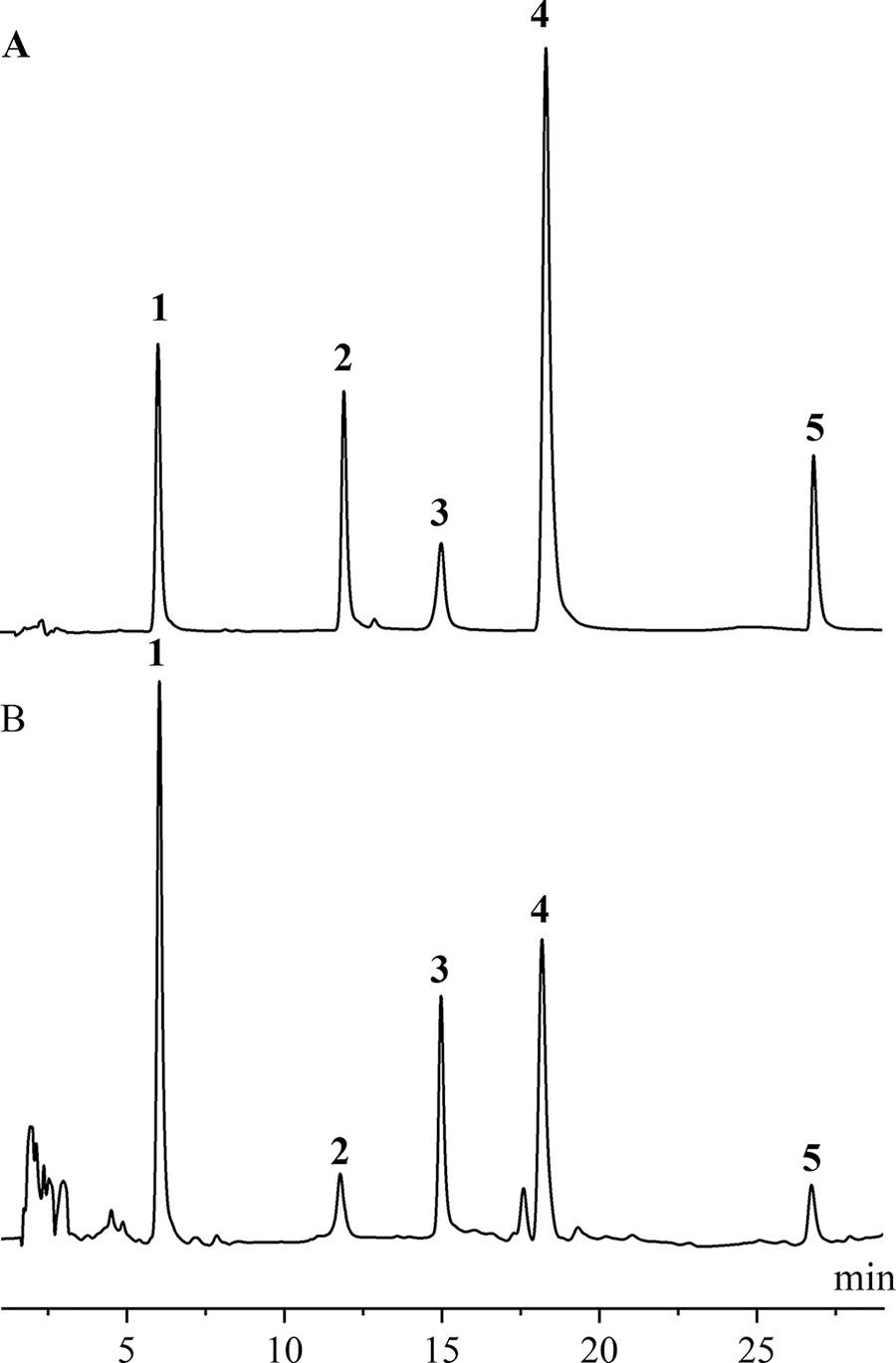
HPLC chromatograms.
Linearity: The regression equation and correlation coefficient are shown in Supplementary Figure S1. The linear regression coefficient r > 0.999 for each component shows that these five components are linear within their respective linear ranges.
Precision: The results revealed that the RSDs were 0.56% for DTX, 1.15% for curdione, 1.99% for curcumol, 1.25% for germacrone, and 1.06% for α-pinene, which indicated that the precision of the instrument was good.
Stability: The RSD values of DTX, curdione, curcumol, germacrone, and α-pinene were 1.25%, 0.86%, 1.19%, 0.81%, and 1.25%, respectively, indicating that the five components in the test solution remained stable for 12 h.
Repeatability: The RSDs of the five components were 0.95% for DTX, 1.07% for curdione, 1.04% for curcumol, 1.09% for germacrone, and 1.35% for α-pinene, which indicated that the research method had good reproducibility.
Recovery experiment: The results are shown in Table 2. The recoveries of all five components ranged from 94.68% to 98.73%, and the results showed that the recoveries of these five components met the requirements.
Recovery Rate of Five Components in DTX-ZTO-MSLN
Results of Process Optimization
Single-factor investigation
Temperature: Because curcuma oil is volatile in heat and the melting point of MG is approximately 70°C, 24 the heating temperature was set to 75°C ± 5°C.
The ratio of PC to P188 dosage: The results revealed that the prepared DTX-ZTO-MSLN particle sizes were 198, 145, 125, 157, and 208 nm. The encapsulation rates were 73.67%, 78.94%, 82.97%, 79.15%, and 74.00%, respectively, indicating that the ratio of PC to P188 significantly affected the particle size. The encapsulation rate was the highest when the ratio was 0.4, and the tentative ratio was set at 0.4 for subsequent optimization.
The ratio of drug to MG: The particle sizes of DTX-ZTO-MSLNs prepared according to the above ratio were 204, 148, 135, 169, and 230 nm, and the encapsulation rates were 73.64%, 83.68%, 86.95%, 82.00%, and 72.78%, respectively, which indicated that the drug and MG had significant influences on the particle size.
Water dosage: The results revealed that the prepared DTX-ZTO-MSLN particle sizes were 202, 158, 133, 141, and 198 nm. The encapsulation rates were 69.67%, 78.98%, 83.40%, 80.34%, and 78.29%, respectively. This finding indicates that adding water also affects the particle size, and the amount of ultrapure water was tentatively set at 30 mL for subsequent optimization experiments.
Stirring and homogenization rate: When the stirring rate was increased, the particle size decreased. When the stirring rate reached 2000 r·min−1, the influence on the particle size decreased. When the homogenization rate was investigated, the particle size tended to become stable when the homogenization rate was 1200 r·min−1. Thus, the optimal stirring rate was determined to 2000 r·min−1 and the homogenization rate was 1200 r·min−1.
Power: When the power was 500 W, the particle size was within the required range and uniformly distributed.
Results of the centralized composite design experiment
The results are shown in Table 3. Regression equations were fitted to the three factors (Tables 4 and 5). The regression equation for the encapsulation rate was as follows: encapsulation rate = 86.58 + 1.63 A − 1.36 B − 0.0564 C + 0.7878 AB + 0.6048 AC + 0.2312 BC −1.82 A2 − 1.01 B2 − 0.1656 C2 (p < 0.000 1, R 2 = 0.9879). The regression equation for the drug load was as follows: drug load = 4.59 + 0.8055 A − 0.7331 B + 0.0182 C + 0.2056 AB + 0.4486 AC + 0.3730 BC − 1.26 A2 − 0.7252 B2 − 0.2416 C2 (p < 0.0001, R 2 = 0.9747). The ANOVA of the regression parameters of the two models revealed that p < 0.0001 and that the lack of fit terms were insignificant, indicating that the models were effective and could be used for response value prediction.
Design Arrangement and Results of Central Composite Design Experiment
Variance Analysis Results of Encapsulation Rate
The ANOVA results for drug loading showed that when the model p < 0.0001, the effect was highly significant, and the terms A, B, A2, and B2 had highly significant effects (p < 0.01). The terms AC, BC, and C2 had significant effects (p < 0.05) (Table 5). The ANOVA results for encapsulation rate showed that when the model p < 0.0001, the effect was highly significant, and the terms A, B, A2, and B2 had highly significant effects (p < 0.01). The terms AB and AC had significant effects (p < .05) (Table 4). The effects of factors A, B, and C on the encapsulation rate and drug loading could be measured by the F value of the model, which revealed that the primary and secondary effects of these factors on the encapsulation rate and drug loading were in the order A (DTX-ZTO/O) > B (Km) > C (W).
Variance Analysis Results of Drug Loading
Results of the response surface analysis
As shown in the Figure 2 (a) and Figure 3(a), when the amount of water was fixed and the values of Km and DTX-ZTO/O were increased, both the encapsulation rate and the drug loading first increased and then decreased. The curvatures of the response surfaces for both the drug loading and encapsulation rates were significant, indicating that the values of DTX-ZTO/O and Km had significant effects on the preparation process, which was consistent with the ANOVA. As the mass fraction of MG (oil phase) increases, the encapsulation rate and drug loading increase, which might be related to the fact that the oil phase acts as a solvent for lipophilic drugs. As the oil phase content increases, more drugs can be dissolved into the oil phase, increasing the encapsulation efficiency and drug loading. However, as the oil content continues to increase, the particle size distribution also tends to increase, which may be due to the merging of lipids at high concentrations. The lipids provide additional space to encapsulate drugs, but merging reduces the total surface area and results in a larger particle size and poorer stability. When the Km ( Figs. 2b and 3b ) and DTX-ZTO/O values ( Figs. 2c and 3c ) were fixed, the changes in the response surfaces of the encapsulation rate and drug loading both decreased with increasing amounts of water, indicating that water had the least effect on the encapsulation rate and drug loading in comparison with the Km and DTX-ZTO/O values, which was consistent with the results of ANOVA.

Response surface map of various factors to drug loading.
Optimization and prediction of DTX-ZTO-MSLN prescription
The response surface diagram revealed that both the encapsulation rate and drug loading capacity first increased but then decreased as each influencing factor increased. According to Design Expert software, the drug loading amount (Y1) and encapsulation rate (Y2) were set to the maximum values, and the optimal prescription was PC/P188 = 0.34, DTX-ZTO/O = 3.23, and W = 29.42 mL
PROCESS VALIDATION RESULTS
DTX-ZTO-MSLN loading and encapsulation rate
Three batches of DTX-ZTO-MSLNs were prepared according to the optimal prescription. The results showed that the average loading value was 5.02%, close to the 4.87% fitted by Design Expert software, and the average encapsulation rate was 89.13%, close to the 87.20% fitted result.
Appearance
As shown in Figure 4, the blank solid lipid nanoparticles and DTX-ZTO-MSLN were clear and unstratified, with obvious light blue opalescence. The prepared nanoparticles were left at room temperature for a period of time, and the study revealed that there was no aggregation or precipitation of the nanoparticles, indicating good stability. The electron microscopy results revealed that the nanoparticles were spherical and well dispersed, with a uniform particle size distribution, meeting the requirements for intravenous drug delivery.
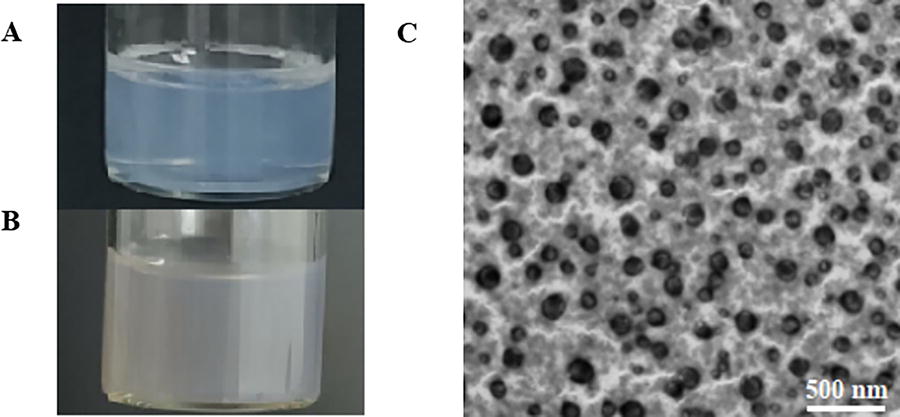
Appearance of SLN
Particle size and potential distribution
The results revealed that the average particle size of the blank solid lipid nanoparticles was 91.67 nm (Supplementary Figure S2), the PDI was 0.282, and the average potential was −30.42 mV. It is generally believed that when the absolute value of the potential is greater than 30 mV, electrostatic repulsion stabilizes the nanoparticles and prevents particle aggregation and precipitation. The average particle size and potential of DTX-ZTO-MSLN were 122.3 nm (Supplementary Figure S3) and −30.67 mV, respectively, and the PDI was 0.298. An analysis of the particle size and potential revealed that DTX-ZTO-MSLNs have good stability.
Differential scanning calorimetry analysis
The results are shown in Figure 5. The characteristic absorption peaks of the solid lipid material were observed at 52°C, indicating that the loading of the solid lipid with ZTO or Fe3O4 did not affect the melting point of the carriers, and that the solid lipid drug-loaded system still existed in the solid state at room temperature.

DSC curves of different samples (12.78 × 14.65 cm).
Determination of pH value
The measured pH was 7.20, 7.12, and 7.00, and the average value was 7.11, which meets the pH standard required by the pharmacopeia.
Determination of iron content and magnetic strength of nanoparticles
The iron content of DTX-ZTO-MSLN was determined via the external standard method via o-diazophene-ultraviolet spectrophotometry, 25 and ammonium ferric sulfate dodecahydrate was used as the standard substance to construct the standard curve. DTX-ZTO-MSLN powder was tested at room temperature via a vibrating sample magnetization intensity meter to observe the change in the sample magnetization intensity. The results revealed that the iron content was 7.38% and that the saturation magnetization intensity of DTX-ZTO-MSLNs was 7.05 A·m2·kg−1.
In vitro drug release investigation.
The results are shown in Figure 6. The mixture was almost completely dissolved in 4 h, and the solid lipid nanoparticles showed prominent slow-release characteristics in vitro. The cumulative dissolution was 78.98% at 36 h. The results of the in vitro release experiments are shown in the Table 6 and are relatively consistent with Weibull’s model (R 2 = 0.9992).
Results of in Vitro Drug Release Fitting
Note: M t is the cumulative release at time point t, M ∞ is the cumulative release at time point ∞, M t/M ∞ is the cumulative release rate, and t is time.
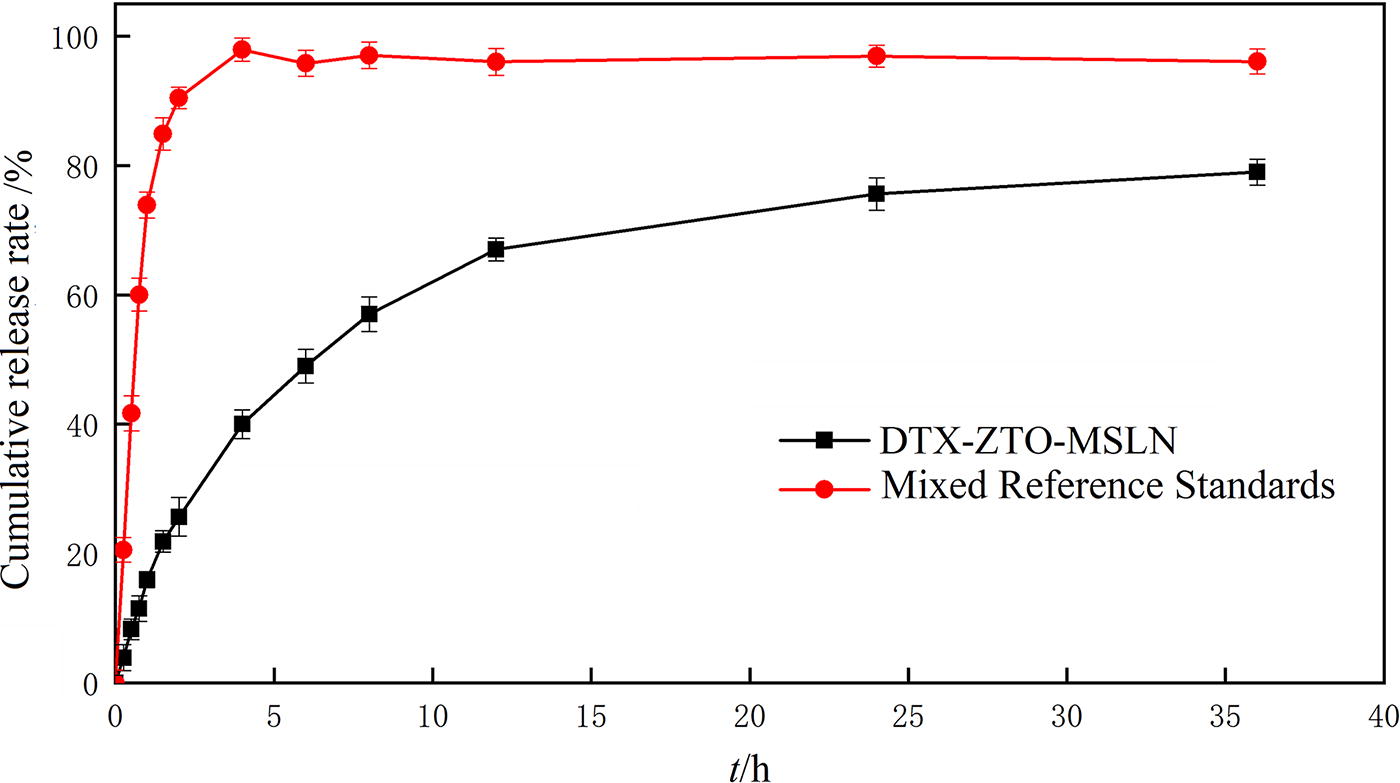
In vitro drug release curves for mixed reference standards and DTX-ZTO-MLSN.
Pharmacodynamic experiments of DTX-ZTO-MSLN in the treatment of breast cancer
Pathological experiment results of rat breast cancer model
The pathological manifestations in the rats revealed that in the DTX-ZTO-MSLN group, the latency period of tumorigenesis was prolonged, and the rate of carcinoma development and the total tumor load were significantly lower than in the model group (Figure 7). The total number of cases of carcinoma and the total number of carcinomas in the model group continuously increased, whereas no new cases were observed in the DTX-ZTO-MSLN group. The MSLN group also presented no new cases or new tumors. Throughout the animal modeling process, the cancer incidence rate and total tumor load of the model group were consistently greater than those of the DTX-ZTO-MSLN group, and the efficacy of the targeted administration of DTX-ZTO-MSLN for the synergistic treatment of breast cancer was greater than those of the administration of the drug alone.

Pathological experiment results of rat breast cancer model. Compared with the model group, *p < 0.05, **p < 0.01.
Effects of DTX-ZTO-MSLN on the proliferation of MCF-7 cells
The results are shown in Figure 8. All doses of DTX-ZTO-MSLNs and the positive control drug epothilone significantly inhibited the proliferation of MCF-7 human breast cancer cells.
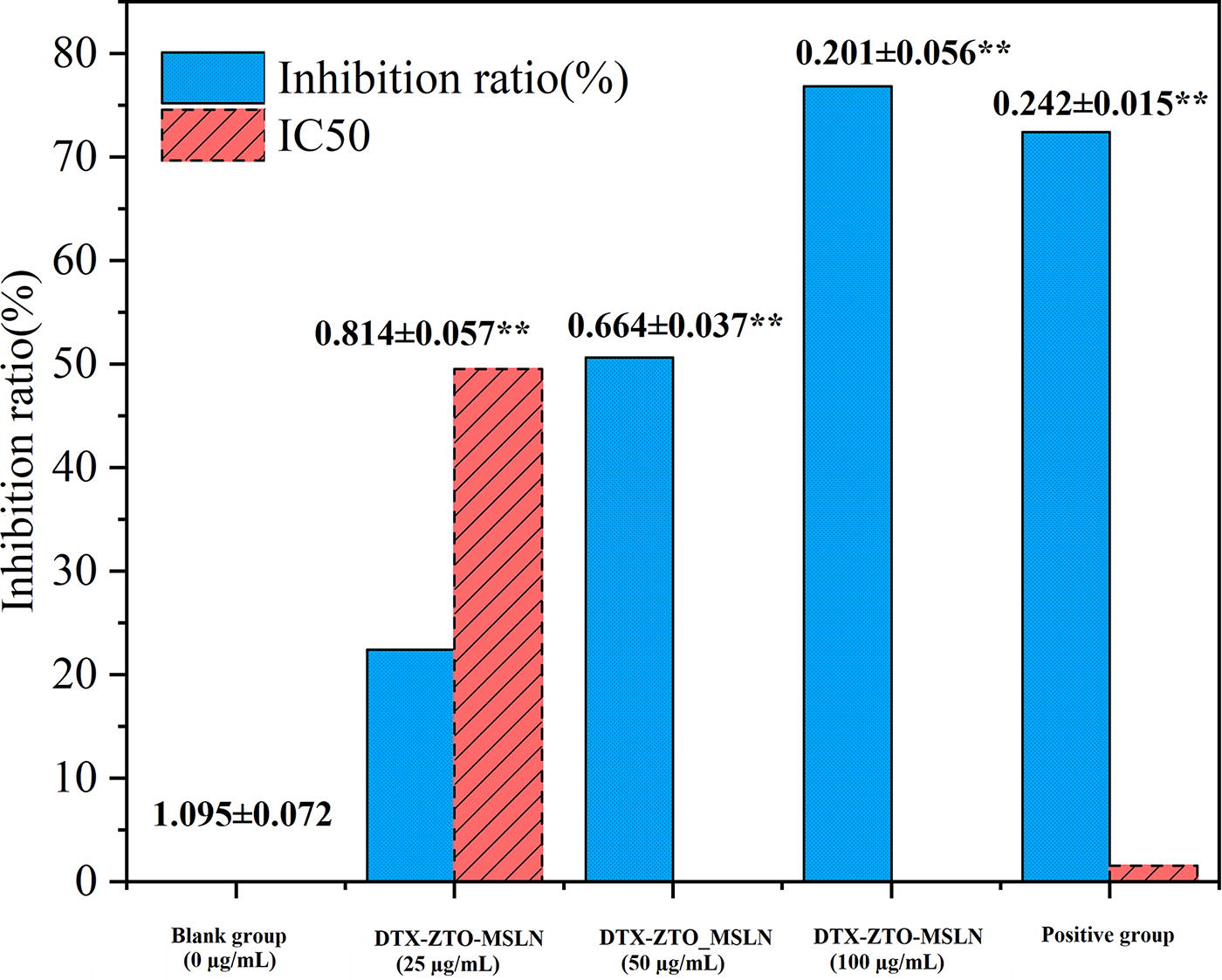
The inhibitory effect of DTX-ZTO-MSLN 48 h on the proliferation of MCF-7 cells (± s, n = 6). Compared with the negative control group, *p < 0.05, **p < 0.01; The values on the bar chart are OD values.
ROS levels in human breast cancer cells MCF-7
H2O2 (200 μM) treatment resulted in a significant increase in ROS levels (p < .05). When MCF-7 cells were exposed to DTX-ZTO-MSLN, the ROS levels decreased with increasing DTX-ZTO-MSLN concentration (p < .05, as shown in Figure 9). These results indicated that the nanodelivery system could eliminate ROS in the tumor microenvironment. A reduction in ROS in the tumor microenvironment can stimulate antitumor immunity and increase the infiltration of T-lymphocytes, achieving an efficient antitumor effect. 26
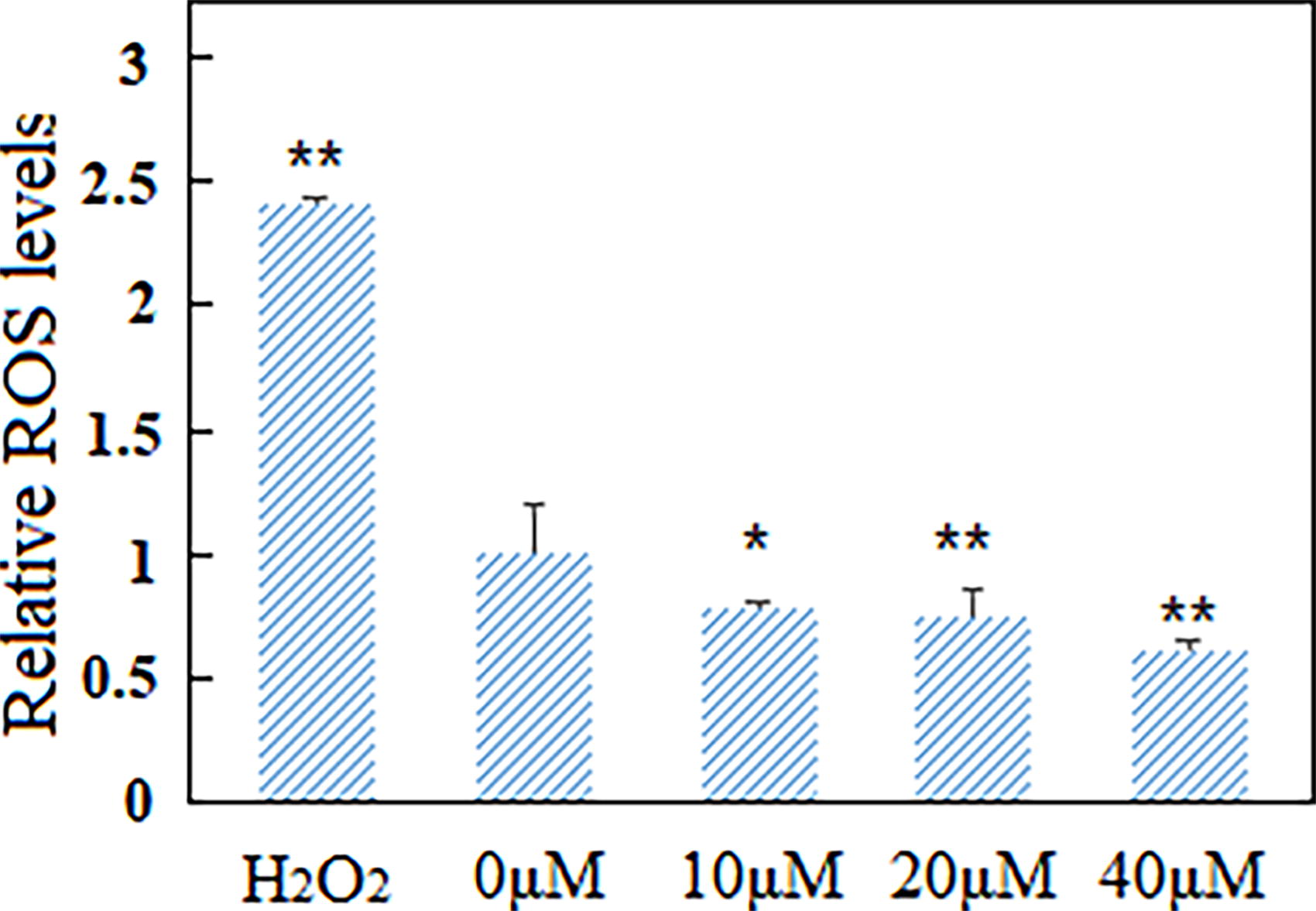
DTX-ZTO-MSLN antioxidant experiment results (9.74 × 11.75 cm, *p < 0.05, **p < 0.01).
DISCUSSION
In this study, various factors affecting the preparation of DTX-ZTO-MSLN were comprehensively investigated via single-factor experiments, from which the main influencing factors, the mass ratio of the total drug loading of DTX and ZTO to MG, the ratio of emulsifier PC to co-emulsifier P188, and the amount of water, were identified. To further investigate the effects of these three factors and their interactions on the encapsulation rate and drug loading of DTX-ZTO-MSLN, the experiments were combined with HPLC to further investigate the effects of interactions on drug loading and encapsulation rates by central composite design-response surface methodology. Central composite design-response surface methodology can achieve high accuracy and predictability with fewer experiments, revealing the degree of influence of each influencing factor and determining the optimal experimental conditions. In nanoparticle preparation process optimization experiments, the encapsulation rate and drug loading are essential indices for evaluating the advantages and disadvantages of the preparation process, and many studies have been conducted to determine the drug encapsulation rate and drug loading in the formulations in combination with the HPLC method. 27 The results of the central composite design of experiments showed that the binomial fitting equation R 2 was close to 1, indicating a good model fit and predictability. 28 The mass ratio of the total drug loading of DTX and ZTO to MG had the strongest effect on the encapsulation rate and drug loading, followed by the ratio of PC to P188. The amount of water had the slightest effect. The response surface results showed that with the increase of each influencing factor, the drug loading capacity and encapsulation rate showed a tendency of increasing and then decreasing.
Figures 2(a) and 3(a) show the interaction effects of DTX-ZTO/O and Km on the drug loading and encapsulation rates at a fixed water content. With the increase of DTX-ZTO/O and Km, the drug loading and encapsulation rate first increased and then decreased, which is in agreement with the results of Gao et al. 29 The Km value is the ratio of the emulsifier to the coemulsifier. Soy phospholipids and Porroxam 188, which have good emulsifying ability, are surfactants commonly used to prepare solid lipid nanoparticles. Figure 2 shows that with increasing amounts of emulsifier, the encapsulation rate and drug loading improved. However, when the amount of emulsifier was too high, the drug loading and encapsulation rates decreased. This may be due to the inability of the formed DTX-ZTO-MSLN surface to absorb the excess surfactant, allowing the excess surfactant in the water to form micelles, 30 in which the drug is dissolved. This effect is consistent with the results of a previous study, 31 where an excessive concentration of surfactant in the aqueous phase led to a decrease in the encapsulation rate of DTX-ZTO-MSLN.
Figures 2(b) and 3(b) show the effects of water dosage and the DTX-ZTO/O ratio on drug loading and encapsulation rate with a fixed Km value. As shown in Figure 2, with the increase of DTX-ZTO/O ratio, the encapsulation rate and drug loading capacity first increased but then decreased; this may be because the low content of MG did not allow complete loading of the drug into the solid lipid nanoparticles, which caused an increase in the free drug. As the content of MG increased, it could bind the drug more and increase its rate of encapsulation in the solid lipid nanoparticles; 32 however, when the addition of MG was further increased, the system became unstable and viscous. The particles aggregated easily, which decreased the binding rate of the drug and consequently the encapsulation rate and the drug loading. Moreover, owing to aggregation the particle size of the DTX-ZTO-MSLN increased significantly.
The response surfaces of the interaction between Km and water content with fixed DTX-ZTO/O at the zero level are shown in Figure 2 (c) and Figure 3 (c). The experimental results suggest that the encapsulation rate of DTX-ZTO-MSLN showed a tendency to increase and then decrease with the increase in water dosage and Km, which may be because the increase in water content favors the formation of oil-in-water-type nanoparticles. When the water content was increased to 30 mL, the encapsulation rate was the highest, and the particle size was the smallest. With increasing water content, the encapsulation rate of the nanoparticles began to decrease, possibly because, the organic phases dissolved in the water could not be removed entirely, which led to a decrease in the encapsulation rate.

Response surface map of various factors to entrapment efficiency.
We also examined the effects of the addition of curcuma oil and Fe3O4 on the physicochemical properties of DTX-ZTO-MSLN. The DTX-ZTO-MSLN solution showed a clear blue opalescence, and the pH and DSC values remained consistent with the requirements, showing that the addition of curcuma oil and Fe3O4 had little influence on the nanoparticle properties. The nanoparticles prepared by this optimized method had good shape and uniform particle size distribution, the preparation method was simple and feasible, and the composition was reasonable. The in vitro drug release results revealed that DTX-ZTO-MSLN exhibited slow release characteristics, suggesting that DTX-ZTO-MSLN may achieve an antiproliferative effect on breast cancer cells through the slow and sustained release of the active components DXT and ZTO after entering breast cancer cells. This study established a rat breast cancer model, and the cancer incidence rate and total rat tumor load of the model group were always greater than those of the DTX-ZTO-MSLN group. The efficacy of the targeted administration of DTX-ZTO-MSLN for the treatment of breast cancer was greater than that of the administration of the drug alone, and the results indicated that DTX and ZTO could exert synergistic antibreast cancer effects. We also conducted an in vitro antibreast cancer activity study using MCF-7 cells as a model, and the results revealed that all doses of DTX-ZTO-MSLN had a strong and concentration-dependent inhibitory effect on the proliferation of human breast cancer MCF-7 cells. Compared with normal breast cells, breast cancer cells have higher levels of ROS. 33 The elevated ROS in the tumor microenvironment severely impair immunogenic cell death and tumor-infiltrating T-lymphocytes and functionally inhibit T-cell activation. 34 The regulation of ROS levels in the tumor microenvironment has been reported to prolong T-cell survival and restore immune responses; 35 therefore, regulating ROS levels in the tumor microenvironment is essential for reversing the immunosuppressive environment. Cai et al 36 developed the ROS inhibitor NAC, which significantly decreased the ROS level in breast cancer cells and suppressed the growth and development of the tumor, and exhibited a good therapeutic effect on triple-negative breast cancer. The DTX-ZTO-MSLN nanodelivery system prepared in this study also reduced the ROS level, suggesting that the mechanism by which DTX-ZTO-MSLN act against breast cancer may involve reducing the ROS level in the tumor microenvironment.
DTX and ZTO have been shown to have antitumor effects on different types of cancers. 37,38 However, only a few studies have reported their encapsulation in nanoparticle drug delivery systems to increase their efficacy. 39,40 The DTX-ZTO-MSLN prepared in this study are the first magnetic nanodelivery system to combine DTX and ZTO. DTX and ZTO are encapsulated in MSLN, and a specific magnetic field is applied to the lesion site in vitro to magnetizes the nanocarrier to a specific site. This system acts as a potent inhibitor of cancer cell proliferation, triggering apoptosis and impairing cell viability. This study suggests that DTX-ZTO-MSLN may be a promising drug delivery system on the basis of the synergistic effect of DTX and ZTO. In addition, this study provides a basis for further detailed investigations of the mechanism of action of DTX-ZTO-MSLN and the safety of their clinical application in vivo.
Footnotes
AUTHORS’ CONTRIBUTIONS
Y.H.: Writing—original draft, Supervision, Investigation, Formal analysis. Y.Z.: Supervision, Investigation, Conceptualization. Jun Liu: Supervision, Conceptualization. Y.B.: Supervision. M.N.: Methodology. C.Z.: Methodology. W.L.: Methodology, Supervision, Resources, Investigation, Funding acquisition. H.B.: Methodology, Supervision, Resources, Investigation, Funding acquisition.
DISCLOSURE STATEMENT
No competing financial interests exist.
FUNDING INFORMATION
The work was supported by
SUPPLEMENTARY MATERIAL
Supplementary Figure S1
Supplementary Figure S2
Supplementary Figure S3