




Abstract
To study genetic diversity and drug resistance of HIV-1 CRF_BC among drug users in Guangdong Province, 67 circulating recombinant form 07_BC (CRF_07BC) and 32 circulating recombinant form 08_BC(CRF_08BC) HIV-1 pol genes were amplified and sequenced. In the protease gene region (PR), 31 CRF_08BC isolates were amplified and 10 high polymorphism positions were identified. The polymorphisms L19I, M36I, R41K, D60E, L63P, H69K, and I93L were complete substitutions, and were followed by T12S (94%), I15V (90%), and L89M (81%) separately. Five high polymorphisms were found in CRF_07BC isolates; there were E35D (88%), R41K (100%), D60E (96%), L63P (99%), and I93L (91%). Four of the identified polymorphism positions (R41K, D60E, L63P, and I93L) were the same in the PR region of both subtypes. In the reverse transcriptase (RT) region six high polymorphism positions, V35T, E36A, T39D/E/N, S48T, V60I, and V245Q, were identified in both subtypes. E53D (97%), I135V/T/R (81%), S162C (94%), Q207E (100%), and R211K (97%) were primarily in CRF_08BC subtypes and D121Y/H (97%) were primarily in CRF_07BC. The NRTI resistance mutation T69S was 94% (30/32) in CRF_08BC. To now, we have found no related reports concerning such high polymorphisms in the position. Polymorphisms V77M (PI) and K201Q (RT) were not found in the mutation profiles; therefore it may have been a new mutation in HIV-1. This study analyzed the difference between CRF_08BC and 07BC polymorphisms among drug users in Guangdong Province, which may help to guide recommendations for diagnostic assays, vaccine design, and antiretroviral regimen strategies in China.
Introduction
G
As we know, the unusual degree of genetic variability makes the human immunodeficiency virus type I (HIV-1) highly heterogeneous. It is subdivided into three groups (M, N, and O), with group M subdivided into nine subtypes.
1
Most HIV-1 strains present in North America, Australia, and Europe belong to subtype B, but subtype B is not the main subtype worldwide; it represents only 10% of the HIV-1 infection worldwide.
2
At present, circulating recombinant forms (CRFs) are playing a major role in the HIV/AIDS global pandemic. To date, 42 CRFs have been identified (Los Alamos National Laboratory
Epidemiological surveys have revealed that China is currently one of the counties in which most of the HIV-1 subtypes and some CRFs are cocirculating. 4 The recent national molecular epidemiology survey showed that HIV-1 subtypes circulating in China were mainly CRF07-BC (50.20%), B (31.66%), and CRF01-AE (15.54%). 5 Two BC recombinant HIV-1 strains, CRF07_BC and CRF08_BC, accounted for most of the HIV-1 infections along distinct routes of heroin trafficking to northwestern and southeastern China, respectively. 6 In recent years, HIV-1 CRF-07 BC and the B subtype pol gene polymorphism from recently infected injecting drug users were studied in China 7,8 ; other research had studied HIV-1 pol gene polymorphisms in different region of China. 9,10 However, little is known about the difference in polymorphisms of the protease and reverse transcriptase gene of HIV-1 CRF-07BC and CRF-08BC in China. The present study examined the genetic diversity of the current HIV-1 CRF_08 BC and CRF_07BC subtype protease (PR) genes (1–99 amino acids) and the partial reverse transcriptase RT gene (1–250 amino acids) and investigated the mutations associated with resistance to protease inhibitors (PIs) and reverse transcriptase inhibitors (RTIs) in HIV-1 CRF_BC-infected patients living in Guangdong Province.
Materials and Methods
Specimen collection and analysis
Ninety-nine HIV-1-infected patients were selected in this study and all of them were infected through injecting drug use (IDU). Thirty two were CRF 08BC and all of them were males, aged 22–57 years (average: 31.5 years). Among them, 18 HIV-1-infected persons were diagnosed in 2007 and 14 HIV-1-infected persons were diagnosed before 2007. None of them received antiretroviral treatment (ART). Sixty-seven were infected with the CRF_07BC subtype, Among these 55 were males and 13 were females, aged 23–59 years (average: 34.5 years). Some of the specimens were collected from HIV-1 newly infected monitor projects and others from CD4 count samples. The samples were assigned names according to UN-AIDS nomenclature denoting the year of sampling, the country of region, and the patient number. 11
RNA extraction, reverse transcriptase polymerase chain reaction (RT-PCR), and nested PCR amplification and sequencing of the PR and RT region
HIV-1 RNA was extracted from 140 μl of plasma using the QIAamp viral extraction kit (Qiagen, Germany). Reverse transcription and nested PCR amplification were performed by a home brew PCR procedure according to established protocol. A one-tube reverse transcriptase PCR kit (Takara, Dalian, China) and PCR kit (Takara, Dalian, China) were used according to the manufacturer's recommendations for amplification of the HIV-1 pol gene (protease 1–99 amino acid and part of reverse transcriptase 1–250 amino acids). The primers were as following: outer primers F5′-TGG AAA TGT GGA AAG GAA GGA C-3′ (2028–2050 nt, HBX2) and R5′-TTC TGT AT TTC TGC TAT TAA GTC TTT TGA TGG − 3′ (3507–3538 nt, HBX2) and inner primers PRO-1 5′-CAG AGC CAA CAG CCC CAC CA-3′ (2147–2166 nt, HBX2) and RT-20 5′-CTG CCA GTT CTA GCT CTG CTT C-3′ (3441–346 nt, HBX2) 12 ; 1334 bp of the HIV gene covering the whole protease and part of the reverse transcriptase gene was amplified. The amplification was carried out in a thermal cycler (ABI 9700, USA) for first round RT-PCR with the following conditions: 50°C for 30 min and 94°C for 5 min followed by 35 cycles at 94°C for 20 s, 55°C for 20 s, 72°C for 2 min, and a final extension at 72°C for 10 min. A first round PCR product (1 μl) was used as a template for the second round PCR amplification. The second round PCR conditions were 94°C for 5 min followed by 35 cycles at 94°C for 20 s, 55°C for 20 s, 72°C for 1 min, and a final extension for 7 min at 72°C. Amplified DNA was visually detected by agarose gel electrophoresis. PCR products were sequenced by Invitrogen (Invitrogen, Shanghai, China).
Identification of resistance mutations and correlation with phenotype
The Stanford Database was used to identify and assess the impact of resistance-associated mutations and polymorphisms on phenotypic resistance. Each reverse transcriptase and protease sequence was compared to that of a subtype B reference strain, HXB2, in the Stanford HIV reverse transcriptase and protease sequence database (
Unusual residues, which excluded sequencing that was wrong in the database, were analyzed in mutation profile data (
Phylogenetic and sequence analysis
Genetic subtypes were determined by phylogenetic tree analysis. After the obtained sequences were edited by ContigExpress software (Invitrogen), the sequences were aligned with previously reported HIV-1 strains of various subtypes from the Los Alamos database (2005 reference sequences). 13 Multiple alignment were performed by BioEdit software. 14 Phylogenetic trees were constructed using the neighbor-joining method and Kimura two-parameter model and implemented by MEGA version 4.0. 15
Statistical analysis
The Chi-square test (Fisher's exact test where appropriate) were performed to detect significant differences in the frequency of amino acids at specific positions between the two different subtypes. Any differences with p < 0.05 were considered statistically significant and potentially relevant.
Results
Drug resistance mutation of the PR and RT regions in CRF_BC
One PI minor resistance mutation, V11I, was identified among 31 HIV-1-infected persons in the CRF_08BC subtypes. The drug resistance mutation rate was 3% (1/31; one sample PR region was not sequenced) in the PR region. But in the RT region, there were 30 NRTI resistance mutations, T69S, found in 32 CRF-08BC HIV-1-infected persons (94%). No drug resistance samples were found in CRF_08BC. Six minor resistance mutations were identified in CRF_07BC subtypes of the PR region among the 67 samples. They were A71V/T (three) and L33I and L10I (two) separately. The rate of drug resistance mutation was 9% (6/67).
In these samples, only one drug resistance mutation (Q151LQ) was identified in the RT sequence in CRF_07BC (1.5%). Q151LQ causes low-level resistance to ABC, AZT, D4T, and ddI and potential low-level resistance to 3TC, FTC, and TDF separately.
CRF_BC natural polymorphisms in the PR region
The natural polymorphisms were different in the CRF_07BC and CRF_08BC subtypes. The polymorphisms that were more than 50% in the samples are listed in Table 1. Ten high polymorphism positions were identified in 31 CRF_08BC PR sequences, and 100% substitutions were present at positions L19I, M36I, R41K, D60E, L63P, H69K, and I93L, followed by T12S (94%), I15V (90%), and L89M (81%). But only five high proportion polymorphisms were identified in CRF_07BC subtypes. They were E35D (88%), R41K (100%), D60E (96%), L63P (99%), and I93L (91%). Polymorphisms T12S, I15V, L19I, M36I, H69K, and L89M were in the CRF_08BC subtype and E35D was in the CRF_07BC subtype. Polymorphisms R41K, D60E, L63P, and I93L were in both subtypes.
Fisher exact test result.
In two subtypes, there are some other polymorphisms in which the amino acid substitutions were less more than 20%. They are listed in Table 2. V77M was listed as the unusual residues in the drug resistance database (sequencing result Fig. 1A). We further analyzed polymorphisms in the mutation profile in the Stanford database; the results showed that no data were available (

V77M and K201Q polymorphism sequencing results. (
CRF_BC natural polymorphisms in the RT region
The natural polymorphisms with which the amino acid substitutions were more than 50% in the RT region are listed in Table 3 in the CRF_07BC and CRF_08BC subtypes. There were six different polymorphisms in two subtypes. The polymorphisms of E53D (97%), I135V/T/R (81%), S162C (94%), Q207E (100%), and R211K (97%) were mainly in the CRF_08BC subtype and D121Y/H (97%) was in CRF_07BC. V35T, E36A, T39D/E/N, S48T, V60I, and V245Q appeared with high frequency in both the CRF_08BC and CRF_07BC subtypes.
Fisher exact test result.
There are also some other polymorphisms for which amino acid substitutions were less than 20% in the two subtypes. They are listed in Table 2. In these polymorphisms, K201Q was listed as unusual residues in the drug resistance database (sequencing result Fig. 1B). We further analyzed the polymorphisms in the mutation profile in the Stanford Database; the results showed that no data were available (
CRF_BC phylogenetic tree and genetic distance
We further analyzed the CRF_07BC and CRF_08BC subtype, constructed the phylogenetic tree, and calculated the genetic distance within the two clusters. The phylogenetic tree is shown in Fig. 2. The intrasubtype hamming distance was 0.018 in CRF-07BC and 0.014 in CRF-08BC. The genetic distance was 0.043 between the two subtypes.
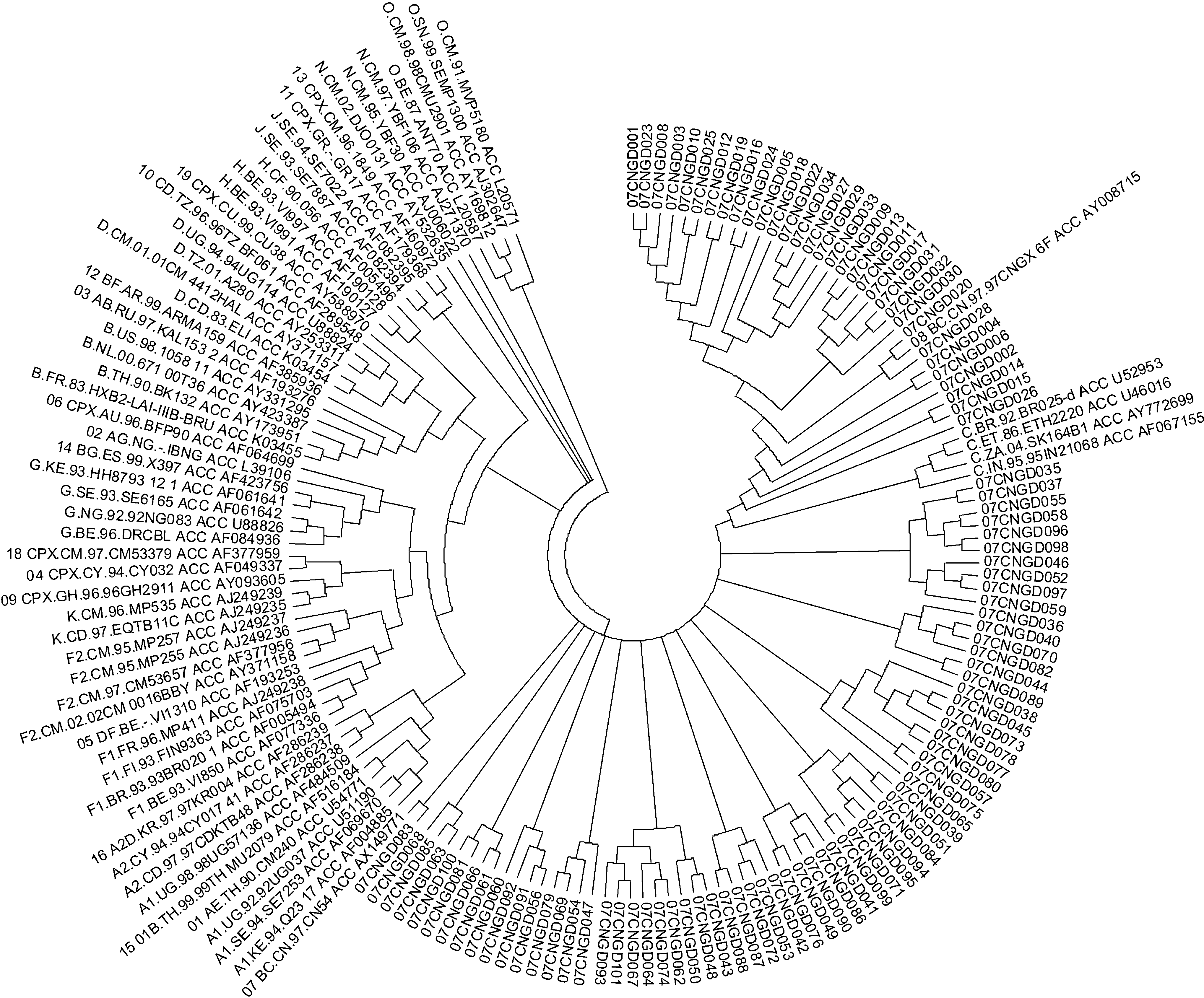
Phylogenetic tree of HIV-1 pol gene sequences of CRF_07BC and CRF_08BC (display topology tree). The phylogenetic trees were constructed using neighbor-joining methods (MEGA 4.0) for the PR-RT region, and the reference sequence from the databases (
Discussion
This study aimed to elucidate the emergence of drug resistance, drug resistance-associated mutations, and the natural polymorphisms in both PR and RT genes of CRF_08BC and CRF_07BC in drug users in Guangdong Province. The results showed that the prevalence of drug resistance to PIs and RTIs was 0% and 1.5%, respectively. The natural polymorphisms were different in the two subtypes. In the PR region, there were 10 high natural polymorphism positions in CRF_08BC subtypes in contrast to only five in CRF_07BC subtypes. The natural polymorphisms R41K, D60E, L63P, and I93L have similar mutation rates in the two subtypes (Table 1, p > 0.05), but the T12S, I15V, L19I, M36I, H69K, and L89M natural polymorphism positions were in particular in CRF_08BC and E35D was in particular in CRF_08BC (Table 1, p < 0.001). In the RT gene, 12 high natural polymorphism positions were identified in two subtypes (Table 2). There were 11 high natural polymorphism positions in the CRF_08BC subtype and only 7 in CRF_07BC (Table 2). Six natural polymorphism positions (V35T, E36A, T39D/E/N, S48T, V60I, and V245Q) have the similar proportion. In the CRF_08BC subtype, there were five natural polymorphisms (E53D, I135V/T/R, S162C, Q207E and R211K) but in the CRF_07BC subtype there was only one (D121Y/H) (Table 2). Although previous studies have reported the natural polymorphism mutation in different subtypes, 9,10 they were mainly in the CRF_AE and CRF_07BC subtypes and seldom in the CRF_08BC subtype. We found that the amino acid polymorphisms in CRF08_BC were more common than the CRF07_BC strains in Guangdong Province.
In the PR region, V77I was a normal polymorphism in HIV-1 about 20% of the time in untreated patients (
As known, the CRF_08BC subtypes first found in southern China were mostly subtype C with portions of the capsid and reverse transcriptase (RT) genes from subtype B. 16 The RT genes from subtype B were located in regions 2241–2538 and the RT regions 100–200 amino acid position (HXB2) in the CRF_08BC subtype. 16 So we compared the polymorphism mutations in CRF_08BC and subtype C with previous reports 17 and found that the most frequent polymorphism positions were the same (χ2 test, p > 0.05); we also found some differences in the two subtypes. In the PR region, the highest frequency polymorphism positions were the same, but CRF_08BC subtypes have two excess high polymorphism positions (D60E and L63P). In the RT region, CRF_08BC subtypes have three (E53D, I135V, and S162C) high frequency polymorphism positions specifically, but subtype C has four (K122E/Q, D123G/N/S, D177E/G/N, and T200A/I/E). 17
From the position of the polymorphisms we found that different polymorphisms in two subtypes were mainly located in the recombined region. So the four high frequency polymorphism positions in subtype C were not found in CRF_08BC and the high frequencies of polymorphisms I135V and S162C were not found in subtype C correspondingly. I135Vand S162C were high frequency polymorphisms in subtype B 7 ; when gene segments including two polymorphism positions were recombined in CRF_08BC, the polymorphisms still existed. The high frequency of the E53D polymorphism was not located in the recombined region and was not found in high frequency polymorphisms in other subtypes in China. 7,10
Although no drug resistance was found in the CRF_08BC subtypes, the drug resistance mutation was very high. In the PR region, only a V11I drug resistance mutation was found, but in the RT region, the T69S mutation ratio was 94%. Such a high T69S mutation has not previously been reported. As we know, T69N/S/A/I were NRTI-selected mutations and their effect on NRTI susceptibility was not known. In a previous study, the T69S mutation was accompanied by two amino acid inserts between codons 69 and 70 of the RT gene, 18 but we have not found any amino acid insert in all the mutation samples in our research.
Why do the T69S mutations appear in such a high proportion in CRF_08BC? Phylogenetic approaches were used to investigate the two clusters and the genetic distance was found to be only 0.014 within CRF_08BC. So founder effects may be the reason for the high T69S mutation in the CRF_08BC subtype, which also may be the case with the Chinese. It may be considered polymorphisms in the Guangdong population. We should further study the HIV pol gene mutation in the CRF_08BC subtype in different populations in Guangdong Province.
One of the most dramatic changes in the global HIV/AIDS pandemic has been the emergence and rapid spread of human immunodeficiency virus type 1subtype C viruses (HIV-1-C), which accounts for about 56% of all global infections. 2,19
The cause of the disproportionate increase in C viruses relative to other HIV-1 strains may be an extra NF-κB binding site in the long terminal repeat and may enhance gene expression, altering the transmissibility and pathogenesis of the C virus. 17 Others have suggested that C viruses may be more stable and that their protease genes may have increased catalytic activity relative to other subtypes. 20 Earlier data found that CRF_08BC prevailed for about 4–5 years in about 13% of drug users in Guangdong Province. 21,22 Our data indicated that CRF_08BC accounted for 18.5% (32/173) of all total infections (unpublished data) in drug users in Guangdong Province. Although the difference were not significant statistically (p = 0.22, χ2 = 1.49), the trend is increasing. CRF_08BC subtypes were mostly subtype C, with only with portions of the capsid and RT genes from subtype B, 16 so it may have epidemiological characteristics similar to subtype C. That is to say, more of the CRF_BC subtype may be found in the Guangdong region in the future.
In conclusion, we first studied the polymorphisms of HIV-1 CRF_BC in drug users in Guangdong Province and analyzed the difference in the two subtypes. In this study, we found two new polymorphisms in HIV-1 and a high proportion of the T69S mutation in CRF_08BC in Guangdong Province HIV-1-infected patients.
Sequence Data
The pol gene sequences of 101 studied HIV-1-infected individuals have been deposited in GenBank with the following accession numbers: FJ387028–387128.
Footnotes
Acknowledgments
This study was supported by Guangdong Province medicine research fund (NO: WSTJJ2007007).
Disclosure Statement
No competing financial interests exist.