




Abstract
The molecular epidemiology of HIV-1 strains circulating in Belem-PA and Macapa-AP, in the Northern region of Brazil, is described using sequences of the C2V3 segment of the env and the pro gene of HIV-1 from patients of the Reference Unit for Special Infectious and Parasitary Diseases (URE-DIPE) in Belem-PA and the Central Laboratory (LACEN) in Macapa-AP. Subtype B was the most frequently found in relation to pro (88.3%) in Belem and in Macapa (97.1%) and env (88.3% in Belem and 100% in Macapa). Subtype F was also described in Belem (9.3% pro and 8.3% env) and Macapa (2.8% pro). Subtype D was described for the first time in the Northern region of the country as well as the recent entry of CRF02_AG. Furthermore, several possible recombinant forms among the various subtypes were found in both cities. The results support the hypothesis that HIV-1 infection is associated with the epidemic of the virus in the Southeast region of the country and that the city of Belem is the most important route for HIV-1 entry in the Northern region of Brazil.
Introduction
P
In Brazil, HIV-1 is characterized by the occurrence of several subtypes of the M group, and includes subtype B, the most prevalent in the majority of the regions, followed by subtypes F, C, and D, 9 although some cities present a distinct pattern of distribution of these subtypes. 10,11 Approximately half of the B subtype strains isolated in Brazil have the tetrapeptide GWGR in the V3 loop of the env gene, differing from the sequence GPGR, which is more prevalent in North America and in Europe. 5,10
The molecular epidemiology of HIV-1 strains circulating in the Northern region of Brazil is poorly known. The State of Para has 43.3% of the cases. Until June 2006, there were 5919 infected individuals, in which 80.4% were men and 19.6% were women. 12 The prevalence of the infection in the State of Amapa is still low, although the region borders French Guiana and a great number of indigenous populations move freely between the two countries.
The present work describes the molecular epidemiology of HIV-1 in the city of Belem (Para) and, for the first time, in the city of Macapa (Amapa), which are the main routes of virus entry in the Northern region of Brazil, and reports for the first time the introduction of the recombinant CRF02_AG in the Amazon region of Brazil.
Materials and Methods
Patient selection and blood collection
Blood samples were randomly colleted from 89 HIV-1-seropositive individuals (58 men and 31 women) attending the Reference Unit for Special Infectious and Parasitary Diseases (URE-DIPE), Belem, Para, between the years of 1998 and 2002 and from 37 individuals (22 men, 6 women, and 9 individuals without information) attending the Central Laboratory (LACEN), Macapa, Amapa, between January and August 2002. The two reference units receive most of the HIV-1-infected persons in both States and provide not only medical but nutritional, dental, and laboratory support including the monitoring of HIV-1 viral load and T CD4+ and CD8+ lymphocyte counts. After obtaining the patient's informed consent, the following data were recorded by the clinician: age, gender, HIV-transmission risk factor [homosexual/bisexual male, intravenous drug user (IDU), hemophiliac/transfusion recipient, heterosexual contact, other/undetermined], dates of the last negative and first positive HIV-1 test, results of T CD4+ lymphocyte counts, and HIV-1 viral load.
Peripheral blood samples (5.0 ml) were collected in two tubes containing EDTA using a vacutainer system. The blood samples were transported to the Virus Laboratory within 24 h for procedures to determine CD4+ T lymphocyte counts and HIV-1 viral plasma load. Subsequently, plasma and peripheral blood mononuclear cells (PBMCs) were stored at −70°C.
Polymerase chain reaction
DNA was extracted from PBMCs using the Puregene kit (Puregene, Gentra Systems, Inc., USA) according to the manufacturer's protocol. The nucleic acid was eluted and stored at −20°C until the moment of use. DNA was used in a nested PCR to amplify part of the pro and the env C2V3C3 region of gp120 from HIV-1. The first-round PCR used 4 μg of the extracted DNA, 125 mM of each dNTP (Invitrogen, USA), 20 pmol/μl of each of the two external primers, and 10 × PCR buffer-MgCl2 (Perkin-Elmer, USA), in a final volume of 50 μl. Reactions were performed in a thermocycler (Perkin-Elmer, USA) for 5 min at 94°C, followed by 35 circles at 94°C (40 s), 50°C (40 s), 72°C (1 min), and extended for 10 min at 72°C. Five microliters of the amplified product was used in the nested PCR using a set of internal primers, in a final volume of 50 μl, employing the same temperature and incubation periods as in the first reaction. Primers used to amplify 290 bp of the protease and a fragment of 500 bp of the C2V3 region of the env were previously described. 13 Amplified products were analyzed by electrophoresis on a 2% agarose gel. The protease fragments were purified using the QIA Quick Purification Kit (Quiagene, USA) prior to direct nucleotide sequencing.
Genetic subtyping and phylogenetic analysis
A sample of 2 μl of the amplified product was directly sequenced using the Big Dye Terminator kit (Applied Biosystems, Foster City, CA) in an automatic sequencer (DNA sequencer model 377, Applied Biosystems, Foster City, CA).
HIV-1 subtyping tools available on the webpage of NCBI (
The alignments of nucleotides and amino acids were performed using the software BIOEDIT version 5.0.9
14
; phylogenetic analyses were performed using the software MEGA, version 3.1.
15
The sequences were aligned along with the respective reference sequences of the subtypes, obtained at the Los Alamos Databank (
T CD4+ lymphocyte counts and HIV-1 viral load
T CD4+/CD8+ lymphocyte counts were performed using the FACScan flow cytometer (Becton Dickinson Immunocytometry Systems, California, USA) using a standard six-tube, two-color monoclonal antibody panel (Becton Dickinson, USA). Plasma viral load was measured by nucleic acid sequence-based amplification (Nuclisens/Nasba, Organon Teknica, Netherlands; lower limit of detection of 80 copies/ml). Both procedures followed the manufacturer's protocol.
Statistical analysis
The χ2 test was used for the association between subtypes and epidemiological data. Statistical significance was defined as p < 0.05.
Results
Epidemiological characteristics
The male/female ratio was 2:1 and the mean age was 37.3 years (range 19 to 66 years) among HIV-1 carriers in Belem and 33.3 years (range 14 to 59 years) among those from Macapa. The prevalence of infection according to the number of school years attended (assessed in 82 individuals) was higher among those who finished or were attending elementary school (83%) and only 11% (9/82) had a university degree. Heterosexual activity was the risk factor associated with transmission that was most frequently reported (61%), while 39% reported homosexual or bisexual behavior in the two cities studied.
The use of intravenous drugs and blood transfusion was cited by two and three individuals, respectively. Fifty (50/73; 68.5%) participants cited only one partner per month, 15 (15/73; 21%) cited from 2 to 19 partners per month, and eight (8/73; 11%) cited sexual contact with more than 20 partners per month. Clinical data of 72 participants were obtained in the two cities studied. The majority (62/72, 86.1%) were classified as HIV-1 infected and 10 participants (14%) were classified as AIDS patients. All the individuals (72) were making use of antiretroviral therapy.
Gonorrhea (51%), syphilis (33%), condyloma (7%), and herpes simplex (9%) were the most frequent sexually transmitted diseases (STD) reported by 44/126 (35%) participants. Six individuals (6/44; 14%) cited more than one STD and four (4/44; 9%) did not produce information on the diseases they had previously experienced.
Genetic subtyping of HIV-1
The C2V3C3 region of the gene env was amplified in 60 samples (67.4%) from Belem and in 16 samples (43.2%) from Macapa, whereas the gene pro was amplified in 86 (96.3%) and 35 (94.6%) samples, respectively.
In relation to env, four subtypes were described in Belem: B (53/60; 88.3%), F (5/60; 8.3%), D (1/60; 1.7%), and C (1/60; 1.7%); subtype B was the only one found in Macapa. In relation to the pro segment, there were four distinct subtypes in Belem: B (76/86; 88.3%), F (8/86; 9.3%), D (1/86; 1.2%), and CRF02_AG (1/86; 1.2%). In Macapa, subtypes B (34/35; 97.1%) and F (1/35; 2.9%) were detected.
Six strains were characterized as mosaics: two were Benv/Fpro (2/126; 1.6%), two Fenv/Bpro (2/126; 1.6%), one Cenv/Bpro (1/126; 0.85%), and one Benv/Dpro (1/126; 0.8%).
Phylogenetic analysis
Phylogenetic analysis of the C2V3 env region of 25 samples (18 from Belem and 7 from Macapa), together with other reference sequences of subtypes B, C, D, and F, are shown in Fig. 1A.
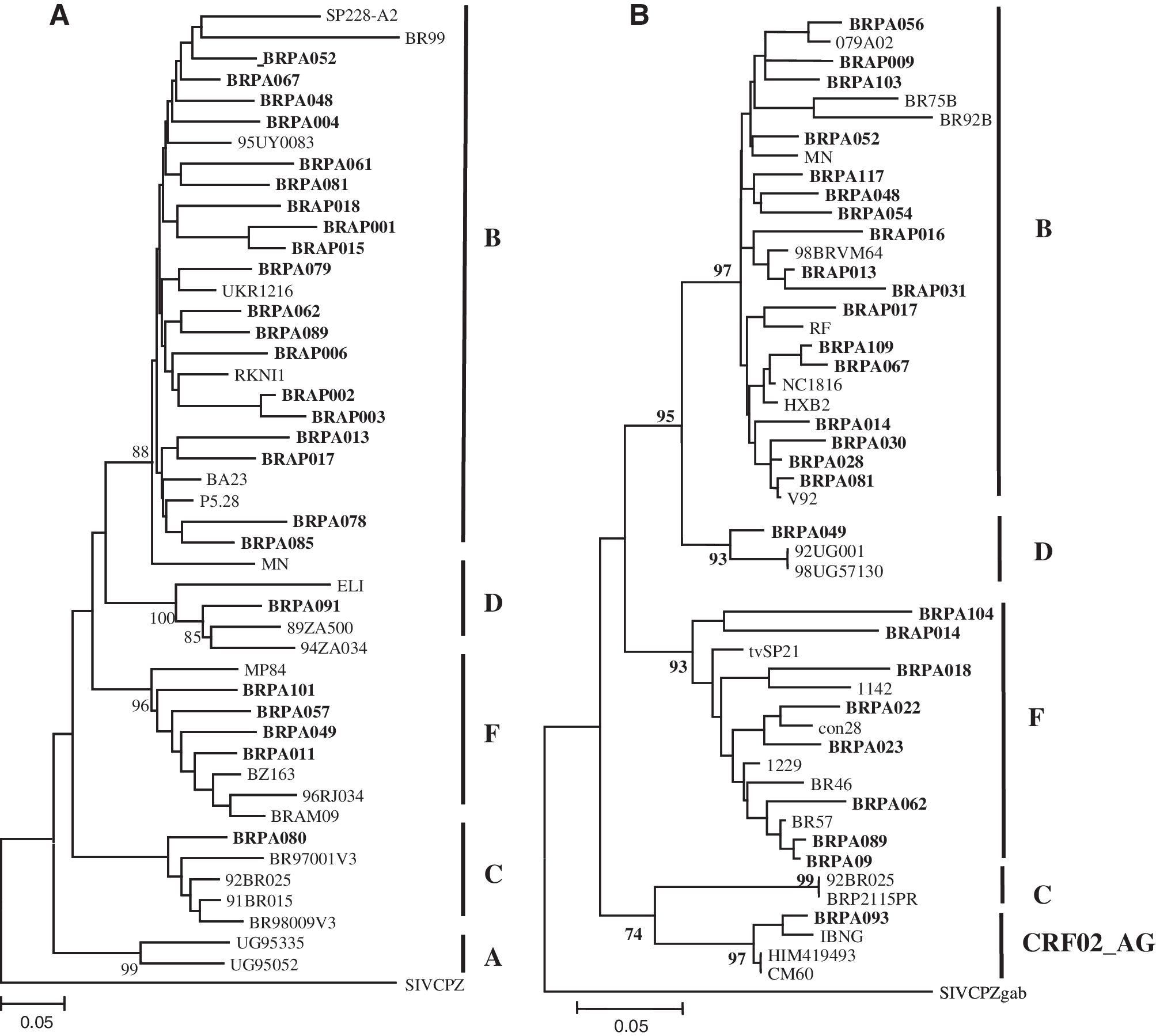
Phylogenetic analysis of HIV-1 isolates from Belem (BRPA) and Macapa (BRAP) compared to the reference HIV-1 group M subtypes available in the Los Alamos database using the neighbor-joining method (Kimura two-parameter). Phenograms are shown in two panels: (
The crown of the V3 loop of the sequences of subtype B revealed at least nine distinct forms. The majority of samples showed the amino acid sequence GPGR (39/76; 51.3%), which is commonly found among the European and North American strains, followed by the motif GWGR (24/76; 31.6%). The sequences GPGS (3.9%), GFGR (3.9%), GPGQ (3.9%), GPGK (1.3%), GPRR (1.3%), GVGR (1.3%), and GFGQ (1.3%) were also described.
The sample subtyped as CRF02_AG presented a high degree of homology and a high bootstrap value (92.3%) with the samples from GenBank isolated in African countries (Fig. 1B). The majority of identified strains showed a profile of susceptibility to protease inhibitors in current use (data not shown).
Discussion
The HIV-1 epidemic in Brazil is largely heterogeneous. Numbers related to the Southern region are higher than in the Northern areas of the country, but the importance of the epidemic in the Northern region of Brazil cannot be underscored. The Amazon region of Brazil borders with nine other South American countries and a poorly controlled transit of persons is the commonest situation observed in most parts of the border.
Belem is the major city in the Northern region and the major port of entry of tourists in the region. Macapa is a smaller setting, but it is not less important because of the consistent contact with bordering countries, particularly with French Guyana. HIV-1 entry in an Indian community from the State of Amapa has been reported 16,17 and the most probable explanation for the infection was contact with prostitutes in Suriname. Consequently, Belem and Macapa constitute two of the most important routes for exchanging HIV-1 strains coming in and out of the Northern region of the country.
The characterization of the population involved with HIV-1 infection has remained unchanged in Belem for the past 10 years. 18 The present article shows a group in which poorly educated, young adult males are still the most involved subjects in the epidemic, similar to what is seen in the southeast (Rio de Janeiro) and south (Rio Grande) of the country. 19,20 Similar to the rest of the country, sexual transmission is the major route for the dissemination of the virus 18,19 together with other commonly recognized sexually transmitted diseases including gonorrhea and syphilis. A similar profile is observed in other regions of the country, 19,21,22 but it is not accompanied by the use of intravenous drug usage as an additional component seen elsewhere in Brazil. 23 –26
The first approach in our laboratory for the molecular surveillance of HIV-1 subtypes in Belem yielded the presence of subtypes B and F using the heteroduplex mobility assay. 18 Here we present evidence, for the first time in the Northern region, of (1) a continuous entry of new subtypes (D, and C), (2) the first report of CRF02_AG entry, and (3) the presence of several env/pro mosaics.
The higher frequencies of subtypes B, followed by F, is a common epidemiological pattern in South American areas 27 –30 as well as in Brazil, 10,31,32 but the finding of other subtypes may compromise the antigenic content when considering a specific antigenic vaccine preparation for the Northern region of the country.
Samples that did not amplify env segments may represent highly divergent strains, without a previous report. 33 The majority (51.3%) of subtype B strains isolated presented the GPGR amino acid sequence found in the Americas 34 –36 and Europe, 37 –39 but the GWGR, a common sequence of the strains circulating in Brazil, 40,41 was detected in 31.6% of the samples. The genetic heterogeneity of the two samples of subtype B (GPGR and GWGR) did not show any significant difference, suggesting that these variants probably made their way into the studied regions at the same time, 42 as well as in the cities of Belem and Macapa.
HIV-1 subtypes isolated in Belem and Macapa presented an apparently higher diversity and divergence than other F subtypes, a fact that may represent a summation of mutations of a strain that is circulating in Brazil 5,32 and in the Northern region 18 since the 1990s.
Subtype C presented the motif GPGQ, which is conserved within the subtype, as previously described. 11 Subtype D was probably introduced from southern regions, as it was isolated from a subject (BRPA091) who had sexual contact with persons from São Paulo and Rio de Janeiro, cities where subtype D has already been reported to occur. 5 It is worth mentioning that the two samples yielding subtype D also presented mosaics (Dpro/Fenv and Bpro/Denv) similar to a previous observation made in Brazil. 31 Recombinant forms are quite common in the country and the presence of a Cenv/Bpro was described for the first time in the Northern region, although we cannot rule out the possibility of amplification of two different viruses coinfecting the same subject.
Subtype CRF02_AG, a highly prevalent strain in several African countries 43 and the most disseminated recombinant subtype in the world, 44,45 was recently introduced in South America 46 and in Rio de Janeiro 47 almost at the same time as in the Northern region, in Belem. It is possible that the recombinant strain has been circulating for a few years in Belem as well as elsewhere in the region.
HIV-1 group M diverged into several subtypes and circulating recombinant forms. 48 Currently, subtype A and CRF02_AG (a recently emerged and fast-spreading strain) account for approximately 75% of new infections worldwide. 48 Subtype B is still the most prevalent in the Americas and the same occurs in Belem and Macapa where the epidemic is more recent. Surprisingly, the degree of genetic diversity found in Belem is unparalleled in Brazil and the most likely explanation is the ease of the port of entry, although the numbers still indicate the beginning of the introduction. The findings indicate the urgent need to keep monitoring the entry and the possibility of changes in the prevalence of different HIV-1 subtypes.
Because of the ability of HIV-1 to rapidly evolve, developing an effective vaccine will be difficult to achieve. The present article depicts a situation that has a direct influence on immunoprophylactic measures that might be put into practice in the country. Furthermore, it emphasizes the constant need for an active molecular surveillance to detect circulating additional stains, so far unidentified in the Amazon region of Brazil, and in other areas of the country.
Footnotes
Acknowledgments
We acknowledge all subjects enrolled in the present study. This work was supported by grants from the Programa Nacional de DST e AIDS (CSV331/2006), Ministry of Health, Brazil, and Universidade Federal do Pará.
Disclosure Statement
No competing financial interests exist.