




Abstract
The presence of transmission clusters and their relationship to the recruitment chain were investigated in an HIV prevalence assessment survey using respondent-driven sampling among men who had sex with men (MSM) in Zagreb, Croatia. HIV infection was found in 18 of 360 participants. Five individuals belong to a transmission cluster of MSM infected with phylogenetically related HIV. All were recruited in later waves (fourth to ninth), suggesting that the population is sexually networked.
R
A recent RDS-based study on the prevalence of HIV and other sexually transmitted infections and sexual behavior of 360 MSM from Zagreb, Croatia conducted between September and December 2006 reported a 4.5% prevalence of HIV infection. 5 The aim of this study was to investigate the presence of transmission clusters and their relationship to the RDS-based recruitment chain among the same cohort of HIV-infected MSM. We also determined HIV genotypes and analyzed mutations associated with resistance to antiretroviral drugs. Thus, in the present study, we enrolled all 18 MSM who were diagnosed with HIV infection in the original RDS study. 6
HIV viral load was determined by using the COBAS AmpliPrep/COBAS AMPLICOR HIV-1 Monitor Test, Version 1.5 (Roche Molecular Systems, Branchburg, NJ). HIV-1 sequencing was performed by using the TRUGENE HIV-1 Genotyping Kit (Visible Genetics, Toronto, Canada). HIV subtypes were determined by using the REGA HIV-1 subtyping tool version 2.0 (available at
Plasma viremia was detectable and higher than 1000 copies of HIV-1 RNA/ml in 13 of 18 participants. Nucleic acid sequencing was successfully performed in 12 participants. All sequences belonged to HIV-1 subtype B. Twenty sequences from 16 epidemiologically unrelated Croatian HIV-infected patients that were obtained during routine clinical monitoring (resistance testing in treatment failures) were also included in the phylogenetic analysis. Phylogenetic relationships between the pol sequences were estimated using the neighbor-joining (NJ) method with the Kimura two-parameter distance model. The reliability of the branching patterns was tested by bootstrap analysis (1000 replicates). The phylogenetic clusters with bootstrap value of gt;98% were considered significant. Sequences are available at the EMBL Nucleotide Sequence Database under accession numbers FN424270–FN424301.
Sequences from 5 of 12 RDS participants appeared within one transmission cluster (bootstrap value ≥98% and branch length<0.015 nucleotide substitutions per site) (Fig. 1). Four of five participants within this cluster subsequently entered clinical care, but one participant failed to collect the results of the survey. Altogether, six newly diagnosed HIV-infected patients from the RDS study entered care, four of whom belonged to the cluster.

Neighbor-joining tree of HIV-1 pol gene (protease and reverse transcriptase) from men who have sex with men (MSM) recruited during a respondent-driven sampling (RDS) study. Sequences from 12 RDS participants are indicated with four-digit numbers-CRO. Twenty sequences from 16 epidemiologically unrelated Croatian HIV-infected patients that were obtained during routine clinical monitoring are indicated with two-digit numbers-CRO.
The individuals who belong to the cluster of MSM infected with phylogenetically related HIV were recruited in the later waves. One was recruited in the fourth wave, two in the sixth wave, one in the eight wave, and one in the ninth wave (Fig. 2). Based on these findings, there seems to be evidence that this population is sexually networked, and that, at least those MSM, were not recruiting their sexual partners, which is one of the assumptions of RDS. Since there was a high degree of phylogenetic homology between individuals in our cluster this might indicate recent and ongoing spread of HIV infection among MSM in Zagreb.
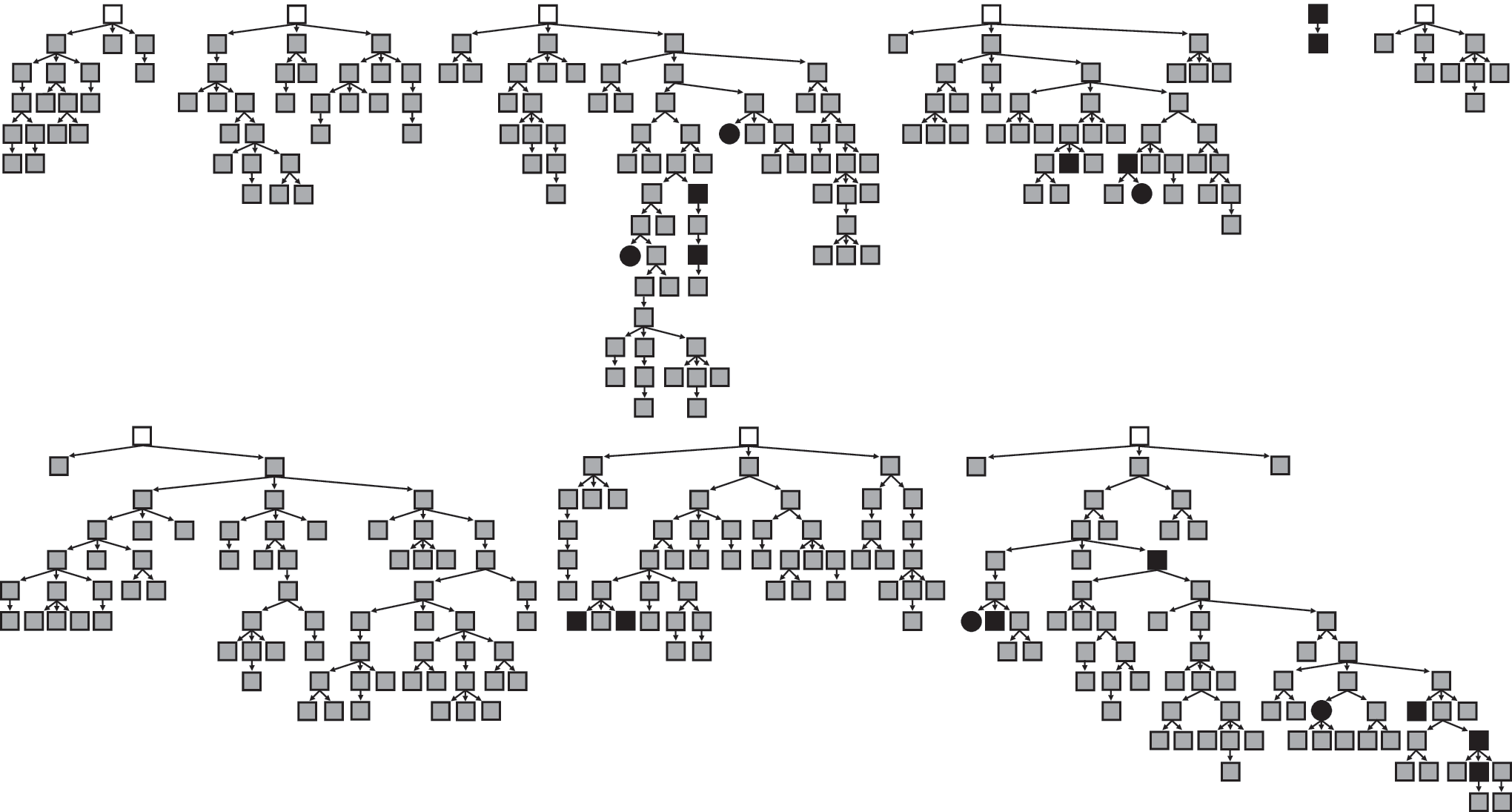
Recruitment networks for the respondent-driven sampling study of 350 men who have sex with men (MSM) from Zagreb, Croatia. Seeds are shown as empty squares at the top of each recruitment network and arrows indicate the direction of recruitment. HIV status of MSM is indicated by shading: black indicates MSM infected with HIV-1 and gray indicates MSM not infected with HIV-1. HIV-infected MSM who belong to the significant transmission cluster (based on the phylogenetic analysis) are presented as black circles. Black squares indicate HIV-infected MSM that do not appear within phyolgenetically significant transmission clusters.
One RDS participant not previously aware of his HIV status carried a mutation T215S that represents a transition between wild type and mutations Y and F. Although the T215S mutation does not cause phenotypic resistance to nucleoside analogues, it does indicate that a resistant virus may have been transmitted.
Our study demonstrated the effectiveness of combining social network analysis and phylogenetics for characterizing HIV transmission among the MSM population in Zagreb. MSM could be the major source of future subtype B transmission within Croatia. The immediate implementation of preventive measures targeting MSM will be necessary to maintain the current status of Croatia as a country with low level HIV epidemics. RDS studies among MSM in so-called low-prevalence countries might contribute to earlier diagnosis and earlier inclusion into care of HIV-infected persons.
Footnotes
Acknowledgments
This study was supported in part by grants from the Croatian Ministry of Science, Education and Sports to Prof. Begovac and Dr. Zidovec Lepej (Grants 108-1080116-0098 and 143-1080116-0097) as well as bilateral Slovenian-Croatian research project titled “Molecular epidemiology of HIV-infection and resistance to antiretroviral drugs” to Prof. Poljak and Dr. Zidovec Lepej. The authors wish to acknowledge Dr. Dunja Z. Babic and Dr. Bostjan Kocjan for the phylogenetic analysis. The research leading to these results received funding from the European Community's Seventh Framework Programme (FP7/2007-2013) under the project collaborative HIV and Anti HIV Drug Resistance Network (CHAIN) grant agreement No. 223131.
Disclosure Statement
No competing financial interests exist.