




Abstract
Although Cameroon, in west central Africa, has a relatively low HIV prevalence of 5–6%, all HIV-1 groups (M, N, O, and P), nearly all HIV-1 group M subtypes, and numerous intersubtype recombinant forms have been identified in Cameroon. In this report, we describe the near full-length sequence of 04CMU11421, an HIV-1 group M subtype J strain collected in Cameroon in 2004. Phylogenetic analysis of the genome sequence shows high bootstrap support with three subtype J reference sequences in the HIV Sequence database. Therefore, 04CMU11421 represents a fourth pure subtype J isolate and the first reported in Cameroon.
H
Cameroon, in west central Africa, has been an important country for studying HIV-1 strain diversity. Although the HIV prevalence of 5–6% is relatively low, 3 all HIV-1 groups (M, N, O, and P), nearly all group M subtypes, and numerous CRFs have been identified in Cameroon. Furthermore, the range of the chimpanzee subspecies Pan troglodytes troglodytes, which has been implicated in zoonotic transmission of HIV into humans, is within Cameroon. 4
HIV-infected specimens were collected in Cameroon and evaluated for unusual viral strains using env immunodominant region (IDR) and V3 peptide enzyme-linked immunoassays (PEIAs). 5 Specimen 04CMU11421 was selected as a potential variant strain based on reactivity to the group M and O IDR peptides and the absence of reactivity to all V3 peptides (data not shown). No patient information was available on this specimen except for a collection year of 2004. Total nucleic acids were extracted from plasma using a QIAamp Blood Mini Kit (Qiagen, Inc., Valencia, CA) according to the manufacturer's protocol. Reverse transcriptase-polymerase chain reaction (RT-PCR) amplification of env IDR using a OneStep RT-PCR Kit (Qiagen, Inc., Valencia, CA) with group M specific primers was performed according to the manufacturer's protocol. PCR fragments were visualized on agarose gels, purified using Exo-SAP IT (US Biochemicals, Cleveland, OH) according to manufacturer's protocol, and sequenced directly. DNA sequencing was performed using the ABI Prism Big Dye Terminator Cycle Sequencing Ready Reaction Kit (Applied Biosystems, Foster City, CA) and ABI Model 3130xl Genetic Analyzer (Applied Biosystems, Foster City, CA). Sequence data were edited manually and contigs assembled using Sequencher 4.7 (Gene Codes Corp., Ann Arbor, MI). Ambiguous nucleotide positions were assigned the appropriate IUPAC designations. The primers used for amplification and sequencing are available on request.
To determine the subtype of 04CMU11421, the env IDR sequence was aligned with HIV-1 reference sequences using the CLUSTAL W method (MegAlign, Lasergene v. 7.2.1, DNAstar, Inc., Madison, WI). Where possible, at least three reference sequences of each subtype and CRF were included in the alignment. Gaps were stripped from the alignment using BioEdit (v. 7.0.4.1, T.A. Hall, 1999, North Carolina State University, Raleigh, NC). Phylogenetic analysis was performed using PHYLIP (v. 3.573, J. Felsenstein, University of Washington, Seattle, WA). Evolutionary distances were estimated with DNADIST (Kimura two-parameter method) and phylogenetic relationships were determined by NEIGHBOR (neighbor-joining method). Reproducibility of trees was evaluated using SEQBOOT (100 replicates) and CONSENSE. Trees were constructed using TreeExplorer (v. 2.12, K. Tamura, Tokyo Metropolitan University, Tokyo, Japan). Programs were run with default parameters. The env IDR sequence of 04CMU11421 branched with the subtype J reference sequences with a bootstrap value of 98% (data not shown).
HIV-1 group M subtype J strains are rare. Only three full-length sequences are in the Los Alamos HIV sequence database, designated SE9173 (accession #AF082395), 6 SE9280 (accession #AF082394), 6 and CDKTB147 (accession #EF614151). 7 The first two isolates were collected in Sweden from individuals who were originally from the Democratic Republic of Congo (DRC). 6 CDKTB147 was collected in the DRC, 7 where the overall prevalence of subtype J has been estimated at 1–8%. 8,9 Subtype J sequences have also been reported in Uganda, 10 Angola, 11 Nigeria, 12 Zambia, 13 Spain, 14 Senegal, 15 Cuba, 16 Cameroon, 15,17 and France, 15,18 but the subtype designations in these reports are based on short subgenomic sequences. CRF06_cpx, CRF11_cpx, and CRF13_cpx contain subgenomic segments of subtype J. 1
Because subtype J strains are rare, the near full-length genome of 04CMU11421 was obtained by RT-PCR and nested PCR amplification of overlapping fragments (Fig. 1). Seven nested PCR fragments were sequenced directly, as described above. Due to sequence heterogeneity in three of the PCR fragments, three subfragments were amplified and cloned prior to sequencing. The PCR fragments and cloned sequences were assembled to obtain the final sequence of 9077 base pairs for 04CMU11421. The genome structure of 04CMU11421 has open reading frames for the structural and accessory genes typical of HIV-1 strains.
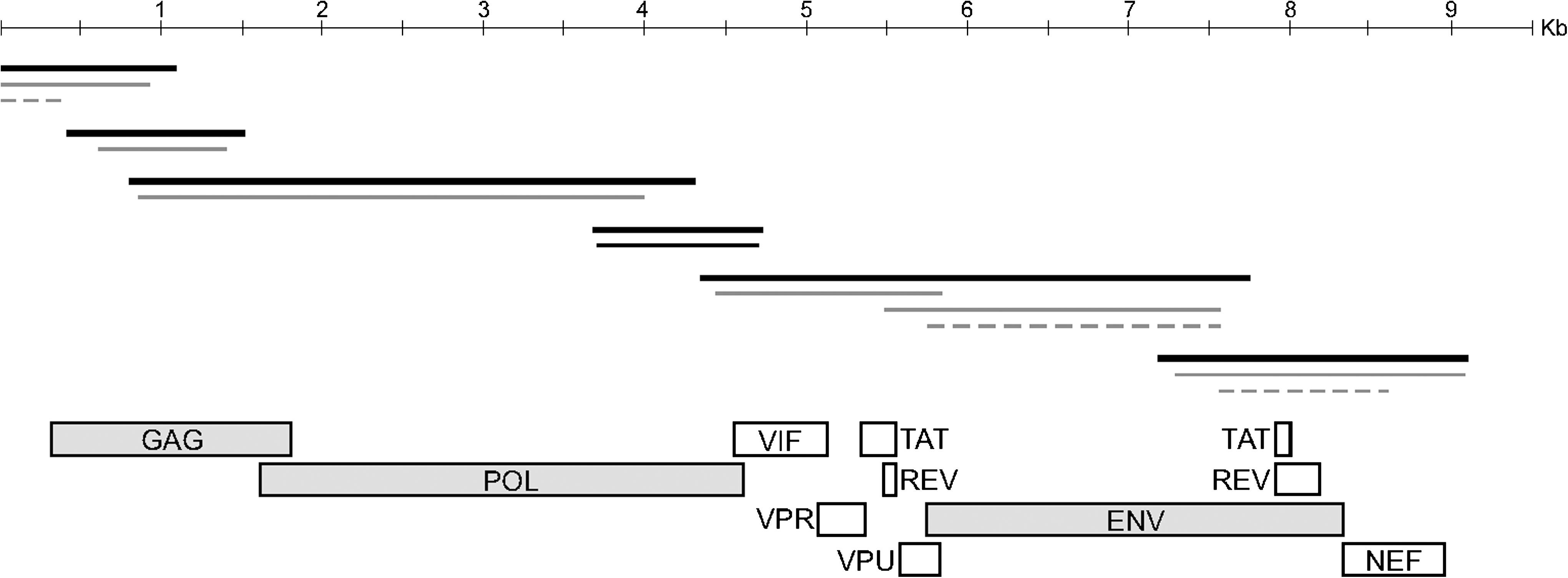
Schematic of strategy to obtain the near full-length genome of 04CMU11421. The genome scale is shown at the top. Thick lines denote first round RT-PCR products. The thin lines denote second round PCR products that were sequenced directly and dashed lines denote second round PCR products that were cloned prior to sequencing. The genome sequence was assembled from the seven overlapping PCR fragments and three cloned fragments. Deduced structural and regulatory genes are mapped below the fragments.
For phylogenetic analysis, the 2008 HIV-1/SIVcpz complete genome alignment was downloaded from the Los Alamos HIV sequence database. 1 The alignment was modified by restricting it to group M subtypes and CRFs. The group N sequence YBF30 was included as the outgroup. Sequence 04CMU11421 was added to this alignment and adjusted manually, and then gap-stripped using BioEdit. Phylogenetic analysis showed that 04CMU11421 branches with the subtype J reference sequences with a bootstrap value of 100% (Fig. 2). Separate phylogenetic analyses of gag, pol, and env gp160 alignments also demonstrated that the sequences of all three genes consistently branched with the subtype J reference sequences with bootstrap values of 100% (data not shown).
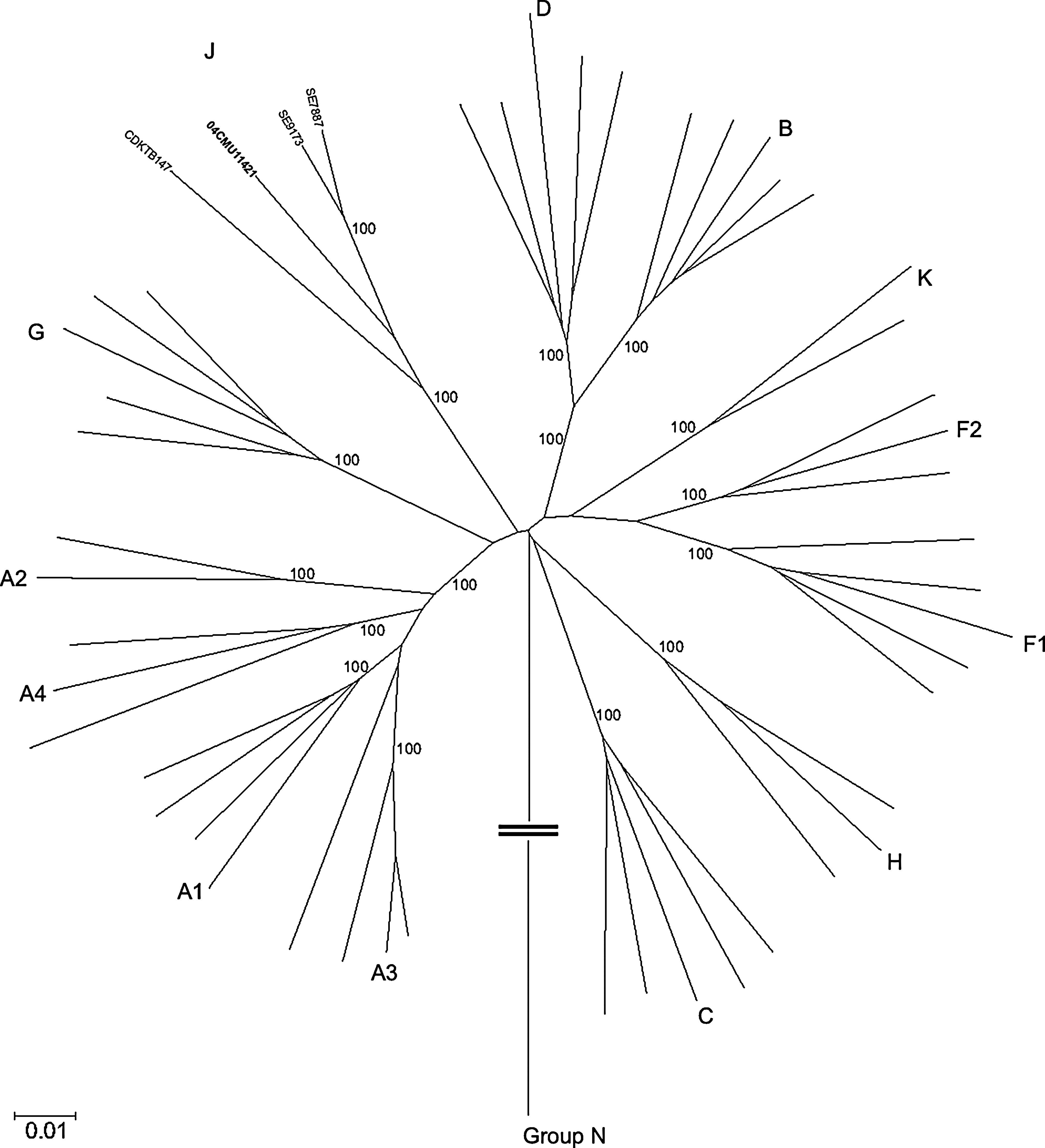
Phylogenetic tree derived from the complete genome alignment of 04CMU11421 and HIV-1 group M reference sequences. The alignment is 8115 base pairs in length after gaps were stripped. HIV-1 group N strain YBF30 was used as the outgroup and bootstrap values are shown for selected branches.
Bootscan analysis using SimPlot (v. 3.5.1, S.C. Ray, John Hopkins University, Baltimore, MD) was performed to compare the overall genomic composition of 04CMU11421 to consensus sequences for group M reference strains (A1, A2, A3, A4, B, C, D, F1, F2, G, H, J, and K) with group N isolate YBF30 used as the outgroup (Fig. 3a). Across the entire genome, 04CMU11421 branched with the subtype J consensus sequence. However, the percent reproducibility fell below 80% in two regions, nucleotide positions 3395–4255 and 6846–7151, in the gap-stripped alignment. In 04CMU11421, these two regions correspond to positions 3808–4673 at the end of pol and 7518–7823 in env. A phylogenetic tree derived from a sequence alignment for positions 3395–4255 shows that 04CMU11421 branches with the subtype J reference sequences with a bootstrap value of 99% (Fig. 3b). In the phylogenetic tree derived from positions 6846–7151, 04CMU11421 branches with two subtype J reference sequences, although the bootstrap value is only 37% (Fig. 3c). The subtype J sequence CDKTB147 did not branch with the other J strains in this tree and appears to be unclassified in this region. Alternatively, there may be insufficient information in this short region (306 bp) for clear classification of subtype J. Removal of CDKTB147 from the bootscan analysis did not significantly alter the scan profile of 04CMU11421 (data not shown). Despite the low bootstrap value, we have classified 04CMU11421 as subtype J in this short region and throughout the entire genome sequence.
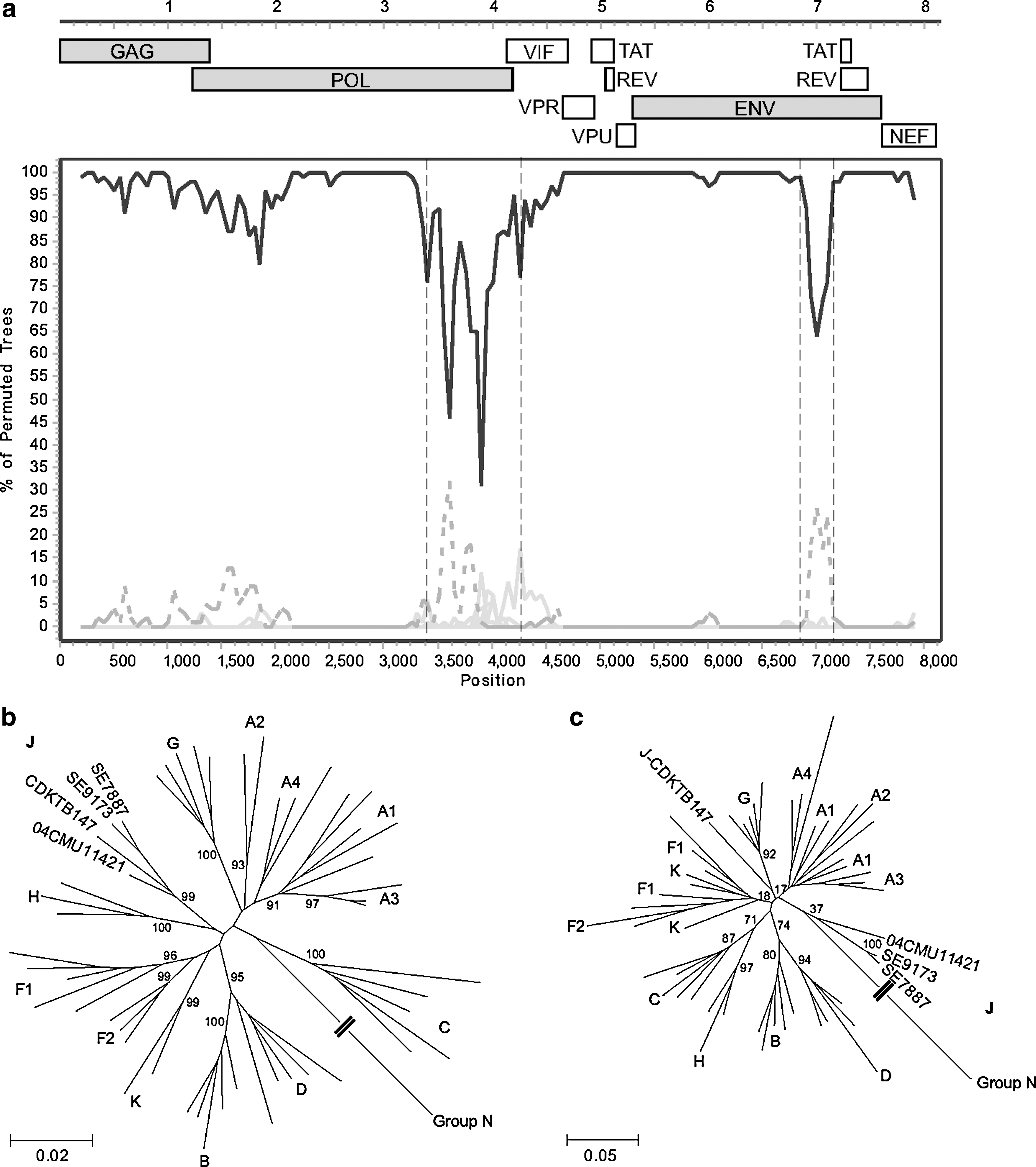
(
The near full-length genome of a fourth strain of HIV-1 subtype J strain has been sequenced. Throughout the genome, 04CMU11421 closely and reproducibly branches with the subtype J reference sequences in the database. This is the first near full-length subtype J sequence described from Cameroon. Although subtype J strains are rare, the addition of this fourth sequence to the database may contribute to our understanding of HIV evolution and classification.
Footnotes
Acknowledgments
The authors wish to thank Priscilla Swanson and Barbara Harris for reviewing the manuscript and helpful editorial comments. The GenBank accession number for 04CMU11421 is GU237072.
Author Disclosure Statement
No competing financial interests exist.