




Abstract
Our previous studies have shown two distinct disease patterns (rapid and normal onset of clinical symptoms) in morphine-dependent SHIV/SIV-inoculated rhesus macaques. We have also shown that control as well as 50% of morphine-dependent macaques (normal progressor) developed humoral and cellular immune responses whereas the other half of the morphine-dependent macaques (rapid progressor) did not develop antiviral immune responses after infection with SIV/SHIV. In the present study, we analyzed the association between cytokine production, immune response, and disease progression. To study the immunological effects of morphine at cytokine levels in the context of a lentiviral infection, we inoculated rhesus macaques with a mixture of SHIVKU−18, SHIV89.6P, and SIV/17E-Fr. These animals were followed for a period of 56 weeks for cytokine level production in plasma. Drug-dependent rapid disease progressors exhibited an increase in IL-18 and IL-1Ra and a decrease in IL-12 levels in the plasma. Morphine-dependent normal progressors and control macaques exhibited an increase in both IL-18 and IL-12, whereas IL-Ra levels remained constant throughout the observation period. These results suggest that rapid disease progression in relation to morphine dependency may be the result of an altered cytokine profile.
I
TH1/TH2 cytokine switch has been found to play an important role during disease progression among HIV-infected individuals. Type I responses are generally found in asymptomatic HIV-infected individuals, whereas type II responses are observed during the symptomatic phase. 7 Opioids have also been shown to enhance the production of proinflammatory cytokines, whereas the production of antiinflammatory cytokines is downregulated by opioids. 8,9 In this study, we sought to determine whether chronic morphine administration contributed to cytokine regulation in “drug-dependent and SIV/SHIV-infected” macaques that could have contributed to the lack of a detectable immune response and disease progression among rapid progressors.
We have established a reliable model of morphine addiction and AIDS in macaques, which has been reported earlier. 1,10 Briefly, morphine dependence was established by injecting increasing doses of morphine (1–5 mg/kg of body weight over a 2-week period) through the intramuscular route at 8-h intervals. The animals were maintained at three daily doses of morphine (5 mg/kg) for an additional 18 weeks. All macaques were infected by the intravenous route with a 2-ml inoculum containing 104 50% tissue culture infective doses each of simian–human immunodeficiency virus SHIVKU−18, 11 SHIV 89.6P, 12 and SIV/17E-Fr. 13 The animals were monitored for a period of 56 weeks.
For the luminex assay, the antibody pairs for interleukin (IL)-12, IL-18, IL-1β, and IL-1Ra were received as a gift from Upstate USA Inc., Chicago, IL; MBL International, Woburn, MA; and R&D Systems Inc., Minneapolis, MN. These were measured in plasma as part of the simultaneous detection of multiple cytokines and chemokines using luminex technology as described previously. 14 The cytokines were measured at weeks 0, 4, 12, 20, 28, 40, and 56 in morphine-exposed and control macaques. The results are presented as concentration in pg/ml. More than a two-fold difference in plasma was considered significant.
In our model we use a mixture of three viruses that has been shown to cause massive CD4+ cell loss and neurological disorders in animals. 10 Using this model, we have previously shown that morphine-dependent macaques showed significantly higher virus replication, and that 50% of the morphine-dependent and -infected animals (3/6) developed SHIV/SIV-induced disease within 20 weeks after infection, designated as “rapid progressors,” whereas other morphine-dependent (n = 3; normal progressors) and control animals (n = 3) survived for much longer. The rapid progressors did not mount any kind of immune response as evident by the lack of envelope-specific binding as well as neutralizing antibodies against either of three viruses and virus-specific cell-mediated immune responses. 6 In our attempt to establish a reason for accelerated disease progression and lack of immune response in half of the morphine-dependent macaques, we sought to determine whether there was a correlation with TH1/TH2 cytokines.
Interleukin 12 is produced by activated macrophages and serves as an essential inducer of TH1 cell development. It has also been found to be important in sustaining a sufficient number of memory/effector TH1 cells to mediate long-term protection to intracellular pathogens. 15 IL-18 is expressed by various cell types including macrophages and dendritic cells and stimulates the proliferation of activated T cell, enhances the activity of NK cells, and stimulates the production of interferon (INF)-γ by TH1, CD8+ T cells, and NK cells. Although IL-18 itself cannot induce strong INF-γ production, it does so in synergy with IL-12. 16,17 Thus, we sought to determine the levels of IL-12 and IL-18 in morphine-dependent and control macaques. The results of these experiments are shown in Figs. 1 and 2, respectively. After virus inoculation, IL-12 levels started to decrease in the morphine group. The levels continued to decrease for the morphine-dependent rapid progressors, whereas the normal progressors exhibited recovery by week 12 postinfection, which continued until week 56. The control macaques exhibited increasing levels up to week 12 with varying levels thereafter. However, the levels of IL-18 in rapid and normal progressors as well as in control macaques increased gradually postinfection with the rapid progressors exhibiting the highest levels of IL-18. In the present study, although IL-18 increased in rapid progressor morphine-dependent macaques, the insufficient production of IL-12 in those animals might have contributed to the compromised ability of this cytokine in INF-γ production by T cells and NK cells. IL-18 might have also contributed to a lack of antiviral immunity in rapid progressors because it is known to promote the development and differentiation of naive CD4+ T cells into type 2 T helper cells.
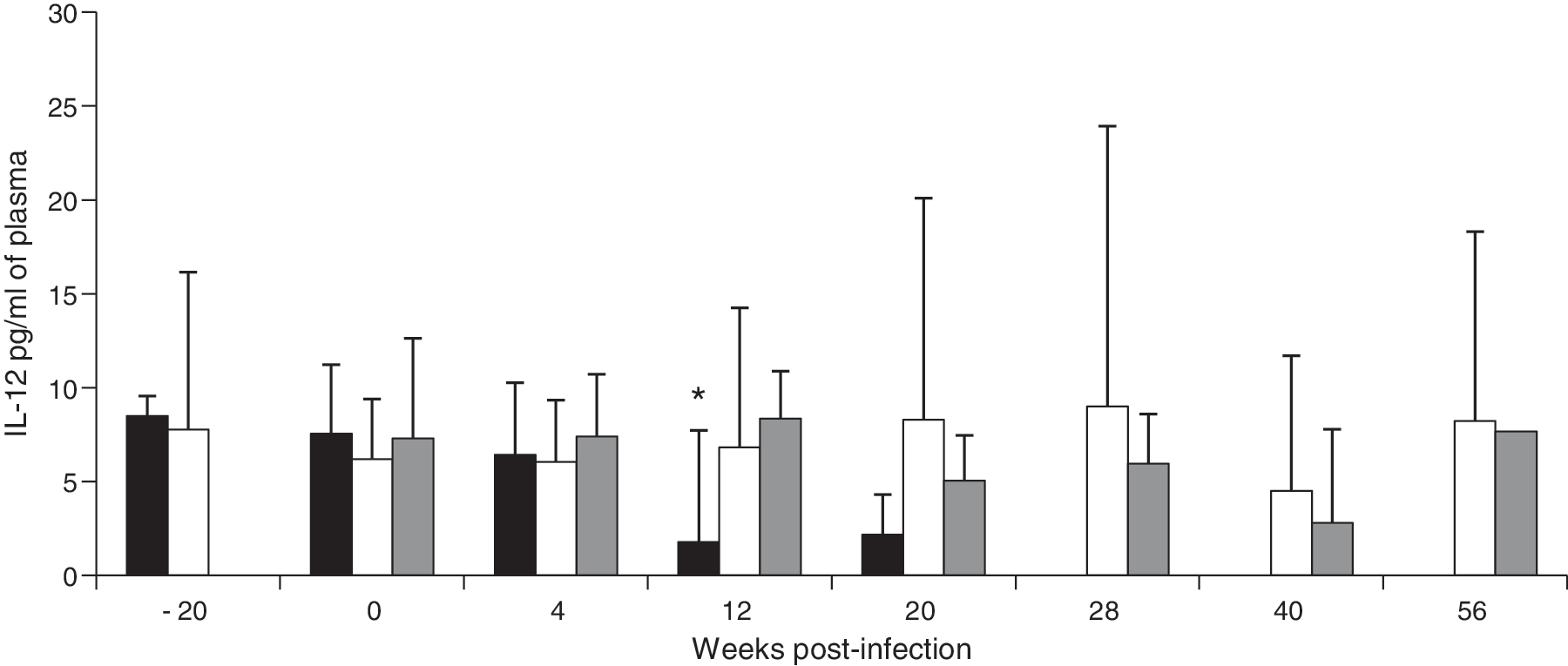
IL-12 levels in plasma of morphine-dependent and control macaques infected with SIV/SHIV. Six morphine-dependent and three control macaques were infected with SHIVKU−18, SHIV89.6P, and SIV 17E/Fr. Plasma samples were collected at weeks −20, 0, 4, 12, 20, 28, 40, and 56. The IL-12 level in plasma was detected using luminex technology as described by Giavedoni and co-workers. 14 The bars (▪ rapid progressor, □ normal progressor, and ▪ control macaques) represent mean values ± standard deviations. The statistical significance was calculated by Student's t test. *p value <0.05 as compared to control macaques.
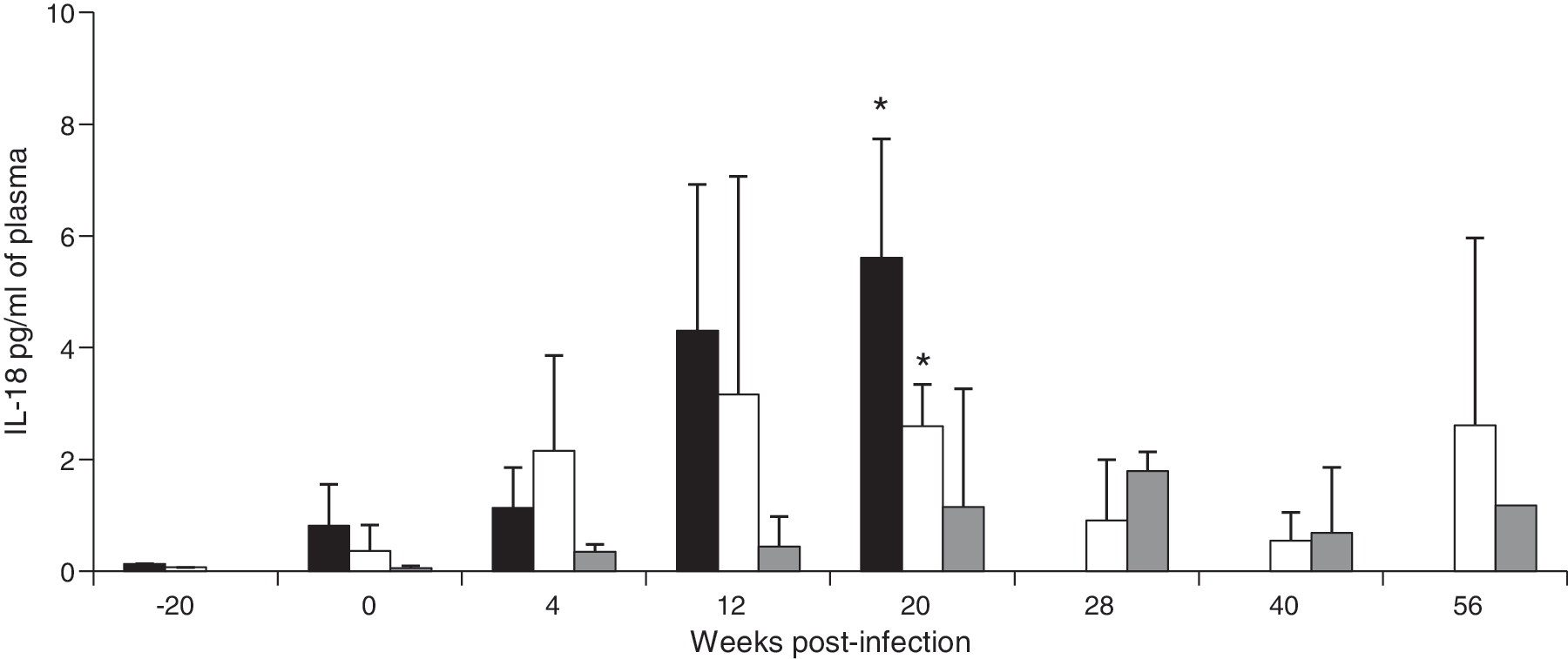
IL-18 levels in plasma of morphine-dependent and control macaques infected with SIV/SHIV. Six morphine-dependent and three control macaques were infected with SHIVKU−18, SHIV89.6P, and SIV 17E/Fr. Plasma samples were collected at weeks –20, 0, 4, 12, 20, 28, 40, and 56. The IL-18 level in plasma was detected using luminex technology as described by Giavedoni and co-workers. 14 The bars (▪ rapid progressor, □ normal progressor, and ▪ control macaques) represent mean values ± standard deviations. The statistical significance was calculated by Student's t test. *p value <0.05 as compared to control macaques.
Interleukin-1β is a proinflammatory cytokine that plays an important role in triggering the immune response during the course of a disease. 18 To investigate the role of the IL-1 system we determined the plasma levels of the IL-1β and IL-1 receptor antagonist (IL-1Ra). No significant changes in the levels of IL-1 β were detected throughout the observation period in either morphine-dependent or control macaques (data not shown). We also investigated the relation between IL-1Ra levels and disease progression. IL-1Ra is a naturally occurring antagonist of IL-1 that is capable of blocking IL-1 effects. 18 IL-1Ra levels have been reported as significantly elevated in HIV-infected patients with no correlation with HIV disease stages. 19 However, it has also been reported that the increasing IL-1Ra concentration in peripheral blood correlates with markers of HIV progression. 20 In our model system, IL-1Ra levels significantly increased in the morphine-dependent rapid progressors (range 1132.0–3235.5 pg/ml) by the time of death, whereas the levels for the normal progressors and control macaques did not show a significant difference (average of 61.2 and 67.5 pg/ml, respectively) as shown in Fig. 3.

IL-1 receptor antagonist (IL-1Ra) levels in plasma of morphine-dependent and control macaques infected with SIV/SHIV. Six morphine-dependent and three control macaques were infected with SHIVKU−18, SHIV89.6P, and SIV 17E/Fr. Plasma samples were collected at weeks −20, 0, 4, 12, 20, 28, 40, and 56. The IL-1Ra level in plasma was detected using luminex technology as described by Giavedoni and co-workers. 14 The bars (▪ rapid progressor, □ normal progressor, and ▪ control macaques) represent mean values ± standard deviations. The statistical significance was calculated by Student's t test. *p value <0.05 as compared to control macaques.
In summary, our results clearly indicate that the decrease in IL-12 and increase in IL-18 might have contributed to the lack of development of an antiviral immune response in rapid progressor morphine-dependent macaques.
Footnotes
Acknowledgments
This work was supported by the National Institute on Drug Abuse (DA015013 and DA025011), the National Institute of General Medical Sciences (GM008239), and NCRR (RR003640).
Author Disclosure Statement
No competing financial interests exist.