




Abstract
The presence of HBV genomes with deletions at the basal core promoter (BCP) is associated with more aggressive liver disease. This 3-year longitudinal analysis of two HIV-HBV-coinfected patients allowed identification of three deletions with dissimilar abundance and permanence into the HBV quasispecies composition. These deletions may contribute to HBV pathogenesis in HIV-coinfected individuals.
I
In HIV/HBV-coinfected individuals, increased HBV replication and lower rates of HBeAg seroconversion compared to HBV monoinfected individuals 5 were observed. It suggests that HIV infection modifies the cell microenvironment enhancing HBV replication; in addition, the HBV genome may differ when HIV coexists. 5
The core promoter (CP) plays a pivotal role in HBV replication and consists of the basal core promoter (BCP) and the upper regulatory region (URR). 6 Liver disease progression in individuals chronically monoinfected with HBV includes the appearance of viral genomes containing deletions, particularly in the BCP, which is associated with a more aggressive course. 7,8 The aim of the current study was to analyze, during a 3-year follow-up, the dynamics of different HBV variants harboring nucleotide deletions in the BCP identified from two HBe-positive HIV-coinfected patients under lamivudine therapy.
However, due to its critical role in the regulation of viral transcription, the sequence variations within the CP are restricted, and usually appear as mixed populations with wild-type (wt) sequence. This fact allows viral replication to proceed in a compensatory mechanism. 6
In a cohort of 22 HBV viremic HIV-coinfected individuals under HAART including lamivudine and followed for a period of 3 years (2006–2008), 9 we identified only two patients (C7 and C19; Table 1), carrying HBV genomes with different BCP deletions and expressing the HBe antigen. Demographic, biochemical (ALT level by the kinetic UV method), immune (CD4 T cell count by flow cytometry), and viral (HBV and HIV) data were collected. With regards to HBV, plasma viral load (lower detection limit: 1000 copies/ml; AMPLICOR HBV MONITOR Test, v2.0, Roche Molecular Diagnostics), genotype (by phylogenetic inference based on S and precore/core gene analysis), and resistance-associated mutations (by pol gene analysis as previously described 10 ) were recorded. HIV plasma viral load (lower detection limit: 50 copies/ml; Versant HIV 3.0 assay, Bayer Co., USA) was also measured. All parameters were longitudinally analyzed from three plasma samples (T1, T2, T3) obtained at each visit every 10 ± 3 months (Table 1).
To investigate the BCP sequence deletion abundance in each HBV viral isolate quasispecies composition, DNA was extracted from plasma samples at T1, T2, and T3 (QIAamp DNA blood kit, Basel, Switzerland) and subjected to nested polymerase chain reaction (PCR) amplification specifically for the HBV BCP genomic region. 11 A 304 nucleotide (nt) product was generated and cloned (pGEM-T Easy vector, Promega, USA). Clone-derived sequences were obtained from each of the 22 HBV isolates analyzed. The HBV isolates from patients carrying BCP deletions (C7 and C19) were ascribed to genotype A2 by phylogenetic inference carried out by the neighbor-joining algorithm. 9 The ALT levels or CD4 T cell counts for both patients did not exhibit marked fluctuations during follow-up.
The dynamics of viral quasispecies for each isolate, by means of molecular cloning, were analyzed using relatively small sample sets (20 clones) as previously validated. 12 Comparing HBV variants found in samples from both patients, it was observed that BCP deletions were different in size and abundance between them (Fig. 1). HBV isolates from patient C19 exhibited two deletion patterns: an 8 bp (nt 1768–1775) and a 20 bp (nt 1753–1772). The former was found abundantly at each time (12 ± 2 out of 20 clones) and was sustained during follow-up.
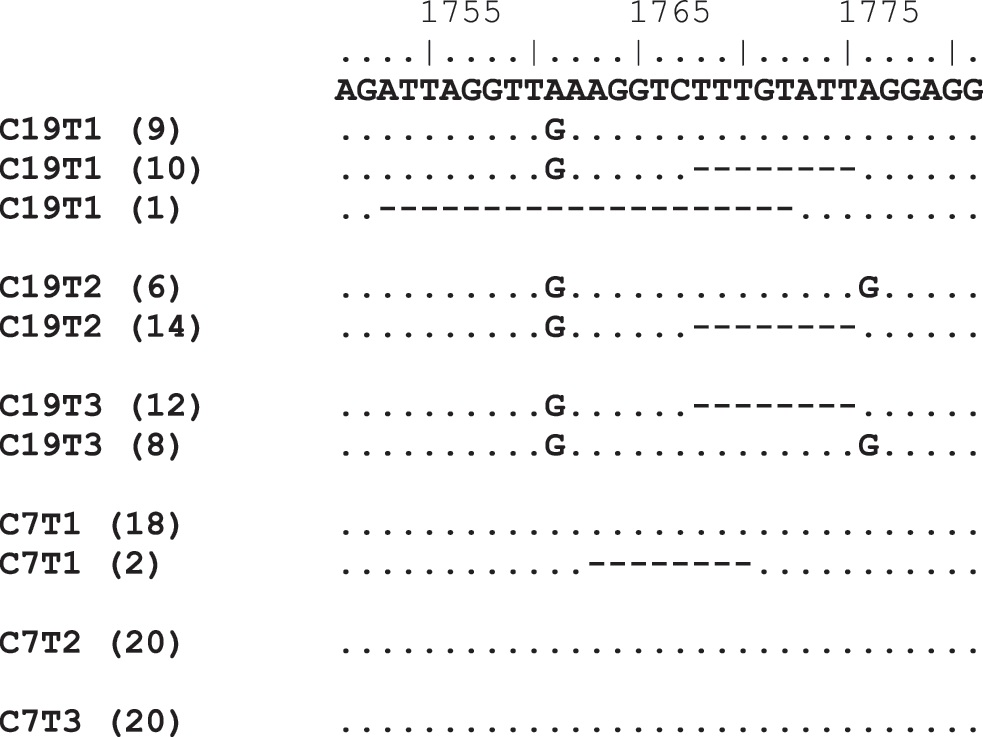
Deletions in the basic core promoter (BCP) of hepatitis B virus (HBV). Partial nucleotide sequences of the BCP (1750–1781) of HBV DNA, aligned to prototype sequence (GenBank X70185) are shown. Each sequence is identified by the patient ID (C7 or C19) followed by the time of sample collection (T1, T2, or T3); in parentheses are the number of clones with identical nucleotide sequences. Dashes: nucleotide deletion.
In contrast, the 20 bp abundance was poor (1 out of 20) and ephemeral (only in the T1 HBV isolate). On the other hand, among HBV isolates from patient C7, a different 8-bp deletion (nt 1763–1770) with low abundance (2 out of 18) was shown only the first time. These HBV genomes containing deletions coexisted with the wt into the HBV quasispecies composition (Table 1). It could be related to the high HBV viral load levels found in both patients during follow-up, representing a compensatory mechanism for viral fitness 6 when the BCP deletion is present, as supported by in vitro experiments. 13,14 Furthermore, the impact of BCP deletions on TA-rich sequences may explain the different kinetics of the HBV genomes containing deletions into the quasispecies. 6 In this regard, the deletion 1768–1775 completely lacks TA3 (1771–1775), which could alter its cis-acting function on the promoter and suppress the BCP function. 15 Among quasispecies, this BCP deletion was mostly preserved and abundant, which may reflect a viral strategy to survive under prolonged therapy that contributes to rescuing the impaired replication of lamivudine-resistant mutants. 16 This role was demonstrated for the HBV core promoter A1762T/G1764A dual mutation. 8,17 In contrast, the other 8-bp and 20-bp deletions (nt 1763–1770 and 1753–1772, respectively) affect the sequence between TA2 and TA3 as well as sites for transcriptional factors such as the liver-enriched factor (LEF), 13 which could explain their low abundance. 6 The impact of these deletions on BCP function by in vitro studies demonstrated a reduced production of pre-C mRNA but increased level of pregenomic RNA. 13,14
All the deletions within BCP would predictably have an influence on the expression of the HBV-X protein. 14 The three deletions described result in a frame shift and truncation at its C-terminal end that removes the serine protease inhibitor domain that is essential for trans-activation activity. 18 This could imply a total or partial removal of its capacity to interact with the HIV-LTR promoter sequence 5 when both viruses coexist. Further in vitro analyses of the replication ability of these HBV variants are warranted to elucidate their role on viral production in the presence of HIV coinfection.
In conclusion, the results of our study make it possible to identify and determine the dynamics of HBV quasispecies including core promoter deletion mutants with different kinetics in HIV-coinfected individuals. This might be one of the many cofactors that have an impact on HBV replication or evasion of therapy pressure.
Footnotes
Author Disclosure Statement
No competing financial interests exist.