




Abstract
This study seeks to analyze nearly full-length viral genomes for distinct genetic characteristics that are unique to local or regional strains and to identify regions that have high variability or are highly conserved. Nearly full length sequences of seven HIV-1 samples were obtained to ascertain the circulating subtype diversity in the HIV-1 epidemic in Jamaica as well as conduct detailed sequence analysis. The phylogenetic analysis of the seven sequences showed all the sequences clustering with HIV-1 pure B subtype references. The predicted amino acid sequenced in the V3 loop for the Jamaican samples showed that six samples contained the characteristic conserved tetrapeptide motif GPGR. One occurrence in isolate 09JM.PF09WX displayed a GQGP tetrameric motif similar to that found in a Korean B strain. All seven isolates (100%) were R5 viruses for preferential cofactor usage. These samples were collected from individuals who had tested positive for 1–5 years and were drug naive. The results suggested that the viruses were isolated from patients in the nonprogressive stage of disease. These are early stages in the assessment and the patient should be monitored to predict the progression of the disease and when HAART should begin.
G
Studies have shown that the main HIV-1 subtype circulating in Jamaica is subtype B, which is also the most common subtype in the Caribbean and the developed world including the United States, Europe, and Australia. 3,4 Nadai et al. also reported that 14 almost full-length genomes of HIV-1 subtype B extracted from infected patients from four Caribbean countries were phylogenetically distinct from the subtype B from other developed regions. 4
Analysis of the entire genome of HIV-1 is important not only because the information provides insight on the evolution of the virus in the population and thus better informs the design of vaccines but also on the progression of the HIV-1 infection as it relates to pathogenesis, the molecular structure, and epidemiology. Rousseau et al. asserted that full-length genome sequencing is important for a thorough in-depth subtyping of HIV-1 as well as the examination of the recombinant events observed in vivo. 5 While being mindful of the occurrence of these mutation events during amplification, it was noted that it is the various diversities that occur at different areas of the viral genome that contribute to shaping the evolution of the HIV-1 virus and thus the full length genome analysis is best suited for this kind of analysis.
To date only partial genome sequences have been studied to determine the circulating subtypes in Jamaica with the exception of one full genome reported by Nadai et al. 4 One goal of this study was to examine regions of high variability, determine any distinct genetic characteristics that are unique to local strains, and identify sites that are highly conserved and thus likely to be important in vaccine development and the assessment of antiretroviral therapy. This study seeks to analyze seven nearly full length sequences of HIV-1 circulating in Jamaica to ascertain the subtype diversity therein.
Blood samples were collected from patients attending public HIV clinics of the Ministry of Health for HIV-1 genotype testing. Following ethical approval the patients gave informed written consent. Peripheral blood mononuclear cells (PBMCs) were purified using the Ficoll-Hypaque procedure and stored for future use. DNA was extracted from the PBMCs using the QIAamp DNA Mini and Blood Mini Kit (QIAGEN) spin protocol since these cells contained the CD4+ lymphocytes that are directly infected with the HIV virus. HIV viral DNA was amplified by polymerase chain reaction (PCR) using a nested strategy with the Expand High Fidelity/Long template PCR system (Boehringer Mannheim). The approach has been described previously and results in a nearly full genome amplicon of approximately 9 kb. 6
At the end of the second round PCR the products were loaded onto a Microcon®
Ultracel YM-50 filter column (Millipore) and purified and concentrated according to the manufacturer's instructions. The purified DNA was viewed on a 0.8% agarose gel and 2 μl was used in each sequencing reaction. The template DNA was sequenced bidirectionally using a BigDye terminator kit (Applied Biosystems Inc.) according to the manufacturer's instructions. Overlapping primers (48) spanning the entire HIV genome were used during sequencing.
4
The sequences were assembled and edited into the final nearly full length HIV-1 genome using the Sequencher v. 4.7 software (Gene Codes Co). Sequence searches were done using the HIV database sequence program (
The sequences of six viral isolates produced normal viral genomes when compared with the HIV-1 subtype B reference with the characteristic nine open reading frames for the coding genes. One of the viruses, 09JM.PF09XN, had a premature in-frame stop codon in gag and another, 09JM.PF09WX, had three instead of two NF-κB sites. The phylogenetic analysis of the seven sequences showed all the sequences clustered with HIV-1 subtype B reference sequences (Fig. 1). The sequence 09JM.PF09WX formed a small cluster with the Dominican and Haitian viruses, while 09JM.PF09YT and 09JM.PF09XN clustered with the only other complete genome sequence from Jamaica. Together these three isolates formed a larger cluster with other viruses from the Caribbean such as Trinidad and Tobago. It was noted that the subtype B virus in Jamaica was distinct from those found in Cuba, which suggested that Cuba and Jamaica have limited commerce. The isolates 09JM.PF0B9L, 09JM.PF0BB5, 09JM.PF0B97, and 09JM.PF0B8J clustered with those viruses found circulating in North America (United States). Nadai et al. 4 concluded that the B strains in the Caribbean were phylogenetically distinct from other B strains; however, they had only one sample from Jamaica. These additional seven samples showed a wider variation in the viral genome and as such it was found that there were some viruses that did not cluster with the rest of the Caribbean (Fig. 1).
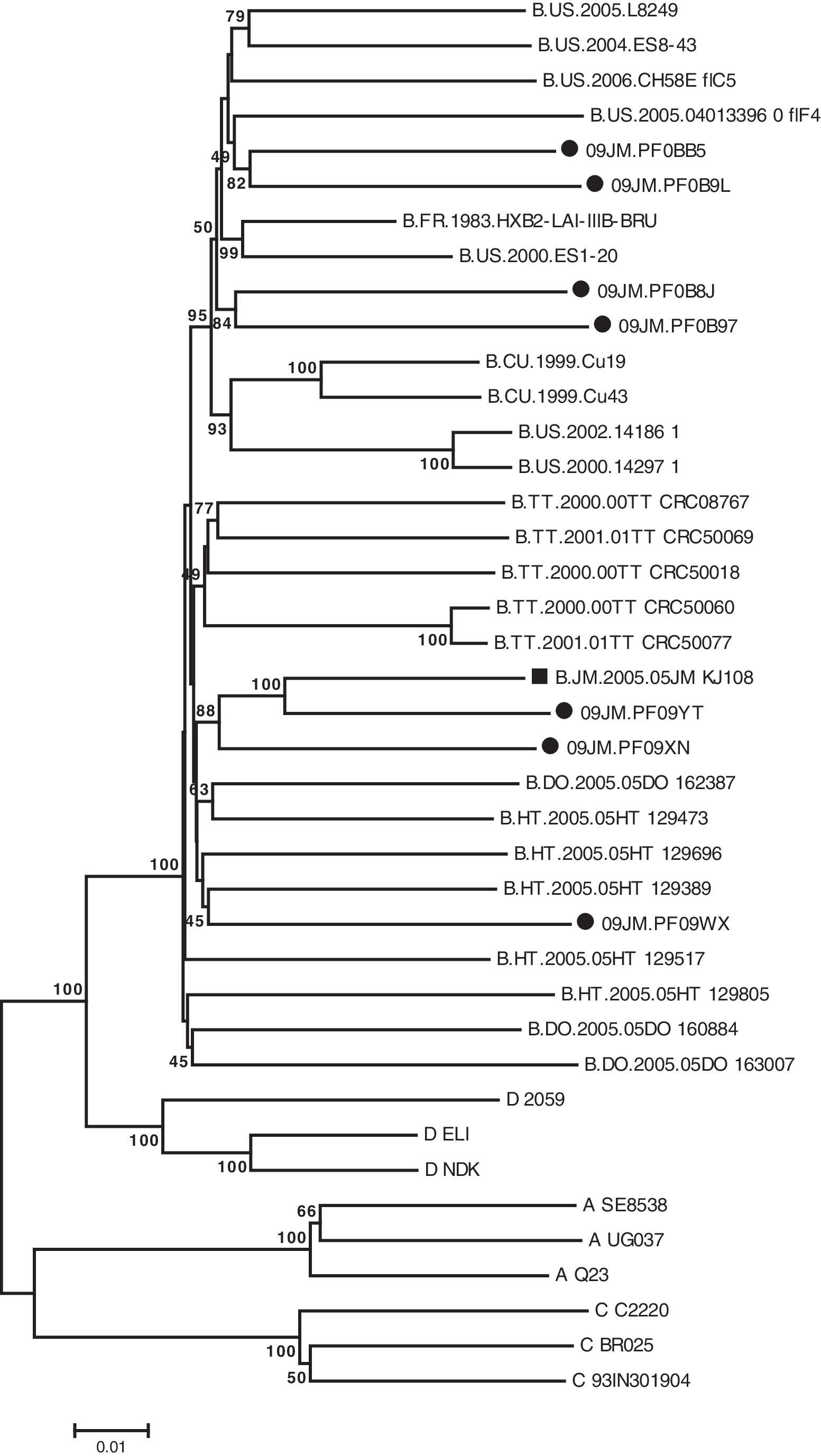
Phylogenetic analysis of the seven nearly full genomic sequences from this study (round dots) of HIV‐1 subtype B isolates found in Jamaica and 59 reference sequences. A square dot is the reported Jamaican sequence. 8 The percentage of replicate trees in which the associated taxa clustered together in the bootstrap test (500 replicates) is shown next to the branches.
An analysis of the protease/RT region of the genome showed one NRTI drug resistance-conferring mutation in sample 09JM.PF0B97 (M41L) and a minor PI mutation in sample 09JM.PF0B9L (L10V). The other samples exhibited no major drug resistance-conferring mutations. The genomic structure of the env gene, which codes for the envelope glycoprotein120, has a structured loop pattern with five variable regions, V1 to V5, interspersed with five conserved regions, C1 to C5. The V3 loop (containing 35 amino acids) within this structure has been shown to be very important in the early stages of infection and has been designated the principal neutralizing determinant. 8
This area of the viral genome is involved in HIV-1-induced cell–cell fusion, viral entry, as well as determining tropism at the cellular level.
9
This domain therefore plays an important role in regulating essential biological properties of the virus. The predicted amino acid sequence in the V3 loop for the Jamaican samples showed that six samples contained the characteristic conserved tetrapeptide motif GPGR (position 42–45), which is the predominant motif in subtype B found in Africa and the Americas (Fig. 2). However, the octapeptide that encompassed the tetrapeptide motif had four distinct patterns of PI

The amino acid alignment sequences of the HIV‐1 V3 loop region. The dots represent amino acids identical to the consensus B; the dashes indicate the gaps introduced in the alignment.
The molecular characteristics of the V3 loop in viral cellular tropism have been linked to the env amino acids at positions 11 and 25. 11 The HIV virus can engage the coreceptors CCR5 (R5) and/or CXCR4 (X4). The viruses that use the R5 coreceptor predominate at the beginning of the infection while those that use the X4 coreceptor are usually not detected until later as the disease progresses. 12,13 The virus strains that use the X4 have been associated with a faster decline with CD4+ cell count and progression to AIDS. 14 The V3 amino acid sequences were analyzed for basic amino acid substitutions at positions 11 and 25 (reference HXB2 positions 306 and 322, respectively).
According to Hoffman et al. sequences with basic amino acid R or K at position 11 and/or K at 25 could be considered X4 viruses, and sequences with no basic amino acid at 11 and 25 could be considered R5. 15 In evaluating the seven amino acid sequences for preferential cofactor usage, we found that all seven isolates (100%) were R5 viruses. At position 11 four of the seven samples had the amino acid S, two with amino acid G and one with D, while for position 25 all seven samples had the amino acid, isoleucine (I). It has been suggested that a progressive change from R5 to X4/R5 (dual-tropic virus usage) through to X4 implies disease progression in the B subtype viruses. 13
Thus, our preliminary results suggest that patients having these viruses from Jamaica are in the nonprogressive stage. These samples were collected from individuals who have tested positive for 1–5 years and were drug naive (Table 1). It may be inferred that these are early stages in the assessment and thus they should be monitored to predict the progression of the disease. The ability to detect the X4 viruses early (or to predict their evolution) from genotypic characterization has clinical prognostic value in approximately 50% of patients in whom X4 may arise. Only one blood sample was collected from each person; however, a more detailed and precise evolutionary analysis could be done if serially sampled viral sequences were collected and analyzed. This could help in identifying the order in which mutations occur and highlight any possible mutations that typically occur early in the R5–X4 transition. 11 The use of the 11/25 as the only rule in defining tropism is limited since there are other factors such as substitutions outside the V3 that impact tropism.16
All are drug-naïve patients.
The HIV-1 epidemic in the Caribbean region and, in particular, in Jamaica is driven predominantly by heterosexual transmission, sex between men, which is generally hidden due to the attached stigma, as well as early age for sexual debut. 3 In Jamaica, there have been severe job losses in the bauxite and other industries resulting in an increased dependence on the tourism sector for economic growth, adding fuel to the growing HIV epidemic. There has also been the added factor of a large population of Jamaicans living and/or working in North America who then return home to visit. It could therefore be expected that the virus strain found, as was evident from this study, may have evolutionary similarities to strains in the United States and Canada. The HIV-1 B strain in Jamaica, based on this study, did not always cluster phylogenically with other B strains in the Caribbean as Nadai et al. originally found. 4 The variations in the genome of HIV-1 in Jamaica (which has a comparatively high prevalence) have so far indicated that a larger sample size may be needed to ascertain any serious impact on drug resistance or novel drug design for subtype B.
Nucleotide Accession Numbers
GenBank accession numbers for the sequences of this study are HM030559–HM030565.
Footnotes
Acknowledgments
Funding for this work was provided by the Institute of Human Virology, University of Maryland School of Medicine, Baltimore, the Ministry of Health and Environment, Jamaica and a study and travel grant from the University of the West Indies, Mona.
Author Disclosure Statement
No competing financial interests exist.