




Abstract
In Brazil, human T-lymphotropic virus type 2 (HTLV-2) is endemic in Amerindians and epidemic in intravenous drug users (IDUs). The long terminal repeat (LTR) is the most divergent genomic region of HTLV-2, therefore useful to characterize subtypes. Nucleotide sequence and restriction fragment length polymorphism (RFLP) analysis of LTR genomic segments of fourteen HTLV-2 strains isolated from HIV-infected patients of Londrina, Southern Brazil, were carried out. Molecular analysis disclosed that all HTLV-2 strains belonged to 2a subtype, and RFLP detected the presence of the a4, a5, and a6 subgroups according to Switzer's nomenclature. RFLP correlated with nucleotide sequence, and phylogenetic analysis clustered HTLV-2 sequences of IDUs into subgroups a5 and a6. HTLV-2 sequences from individuals of sexual risk factor clustered into the a4 subgroup. These results extend the knowledge of the genetic diversity of HTLV-2 circulating in Brazil and provide insights into HTLV-2 transmission and virus movement in this geographic area.
H
The routes of HTLV-2 transmission depends on the population analyzed, where sexual intercourse and breast-feeding are the main forms among Amerindians and the general population of Brazil, 4,7 while blood-born transfusion by sharing HTLV-infected needles account for transmission/acquisition among IDUs. 6,9 –11
Molecular characterization of env, long terminal repeat (LTR), and tax genomic regions of HTLV-2 has recognized three HTLV-2 subtypes: HTLV-2a, HTLV-2b, and HTLV-2d. In Brazil, a unique HTLV-2 subtype was detected among IDUs and Amerindians; this subtype possesses a long transactivating protein Tax similar to HTLV-2b and the env, and LTR genomic regions similar to HTLV-2a. 4 Therefore, this HTLV-2 subtype was tentatively named HTLV-2c, 4 albeit complete nucleotide sequences of several genomes had unequivocally demonstrated that the Brazilian HTLV-2 strains are molecular variants of the HTLV-2a subtype. 12 –14 Interestingly, molecular analysis of Brazilian HTLV-2a isolates disclosed that they have originated from two sources: Brazilian Amerindians and European/North American IDUs. 15 HTLV-2b subtype, although endemic in Amerindians from Central America, Colombia, Venezuela, Chile, and Argentina, was only recently detected in Brazil among blood donors from the South, 16 and in IDUs infected with HIV from the Southeast. 17
Several years ago, we conducted a study on the prevalence of HTLV-1 and HTLV-2 in HIV/AIDS patients from Londrina and vicinities, South of Brazil, and disclosed high frequency of HIV/HTLV-2 co-infection in these patients.
11
Using restriction fragment length polymorphism (RFLP) analysis of LTR and env genomic regions, we identified HTLV-2a circulating in this geographic region.
18
At present, we decided to extend this data searching for HTLV-2a subgroups correlating with risk factor for HTLV transmission/acquisition. Using a classification system that accommodate restriction sites described by Switzer
19
and Eiraku,
20
we employed seven enzymes in RFLP LTR genomic analysis (i.e., Dra II, Ban II, Ava II, Sau I, Bgl I, SacII, and Sma I). Nested polymerase chain reaction was used to amplify a 666-bp LTR region (nt. 64 to 729),
18
and the products obtained were submitted to RFLP and sequencing analysis. Predicted endonuclease maps were constructed using Sequencher 4.7 software and NEBcutter V2.0 (
LTR-amplified products were sequenced in a ABI 3100 Genetic Analyser (Applied Biosystems, Foster City, CA). All sequencing chromatograms obtained were assembled and manually edited with Sequencher 4.7 software. Multiple alignments were performed using ClustalW multiple-sequence alignment software, with a reference set available in the GenBank database (
Phylogenetic analysis of a segment of 458 bp of 88 HTLV-2 LTR sequences including the fourteen new sequences of Londrina, Southern Brazil (GenBank accession number GU573730 to GU573743) were used to construct the phylogenetic tree (Fig. 1).
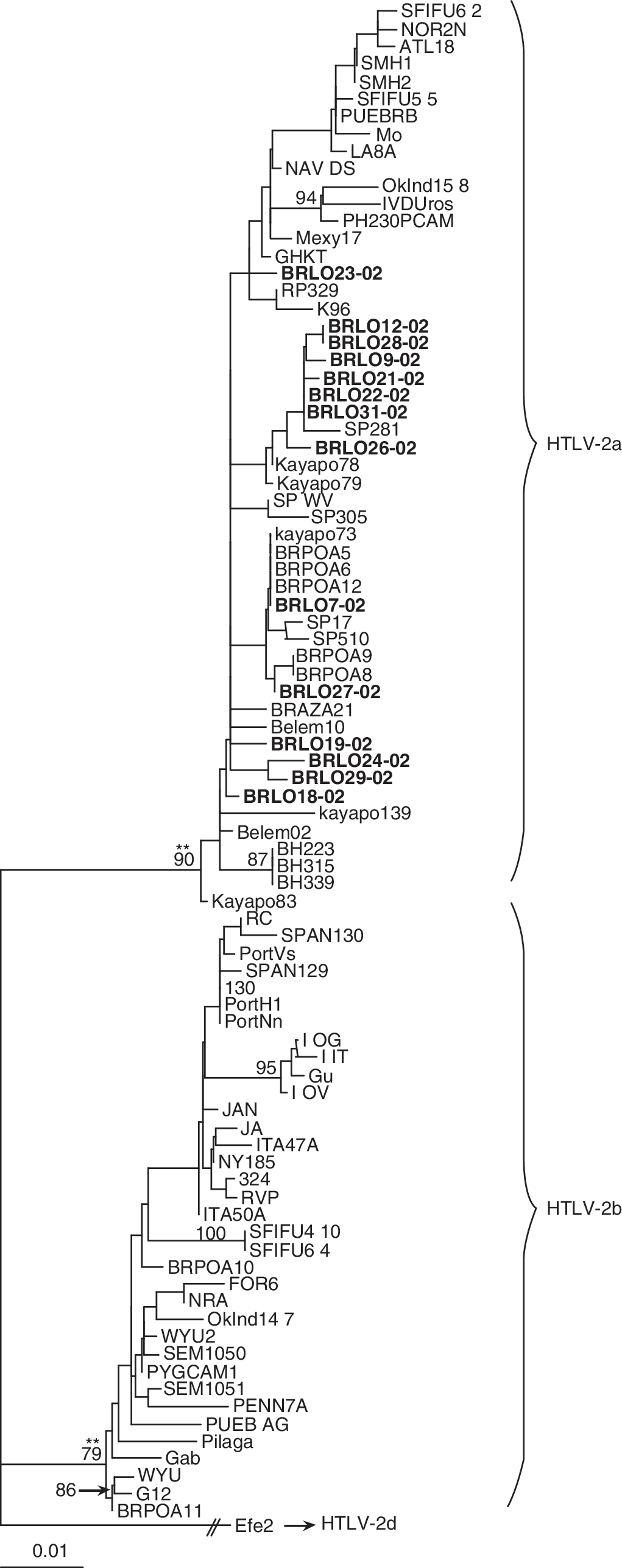
Representative Neighbor Joining phylogenetic tree of partial HTLV-2 LTR region (458 bp) generated with the HKY+i+G model, using Paup 4b10. Bootstrap values above 70% in key branches are depicted. Sequences from Londrina, Southern Brazil are in
Seventy sequences were obtained in GenBank: 21 sequences of Brazilian Amerindians, blood donors, and IDUs (19 of subtype 2a, and two of subtype 2b), 49 sequences of endemic and epidemic populations of other countries [15 of subtype 2a, 33 of subtype 2b, and one of subtype 2d (considered as the outgroup)] along with four sequences from Sao Paulo (Southeast Brazil) not published yet (SP17, SP281, SP305, SP510), were included in the analysis.
As shown in Figure 1, all HTLV-2 sequences from Londrina clustered into subtype 2a beside other Brazilian sequences. Figure 2 shows in detail HTLV-2a cluster, grouping the new sequences into three main subgroups named a4, a5, and a6, according to RFLP. Table 1 shows the predicted fragments obtained by RFLP maps, confirming the results obtained by phylogenetic trees (Figs. 1 and 2) and gel profiles (not shown). Interestingly, one of sequences (BRLO23-02) although classified as subgroup a4 by RFLP, clustered apart of this subgroup on the phylogenetic tree, but near to other Brazilian sequences; RP329 and K96 that belong to a blood donor from Ribeirão Preto and a Kayapo Indian from Amazonia. 14 Of note, one branch of HTLV-2a subgroup a6 was almost exclusively composed of sequences from Londrina. Additionally, sequences from Sao Paulo, not yet in the GenBank, clustered in the same three groups of HTLV-2a from Londrina. Although the limited number of samples analyzed, we could speculate on the route of virus transmission/acquisition. In fact, when we searched for risk factors of such patients, sequences of subgroup a4 (including the BRLO23-02) were of individuals of sexual risk factor, while sequences of subgroups a5 and a6 were of IDUs.
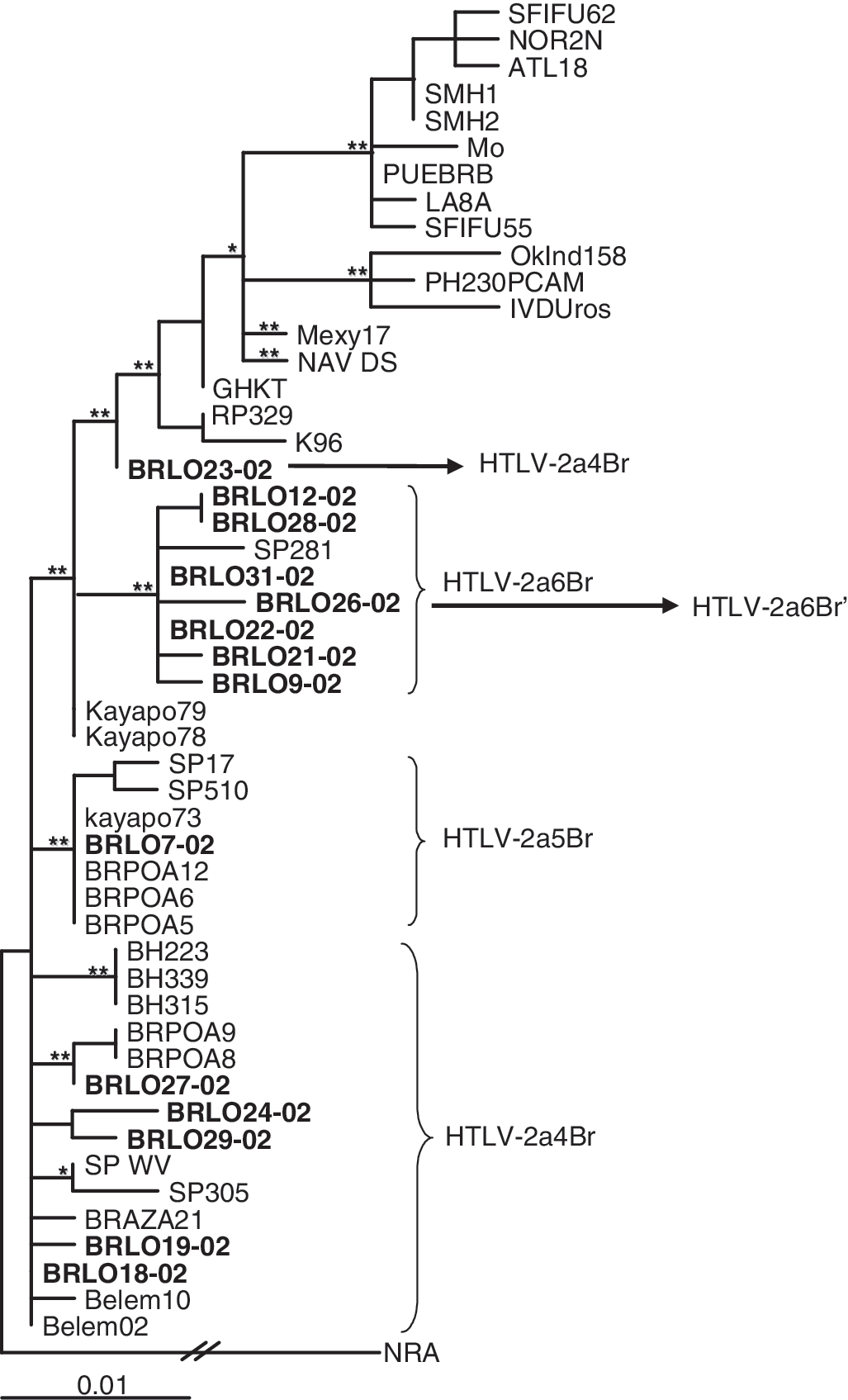
Representative Maximum Likelihood phylogenetic tree of partial HTLV-2a LTR region (458 bp) generated with the HKY+i+G model, using Paup v4b10. The analyzed samples are showed in
Sequences belonging to each subgroup according to Switzer et al., 1995 classification system:19 HTLV-2 a4: BRLO18, BRLO19, BRLO23, BRLO24, BRLO27, BRLO29, and SP305; HTLV-2 a5: BRLO7, SP17, and SP510; HTLV-2 a6: BRLO9, BRLO12, BRLO21, BRLO22, BRLO28, BRLO31, and SP281; HTLV-2 a6’: BRLO26.
These results corroborate the results obtained in previous studies that clustered Brazilian viruses in a single HTLV-2a clade, although with considerable diversity among them. 2,12 –14,17,19,20 Additionally, several studies conducted with Brazilian HTLV-2 sequences pointed virus transmission from Indians to IDUs of urban areas, 1 –4,12 –14,17,19,20 but the finding of a group almost exclusively of IDUs (subgroup a6) could represent different route of virus transmission or different evolutionary rate. In accordance of the last hypotheses, higher evolutionary rate and genetic diversity of HTLV-2 are detected in European IDUs than in Indians endemic populations. 21 Therefore, we could speculate these events to occur among IDUs of Londrina, Southern Brazil.
Moreover, the present study confirms RFLP as an alternative method for performing HTLV-2 epidemiological studies in countries with poor resources setting. In conclusion, this is the first study on molecular characterization of HTLV-2 sequences from Londrina, Southern Brazil, providing insights in HTLV-2 dynamic epidemic in Brazil.
Footnotes
Acknowledgments
The authors are indebted to João Paulo Gervásio Batista and João Leandro de Paula Ferreira for their support.
This study was supported by Ministério da Ciência e Tecnologia/Conselho Nacional de Desenvolvimento Científico e Tecnológico (MCT/CNPq), Brasil, (Universal Grant number # 481040/2007-2), fellowship to ACA (Grant number # 303328/2009-6).
Author Disclosure Statement
No competing financial interests exist.
Sequence data
The GenBank accession numbers for the sequences included in the phylogenetic study are as follows: LTR: SFIFU6 2 (U73022), NOR2N (U10258), ATL18 (U10252), SMH1 (Y05147), SMH2 (Y09148), SFIFU5 5 (U73010), PUEBRB (U10262), Mo (M10060), LA8A (U10256), NAV DS (U10257), Oklnd15 8 (U73015), IVDU ros (AF054272), PH230PCAM (Z46838), Mexy17 (L42510), GHKT (L42507), RP329 (AF326583), K96 (AF326584), Kayapo78 (AF139388), Kayapo79 (AF1239389), SPWV (AF139382), Kayapo73 (L42509), BRPOA5 (DQ028605), BRPOA6 (DQ028606), BRPOA12 (DQ028613), BRPOA9 (DQ028608), BRPOA8 (DQ028607), BRAZA21 (U10253), Belem10 (AF139393), Kayapo139 (L42508), Belem02 (AF139392), BH223 (AY509600), BH315 (AY509601), BH339 (AY509602), Kayapo83 (AF139390), RC (L77235), SPAN130 (U10266), PortVs (AY622979), SPAN129 (U10265), 130 (L77242), PortH1 (AY622977), PortNn (AY622978), I OG (Y09154), I IT (Y09151), Gu (X89270), I OV (Y09155), JAN (L77241), JA (L77239), ITA47A (U10254), NY185 (U10259), 324 (L77243), RVP (L77244), ITA50A (U10255), SFIFU4 10 (U73016), SFIFU6 4 (U73018), BRPOA10 (DQ 028611), FOR6 (AF054273), NRA (L20734), Oklnd14 7 (U73009), WYU2 (U12794), SEM1050 (U10263), PYGCAM1 (Z46888), SEM1051 (U10264), PENN7A (U10260), PUEB AG (U10261), Pilaga (AF054271), Gab (Y13051), WYU (U12792), G12 (L11456), BRPOA11 (DQ028612), Efe2 (Y14365).
The GenBank accession numbers of the HTLV-2 fragments sequenced in our laboratory and included in the phylogenetic analysis are as follows: LTR: BRLO7-02 (GU573730), BRLO9-02 (GU573731), BRLO12-02 (GU573732), BRLO18-02 (GU573733), BRLO19-02 (GU573734), BRLO21-02 (GU573735), BRLO22-02 (GU573736), BRLO23-02 (GU573737), BRLO24-02 (GU573738), BRLO26-02 (GU573739), BRLO27-02 (GU573740), BRLO28-02 (GU573741), BRLO29-02 (GU573742), BRLO31-02 (GU573743).