




Abstract
In 2007, 14 Dutch men having sex with men (MSM) filed a criminal case against three other men, accusing them of administering sedative drugs, sexual abuse, and deliberate subcutaneous injections with HIV-1-infected blood. Medical files showed that 9 of 17 men presented with an acute HIV-1 infection syndrome during 2006–2007. Two men were not infected with HIV. Analysis of viral strains in the 12 MSM and the three alleged donors showed that one donor and six recipients were double infected with two distinct HIV-1 subtype B strains, while another five recipients and one donor were single infected with either strain. Two men were infected with unrelated strains. The finding of multiple double infections with very similar HIV-1 strains is without precedent.
Introduction
HIV
Materials and Methods
Participants' samples
Blood plasma samples have been collected from 15 HIV-1-infected men, all living in the northern provinces of The Netherlands, in relation to a criminal investigation. Eleven patients were seen at the University Medical Centre Groningen, Groningen, The Netherlands, three at the Medical Centre Leeuwarden, Leeuwarden, The Netherlands, and a single patient at the University Medical Centre Utrecht, Utrecht, The Netherlands. Samples analyzed were taken at or close to the moment of the first positive HIV-1 antibody test.
Amplification and sequencing of viral RNA
HIV-1 protease/reverse transcriptase gene sequences were generated with the ViroSeq HIV-1 genotyping kit version 2 (Celera Diagnostics, Alameda, CA). For analysis of part of the env gene, viral RNA was isolated from plasma with a method using silica and GuSCN. 6 The env V3–V4 fragment (nt 6949–7519 of HXB2) was amplified with primers ED12 and ED31. 7 Nested primer sequences were 5′ACAGGGCCATGYAMAAATGT 3′ and 5′ ATGGGAGGGGCATACATTGC 3′. Amplification products were cloned with the TOPO TA cloning kit (Invitrogen, Carlsbad, CA), and sequenced with the BigDye Terminator cycle sequencing kit (Applied Biosystems, Foster City, CA). Sixteen clones were analyzed per sample. From donor 3 in total 42 clones, from two different sampling moments, were analyzed.
Electrophoresis and data collection were performed on an ABI PRISM 3100 genetic analyzer (also from Applied Biosystems). Additional nested PCR analyses were done with strain-specific primers designed to amplify 214 nt of the V3–V4 region of the env gene.
Phylogenetic analysis
Sequences were aligned with reference HIV-1 env V3–V4 sequences (from the Los Alamos National Laboratory at
Ethics
All individuals studied gave written informed consent, and the protocol and consent forms were approved by the Medical Ethics Review Committee, in accordance with Dutch Law (WMO). Although study participants were aware that accusations and litigations based on scientific disclosure of the data presented here might potentially jeopardize their legal position in criminal court, as the Court of Appeal has not yet reached a final verdict, we made every effort to refrain from revealing anonymous or study participants.
Results
In 2007, 14 MSM from The Netherlands filed a criminal case against three other MSM, accusing them of administering sedative drugs, sexual abuse, and deliberate subcutaneous injections with HIV-1-infected blood without consent between the end of 2005 and the beginning of 2007. For clarity, these 14 MSM will be referred to as “recipients” and the three accused men as “donors.” Twelve of the 14 recipients and three of three of the donors tested HIV-1 positive. Eight recipients and one of the alleged donors reported an acute HIV syndrome before or around the time of seroconversion in 2006–2007. Patient characteristics are summarized in Table 1. Two recipients (11 and 13) were not infected with HIV as demonstrated by a lack of anti-HIV antibodies.
Patient 5 has a triple HIV-1 infection with both strains 1 and 2 and a third, unrelated strain.
Population sequencing of the HIV-1 pol gene indicated a high number of degenerate base codes (IUPAC-IUBMB codes for incompletely specified bases in nucleic acid sequences) in the RT part of the sequence for two participants, suggestive of an HIV dual infection (Table 1). 2,9 Subsequent sequencing of env gene clones and phylogenetic analysis identified dual infections in an even higher number of study participants. In particular, a total of seven study participants, six recipients and one donor, were found to be infected with two distinct HIV-1 subtype B strains (Table 1 and Fig. 1). As an example, analysis of all V3–V4 env sequences derived from a single patient is shown for recipient 14 (Fig. 2).

Phylogenetic analysis of HIV-1 env. HIV-1 env V3–V4 sequences were aligned, resulting in 574 aligned positions, and analyzed with the GTR + I model and the parallel version of MrBayes 3.1, modified to use the sprng library (
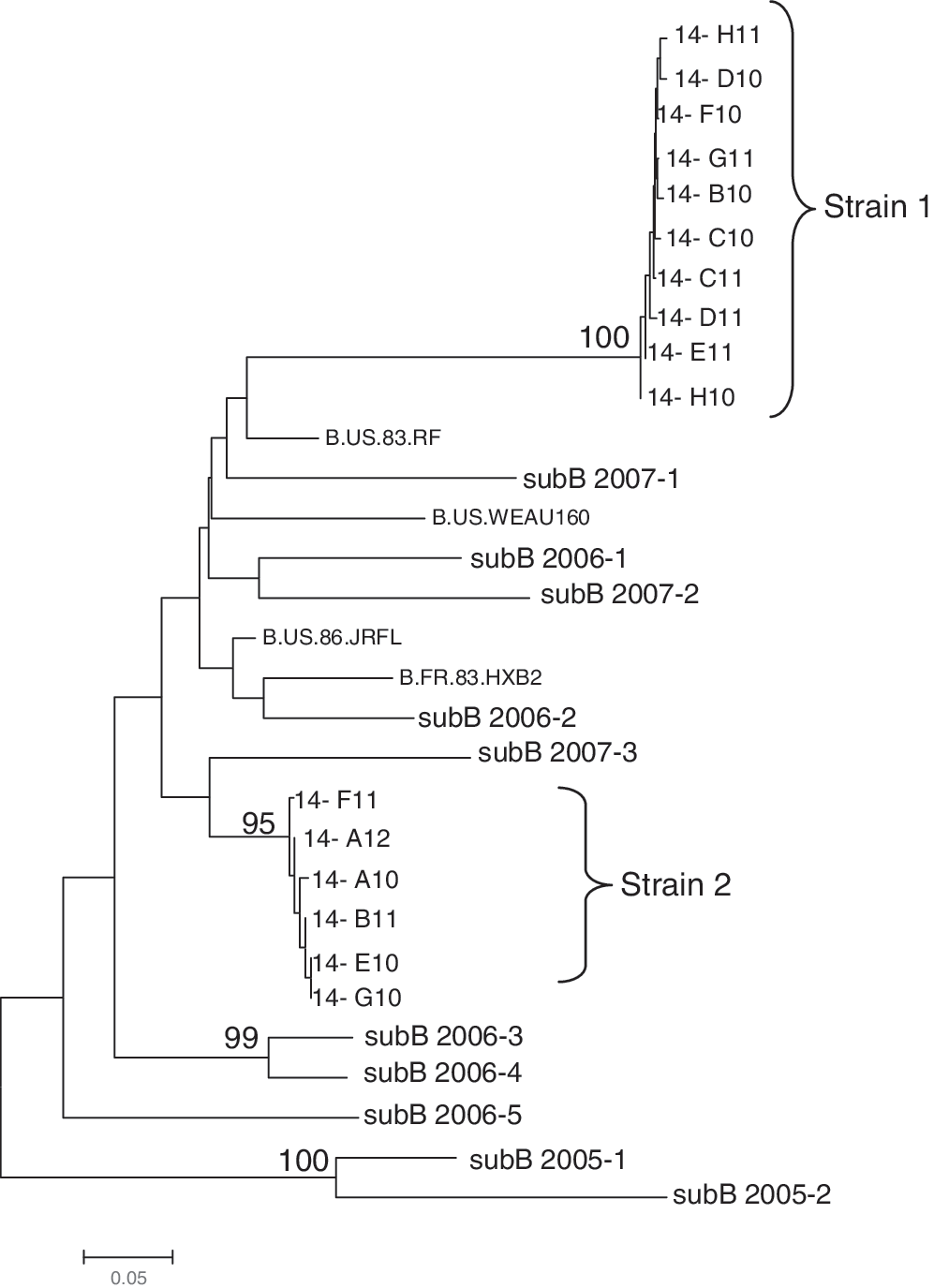
Analysis of the env V3–V4 sequences from recipient 14. HIV-1 env V3–V4 sequences obtained from recipient 14 (indicated with 14 followed by the clone number) were aligned with reference HIV-1 subtype B sequences and analyzed with the neighbor-joining method implemented in MEGA4 using the gamma-distributed Tamura–Nei model with α = 0.38 (see the Materials and Methods section). HIV-1 subtype B strains 1 and 2 are indicated. Bootstrap values ≥90 are indicated. The scale bar indicates the genetic distance between the sequences (as calculated with the Tamura–Nei method, see the Materials and Methods section).
Counting the number of degenerate base pairs probably underestimates the incidence of early, within subtype HIV dual infection. Sequencing of an additional gene fragment improved the detection of dual infections, 10 as in two patients (4 and 12) the pol and env sequences clustered with both strains. Strain specific primers were designed that were able to amplify both strain 1 and 2 env fragments from blood plasma. This resulted in an extra double infection in subject 4, suggesting that one strain had been missed by analyzing only 16 clones. Recombination may obviously obscure the analysis of HIV-1 dual infections. In subject 12, analysis of the pol gene resulted in detection of only strain 2 sequences, while when sequencing env clones only strain 1 sequences were found.
An explanation could be that a recombinant virus was generated that outgrew the parental strains. Alternatively, patient 12 could already have been infected with a recombinant virus. Strain 2 env sequences were not amplified from subject 12 using strain-specific primers, indeed suggesting the presence of only a recombinant form. One recipient (8) and one donor (1) were infected with HIV-1 subtype B strains unrelated to each other or to the virus variants of any of the other subjects (Fig. 1). Subject 8 was already HIV positive far before the 2006–2007 period.
The relatively high number of degenerate base codes seen in donor 1 is probably related to an advanced disease state, as this individual presented at his first HIV test in 2003 with low CD4+ T cell counts that warranted immediate start of antiretroviral therapy. Donor 3, who first tested HIV-1 antibody positive in April 2005, was dually infected with the two subtype B strains, named strain 1 and 2 (Fig. 1). Donor 2, who seroconverted in May 2006, was infected with only one of these strains, strain 1 (Fig. 1). The three donors were involved in an unsafe sexual relationship with each other. Donor 1 has been effectively treated with antiretroviral therapy since 2003 with a plasma viral load <50 copies/ml and is thus unlikely to transmit virus. In addition, he was found to be infected with a subtype B strain unrelated to those found in the other donors or recipients.
A total of six recipients were infected with the same two strains as donor 3, whereas three recipients were infected with strain 1 only and two others only with strain 2 (Table 1). Recipient 5 harbored a triple HIV-1 infection with the two strains first identified in donor 3 and an unrelated subtype B strain. Donor 3 represents most likely the viral source for the double infections in the six recipients, as he tested HIV positive in 2005, well before the other persons did.
Discussion
We report an unusual cluster of identical HIV-1 dual infections in seven recently infected MSM from the city of Groningen in The Netherlands. In addition, another six men were infected with either one of the strains found in the dual infections. It remains possible that some of these are also dual infected, but that the second virus is replicating at a reduced level, thus escaping detection. The recipients knew the three alleged donors, who organized both private meetings and sex parties at their home. At these parties, HIV-1 could not only have been transmitted sexually, but the donors may also have injected their own blood subcutaneously into the recipients on several occasions.
Direct blood injections could explain the extremely high number of HIV-1 dual infections seen among the recipients, given the fact that one of the donors was dually infected with two HIV-1 strains early on. Simultaneous transmission of these strains by subcutaneous injection would be a much more efficient way to transmit both viruses than sexual transmission, which is characterized by the transmission of a single infectious unit in over 75% of cases as determined for heterosexual transmission of subtype B and subtype C HIV-1 variants. 11,12 Indeed, multivariant transmission is common in intravenous drug users compared to heterosexuals. 13 Donor 2, who became infected with strain 1 only, most likely derived from donor 3, denied the use of needles in his relationship with donor 3, suggesting that the single virus strain was transmitted sexually.
In the recipient patients, only five individuals (45%) were infected with a single strain (possibly the result of a single transmitted virus) while six other men (55%) were infected with at least two infectious viruses as documented by their dual infection. Because most samples were analyzed relatively early after acute infection, these cases likely represent coinfections and not superinfections. In the single infected patients, a second strain could have been missed because only 16 env clones were sequenced. With a confidence level of 95%, sequencing 16 clones detects a minority population that comprises at least 17% of the viral population. In the blood plasma sample of donor 3, strain 2 comprised the majority of the clones that were sequenced (38/42 = 90%) versus 4/42 clones (10%) for strain 1. A similar pattern was seen in four dually infected recipients, where strain 2 clones were overrepresented (77–93% of env clones). In contrast, strain 1 was the major HIV variant in recipient 14, where 62% of env clones belonged to this strain. In the single infected recipients, strain 1 was seen in three individuals and strain 2 was seen in two individuals. In the two individuals with a single strain 2 infection, the possibility that strain 1 was erroneously missed during amplification was tested with a strain-specific PCR amplification. The additional experiments did not reveal strain 1 sequences in these individuals, suggesting that they are infected exclusively with strain 2.
To our knowledge, an outbreak of epidemiologically linked HIV-1 dual infections has never been reported before. It would be of interest to monitor disease progression in the individuals described here, as there has been no systematic research on the effect of HIV dual infection compared to single infection on disease progression. In this specific transmission cluster, the impact of host factors could also be examined, as viral variation is limited. On the other hand, unique recombinant viruses may evolve in individual patients, which would also be an important subject for future study.
Footnotes
Acknowledgments
The Amsterdam Cohort Studies on HIV infection and AIDS, a collaboration between the Amsterdam Health Service, the Academic Medical Center of the University of Amsterdam, the Sanquin Blood Supply Foundation, and the University Medical Center Utrecht, are part of the Netherlands HIV Monitoring Foundation and financially supported by the Netherlands National Institute for Public Health and the Environment.
Author Disclosure Statement
No competing financial interests exist.