




Abstract
Circulating recombinant form (CRF) 16_A2D is a rare HIV strain among the most recently identified subsubtype A2. Samples taken from an HIV-seropositive married couple who attended a voluntary counseling and testing unit in Dhaka, Bangladesh showed two rare CRF16_A2D isolates. Further genetic analyses targeting three HIV genes (gag, pol, and env) showed that the two isolates from the couple were closely related making it likely that one of them acquired the virus and transferred it to the other. The husband admitted that he had contact with sex workers and both wife and husband had never traveled outside the country. This indicates that the husband might have acquired the virus from sex workers and that this rare strain is already circulating in the country. Detecting unusual isolates is important to determine the true diversity of HIV strains in the country. Monitoring of such strains will help in identifying transmission patterns and possible interventions to prevent the spread of HIV infection.
HIV-1
The International Centre for Diarrhoeal Disease Research, Bangladesh (ICDDR,B) runs a Voluntary Counseling and Testing (VCT) Unit in Dhaka where counseling is provided to HIV patients. A 46-year-old male client with his wife came to the VCT unit in 2006 and both were found to be HIV positive by ELISA, which was confirmed by Western blot. CD4+ T cell counts in male and female patients were 47 and 246 per microliter, respectively. Viral RNA was extracted from plasma samples in both cases and labeled 06BD2241 and 06BD2242 for the male and female, respectively.
Reverse transcription was performed with RNA that was amplified by nested polymerase chain reaction (PCR) at junction p17/p24 of the gag gene (nt 895 to nt 1510) and at the partial regions of both the pol (RT) (nt 2634 to nt 3292) and env (gp120) (nt 6889 to nt 7440) genes. Sequencing of the amplified products was performed using an ABI 377 automatic DNA Sequencer (ABI Warrington) as described previously. 12 The chromatogram sequencing files were inspected using Chromas 2.23 (Technelysium, Queensland, Australia), and the consensus sequences were prepared using SeqMan II (DNASTAR, Madison, WI). Multiple sequence alignments were calculated using Clustal X 1.81. 13
To determine the extent of genetic distance within Bangladeshi strains, the pairwise distances were estimated using the Kimura two-parameter model in Mega 4. Subtyping was carried out using the HIV genotyping tools (
In the gag region, the Bangladeshi isolates showed a high level of similarity between them (nt identity 94.7%). Analysis against other global isolates revealed 92.9% (06BD2241 male) and 95.2% (06BD2242 female) identities with the Canadian isolate GAG-3324. In the pol region, both Bangladeshi isolates showed a 98.2% identity to each other as well as 95.8% (06BD2241 male) and 95.3% (06BD2242 female) identities to the Kenyan isolate KNH1271. Regarding the env region, the Bangladeshi isolates were 89.9% identical to each other. The male isolate showed an 83.8% identity to DDJ369 (AY521631.1) from Senegal and the female isolate was found to have an 83.1% identity to the Kenyan isolate 00KE_NKU3004 (AF457088.1).
In terms of the dendrogram patterns (Fig. 1), the two Bangladeshi isolates clustered together very closely in three regions (gag, pol, and env). Both isolates clustered closely with the Canadian isolate BCCFE_HOMER_HIV_GAG_3324 and the Kenyan isolate KISII5009 in the gag region. The Kenyan isolate KISII5009 was previously reported as CRF16_A2D based on a complete genome sequence; however, the complete subtype information of the Canadian isolate was not known because the pol and env gene sequences were not available. In the pol region, our isolates clustered in the same branch with two CRF16_A2D strains from Kenya (isolate KNH1239 and KISII5009). Finally, the env tree indicated that the Bangladeshi isolates, as expected, clustered with the subtype A2 isolate (97CDKTB48 from Congo).
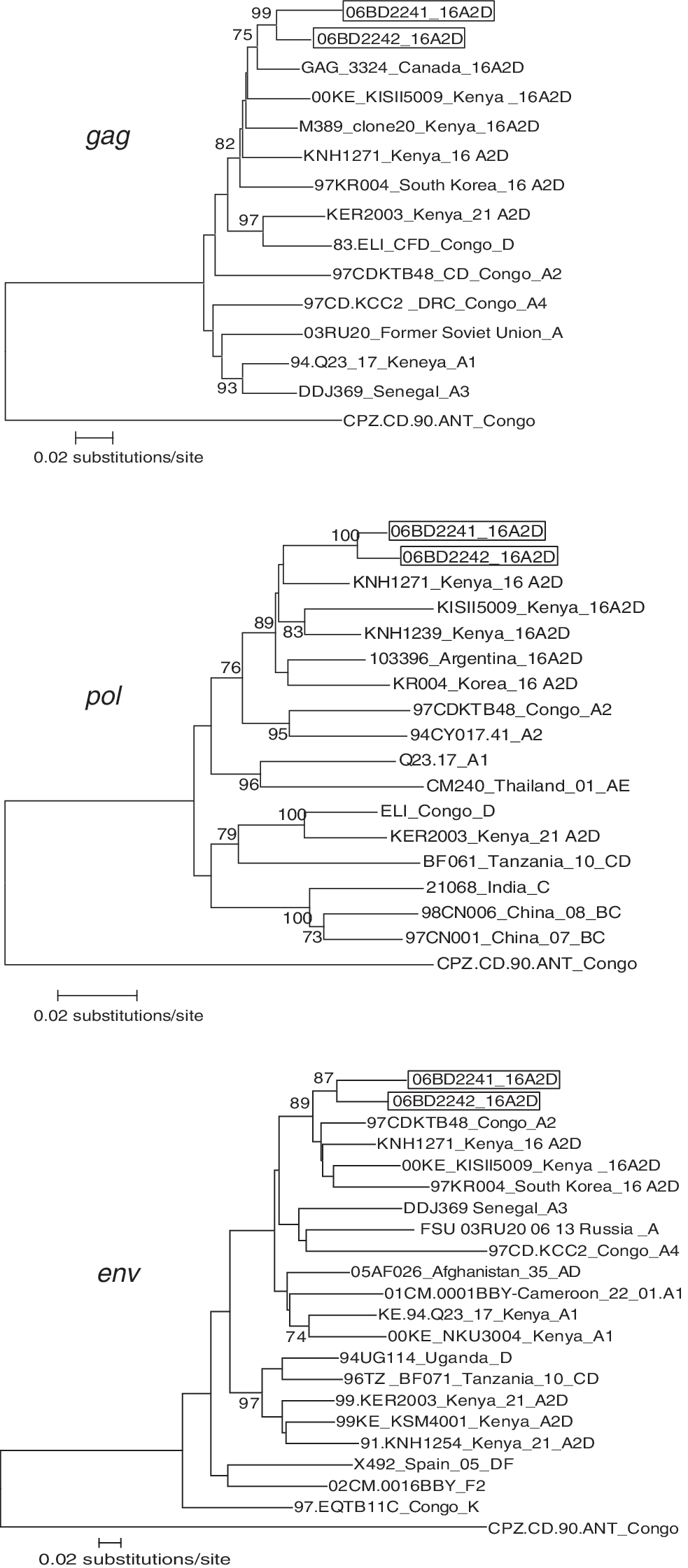
Neighbor-joining phylogenetic trees based on nucleotide sequences of the partial gag, pol, and env encoding genes (∼550 nt bases) for Bangladeshi HIV-1 CRF16_A2D subtypes with other strains available in GenBank. The Bangladeshi isolates are in boxes. The numbers adjacent to the nodes represent the value of bootstrap support (100 replicates) for the clusters to the right of the node. Bootstrap values lower than 70% were not shown. The dendrogram is rooted using HIV-1 CPZ.CD.90.ANT. The GenBank accession numbers were GAG_3324 (EU242381.1) from Canada, HIV-1 isolate 00KE_KISII5009 (AF457060.1) from Kenya, KNH1239 (AY945739.1) from Kenya, M389_clone20 (AY772974.1) from Kenya, KNH1271 (AY945736) from Kenya, isolate QA284 (DQ136741.1) from Kenya, isolate 103396 (AY365678.1) from Argentina, HIV-1 isolate 97KR004 (AF286239) from South Korea, KER2003 (AF457051) from Kenya, 83.ELI_CD_D (K03454) from Democratic Republic of the Congo, 97CDKTB48 (AF286238) from Democratic Republic of the Congo, 94CY017.41(AF286237) from Cyprus, isolate Q23-17 (AF004885) from Kenya, CM240 (U54771) from Chiang Mai, Thailand, 97CD.KCC2 (AM000053.1) from Democratic Republic of the Congo, 03RU20 (AY500393.1) from the former Soviet Union, A1.KE.94.Q23_17 (AF004885) from Kenya, DDJ369 (AY521631) from Senegal, CPZ.CD.90.ANT (U42720) from Congo, AR04-320 from Belgium (EU882800.1), 94CY017_41 (AF286237) from Cyprus, 97KR004 (AF286239) from South Korea, HIV-1 isolate 3800 (FJ183602.1) from Germany, HIV-1 isolate KNH1254 (AY945737.1) from Kenya, HIV-1 isolate KER2003 (AF457051.1) from Kenya, HIV-1 isolate TV441 (FJ647160.1) from South Africa, HIV-1 isolate PS088 (FJ199663.1) from South Africa, HIV-1 isolate 99CM-ST0789 (AY489905.1) from Cameroon, A1.RW.92.92RW008 (AB253421) from Rwanda, 05AF026 (EF158043) from Afghanistan, 01CM_0001BBY (AY371159) from Cameroon, KE.94.Q23_17 (AF004885) from Kenya, 00KE_NKU3004 (AF457088.1) from Kenya, D.UG.94.94UG114 (U88824) from Uganda, 96TZ_BF071 (AF289549) from Tanzania, 96TZ_BF061 (AF289548) from Tanzania, 21068 (AF067155) from India, 98CN006 (AF286229) from China, 97CN001 (AF286226) from China, 99KE_KSM4001 (AF457072.1) from Kenya, 99.KER2003 (AF457051.1) from Kenya, 91.KNH1254 (AY945737) from Kenya, X492 (AY227107) from Spain, F2.CM.02.02CM_0016BBY (AY371158) from Cameroon, and K.CD.97.EQTB11C (AJ249235).
We examined the recombination break points of three genes of our strains using SimPlot analysis (Fig. 2). Both the 06BD2241 and 06BD2242 isolates were found to be recombinant strains consisting of subtypes A2 and D in the gag (at positions 1010 and 1021 respectively) and pol (3024 and 3019) regions, but in the env region no recombination was found. This same pattern was seen in the reference CRF16_A2D isolates. The partial sequences of pol (RT) regions (nt 2634-3292) were submitted to the HIV drug resistance tool St-HIVdb (

Based on the genetic analyses of these two nearly identical HIV strains, it is likely that the wife was infected with an HIV strain from her husband or vice versa. The husband admitted that he had contact with sex workers and both wife and husband had never traveled outside the country. This indicates that the rare CRF16_A2D HIV strain is already circulating in the country and that the husband might have acquired the virus from sex workers. It would be noteworthy that subtype A2 and D have never been isolated from Bangladeshi sex workers. Information concerning HIV-1 subtypes is important to better understand transmission patterns and because genetic variation has an impact on the effectiveness of antiretroviral treatment. 15 Although subtype C is the predominant HIV-1 strain circulating in Bangladesh, identification of rare genetic forms of HIV-1 in the country helps in monitoring the true genetic diversity of circulating strains. As in other areas of the world, but more particularly in a low prevalence country, such cases and subtype identification will help in identifying future trends of HIV infection and suitable treatment regimens required for individual patients.
Sequence Data
Nucleotide (nt) sequences were submitted to GenBank using Sequin version 7. GenBank accession numbers for the gag gene sequences of the Bangladeshi strains are GU810374 and GU810375; the corresponding numbers for the pol and env gene sequences are GU810376, GU810377, GU810378, and GU810379, respectively.
Footnotes
Acknowledgments
This research protocol (2008-051) was funded by ICDDR,B and its donors, which provide unrestricted support to the Centre for its operations and research. Current donors providing unrestricted support include the Australian Agency for International Development (AusAID), Government of the People's Republic of Bangladesh, Canadian International Development Agency (CIDA), Embassy of the Kingdom of the Netherlands (EKN), Swedish International Development Cooperation Agency (Sida), and the Department for International Development, UK (DFID). We gratefully acknowledge these donors for their support and commitment to the Centre's research efforts.
Author Disclosure Statement
No competing financial interests exist.