




Abstract
Adenovirus (Ad) is still under extensive investigation as a vector for HIV vaccination; however, one possible explanation for the failure of Merck's STEP trial is the relatively weak immunogenicity of replication-defective Ad vectors. In this study, a novel strategy to enhance the immunogenicity of replication-defective Ad-based HIV vaccines was developed. First, a recombinant plasmid expressing adenoviral E1 protein (pVAX-E1) was constructed to complement the E1-deleted replication-defective Ad vectors in trans. Then, the immunogenicity of the vaccine regimen of Ad5-HIV gag plus pVAX-E1 plasmid was assessed in rhesus macaques. Compared with traditional administration of Ad-based vectors alone, the results showed that our strategy elicited a more sustained and robust HIV gag-specific cellular response and enhanced long-term proliferation of CD4+ and CD8+ T lymphocytes. This strategy represents a proof-of-concept that enhances the immunogenicity of replication-defective Ad-based vectors, and it exemplifies the useful implications for Ad-based HIV vaccines and other vaccines.
A
Both replication-defective and replication-competent adenoviral recombinants have been widely explored for use in vaccines and gene therapy for HIV and other infectious diseases. 9 –12 Although replication-defective Ad vectors with the E1 region deletion are safe and elicit effective specific immune responses, 13 –15 replication-competent Ad vectors are more immunogenic. 16,17 However, this ability to replicate, together with the potential for causing disease, leads to increased safety concerns for replication-competent Ad vectors. 11,18
The difficult option of choosing replicating or nonreplicating Ad vectors prompted us to explore a strategy that achieves a balance between safety and immunogenicity. It is well known that E1 gene products are essential for the initiation of late adenoviral gene expression 19 and therefore have to be provided in trans during production of E1-deleted replication-defective Ad vectors; for example, a packaging 293 cell line that has been stably transfected with the E1 region of the adenoviral genome may be used. 20 In this study, we hypothesized that a plasmid expressing the E1 protein would complement the E1-deleted replication-defective Ad vectors in trans and make the replication-defective Ad5 (E1-deleted) vector induce more potent and persistent cellular immunity to the encoded antigen.
We first isolated the adenoviral E1 gene (E1a, 560–1545 bp, GenBank accession: AC_000008) from 293 cells by reverse-transcriptase polymerase chain reaction (RT-PCR), and it was cloned into a eukaryotic expression plasmid pVAX (pVAX-E1). The pVAX-E1 plasmid expressed the protein of interest effectively and in high levels (data not shown). Subsequent analysis was carried out to determine whether the pVAX1-E1 plasmid might compensate for the replication ability of replication-defective Ad5 (E1-deleted), by providing their functions in trans in vitro. We assessed this hypothesis in both a human-derived type II pulmonary epithelial cell line (A549) and a monkey-derived kidney cell line (Vero), and the results showed that the Ad5 (E1-deleted) vector achieved, to some extent, the ability to replicate with the cotransfection of pVAX1-E1a in cell lines that did not originally support its propagation (Fig. 1). 21
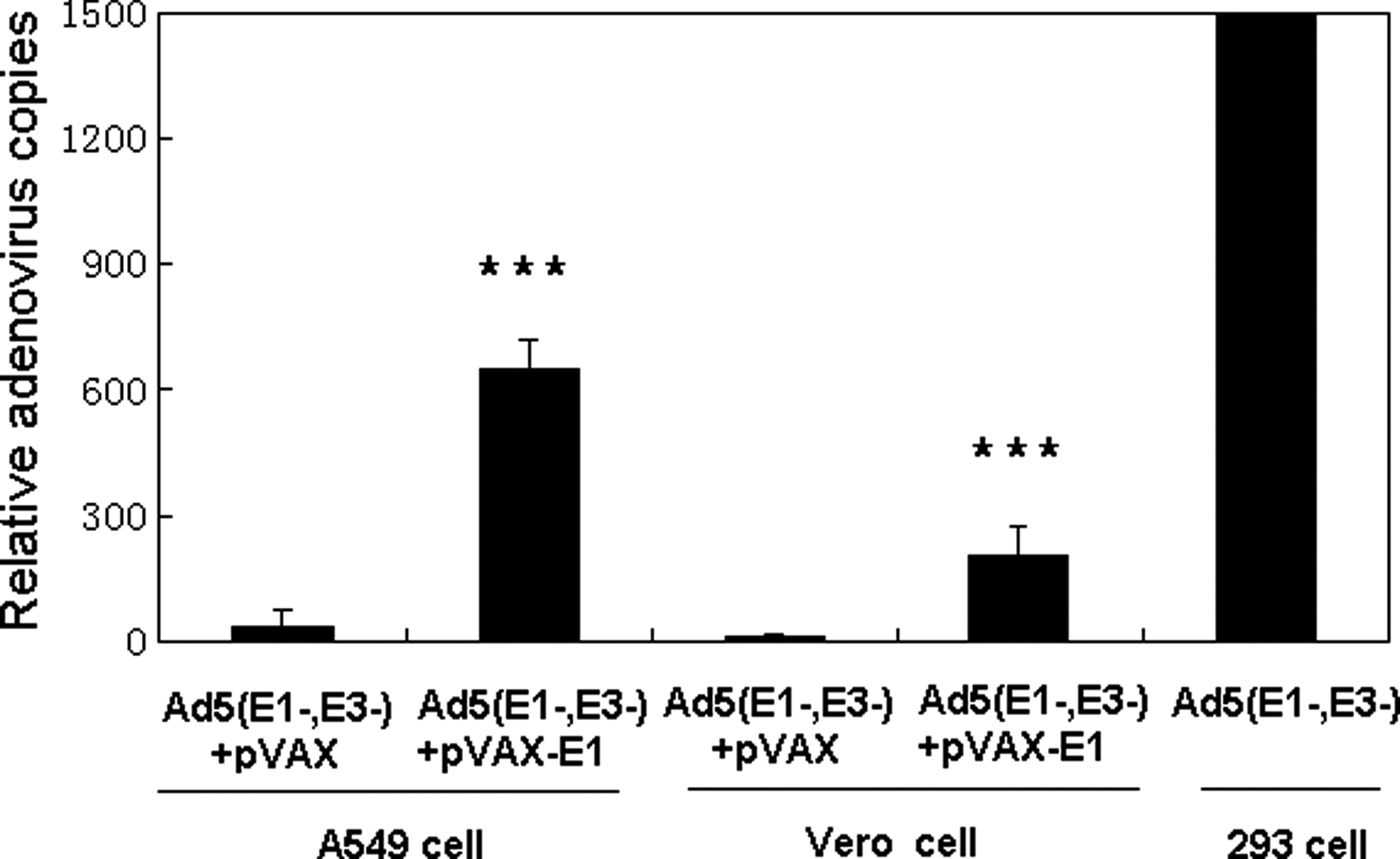
The replication-incompetent Ad5 (E1-deleted) vector achieved limited replication ability by pVAX1-E1 in trans in vitro. A549 cells or Vero cells were transfected with pVAX1-E1 and then infected with Ad5 (E1-deleted, E3-delted) virus. After 12 and 48 h, the Ad5 genomic DNA of those infected cells was extracted and quantified with syber-green-based PCR, as previously reported. 21 293 cells were used as a positive control. The bars represent the standard error. ***p < 0.001.
We next sought to assess whether our strategy might induce more potent and persistent cellular immunity in vivo than replication-defective Ad vaccination alone. To test this, a recombinant replication-defective adenovirus expressing the Gag antigen of the HIV 08BC subtype, which is a strain commonly found in China, 22 was constructed. Cohorts of 12 Mamu-A*01-negative Chinese-origin rhesus macaques were intramuscularly injected with one of the following vaccinations at week 0 and week 15: (1) 10 11 vp Ad5-gag; (2) 10 11 vp Ad5-gag plus 50 μg pVAX-E1, which were intramuscularly inoculated at the same site at the same time; or (3) empty vector (Fig. 2A). The use of experimental animals was approved by our Institutional Animal Care and Use Committee (IACUC).
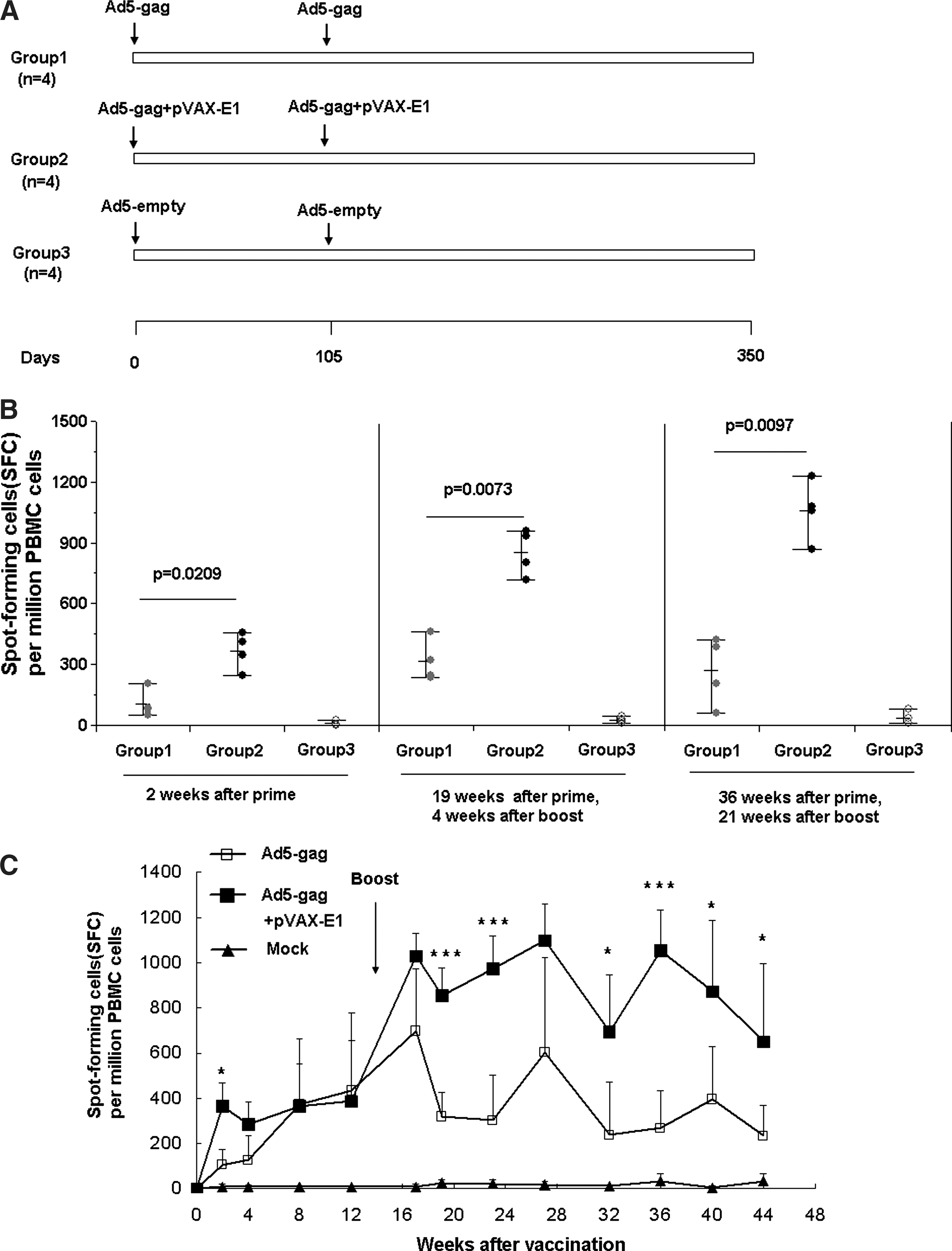
Induction of enhanced HIV-specific IFN-γ ELISPOT responses in rhesus monkeys by this strategy. Cohorts of 12 Mamu-A*01-negative Chinese-origin rhesus macaques (n = 4 per group) were immunized according to schedule
We then monitored the vaccine-elicited, HIV-specific cellular immune response by interferon (IFN)-γ ELISPOT assays as previously reported. 23 Consistent with our original hypothesis, there were significantly stronger Gag-specific cellular responses at 2 weeks after prime immunization of macaques immunized with Ad5-gag plus pVAX-E1 than in those immunized with Ad5-gag alone (p = 0.0209, Fig. 2B). These responses were further enhanced after the boost immunization (4 weeks after boost, p = 0.0073), and persisted until 36 weeks after immunization (p = 0.0097). Moreover, throughout this experiment the dynamics of Gag-specific cellular responses were observed (from 0 week to 44 weeks after prime immunization), and it was clear that the specific responses in the monkeys of group 2 were more robust and persistent than those of group 1 (Fig. 2C). There was no detectable response against Gag antigen in the mock-vaccinated animals at any time.
It should be noted that cellular responses against Gag antigen were not significantly enhanced in those rhesus macaques immunized with Ad5-gag alone after boost vaccination (Fig. 2B and C). This observation was consistent with the findings that preexisting Ad5-specific neutralizing antibodies have been reported to reduce and diminish the immunogenicity of Ad5 vector-based vaccines in preclinical and clinical trials. 24 –26 We therefore wished to assess the specific anti-Ad5 neutralizing antibodies as previously reported. 27 The robust anti-Ad5 neutralizing antibodies were elicited in all of the immunized monkeys after prime immunization and were boosted greatly after the second Ad5 vector administration (Fig. 3). Interestingly, cellular responses against Gag antigen were significantly boosted in those rhesus macaques immunized with Ad5-gag plus pVAX-E1 (Fig. 2B and C), which suggests that our strategy might have important implications in overcoming preexisting Ad5-specific immunity.
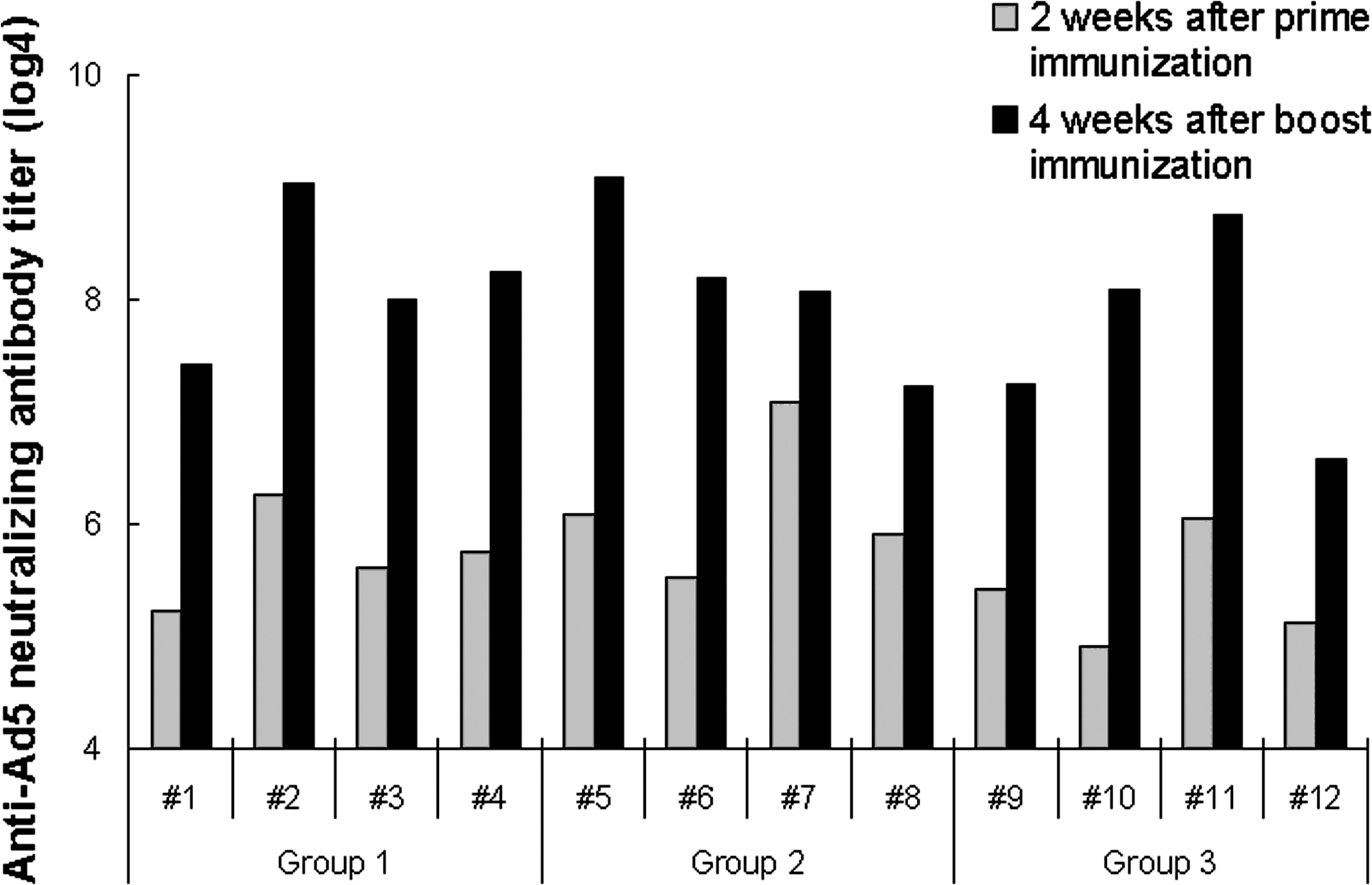
Quantitative measure of the specific anti-Ad5 neutralizing antibody titer, based on the SEAP reporter gene. The specific anti-Ad5 neutralizing antibody titer was quantitatively measured as previously reported. 27 Results showed that robust anti-Ad5 neutralizing antibodies were elicited in all 12 monkeys at 2 weeks after prime immunization and boosted greatly after second Ad5-vector administration.
Furthermore, we evaluated vaccine-induced CD4+ and CD8+ T cell proliferation by CFSE staining at 36 and 40 weeks postvaccination, as previously reported. 23 As expected, there were more proliferative, antigen-specific CD4+ T cells (p = 0.0323) and CD8+ T cells (p = 0.0339) after Gag peptide stimulation in the rhesus macaques that received Ad5 gag plus pVAX-E1 than in those rhesus macaques that received Ad5 gag alone (Fig. 4).

Specific T cell proliferation ability was detected by CFSE staining at 36 weeks post-vaccination.
Recent data demonstrated that HIV-specific CD4+ and CD8+ T cells in primary and long-term nonprogressive HIV-1 infection have strong ex vivo proliferative capacities, whereas this effector function is absent in acute and chronic progressive HIV-1 infection. 28 –30 It is well established that there is a transient and sharp loss of CD4+ T cells in the acute phase of HIV-1 infection, and it is thought that loss of CD4+ T cell proliferative ability would subsequently accelerate the loss of CD4+ T cell numbers. Therefore, induction and maintenance of antigen-specific T lymphocyte proliferation, especially CD4+ T proliferation, would be beneficial for preventing and controlling HIV infection and the pathologic progress. Significantly, antigen-specific CD4+ T cell proliferation was promoted in our strategy (Fig. 4B).
Safety issues are a critical concern in vaccine development, especially in clinical applications. Although the risk associated with injection of a plasmid coding for an E1 gene should be taken into consideration, our strategy was safer than a replication-competent Ad vector that expressed the E1 gene products constitutively. The replication ability (if any) of Ad vectors in our strategy was limited since the plasmid-expressing E1 protein level would be decreased and diminished with the plasmid naturally degraded in the body. Moreover, since there are not any homologue sequences between this E1 plasmid and the defective Ad5 genome, replication-competent Ad5 virus capable of multiple rounds of replication would not be generated in our strategy. In fact, all experimental animals in this study appeared generally healthy, and there were no significant differences in general observations or body weights between the treatment and control groups. Hematology analysis and serum biochemical parameters were also evaluated and all study animals were within normal range throughout the experiment (data not shown).
Adenoviruses are relatively species specific and the propagation of human Ad5 is restricted to humans and chimpanzees. 31 Because Ad5 can not propagate in rhesus macaques, the observation of enhanced immunogenicity might not be caused by the limited replication of E1-deleted Ad5 vector. The exact mechanism for this phenomenon is currently under investigation; however, the plasmid-expressing E1 protein could initiate the expression of a variety of adenoviral late gene products, 19 which might, in turn, contribute to the activation of a more extensive immune response and be beneficial to maintaining T cell proliferation.
A variety of adenovirus-based strategies are under investigation for use as vectors for vaccination and gene therapy, and safety and efficiency are two major concerns when assessing vaccines. Interestingly, our strategy has achieved a balance between both safety and efficiency. It is important to highlight the fact that our strategy can boost IFN-γ-mediated ELISPOT responses and promote the long-term proliferation ability of T lymphocytes, which indicates successful proof-of-concept and demonstrates that this combination enhances the immunogenicity of the original replication-defective Ad-based vector. It remains unclear, however, whether the robust cellular responses confer enhanced protection against HIV-1 virus, since there is not an appropriate challenge model to assess the HIV-1 virus directly. Further studies will therefore be required to evaluate this possibility and to test the protection efficacy of our strategy with SIV based Ad vectors.
Taken together, we developed a novel strategy to enhance the immunogenicity of a replication-defective Ad-based vector. Compared with traditional administration of Ad-based vectors, the results showed that our strategy elicited a more sustained and robust HIV gag-specific cellular response and long-term proliferation ability of CD4+ and CD8+ T lymphocytes in rhesus monkeys. Our findings have important implications not only for adenovirus-based HIV vaccines, but also for the application of recombinant adenoviruses to others vaccines or as vectors for gene therapy.
Footnotes
Acknowledgments
This study was supported by the Bureau of Science and Technology of Guangzhou Municipality S&T support program(2010J-E381), the National Natural Science Foundation of China (81000737), the Knowledge Innovation Program of the Chinese Academy of Sciences (KSCX1-YW-10), the National Key Science & Technology Specific Projects of China (2008ZX10001-011), and the National Science Fund for Distinguished Young Scholars of China (No. 30688004). We gratefully acknowledge Merck Co. USA for technical support with ELISPOT.
Author Disclosure Statement
No competing financial interests exist.