




Abstract
Yunnan province was considered the HIV-1 epicenter of China, where many subtypes and CRFs of HIV-1 were circulating. CRF07_BC and CRF08_BC were two of the main circulating subtypes that caused more than 90% of the HIV-1 infections in intravenous drug users (IDUs) in this district. The cocirculation of these two CRFs in the same area and population predicted the emergence of new second-generation recombinants. This study presented a near full-length genomic analysis of a novel HIV-1 recombination (09YN072) involving CRF07_BC and CRF08_BC. The analyses of the sequence of 09YN072 showed that two CRF07_BC segments were inserted into the CRF08_BC backbone. The discovery of the novel recombinant strain complicates the HIV-1 epidemic in Yunnan, China, as well as the development of effective vaccines to limit the spread of HIV-1 in China.
R
Yunnan is a province of China severely affected by HIV. Located in southwest China, it has a long history of heroin trade. Adjacent to the “Golden triangle” area, which is famous for opium production, 2 Yunnan is the main transfer area of illicit drugs into China. So it was not surprising to report the initial HIV-1 epidemic among intravenous drug users (IDUs) in Yunnan in 1989, which was caused by a mixture of viruses closely resembling European/North American subtype B and Thai subtype B (B′). 3 –6 Nowadays, multiple HIV-1 genotypes, including B, C, CRF01_AE, CRF07_BC, and CRF08_BC, are all involved in the epidemiology of HIV-1. 7
The coexistence of multiple subtypes in the same population in the same area always causes the formation of circulating recombinant forms (CRFs). In recent years, some new URFs consist of B/C, C/CRF01_AE are continuously emerging in this area. 8 CRF07_BC and CRF08_BC presumably originated among IDUs in Yunnan in the early 1990s, 9 and then spread along known drug trafficking route to other districts such as Guangxi and Xinjiang autonomous regions. 10,11 More than 90% of the infected IDUs in Yunnan today had CRF07_BC or CRF08_BC viruses. The cocirculation of these two CRFs of HIV-1 in the IDUs population in Yunnan predicted the emergence of new recombinants. 12
Here we characterized a novel recombinant involving CRF07_BC and CRF08_BC, which is different from the recombinants reported before. Sample 09YN072 was collected in 2008 from a 31-year-old male residing in Yunnan province, who was diagnosed as HIV-1 positive in 2002. HAART therapy was in progress from 2005. The near full-length genome of 09YN072 was amplified from plasma RNA by RT-PCR as described previously.
13
The positive PCR products were sequenced by Biomed Genomics Company (China) with a variety of internal specific primers (available on request) after being purified. All of the sequenced fragments were edited, assembled into contiguous sequences on a minimum overlap of 30 bp with a 99–100% minimal mismatch with ContigExpress software, which is a component of Vector NTI Suite 6.0. Finally, a near-full length genome of 8873 bp length was obtained with the nine open reading frames (ORFs) intact and opened. To avoid potential laboratory contamination, an online BLAST search tool against the HIV-1 sequence database was used, and no evidence of contamination was observed. Sequence 09YN072 was aligned with HIV-1 strains of reference subtypes (A–D, F–H, J, K) and some CRFs (CRF01_AE, CRF07_BC, and CRF08_BC) obtained from the Los Alamos HIV Database (
As shown in Fig. 1, the 09YN072 sequence was located between the monophyletic clusters of CRF07_BC and CRF08_BC reference sequences, suggesting its close relationship to these two CRFs (Fig.1).

Phylogenetic tree analysis. A neighbor-joining tree was created with the near full-length sequence of the 09YN072 strain and the representative strains of different HIV-1 group M subtypes (
To analyze the recombination of the 09YN072 strain, the sequence was submitted to the Recombination Program (RIP; version 3.0) available at the HIV sequence database (
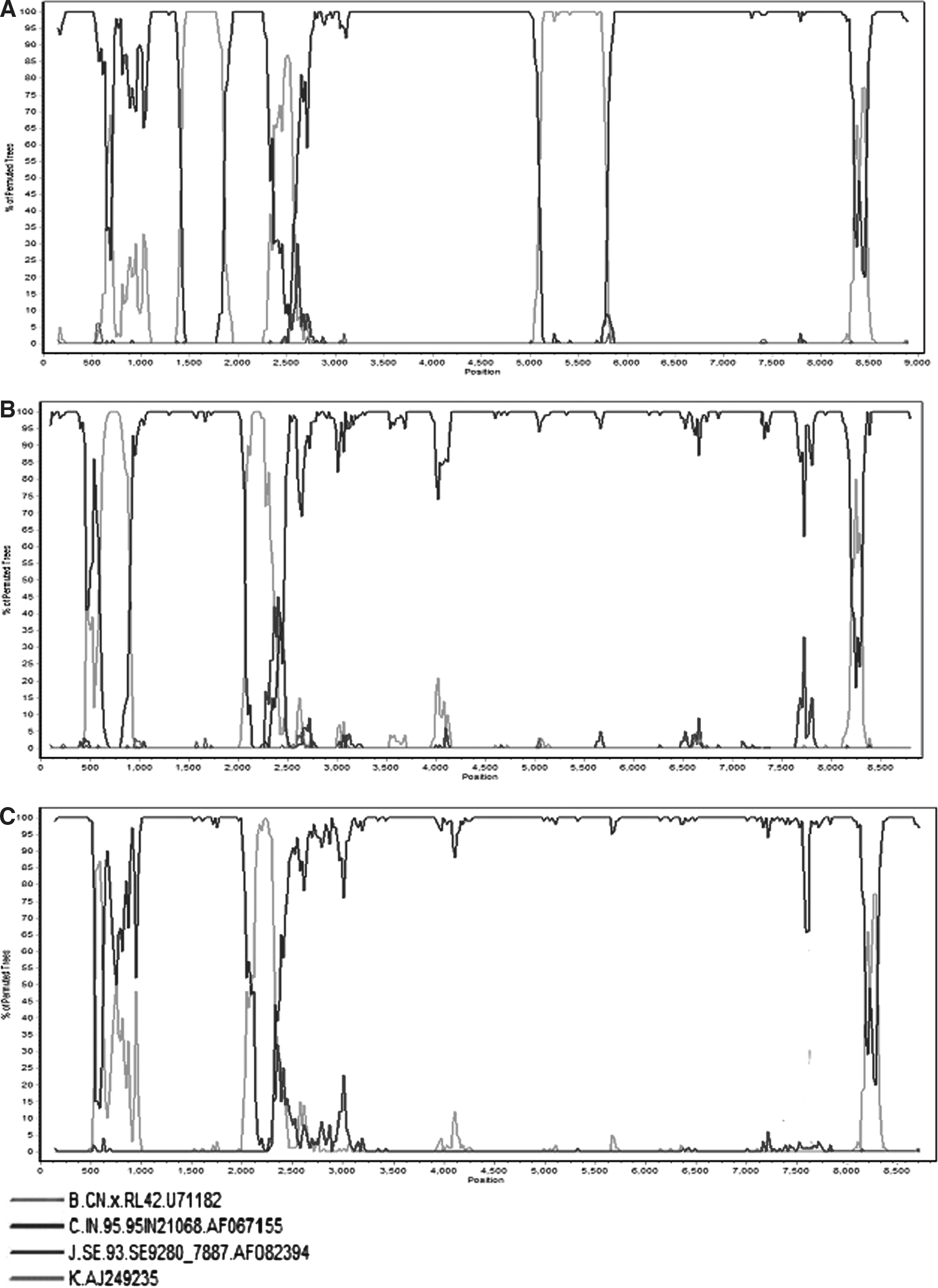
Bootscan analysis of CRF07_BC (97CN54)
Since the possible involvement of CRF07_BC and CRF08_BC in the structural makeup of 09YN072 was suggested, we further scrutinized its recombinant structure by similarity plot and bootscan analysis testing the relationship to CRF07_BC and CRF08_BC. Similarity plot analysis by SimPlot was performed using reference strains of subtype A1, B, C, D, F, G, H, J, CRF07_BC, and CRF08_BC to prove the recombinant structure after removing all of gaps in the alignment using the online Gapstreeze software (
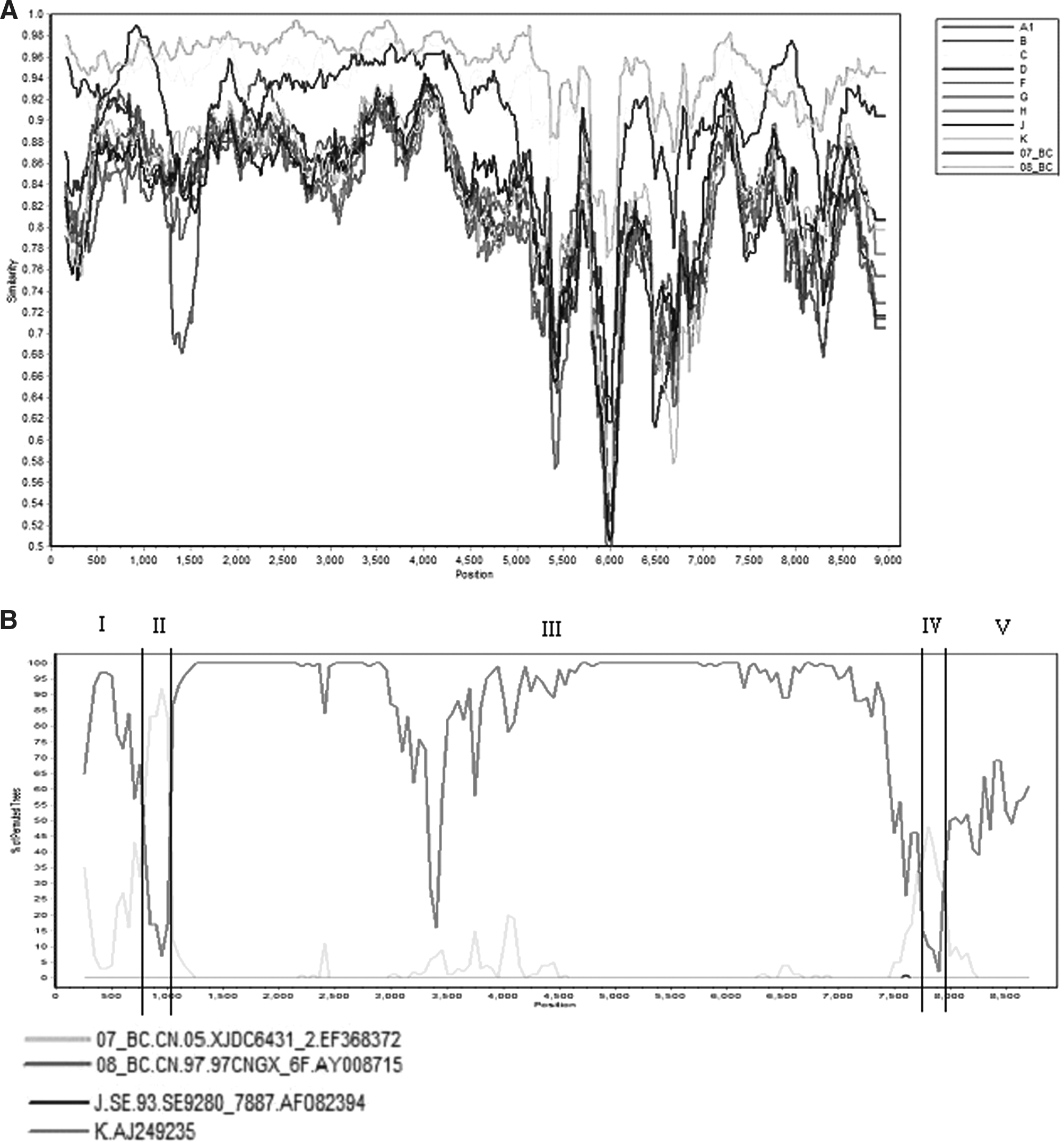
Similarity plots and bootscan analysis for 09YN072.
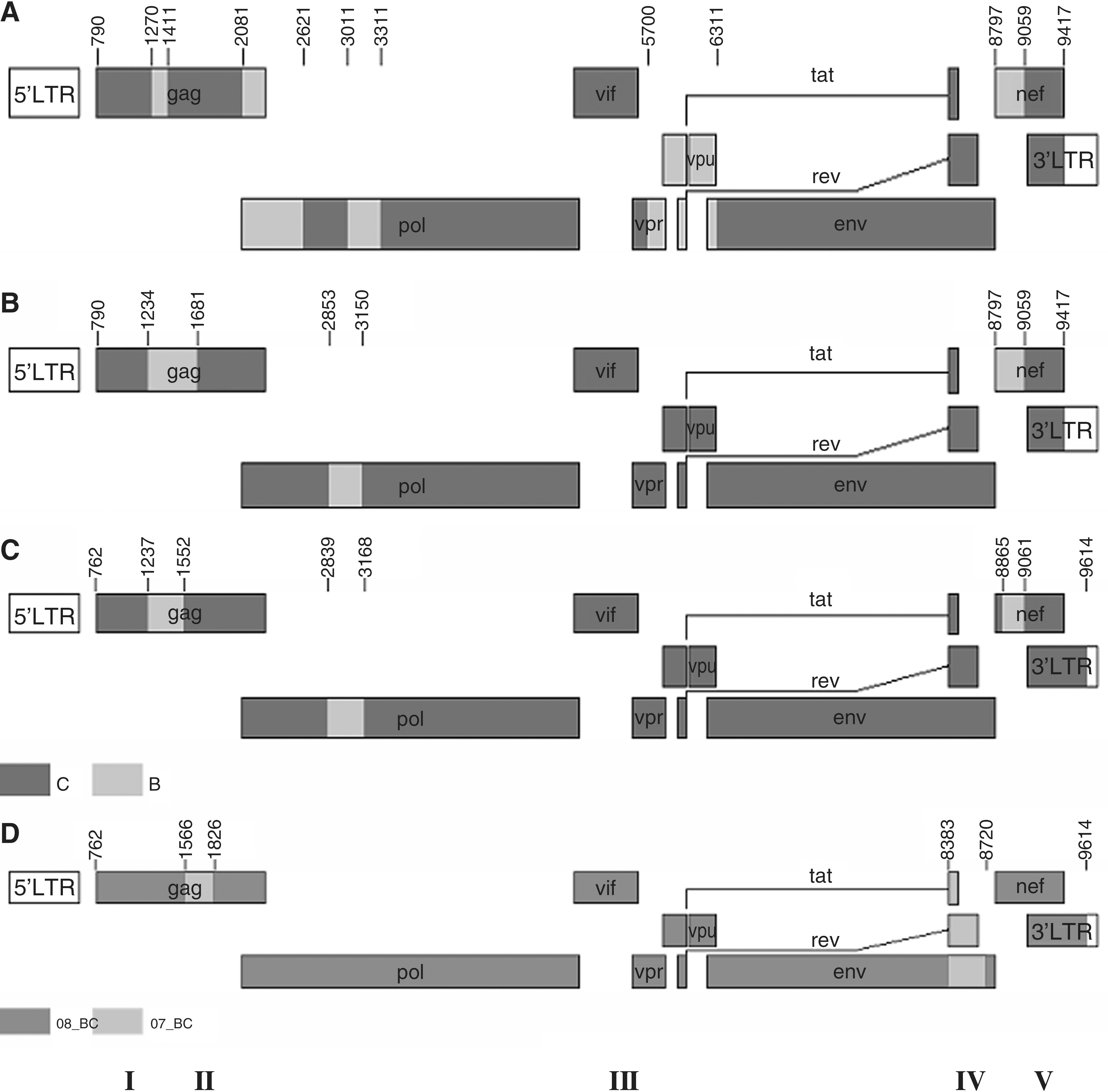
Schematic representation of the mosaic structure of CRF07_BC (97CN54)
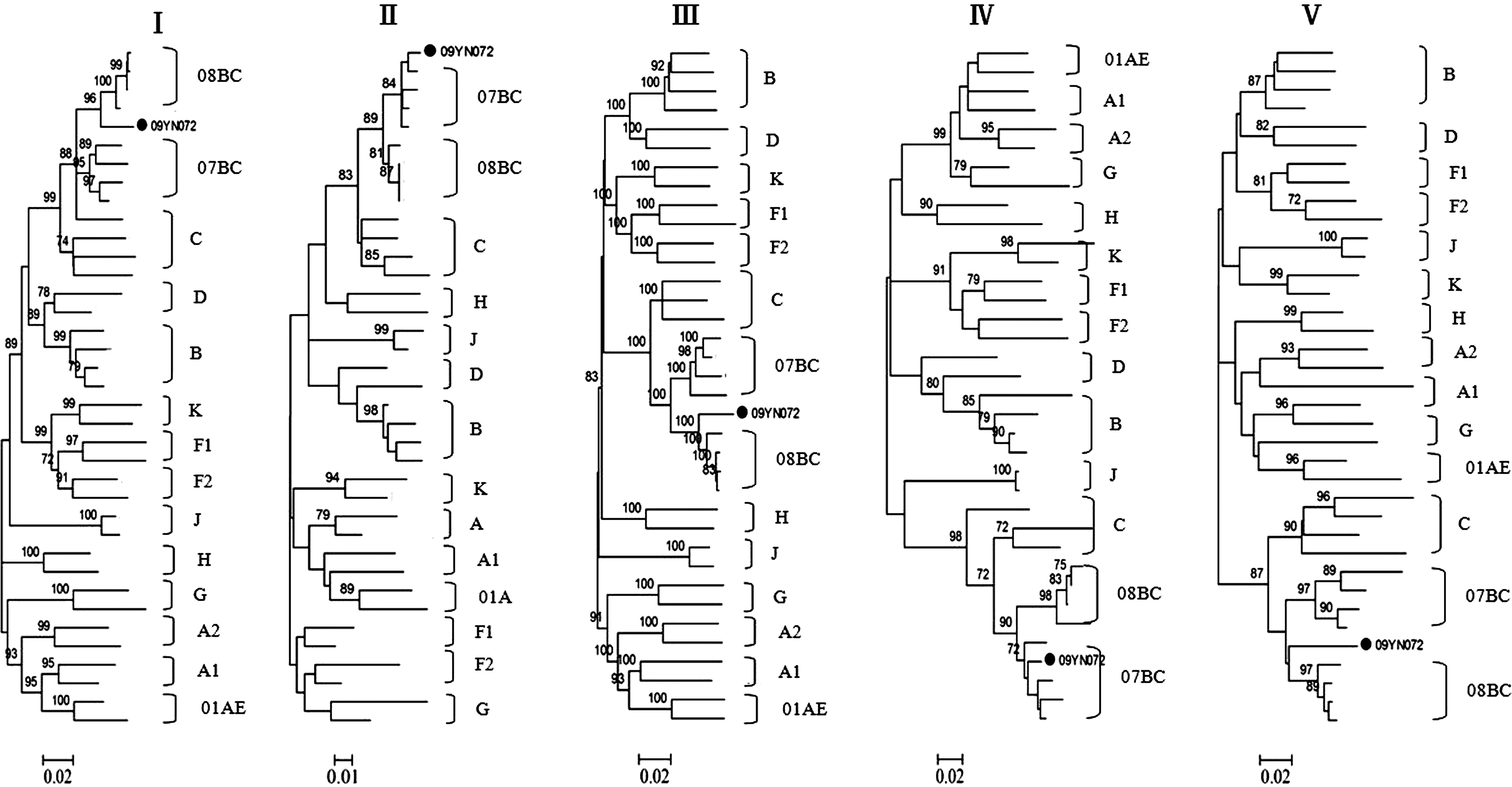
Phylogenetic analyses of five mosaic segments (I–V) defined by bootscanning. The phylogenetic trees were constructed by the neighbor-joining method using the Kimura two-parameter model as implemented in MEGA 4.0. The subtype references are those included in the reference alignment at the Los Alamos HIV Sequence Database. Three CRF strains circulating in China including two CRF01_AE, CRF07_BC, and CRF08_BC were also used in phylogenetic analyses together with the standard subtype references. The stability of the nodes was assessed by bootstrap analysis with 1000 replications, and only bootstrap values of >70 were shown at the corresponding nodes.
Rongge Yang et al. 2 identified some recombinants involving CRF07_BC and CRF08_BC in 2003, and have characterized the mosaicism structures of two similar strains, which were widely divergent as 09YN072. In those two strains, four segments of CRF07_BC were inserted into CRF08_BC; three of them were located within the 5′ portion of the gag-pol region and one within the 3′ portion of nef region. Different from those two strains, only two CRF07_BC segments were inserted into the CRF08_BC backbone in our strain.
CRF07_BC and CRF08_BC are two closely related recombinants derived from Thai subtype B and Indian subtype C lineages. A recent Bayesian coalescent analysis 15 showed that CRF08_BC might have emerged in Yunnan earlier (1990) than CRF07_BC (1993), whereas CRF07_BC had spread quickly to various geographically disparate regions of China other than CRF08_BC, which only spread later to nearby Guangxi autonomous region and to the northern Liaoning province. Today, CRF07_BC, CRF08_BC, and C subtypes were considered to be responsible for 53% of the HIV infections in Yunnan, 16 where new recombinants and even second-generation recombinants between the previously established first-generation CRFs appear to be arising continually. These recombination events may provide more fitness and selective advantages than the parental viruses. 17
In summary, we report a unique near full-length genomic sequence of the CRF07/08_BC recombinant of HIV-1 obtained from the Yunnan province of China. The emergence of such a new generation of second-generation recombinants could further complicate the prevalence of HIV-1 in the population in Yunnan, as well as the development of effective vaccines to limit the spread of HIV-1 in China.
Sequence Data
The genome sequence of 09YN072 was deposited in GenBank with accession number HQ225812.
Footnotes
Acknowledgments
This work was supported by the National Key S&T Special Projects on Major Infectious Diseases (Grants 2008ZX10001-004, 2008ZX10001-012) and the National Natural Science Foundation of China (Grant 30700706). We also want to thank Dr. Feng Gao of Duke Human Vaccine Institute, Duke University Medical Center for providing the technical support for the reverse transcription and nested PCR.
Author Disclosure Statement
No competing financial interests exist.