




Abstract
The aim of this study was to investigate HIV-1 molecular diversity and the epidemiological profile of HIV-1-infected patients from Ribeirão Preto, Brazil. A nested PCR followed by sequencing of a 302-base pair fragment of the env gene (C2–V3 region) was performed in samples from HIV-1-positive patients. A total of 45 sequences were aligned with final manual adjustments. The phylogenetic analyses showed a higher prevalence of HIV-1 subtype B in the studied population (97.8%) with only one sample yielding an F1 subtype. The viral genotyping prediction showed that CCR5 tropism was the most prevalent in the studied cohort. Geno2pheno analysis showed that R5 and CXCR4 prediction were 69% and 31%, respectively. There was no statistical significance, either in viral load or in CD4+ T cell count when R5 and X4 prediction groups were compared. Moreover, the GPGR tetramer was the most common V3 loop core motif identified in the HIV-1 strains studied (34.1%) followed by GWGR, identified in 18.1% of the samples. The high level of B subtype in this Brazilian population reinforces the nature of the HIV epidemic in Brazil, and corroborates previous data obtained in the Brazilian HIV-infected population.
H
HIV-1 can be divided into three distinct groups named M, N, and O. Whereas HIV-1 strains belonging to the O and N groups show only a limited circulation in West Central Africa, the M group includes the majority of HIV-1 strains responsible for the pandemic and is globally distributed. Furthermore, group M viruses can be subdivided in 11 subtypes: A–D, F–H, and J–K. Some studies have shown that the geographic occurrence of HIV-1 subtypes is not randomly distributed among the globe. 3 Thus, genetic diversity studies of HIV-1 are useful to monitor the spread of this virus in the world and even to achieve antiretroviral therapy among selected populations. In Brazil, HIV-1-infected patients have had free access to antiretroviral therapy since the early 1990s, a policy that has decreased HIV-related mortality and morbidity. The Brazilian epidemic is characterized by the predominance of HIV-1 subtype B (51.6–95.1%) mainly in the southeast, with a cocirculation of HIV-1 F1 (3–48.4%) and a minor proportion of HIV-1 C with 1–3% of the confirmed cases. 4
The city of Ribeirão Preto has a population of approximately 600,000 people, is located in southeast Brazil, and has a long history of dealing with HIV-1 infection since the first case of AIDS in Ribeirão Preto was documented in 1984. In addition, Ribeirão Preto has the sixth highest AIDS incidence rate in Brazil, and this high HIV prevalence rate is one of the most important public health problems of the city. However, there are no recent published data regarding HIV-1 subtypes in the general population of Ribeirão Preto. Due to these facts, in the present study we investigated the prevalence of circulating HIV-1 subtypes in samples obtained from infected individuals followed in the AIDS Clinics of the Clinical Hospital of the School of Medicine of Ribeirão Preto of the University of São Paulo. We also analyzed the genetic diversity of the HIV-1 gp120 V3 envelope region in chronically infected patients. 5
A total of 45 samples were collected between 2001 and 2002 from individuals regularly attended the Adult HIV Clinics of the Clinical Hospital of the School of Medicine of the University of São Paulo (HC-FMRP-USP) at Ribeirão Preto, Brazil. The protocol was approved by the institutional Ethics Review Board of HC-FMRP-USP and blood samples were collected after obtaining informed written consent. The selection criteria included HIV-infected patients older than 18 years whose past and current medical records, including laboratory tests (viral load and CD4 T cell count) and data on therapeutic failure, were available in their medical charts. For subtyping and phylogenetic analysis, the HIV-1 RNA was extracted from plasma samples using the QIAamp Viral RNA Mini Kit (Qiagen Inc., Santa Clarita, CA). Amplification of the env gene of HIV-1 was performed with two sets of primers in a two-step nested PCR strategy. The primers used in the first round of RT-PCR, as described by Wolfs et al., 6 were 5′ V3-ATAAGCTTCAATGTACACATGGAATT (nucleotide position 6959–6976) and 3′ V3-ATGAATTCATTACAGTAGAAAAATTCCC (nucleotide position 7362–7381). For the second round of amplification, primers J-5′-2-KSI-ATAAGCTTGCAGTCTAGCAGAAGAAGA and J-3′-2-KSI-2-ATGAATTCTGGGTCCCCTCCTGAGGA were used. Sequencing of nested PCR products of the env gene was done with ABI Prism Big Dye Terminator Cycle Sequencing Ready kit (Applied Biosystems, USA). Of the subjects included in this study, 25 (55.5%) were males and 20 (44.5%) were females. Their ages ranged from 18 to over 50 years (Table 1), but the highest number of individuals included in the study was between 31 and 50 years old. Risk factors for acquiring HIV infection were distributed as follows: 28 (62.2%) had a history of unprotected heterosexual practice, four (8.9%) had a history of intravenous drug use, only one (2.2%) reported blood transfusion as a risk factor, and three (6.7%) had other risk factors (Table 1). However, some individuals reported more than one risk factor, eight (17.8%) had a concomitant history of unprotected sex and intravenous drug use, and one (2.2%) reported blood transfusion and unprotected sex. By the time of sample collection, 71.1% of patients were on active antiretroviral drug treatment, and the remaining (28.9%) was treatment naive.
These subjects reported more than one HIV exposition history.
Related to antiretroviral therapy status before sample collection.
Subject profiles varied according to the HIV-1 infection stage (based on CDC, U.S. Centers for Disease Control and Prevention, classification). Most of the studied population (77.9%) was classified at the C3 stage, characterized by a CD4+ T cell count of less than 200 cell/ml. The second highest group belonged to the B2 stage (9%). The mean viral load was 5.03 log10 copies/ml for the CDC A stage, 5.06 log10 for the B stage, and 4.92 log10 for the C stage (Table 2).
Viral load and CD4 parameters were evaluated at the time of sample collection.
Total of subjects with CXCR4 or CCR5 predicted by the described method.
Log10 copies/ml.
To determinate the coreceptor usage we employed two prediction methods based on bioinformatics. The viral tropism analysis was distributed according to HIV stage (Table 2). From observed C3 stage status, most were predicted to be CCR5 tropic (55.5%); 26.6% showed a CXCR4 prediction (geno2pheno) and the charge rule 11/25 demonstrated 62.3% of CCR5 and 20% of CXCR4. In HIV infection, the entry process is determined by coreceptor interaction in the sense that the macrophage tropic viruses use CCR5 and T-tropic viruses bind CXCR4preferentially, with the cell surface molecules acting as chemokine receptors. The macrophage tropic viruses are less pathogenic and infect only activated CD4+ T cell and macrophages, and they are encountered over the entire course of HIV infection. In contrast, CXCR4 variants preferentially infect resting T cells and present a higher replication rate and increased pathogenicity and are most frequently observed in advanced stages of the disease. 7,8 The viral loads and T cell counts of our samples were compared to viral tropism predictions of both described methods. The statistical analysis showed no difference between viral load and CD4+ count according to coreceptor use. Figure 1 shows the results according to geno2pheno prediction only. In this analysis we included only those subjects with CDC stage C3 and antiretroviral therapeutic failure.

The graphic represents the values of the CD4+ T cell count and viral load distributed according to viral prediction by geno2pheno. There was no statistical significance (Fisher's exact test) between CCR5 and CXCR4 prediction.
Here, we analyzed the tropism of HIV isolates from HIV-1-infected patients by V3 genotyping prediction. Both geno2pheno and charge rule 11/25 methods showed a good predicted coreceptor usage agreement. Mefford et al. showed that the accuracy of these two methods was 83.3% for charge rule and 90% for geno2pheno, when used for the prediction of coreceptor usage in samples from patients with HIV-associated dementia. 9 In this study, a higher prevalence of CCR5 tropic viruses was observed, even in patients with advanced stages of AIDS, indicating that they would be susceptible to coreceptor inhibitors. It is believed that 40–50% of the infected individuals carry CXCR4 tropic viruses. 9,10 Here we found 31% and 20% of the patients had this variant according to geno2pheno and charge rule 11/25, respectively. The importance of determining HIV-1 tropism relies on the fact that coreceptor interaction is now a target for drugs that act by blocking virus entry and coreceptor inhibitors have been recently released, and finally, the efficacy of the treatment could be monitored by these methods. The drawback of this technique is the fact that even though tropism prediction based on the V3 genotyping of HIV-1 RNA extracted from plasma samples is easy to perform, these methods cannot be 100% efficient in predicting HIV-1 coreceptor use. Although R4 viruses are associated with a rapid decline in CD4+ T cell count and increased viral load, we did not find statistical differences in these parameters in our results; this could be explained by the low number of analyzed individuals and by the heterogeneous distribution, in respect to antiretroviral therapy, of our studied group. Therefore, a prospective study could be more accurate in analyzing these data.
The V3 region nucleotide sequence of the HIV-1 env gene, obtained from all 45 of the analyzed subjects, was aligned with sequences from the Los Alamos HIV sequence database by using the HIV BLAST Search (
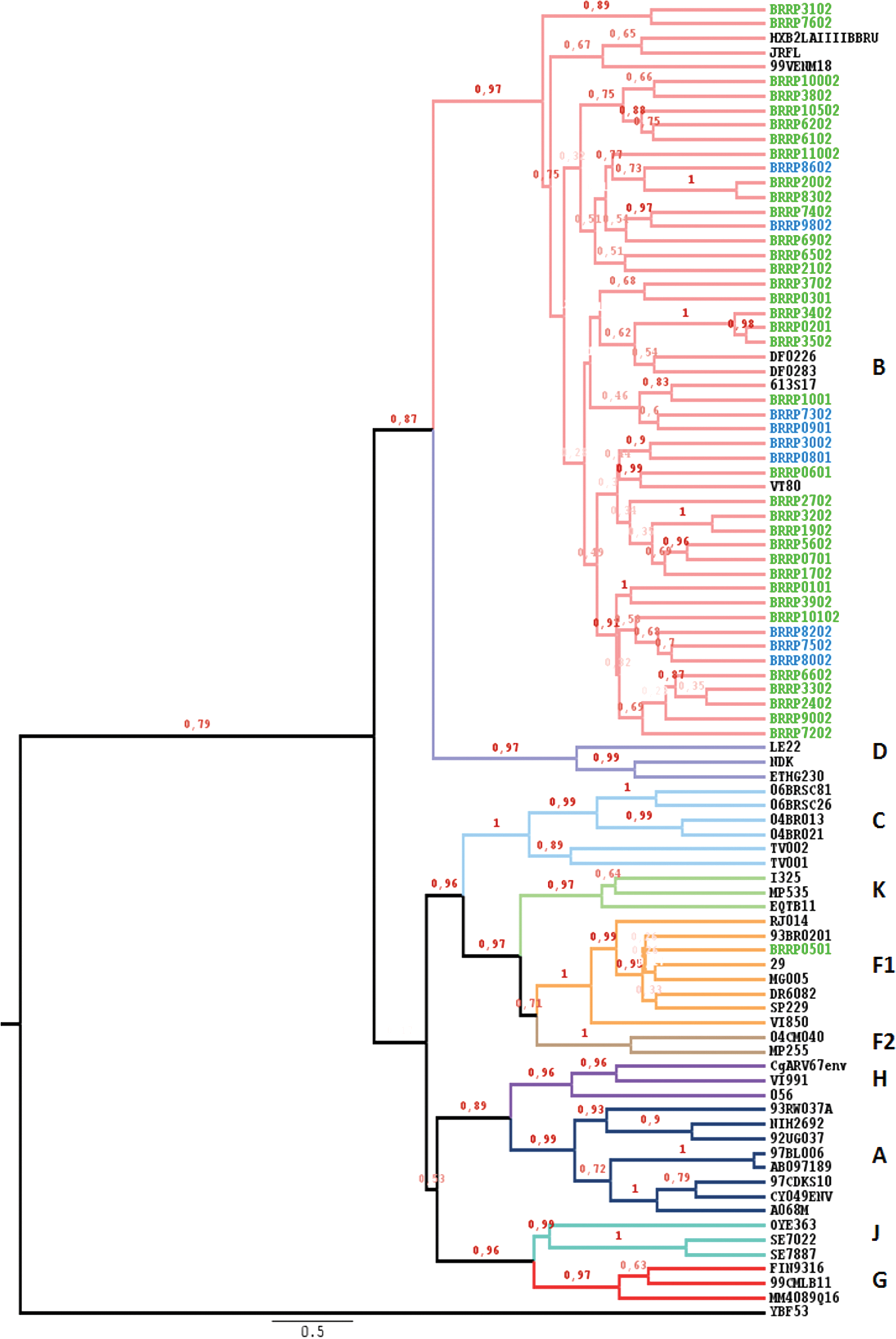
Evolutionary relationships of 91 taxa based on the env V3 region determined in HIV-1 samples from Ribeirão Preto and group M reference sequences from the Los Alamos database. The group O sequence was used as the outgroup. The evolutionary history was inferred using the Bayesian analysis method and the consensus tree was inferred from 10,000 trees. Posterior probability values range from 0.5 to 1.0 according to the gradation of the red color. Sequences of the GWGR motif from HIV-1 samples obtained in the present study are shown in blue and sequences obtained with the other motifs are shown in green. Color images available online at
The distribution of HIV-1 in Brazil is heterogeneous in terms of subtype incidence. In northeast Brazil the main subtype circulating is the B subtype comprising almost 90% of the analyzed samples, but a few cases of F, C, and B/F recombinants have been documented. 11 In the north region there is a similarity in distribution of the B and B/F recombinants, each with a prevalence of 35%, followed by a 16% prevalence of subtype F. The molecular epidemiology of HIV-1 isolates from south Brazil identifies subtype C as the major circulating subtype, since 48% of analyzed samples were subtype C and 23% were subtype B. 12 To improve our knowledge of HIV-1 epidemiology in southeast Brazil, in the city of Ribeirão Preto we assessed the genetic diversity of HIV-1 strains circulating in this region by direct sequencing of the V3 loop region. Based on the phylogenetic analyses, a large proportion of HIV-1 subtype B (97.8%) was observed in the studied subjects, followed by an F1 subtype with 2.2% of the analyzed subjects. Although differences in the pattern of subtype distribution have been documented among geographic regions, the B subtype is the predominant HIV-1 circulating subtype in Brazil, followed by F, C, and isolated cases of D and A. 13 In our study, the results support the previously documented distribution among HIV-1 in Brazil, where the B subtype is the prevalent circulating subtype.
To characterize the HIV-1 isolates, the V3 loop amino acid sequence was analyzed on a site-by-site basis. Sequence characteristics of HIV-1 V3 loops from the circulating isolates in Ribeirão Preto are shown in Fig. 3. It was possible to observe a total conservation for nine of the 35 analyzed amino acid residues (25.7% of conservation). The conserved positions were particularly located in the C-terminal end (C1, R3, P4) and in the N-terminal end (G28, I30, R31, A33, C35). The positions in which variations did not exceed 5% were concentrated in the base (N6) and the stem (N7, T8), except for the glycine, proline, and glycine (GPG) motif at the tip of the loop. The most variable position was the 25th and was the determinant for the 11/25 rule (Fig. 3).
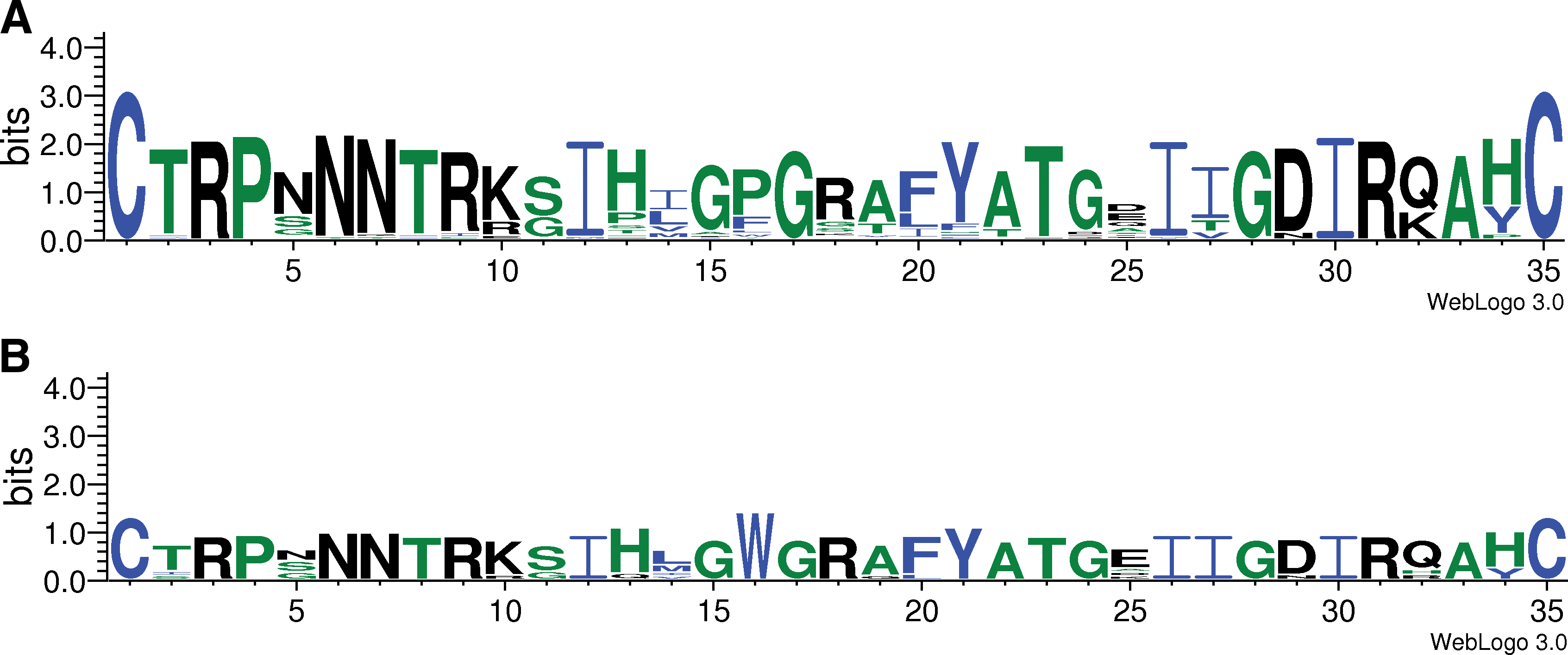
Sequence logos of V3 residue sequences generated in this study. The character and size of each logo represent the proportion of an amino acid at the specific site. Sequences of GPG viruses and viruses with other motifs such as GFG and GLG are shown in
Considering the V3 amino acid sequence of B subtype isolates analyzed in this study with GWGR and GPG and GXGX tetramers, many contained amino acid substitutions presented at high frequencies, whereas others were unique substitutions. The sites that differed most among GWGR and GXGX viruses were sites 13, 14, 18, and 25. At sites 13 and 18 there was a minor difference in amino acid proportion; however, at sites 14 and 25 the difference was more pronounced. At site 14, the proportions of leucine, methionine, isoleucine, and valine were, respectively, 50%, 25%, 12.5%, and 12.5% in GWGR viruses, compared with 32.4%, 10.8%, 40.5%, and 13.5% in GXGX viruses. The substitution leucine-to-isoleucine involved one transversion at the first site of the triplet (i.e., CTA to ATA). However, the most evident difference between GWGR and GXGX viruses was in the aspartic acid (D) and glutamic acid (E) proportions at site 25. An almost equivalent ratio of aspartic acid to glutamic acid (27% and 24.3%, respectively) was observed between the GXGX. Nevertheless in the GWGR viruses there was an imbalance in the proportion of aspartic and glutamic acids at site 25 of the V3 loop (12.5% and 62.5%, respectively). Considering the tropism prevalence in these phenotypes we could observe that the GWGR phenotype contains mainly R5 viruses (7/8) and less X4 (1/8). But considering the GXGX phenotype we could observe a mixture of R5 and X4 phenotype (taking into consideration the charge rule analysis); 64% (24/37) were classified as R5 viruses and 36% (13/37) as X4 viruses.
A unique and intriguing characteristic of the HIV-1 epidemic in Brazil relies on the fact that approximately half of the B subtype isolates exhibit the tetramer GWGR at the tip of the V3 loop. 12,13 These variant viruses are not frequently observed in other countries such as China, France, the Czech Republic, the Philippines, and Cuba. 14 Another motif (GPGR) is found mostly in North American and European strain isolates. 15 To document the frequency of these variants in the population of Ribeirão Preto, we aligned the amino acid sequence of our isolates and compared the frequencies of motif variants in this population. Here we observed that 18.1% of the obtained sequences presented the GWGR variant and that the majority of our analyzed cohort (34.1%) showed the GPGR variant motif. The other 47.8% presented a different phenotype, GXGX. In a different study, in samples collected in 1983, a prevalence of 50% of the GWG phenotype and 42% of the GPG phenotype was observed; 8% presented an indeterminate status. 16
We have also observed that GWGR and GXGX viruses were distinct in terms of the amino acids frequencies at V3 sites 14 and 25. Moreover, it is important to mention that the presence of negative amino acids at this site has been implicated in a better replicative fitness of HIV-1 R5 strains. 17 The amino acid most frequently identified at site 14 of the GWGR viruses was leucine, whereas in the GXGX viruses it was isoleucine. The impact that this substitution has on HIV-1 fitness was not relevant, given that the two amino acids share the same hydrophobic characteristics. A similar finding was shown by Leal et al., 14 but instead of leucine they found more methionine in GWGR viruses. On the other hand, the differences at site 25 could have an impact on viral replicative fitness. This has been demonstrated for HIV-1 subtype B by site-directed mutagenesis in R5 variants. The residues most valuable for virus infectivity were aspartic acid and glutamic acid, whereas hydrophobic amino acids caused a reduction in HIV-1 fitness. The most common amino acid (aspartic acid) at the V3 region in site 25 is associated with higher viral infectivity. The second most common amino acid (glutamic acid) at site 25 is also associated with high viral infectivity; however, the viruses presenting glutamic acid in R5 variants are 18% less fit than those presenting aspartic acid. In the present study a similar ratio of aspartic acid to glutamic acid in the GXGX viruses was observed, but in the GWGR viruses there was an imbalance in the proportion of aspartic and glutamic acids at site 25 of the V3 loop (12.5% and 62.5%, respectively). This finding could be related to the theory that GWGR viruses are less pathogenic than other strains from the B subtype in Brazil, demonstrated in an analysis involving the disease progression rate. 16 But this observation may lead to an incorrect notion if we consider the viral tropism. X4 variants are associated more with a rapid decline in CD4+ cell counts and accelerated progression to AIDS and the comparison between GWGR and GXGX viruses could incorporate the profile of coreceptor usage. As observed, most of the GWGR viruses were R5 variants, whereas GXGX viruses were a mixture of R5 and X4 variants. Consequently, this could lead to the incorrect assumption that infection with a GPGR virus results in lower CD4+ cell counts or more rapid progression to AIDS than infection with a GWGR virus.
In conclusion, we selected the V3 region because of the great potential this region has in multiple analyses and mainly because this gene region has been shown to provide accurate phylogenetic relationships. We showed that the main circulating subtype in Ribeirão Preto is the B subtype presenting the typical GPGR motif. We recognize the lack of homogeneity in our samples in terms of antiretroviral treatment and the low number of analyzed samples. However, this study is important because we addressed the full genotypic characteristics of the env V3 loop and similar studies are scarce in Brazil, given the role of V3 variation in disease progression. Moreover, it is important to monitor the variability among HIV subtypes in order to achieve success with HIV prevention and treatment programs.
Footnotes
Author Disclosure Statement
No competing financial interests exist.
References
Supplementary Material
Please find the following supplemental material available below.
For Open Access articles published under a Creative Commons License, all supplemental material carries the same license as the article it is associated with.
For non-Open Access articles published, all supplemental material carries a non-exclusive license, and permission requests for re-use of supplemental material or any part of supplemental material shall be sent directly to the copyright owner as specified in the copyright notice associated with the article.
