




Abstract
A molecular epidemiological investigation (n = 62) conducted in western Hubei, Central China, revealed that HIV-1 subtype B' (Thailand variant of subtype B) predominated not only among former plasma donors (FPDs) (29/29, 100%) but also among heterosexuals (27/31, 87%), suggesting that subtype B' appears to bridge the spread from FPDs in the general population in this particular area in Central China.
N
We conducted the molecular epidemiologic study in western Hubei Province in Central China, one of the area in which a large number of FPDs were infected in the early to mid 1990s; we found that HIV-1 subtype B' predominates among FPDs as well as heterosexuals, suggesting that the local epidemic of subtype B' among FPDs is likely responsible for the outbreak among heterosexuals in this particular region in Central China.
Study subjects (n = 62) were recruited between July 2007 and March 2008 in Enshi prefecture in western Hubei Province (Fig. 1, inset). The study was approved by the Committee for Human Research in the Center of Diseases Control (CDC) of Enshi prefecture. The patients' clinical and epidemiologic backgrounds were collected through an interview by the CDC officers. Study subjects (n = 62) include 36 heterosexuals (13 males, 23 females), 31 FPDs (26 males, 5 females), one IDU (female), and one mother-to-child transmission (MCT) case (male, 6 years old). Subjects consisted of 39 adult males with an age range of 29 to 60 years old (mean: 40.1 ± 8.6 years old) and 29 females with an age range of 22 to 52 years old (mean: 36.1 ± 8.6 years old). All 62 specimens were serologically determined as HIV-1 positive. No HIV-2 infections were detected.
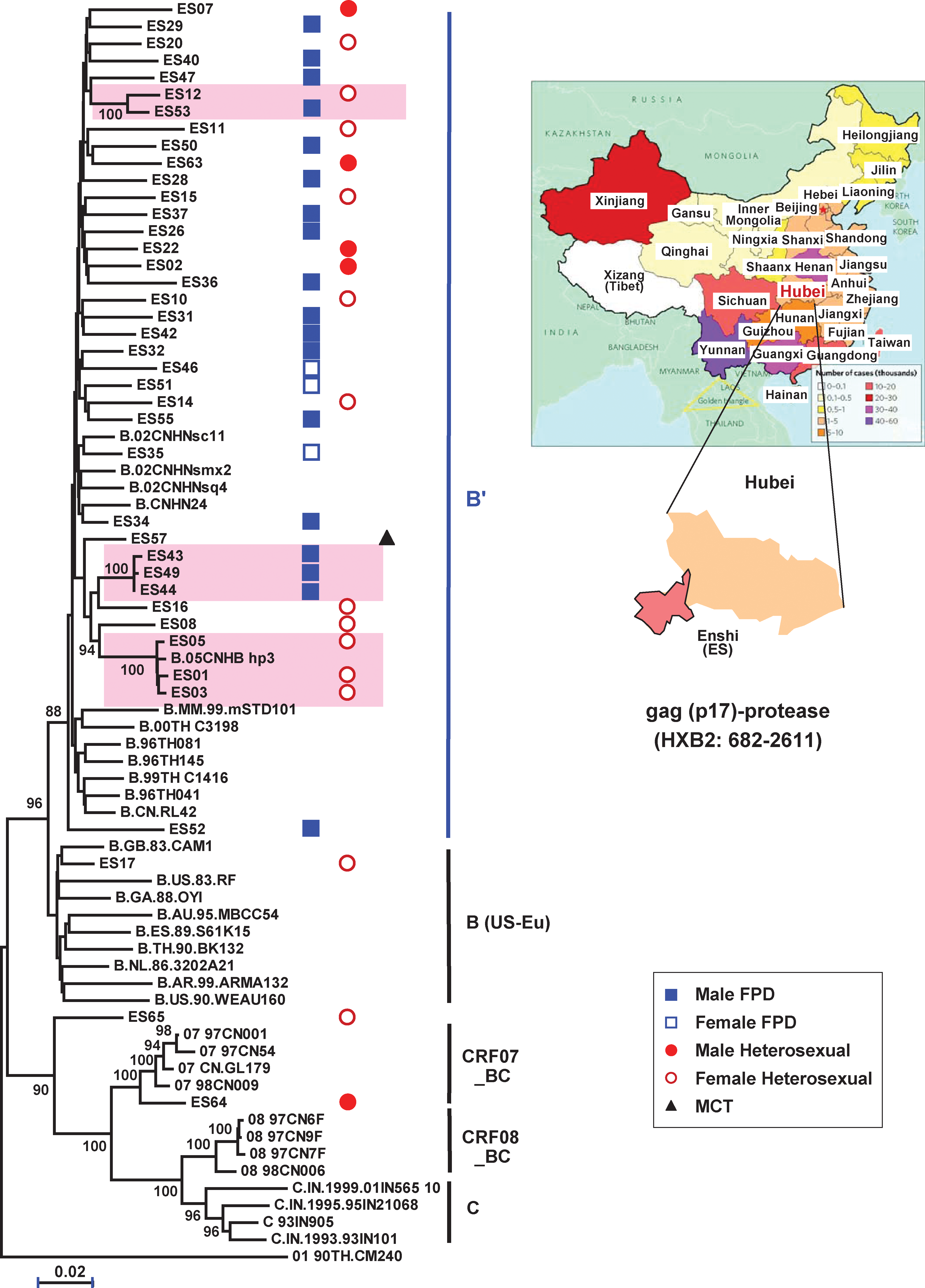
Neighbor-joining tree of HIV-1 sequences from western Hubei, Central China based on the 1.9-kb HIV-1 gag-pol region (HXB2: 682–2611 nt). An HIV-1 CRF01_AE (90TH.CM240) sequence was used as an outgroup. Only part of the tree relevant for the present study is shown for simplicity. Bootstrap values greater than 70 are shown at the corresponding nodes. Because of the shortness of the nucleotide sequences, some strains cannot be included in this 1.9-kb tree, including one subtype B'-infected female intravenous drug user (IDU) (ES58) and two CRF01_AE-infected heterosexuals (ES06 and ES68). ES65 (from a female heterosexual) is a URF comprised of subtype B' with a short segment of subtype C (see the text). Closed square (male former plasma donor, FPD); open square (female FPD); closed circle (male heterosexual); open circle (female heterosexual); closed triangle (mother-to-infant transmission, MCT). Inset, map of China on which the study site (the Enshi district in Hubei province) is indicated.
EDTA-treated whole blood specimens were collected and peripheral blood mononuclear cells (PBMCs) were separated on Ficoll-Hypaque density gradient centrifugation (Amersham Biosciences AB, Uppsala, Sweden). Proviral DNA was isolated from PBMCs with guanidine detergent (Invitrogen, Carlsbad, CA). Plasma HIV-1 RNAs were extracted by the QIAamp RNA Blood Mini Kit, Qiagen, Hilden, Germany. The HIV-1 nucleotide sequences of the gag-pol regions were determined either by proviral DNA or plasma HIV-1 RNA. 15 The polymerase chain reaction (PCR) primers used for this study were as follows. For the 3.0-kb HIV-1 gag-RT region (HXB2: 760–3825 nt), the first PCR primers are 3K1L (5′-GTAACTAGAGATCCCTCAGACCCATTTAGT-3′) and 3K1R (5′-ACATTTATCACAGCTGGCTACTATTTCTTTT-3′) and the second PCR primers are 3K2L (5′-CAGTATTAAGCGGGGGACAATTAGATAGAT-3′) and 3K2R (5′-ATAATTTCACTAAGGGAGGGGTATTGATAA-3′). For the 1.9-kb gag (p17)-protease region (HXB2: 682–2611 nt), the first PCR primers are 172A (5′-ATCTCTAGCAGTGGCGCCCGAACAG-3′) and 505B (5′-ACTCTTGCTTTATGGCTGGGTCC-3′) and the second PCR primers are 174A (5′-CTCTCGACGCAGGACTCGGCTTGCT-3′) and 506B (5′-CCTGACATGCTGTCATCATTTCTTCTA-3′). For the 0.89-kb protease-RT genes (HXB2: 1726–2611 nt), the first PCR primers are 507A (5′-AAGGAACCCTTTAGAGACTATGTAGA-3′) and 503B (5′-TATGGATTTTCAGGCCCAATTTTTG-3′) and the second PCR primers are 508A (5′-GTAAAAAATTGGATGACAGAAACCTTG-3′) and 504B (5′-ACTTTTGGGCCATCCATTCC-3′). PCR products were subjected to DNA sequencing after TA cloning using an automated ABI 3730 DNA sequencer (Applied Biosystems Inc. USA).
Of 62 specimens, a 3.0-kb HIV-1 gag (p17)-RT region (HXB2: 760–3825 nt) from 33 samples, and a shorter fragment of either the 1.9-kb region covering gag (p17)-protease (HXB2: 682–2611) from 40 samples, or a 0.89-kb region covering protease-RT genes (HXB2: 1726–2611 nt) from 62 samples, were successfully amplified and sequenced. All the nucleotide sequences were screened using the BLAST program (National Center For Biotechnology Information, USA) to search for sequence similarities to previously reported sequences in the databases and to eliminate potential laboratory errors. These nucleotide sequences were aligned with reference sequences (
Figure 1 shows the neighbor-joining tree based on the 1.9-kb gag (p17)-protease regions (HXB2:682–2611). The distribution of HIV-1 genotypes based on the 0.89-kb protease region (HXB2: 1726–2611) in western Hubei (n = 62) was as follows: HIV-1 subtype B′ (57/62, 91.9%); CRF01_AE (2/62, 3.2%); subtype B (U.S.-European subtype B) (1/62, 1.6%); CRF07_BC (1/62, 1.6%); and URF (1/62, 1.6%) (Table 1). HIV-1 subtype B′ predominated both among FPDs (29/29, 100%) and among heterosexuals (26/31, 83.8%). Subtype B′ was also detected in one MCT case (ES59) as well as one IDU case (ES58) (Table 1, Fig. 1). We also found that ES65 (female heterosexual) was placed outside of the known HIV-1 genotypes (Fig. 1). Recombination breakpoint analyses revealed that ES65 is a recombinant comprised of subtype B′ (1.2-kb long; HXB2: 1443–2611 nt) and a small segment of subtype C (0.7-kb long; HXB2: 682–1437 nt) in the 1.9-kb gag (p17)-protease region. In contrast, CRF01_AE, a prevalent strain among heterosexuals in China, 6 –8 was detected in only two heterosexuals (2/31, 6.5%) in that region (Table 1).
HIV-1 genotypes were determined on the basis of the 0.89-kb gag (p17)-protease region, except for one female heterosexual case (EN65) that was found to carry a URF comprised of subtype B′ with a small segment of subtype C (see text and Fig. 1). The number of female cases are given in parentheses. IDU, injecting drug user; FPD, former plasma donor; MCT, mother-to-infant transmission.
Interestingly, the profile of distribution of subtype B′ by gender shows a male dominance (male:female = 24:5) among FPDs and a female dominance (male:female = 8:18) among heterosexuals (Table 1). This may suggest that HIV-1 subtype B′ is likely being transmitted from the FPD population to the general population through the heterosexual route. Although no apparent epidemiologically linked pairs of heterosexual transmission (for instance, husband–wife) and MCT were reported by interviews, some of the subtype B′ sequences formed clusters with significant statistical supports in the tree: ES12 and 53; ES01, 03 and 05; and ES43, 44 and 49 (Fig. 1).
In conclusion, the high prevalence of subtype B′ among heterosexuals suggests that subtype B′ strains are bridging the spread from FPDs into the general population in China. 21 Our findings indicate an urgent need for effective measures to prevent further transmission from high-risk groups to the general population in China.
Footnotes
Acknowledgments
This study was supported by the Key National Science and Technology Program in the 11th Five-Year Period (Grant 2008ZX10001-004) and the Capital Program of the Chinese Academy of Sciences (Grant KSCX1-YW-10) and partly by grants from Ministry of Health, Labour and Welfare, Ministry of Education, Science and Technology (Japan), and Japanese Foundation for AIDS Prevention (JFAP).
Author Disclosure Statement
No competing financial interests exist.