




Abstract
HIV infection in the central nervous system (CNS) can progress to AIDS dementia complex; currently, little information on the characterization of the HIV-1 env gene from the CNS is available in infected Chinese patients. In the study, the C2–V5 regions of the HIV envelope gene were cloned and sequenced from both cerebrospinal fluid (CSF) and blood samples of five infected Chinese patients. Sequence analysis revealed that the sequences from Yunan province clustered closely with subtypes CRF07_BC, CRF08_BC, and C, and the sequences from blood showed a significantly higher divergence from those from the CSF. In addition, as predicted by the 11/25 charge rule and geno2pheno program, most of the HIV viral quasispecies from both CSF and blood use CCR5 as coreceptor. These data provide valuable information on a detailed evaluation of the pathogenesis of HIV infection in different tissues of Chinese HIV-infected patients, and our findings would be helpful for the design of vaccines and therapy strategies.
I
Five HIV-infected patients in Yunnan were included in the present study; all were HIV-1 positive and had never received antiretroviral therapy. All subjects had plasma and cerebrospinal fluid (CSF) HIV RNA >2500 copies/ml (Table 1). Blood and CSF samples were collected between March 2010 and May 2010, with patients' written consent and with approval from the ethical review committee. Viral RNA was purified from blood and CSF using the QIAamp Viral RNA Mini Kit (Qiagen, Duesseldorf, Germany) according to the manufacturer's protocol. The purified RNA was then subjected to polymerase chain reaction (PCR) amplification using primer pairs of outer forward (ENV-FO: atgggatcaaagcctaaagccatgtgt) and outer reverse (ENV-RO: gcgcccatagtgcttcctgctgctgc); nested PCR with interior forward (ENV-FI: ctgttaaatggcagtctagc) and interior reverse (ENV-RI: acttctccaattgtccctcat) was used to amplify the C2–V5 regions of the env gene. Multiple HIV-1-negative controls were utilized to detect any possible contamination. PCR products were cloned using the TA cloning system (Takara, Dalian, China). For each patient, approximately eight randomly selected clones per sample were sequenced on an ABI 3730 genetic analyzer.
The nucleotide sequences were assembled and error checked (GenBank accession numbers HQ452544–HQ452613). The C2–V5 sequences from each clone were aligned with reference sequences from different HIV-1 subtypes available from the Los Alamos HIV-1 databases and GenBank by the Clustal W multiple sequence alignment program from the Mega 4.0 software package. The sequences exhibited the usual alterations in the viral genome, especially in the variable region. The phylogenetic tree was first made by the neighbor-joining method and Kimura two-parameter model on
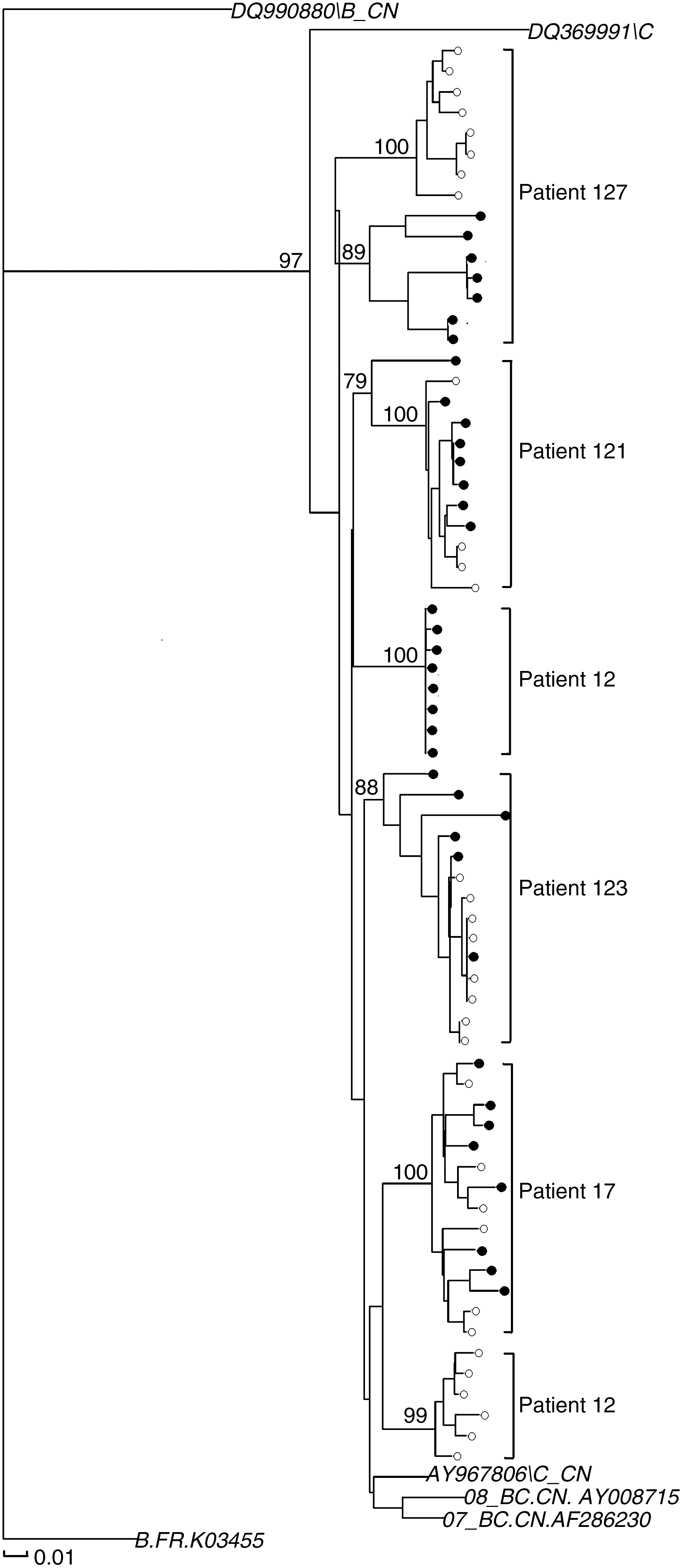
Phylogenetic reconstruction from envelope (C2–V5) clonal sequences in cerebrospinal fluid (CSF) and blood samples of five HIV infected Chinese patients.
Analysis of viral divergence was determined by the nucleotide distance between each viral quasispecies and CRF07_BC. The Kimura two-parameter corrected population divergence was calculated for clonal nucleotide sequences using the distance program from the Mega 4.0 software package. The statistical significance of the differences between the CSF and blood was determined using nonparametric statistics, the Mann–Whitney test. We found that the mean nucleotide distance of the founder virus from blood was significantly higher than that from CSF (p=0.007) (Fig. 2); the result indicated that immune pressure may have a different impact on viral evolution in different tissues of the host. The intrapatient nucleotide diversity of the envelope sequences was analyzed, however, the analysis did not reveal any significant difference between CSF and blood samples (data not shown).

Divergence analyses of envelope (C2–V5) clonal sequences in cerebrospinal fluid (CSF) and blood samples of five HIV-infected Chinese patients. Kimura two-parameter corrected population divergence was calclulated for clonal necleotide sequences using the distance program from the Mega 4.0 software package. The distances of all sequenced clones from the CRF_07BC founder strain AF286230 were plotted as different sample types. Mean divergence of each group is indicated by a line (——). Statistical significance of the differences between CSF and blood was performed using nonparametric statistics, the Mann–Whitney test.
The deduced C2–V5 region of the HIV env amino acid sequences was aligned with reference B (GenBank accession number k03455) by the Clustal W multiple sequence alignment program from Mega 4.0. The envelope region contains genetic sequences that are responsible for cell tropism; the third variable loop (V3) alone appears to be an important determinant for coreceptor usage.
10
The phenotype prediction programs based on V3 sequences have been developed to predict the coreceptor usage. We first used the 11/25 charge rule to characterize coreceptor usage in different tissues.
11,12
In the study, we found that the amino acids were serine (S) at codon 11 in all the sequences and threonine (T) at codon 25 in most of the sequences, except for arginine (R) in the sequences from the CSF samples of patient 127. According to the 11/25 charge rule, most HIV strains in the study use CCR5 as the coreceptor except for the strain from the CNS of patient 127. Based on the HIV-1 V3 sequence, coreceptor usage was also analyzed by the other phenotype prediction program, geno2pheno, online (
Cytotoxic T lymphocyte (CTL) activity is a major component of the host immune response, which is responsible for controlling HIV replication; HLA-A2 and HLA-A11 are two predominant alleles in Chinese HIV-infected patients. 13 An HLA-A2-restricted CTL epitope in the V3 region of HIV gp120 was identified by Alexander-Miller et al. 14 When compared with the aligned amino acid sequences in the study, the identified epitope was not conserved (data not shown).
In summary, we characterized the C2–V5 region of the env gene from the CSF and blood samples that were obtained from five HIV-infected Chinese patients. All the sequences from Yunan province clustered closely with subtype sCRF07_BC, CRF08_BC, and C, and the sequences from blood showed a divergence significantly higher than from CSF. In addition, most of the HIV viral quasispecies from both CSF and blood use CCR5 as the coreceptor. These data provide valuable information for a detailed evaluation of the pathogenesis of HIV infection in different tissues of Chinese HIV-infected patients, and our findings would be helpful in designing vaccines and therapy strategies.
GenBank Accession Numbers
The GenBank accession numbers of the nucleotide sequences reported in this paper are HQ452544–HQ452613.
Footnotes
Acknowledgments
This work was supported by the National Natural Science Foundation of China 30910103915, 30870853 (D. Chen), the Major National Science & Technology Program (2009ZX 10004-902), the Beijing Natural Science Foundation 7101005 (D. Chen), and the 11th Five-Year SciTech Fund of China 2008ZX10001-007, 2008ZX10001-004.
Author Disclosure Statement
No competing financial interests exist.