




Abstract
The purpose of this study was to investigate the genetic diversity of HIV-1 circulating in Beijing and its molecular epidemiological linkages with regard to risk factors of viral transmission. HIV-1 from plasma samples of 280 diagnosed individuals (2006–2007) was characterized. The gene fragments of gag, pol, and env from the infected plasma samples were amplified by reverse transcriptase polymerase chain reaction (RT-PCR), sequenced, and phylogenetically analyzed. From the 280 plasma samples analyzed, a total of 496 sequences were successfully amplified from the gag, pol, and env genes. Nine HIV-1 group M subtypes or CRF including A1, B, B′, C, CRF01_AE, CRF02_AG, CRF06_cpx, CRF07_BC, and CRF08_BC, and six new B′/C recombinants were identified. CRF07_BC was found to be the most dominant subtype (32.5%) followed by CRF01_AE (25.0%), B (20.0%), and B′ (15.7%). The data from this study indicate the existence of multiple HIV-1 subtypes or CRFs in Beijing and may be proven useful in the development of vaccine candidates in the future.
I
Beijing, the capital of the largest developing country, which had held the 29th Olympic Games successfully in 2008, becomes a preferred destination for thousands of domestic and foreign tourists every year. Located in the north of China, Beijing is one of the largest and most dynamic cities in the country with 12 million inhabitants and more than 9 million migrants annually. Some of those migrants are HIV-1 infected when they arrive, increasing the HIV-1 epidemic in this city.
Since the first case was detected in 1985, 2 6383 cumulative cases of HIV-1 infection were reported in Beijing by May 30, 2009. Beijing is the twelfth highest ranking city for HIV-1 prevalence in China. The main modes of HIV-1 transmission in this city are reportedly through sexual contact (38.99%) and intravenous drug users (IDUs) (31.74%), whereas only 10.94% and 1.0% have been attributed to contaminated blood transfusion and mother-to-child transmission, respectively. HIV-1-infected Beijing permanent residents accounted for only 21.04% of the total infected cases, whereas migrants accounted for 73.98% and foreigners for 3.87%. Thus, migrants in Beijing constitute the focus group in the control of the spread of HIV-1.
HIV-1 exhibits an extremely high genetic diversity. Phylogenetic analysis allows classification of HIV-1 strains into three groups: M, N, and O.
3
The M (main) group, the widest spread, has been further subdivided into at least nine subtypes (A–D, F–H, J, and K) and 48 circulating recombinant forms (CRFs) (
The objective of the present study was to investigate the genetic diversity and epidemiology of HIV-1 subtypes circulating in Beijing. This study was approved by the Committee on Human Research at the Beijing Center for Disease Prevention and Control (Beijing CDC) and enrollment in this study by the participants was based on their informed consent after ensuring anonymity.
Blood samples were collected from 320 drug-free newly diagnosed HIV-1 individuals in 2006 and 2007 in Beijing CDC and stored at −80°C. Demographic data and risk factors for HIV-1 infection were requested during interviews using a designed questionnaire. CD4+ lymphocyte counts were determined by flow cytometry (FC500, Beckman Company, USA) at the time samples were collected (within 24 h). RNA was isolated from plasma using the QIAamp viral extraction kit (Qiagen Germany). HIV-1 cDNA was obtained with reverse transcriptase polymerase chain reaction (RT-PCR) using the TaKaRa One Step RNA PCR kit (TaKaRa Biotechnology Co. Ltd., Dalian, China), and then subjected to nested multiple polymerase chain reaction (PCR) for the amplification of the gag, pol, and env genes using corresponding primer pairs and the reaction conditions previously described.
4
PCR products were separated by agarose gel electrophoresis, and purified using a Qiagen gel extraction kit. DNA sequencing was performed using fluorescent dye terminators (ABI 3730 sequencer). The sequences were aligned with previously reported HIV-1 strains of various subtypes from the Los Alamos database using Vector NTI 8.0 software (Invitrogen, USA). Multiple alignments were performed automatically by BioEdit with minor manual adjustments. Gaps were introduced to create the alignment. All the nucleotide sequences obtained were screened by HIV-BLAST (
The Kimura two-parameter method was used for the determination of the evolutionary distance. The reliability of the branching patterns was assessed by bootstrap analysis with 1000 replicates. Phylogenetic tree analysis was performed using the neighbor-joining method implemented by MEGA 4 software and intrapatient and interpatient distances were also calculated. 5
Forty samples could not be successfully sequenced and were therefore excluded from the analysis, resulting in 280 samples with the characteristics shown in Table 1. Of the 280 plasma samples analyzed, 267 gag (671 bp, encoding a portion of p24 and p17), 139 pol (1315 bp, encoding the protease gene and part of the reverse transcriptase gene region), and 90 env (668 bp of the C2-V5 region) genes were successfully amplified, DNA sequenced, and phylogenetically analyzed. The 280 samples mostly come from 25 provinces including Beijing, Sichuan, Henan, and Xinjiang among others. The origins of 6.8% (19/280) were unknown. Thirty-five patients were symptomatic and 245 were asymptomatic. The mean CD4+ T lymphocyte counts were 377 cells/mm3. The 280 samples analyzed were from 234 men, aged 13–68 years (average: 32.3 years), and 46 women, aged 21–55 years (average: 33.2 years). In addition to the Han ethnic group, which accounted for the majority of our study participants (217/280; 77.5%), HIV-1 was detected in five other minority populations including Uyghur (49/280; 17.5%), Yi(7/280; 2.5%), Dai (3/280; 1.1%), Manchu (3/280; 1.1%), and Hui (1/280; 0.36%).
Phylogenetic analysis using the neighbor-joining methods revealed a complex pattern of HIV-1 diversity in this population. From the 280 samples, 1 (0.36%), 56 (20.0%), 44 (15.71%), 8 (2.86%), 70 (25.0%), 1 (0.36%), 1 (0.36%), 91 (32.5%), 2 (0.71%), and 6 (2.14%) were infected with HIV-1 subtypes A1, B, B′, C, CRF01_AE, CRF02_AG, CRF06_cpx, CRF07_BC, CRF08_BC, and new B′/C recombinant, respectively (see Fig. 1 and Table 2). Phylogenetic analysis of 186 paired env/pol/gag sequences showed that 180 (96.8%) had concordant subtypes in the gag, pol, and env region, while six (3.2%) were discordant indicating recombination. The six new recombinants in the gag/pol/env gene were CRF07_BC/C/-, CRF07_BC/-/C, CRF08_BC/CRF08_BC/CRF07_BC, CRF07_BC/ CRF07_BC/C, CRF08_BC/CRF08_BC/C, and C/CRF08_BC/- (- indicates unknown). It should be noted that all the viruses studied here are classified only on the basis of relatively short fragments and that additional long sequences will be required for defining the new recombinant.
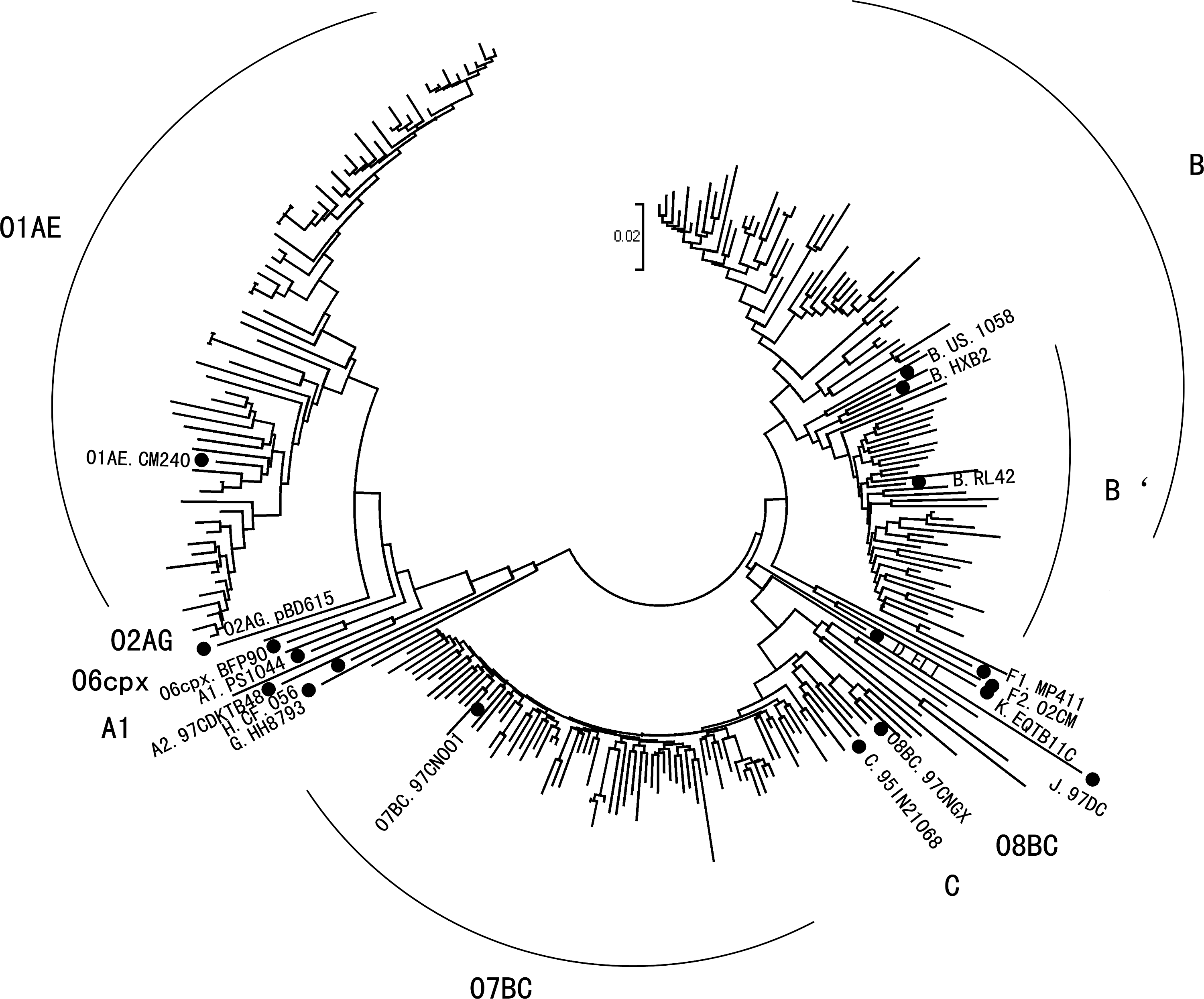
Phylogenetic tree analysis of HIV-1 gag gene sequences. The phylogenetic tree was constructed using neighbor-joining methods (MEGA 4) for the gag region. The black solid square indicates reference sequences from the Los Alamos HIV sequence database.
Includes Inner Mongolia, Jiangsu, Jiangxi, Shandong, Hubei, Chongqing, Guangxi, and Hainan province.
Furthermore, the distribution of subtype was associated with the patients' risk method (Table 3). The subtypes circulating in heterosexual people were very diverse, consisting of nine subtypes and four new recombinants; the most predominant was CRF07_BC followed by CRF01_AE. Surprisingly, CRF07_BC was identified in one (4.3%) heterosexual person in 2006, but was detected in 14 (38.9%) individuals diagnosed in 2007, suggesting the introduction of HIV-1 CRF07_BC in heterosexual people. The subtypes in homosexual people were mainly CRF01_AE and B. CRF01_AE had increased from 38.9% in 2006 to 46.8% in 2007 and became the most dominant subtype in these people.
Hetero, person infected via heterosexual contact; Homo, person infected via homosexual contact; IDUs, injecting drug users; Blood, person infected via transfusion with contaminated blood products.
The number genotyped in 2006 and 2007 is shown in parentheses.
The subtype in IDUs was mainly CRF07_BC and in former blood donors was mainly B′. The distribution of subtypes among patients was correlated with their province of origin. For example, subtype B’ were predominantly found in Henan immigrants (see Table 2), whereas CRF07_BC was associated with individuals from Xinjiang province, suggesting that many of these immigrants were likely infected in their home province. Both subtype B′ and CRF07_BC are known to be the predominant subtype and CRFs in Henan and Xinjiang province. 6,7 We also identified one CRF02_AG in individuals from Cameroon. Another subtype and recombinant form found in this study was A1 and CRF06_cpx, which was highly prevalent in Africa and was now identified for the first time in Beijing. Among native individuals, CRF01_AE and B were predominant, constituting 60.3% of the total.
To track the origin of these variants, phylogenetic analysis of the gag region was employed by searching HIV sequence databases for similar sequences to make the phylogenetic tree. All CRF07_BC samples clustered together with the reference sequence 97CN54 and 97CN001 in a well-defined monophyletic group suggesting their Xinjiang origin. The cluster includes an isolate (2004. TWD3) from Taiwan province, indicating that the CRF07_BC circulating in Taiwan and Beijing may have a common ancestor. 8 All the B′ isolates clustered with reference sequence RL42 and some sequences from Henan province. Within subtype B, 94.3% (50/53) of the sequences were segregated into two large subclusters (founder effect) with some sequences from Liaoning province. Of the CRF01_AE sequence in the gag gene, 20.9% (14/67) was found to be closely related to the isolate CM240 previously identified from Thailand. However, 74.6% (50/67) of the CRF01_AE sequence was grouped into two large-scale subclusters containing some sequences from Liaoning and Fujian provinces in China, suggesting the existence of a differentiated subgroup of CRF01_AE strains with different origins (see Fig. 1).
HIV-1 is remarkable for its mutability, resulting in its resistance to antiretroviral agents and escape from immune surveillance. 9 Mutability is also used for taxonomic classification of these viruses into clades or genetic subtypes. HIV-1 molecular epidemic surveillance during 2001–2002 revealed that there were at least seven major HIV-1 subtypes circulating in China. 10 The most prevalent subtypes were the B′/C recombinant (50%; mainly found in IDUs), followed by B′ (29.1%; former plasma/blood donors) and CRF01_AE (15.5%; heterosexual transmission).
Consistent with another report in 2002, 11 only 2.6% of sequences studied belonged to subtype B and most of this subtype was from men who have sex with men (MSM). In the current study, 280 HIV-1 strains from 320 infected patients diagnosed between 2006 and 2007 in Beijing were genetically characterized. Subtype characterization showed that CRF07_BC was the most prevalent, identified in 91 of the 280 samples analyzed (32.5%), while subtypes CRF01_AE, B, and B′ were found in 70 (25.0%), 56 (20.0%), and 44 (15.7%), respectively. Other minor subtypes such as A1, C, CRF02_AG, CRF06_cpx, and the new B′/C recombinant were observed in 19 samples (6.8%). This is in agreement with previous studies conducted in Shanghai, China. 12 However, our study is the first to address the distribution of HIV- 1 subtypes in Beijing, the capital of China.
Over 80.0% of samples were sorted as non-B samples, suggesting that the distribution of HIV in Beijing is different from that found in Europe and North America where subtype B is predominant. Further phylogenetic analysis demonstrated that there was province-specific clustering among the samples: most B′ isolates were isolated from individuals from Henan province whereas CRF07_BC was isolated from individuals from Xinjiang province. Within the permanent residents in Beijing, however, CRF07_BC also reached 21.8%, making it the largest combined subtype among newly diagnosed patients from 2006 to 2007. Interestingly, subtype B and CRF01_AE clusters were phylogenetically related to the clusters previously demonstrated in a neighboring province such as Liaoning and Heilongjiang, suggesting that Beijing and the two provinces harbor some common microepidemic variants.
Nearly all the HIV-1 subtypes identified in this study were from the heterosexual risk group. The broad HIV-1 genetic diversity among the heterosexual transmission population suggests that the diversification of HIV-1 in Beijing may continue in the future if no adequate and effective intervention programs are introduced to prevent further spread of HIV-1 infection. It has been suggested that HIV-1 subtype B was introduced into China via homosexual and bisexual activity between men from North America, with subsequent diffusion into the heterosexual population, and that CRF01_AE was introduced into the Chinese population from Thailand through heterosexual contacts. 13 The majority of HIV-1 subtypes among MSM worldwide were subtype B, 14 and subtype B was previously reported to have a prevalence of 100% in 2002 and 71.1% in 2005 among samples from homosexual people in Beijing. 4,11
We have reported that the previous predominant subtype B in MSM in Beijing was replaced by CRF01_AE, parallel to the HIV-1 increase in prevalence from 0.4% to 5.8% in the MSM group during the period from 2004 to 2006. 15 The association of subtype B with MSM remains and subtype B was still the second predominant subtype circulating in MSM, accounting for 41.8%. With regard to subtype B′, we report in this study a significant decrease in prevalence from 21.6% to 11.6% in Beijing during the period from 2006 to 2007 (p<0.05), as a result of the ban on commercial plasma donations in China.
CRF07_BC and CRF08_BC are two types of B′/C recombinant strains first documented among Chinese IDUs in 2000. CRF07_BC (prototype strains, 97CN54 and 97CN001) was distributed among IDUs in Xinjiang province in northwest China, whereas CRF08_BC (prototype strain, 97CNGX6F) was circulating widely among IDUs in Guangxi province in southeast China. In this study, we found that CRF08_BC constituted only a small fraction (1.4%) in IDUs, while CRF07_BC accounts for 87.5%. In addition, CRF07_BC was also identified in 25.4% of heterosexual people, which is usually transmitted through IDUs. In the subtype B′ and CRF07_BC clades, sequences from individuals infected through different transmission routes were intermixed in the tree and failed to cluster within any supported monophyletic subcluster. In contrast, there were two large-scale clustering of sequences by the gag region in homosexual transmission within subtype B and CRF01_AE and a number of close associations between pairs of individuals was also observed.
The finding that 94.3% and 74.6% of the subtype B and CRF01_AE sequences, most from MSM, fell within two subclusters of genetically related strains was distinct from those of published isolates from other countries, suggesting that Beijing may have been experiencing a growing HIV-1 epidemic in homosexual people and that the strategies to control the spread of the epidemic in Beijing should be urgently planned. Such a pattern also suggests that the city experienced the independent introduction and subsequent dissemination of different subtype B and CRF01_AE lineages, in a pattern resembling multiple scattered microepidemics. It should be noted that all the virus classifications in this study were based on the relatively short gene fragments amplified. The possibility that they might be fragments embedded in other mosaic sequences could not be ruled out. Full-length sequencing of these samples would help assign a subtype for the viruses precisely.
In summary, we demonstrate the cocirculation of nine HIV-1 group M subtypes or CRF (A1, B, B′, C, CRF01_AE, CRF02_AG, CRF06_cpx, CRF07_BC, and CRF08_BC), as well as the occurrence of six new B′/C recombinants in Beijing. The HIV-1 diversity in Beijing is changing by both the introduction of foreign strains and the further recombination of the locally circulating viruses. A better understanding of the dynamics of the HIV-1 epidemic in Beijing requires the continuance of a similar study on the diversity and routes of the spread of HIV-1 in the city and is invaluable in monitoring the prevalence and emergence of different viral lineages, and may eventually be of importance in the development of a geographically related vaccine.
Footnotes
Acknowledgments
This study was supported by China megaprojects in infectious diseases (2008ZX10001-009). We thank all laboratory members of the National Institute for Viral Disease Control and Prevention of China and the Beijing Center for Disease Prevention and Control for their support in carrying out this work.
Author Disclosure Statement
No competing financial interests exist.