




Abstract
HTLV-1-associated myelopathy/tropical spastic paraparesis (HAM/TSP) is a chronic and progressive disorder caused by the human T-lymphotropic virus type 1 (HTLV-1). In HTLV-1 infection, a strong cytotoxic T cell (CTL) response is mounted against the immunodominant protein Tax. Previous studies carried out by our group reported that increased IFN-γ enzyme-linked immunospot (ELISPOT) responses against the region spanning amino acids 161 to 233 of the Tax protein were associated with HAM/TSP and increased HTLV-1 proviral load (PVL). An exploratory study was conducted on 16 subjects with HAM/TSP, 13 asymptomatic carriers (AC), and 10 HTLV-1-seronegative controls (SC) to map the HAM/TSP-associated CTL epitopes within Tax region 161–233. The PVL of the infected subjects was determined and the specific CTL response was evaluated with a 6-h incubation IFN-γ ELISPOT assay using peripheral blood mononuclear cells (PBMCs) stimulated with 16 individual overlapping peptides covering the Tax region 161–233. Other proinflammatory and Th1/Th2 cytokines were also quantified in the supernatants by a flow cytometry multiplex assay. In addition, a set of human leukocyte antigen (HLA) class I alleles that bind with high affinity to the CTL epitopes of interest was determined using computational tools. Univariate analyses identified an association between ELISPOT responses to two new CTL epitopes, Tax 173–185 and Tax 181–193, and the presence of HAM/TSP as well as an increased PVL. The HLA-A*6801 allele, which is predicted to bind to the Tax 181–193 peptide, was overpresented in the HAM/TSP patients tested.
Introduction
H
A previous study in our laboratory using pools of overlapping peptides that covered the entire sequence of Tax strongly suggested that the specific IFN-γ CTL response to Tax region 161–233 is capable of discriminating HAM/TSP patients from AC. 18 In the present study, we confirmed these findings by mapping the CTL epitopes responsible for the discriminatory response and evaluated the association between the response elicited by these epitopes and the PVL in patients with HAM/TSP and AC.
Materials and Methods
To pinpoint the specific CTL epitopes that discriminate HAM/TSP patients from AC within Tax region 161–233, we enrolled 29 HTLV-1-infected subjects (16 patients with HAM/TSP and 13 AC) consecutively from the HTLV-1 cohort at the Instituto de Medicina Tropical Alexander von Humboldt, along with 10 HTLV-1-seronegative controls (SC). The study was approved by the Institutional Ethics Committee of the Universidad Peruana Cayetano Heredia and written informed consent was obtained from all participants. HTLV-1 infection was determined by at least one positive ELISA result and at least one positive confirmatory test result (either Western blot, line immunoassay, or a detectable PVL). 19 The diagnosis of HAM/TSP was made by experienced physicians according to internationally accepted criteria. 20,21
PBMCs were isolated by Ficoll gradient centrifugation and suspended in complete medium [RPMI 1640 medium (Gibco, Paisley, Scotland) supplemented with 5% pooled human serum from healthy donors, 100 IU/ml penicillin, and 100 μg/ml streptomycin (Gibco, Paisley, Scotland)]. 18,22 We used a short-incubation (6 h) IFN-γ ELISPOT assay 11,18 to identify the epitopes that discriminate HAM/TSP patients from AC within Tax region 161–233. Freshly isolated PBMCs were stimulated with 16 individual overlapping 13-mer peptides (offset=4 amino acids) covering Tax region 161–233 (Table 1), as well as with the Tax 11–19 peptide (Mimotopes, Clayton Victoria, Australia). Incubation with medium alone served as negative control. Each peptide was used at a final concentration of 1 μg/ml, and a CD28/CD49d costimulatory reagent (Becton Dickinson, San Diego, CA) was included in all assays as reported previously. 18 The number of spot-forming cells (SFC) was determined with the AID software (AID ELISPOT Reader, Strassberg, Germany). The background response (unstimulated cultures) was subtracted from the values obtained with peptide-stimulated samples.
In addition, the supernatants from the ELISPOT assays were analyzed with a flow cytometry multiplex assay (Bender Medsystems, Vienna, Austria) to determine the levels of 10 cytokines [interleukin (IL)-1β, IL-2, IL-4, IL-5, IL-6, IL-8, IL-10, IL-12p70, tumor necrosis factor (TNF)-α, and TNF-β].
The PVL was determined in all samples by quantitative PCR (qPCR) and expressed as HTLV-1 copies per 104 PBMCs as previously described. 22,23
The frequency of HLA-A*02 was determined by flow cytometry.
18
To identify the potential HLA class I alleles capable of binding CTL epitopes within Tax region 161–233, we used an in silico screening based on the Metaserver algorithm for evaluating 47 HLA class I alleles (
The chi-square test was used to analyze categorical variables and the Mann–Whitney U test for continuous variables without a normal distribution. The correlations between the PVL and the response elicited by the CTL epitopes within Tax region 161–233 and Tax 11-19 were evaluated using the Spearman's rank correlation test.
Results
Demographic data are summarized in Table 2. HAM/TSP patients and AC were significantly older than SC (p<0.01). The proportion of subjects of Andean origin and the proportion of women were higher among patients with HAM/TSP than among SC (p<0.01). There were no significant differences in age, sex, and ethnic background between HAM/TSP patients and AC.
Age is presented as the median (Q1–Q3).
Male gender and Andean origin are presented as absolute numbers and percentages (in parentheses).
HAM/TSP, HTLV-1-associated myelopathy/tropical spastic paraparesis; AC, asymptomatic carriers; SC, seronegative controls; HTLV-1, human T-lymphotropic virus type 1; Q1–Q3, first quartile–third quartile.
As shown in Table 3, PBMCs from most HTLV-1-infected subjects produced IFN-γ in response to the 16 individual overlapping peptides from Tax region 161–233 and Tax 11–19 peptide, whereas SC failed to do so (p<0.01). HAM/TSP patients tended to show stronger responses than AC to the majority of individual peptides from Tax region 161–233, but only three peptides spanning amino acids 173–185 (p<0.01), 181–193 (p<0.05), and 185–197 (p<0.05) clearly discriminated HAM/TSP patients from AC. There was a significant correlation between IFN-γ production stimulated by these peptides and PVL [Spearman's rho (ρ) 0.65, 0.62, 0.57; respectively, p<0.01, n=29, Fig. 1]. Therefore, two CTL epitopes were identified with this approach: one referred to as Tax 173–185 and the other located within the overlapping region of peptides Tax 181–193 and Tax 185–197. Although we confirmed a stronger IFN-γ response to Tax 11–19 in AC as compared to HAM/TSP patients, as previously reported, 18 the difference was not significant. Neither was there a significant correlation between IFN-γ production in response to Tax 11–19 and PVL [Spearman's rho (ρ) −0.19; p=0.3, n=29]. The fact that the IFN-γ response to the 16 peptides from Tax region 161–233 was always slightly higher in HAM/TSP than in AC, as opposed to the response to Tax 11–19, confirms the specificity of our observations.
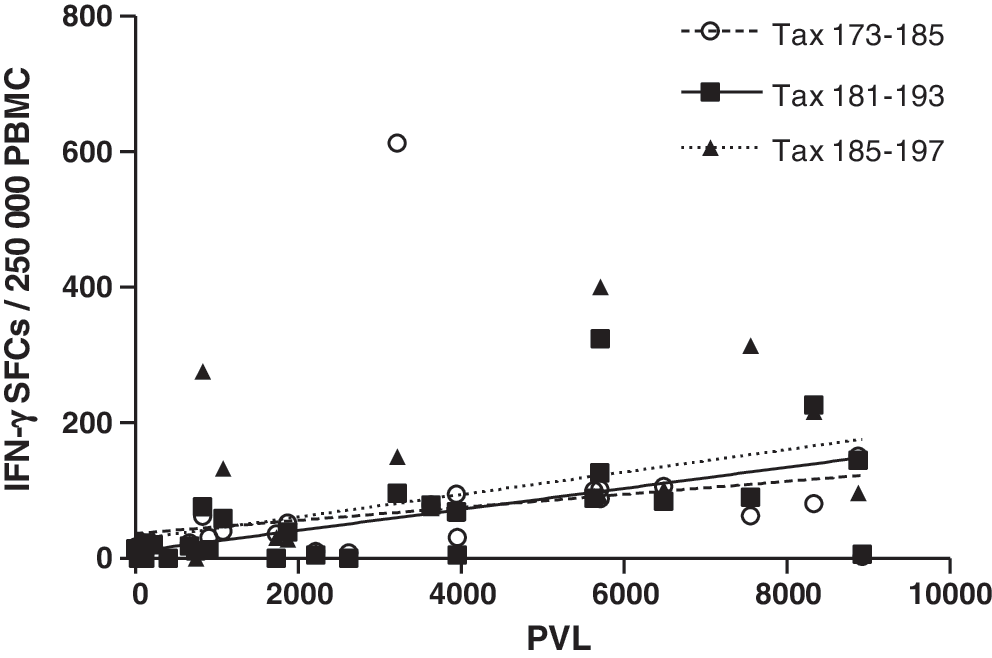
Correlation between the ELISPOT IFN-γ production stimulated by Tax 173–185, Tax 181–193, and Tax 185–195 peptides, and HTLV-1 proviral load (PVL). ELISPOT, enzyme-linked immunospot; IFN-γ, interferon-γ; SFC, spot-forming cells; PBMC, peripheral blood mononuclear cells; PVL, HTLV-1 proviral load.
p value for the comparison between HAM/TSP patients and asymptomatic HTLV-1 carriers (AC). Significant differences are indicated in bold.
IFN-γ responses to Tax peptides are expressed as IFN-γ SFCs/250,000 PBMCs.
Mann–Whitney test.
Other cytokine responses are expressed in pg/ml.
HLA allele is presented as absolute numbers and percentages (in parentheses).
Chi-square test (continuity correction).
Provirus load is expressed as the HTLV-1 copy number/104 PBMCs.
Data are presented as median (Q1–Q3).
HAM/TSP, HTLV-1-associated myelopathy/tropical spastic paraparesis; Q1–Q3: first quartile–third quartile; IFN-γ, interferon-γ; SFC, spot-forming cells; PBMCs, peripheral blood mononuclear cells.
Other cytokine responses to Tax 173–185 and Tax 185–197 peptides were also evaluated in the supernatants from 6-h incubation ELISPOT assays. Out of the 10 cytokines evaluated, only 4 (IL-1β, IL-6, TNF-α, and IL-8) were measurable. Whereas IL-8 production was similar in SC and both groups of HTLV-1-infected individuals, IL1-β, IL-6, and TNF-α levels were the highest in AC and the lowest in HAM/TSP patients (Table 3).
The CTL epitopes within Tax region 161–223 were divided into strong and weak binders according to their predicted binding affinity to HLA class I alleles. An in silico approach 17,24,27 suggested that the alleles A*6801, A*3101, B*0702, and A*3001 would have a high binding affinity to the two epitopes that discriminate HAM/TSP patients from AC (Table 4). We then determined the frequency of these alleles in our population using sequence-specific PCR primers as described elsewhere. 28 Only A*6801, which is predicted to bind Tax 181–193, was overpresented in HAM/TSP patients as compared to AC (p<0.05, Table 3). Moreover, a significant increase of the median IFN-γ response to Tax 181–193, expressed as IFN-γ SFCs/250,000 PBMCs, was observed in HLA-A*6801-positive subjects [median=121; first quartile (Q1)–third quartile (Q3)=67–251, n=6] compared to HLA-A*6801-negative subjects (median=14; Q1–Q3=2–69, n=23, p<0.05). In addition, the median PVL, expressed as HTLV-1 copies per 104 PBMCs, was significantly higher for HLA-A*6801-positive subjects (median=5670; Q1–Q3=3063–8469) as compared to HLA-A*6801-negative subjects (median=989; Q1–Q3=192–3945, p<0.05).
CTL epitopes within Tax peptides are indicated in bold.
Metaserver scores for Tax 175–183 (HPGQLGAFL) binding to HLA-B*0702, as well as Tax 178–186 (QLGAFLTNV) binding to HLA-A*0211 or HLA-A* HLA-B*0702, are included for comparison purposes.
Discussion
The present study was meant to fine-map CTL epitopes within Tax region 161–233, which are associated with increased IFN-γ production in HAM/TSP patients, in a follow-up of our previous work. 18 In this regard several CTL epitopes within the Tax protein have been evaluated by various research groups for their association with HTLV-1-related disease. 29 –35 For instance, Tax 88–96 and Tax 272–280, restricted by HLA-A*11, 29 and Tax 301–309, restricted by HLA-A*24, 32,35 were shown to be recognized by CTL from patients with adult T-cell leukemia (ATL). Furthermore, it has been reported that Tax 11–19, Tax 31–45, and Tax 101–115, epitopes located in the Tax N-terminus and restricted by the HLA-A*02 allele, are subject to positive selection pressures by CTL in HAM/TSP patients. 34 In addition, other alleles such as HLA-B*07, HLA-Cw*08, and HLA-B*54 have been reported to be associated with HAM/TSP. 14,36 Finally, CTL responses to proteins other than Tax have also been evaluated. It was recently shown in a Japanese cohort 17 that individuals who remain asymptomatic and, independently, have a low PVL, are significantly more likely to have HLA class I alleles that bind the HBZ viral protein.
By using a specific ELISPOT assay, two CTL epitopes that had not been reported before were shown to elicit an increased IFN-γ response in PBMCs from HAM/TSP patients, which is associated with higher PVL and discriminates them from AC. Other cytokine responses were also evaluated in these subjects. Although not significant, a decrease of IL-1β, IL-6, and TNF-α production in response to Tax 175–185 and Tax 181–193 was observed in PBMCs from HAM/TSP patients as compared to AC or SC. Because IL-1β, IL-6, and TNF-α are considered typically as monokines, we hypothesize that a reduction of those cytokines in HAM/TSP might be an indirect response, as a consequence of the T cell activation. The contribution of this phenomenon to HAM/TSP pathogenesis needs to be investigated.
In addition, an in silico screening revealed that the A*6801, A*3101, B*0702, and A*3001 alleles have a high predicted binding affinity to epitopes within Tax region 161–233 and the A*6801 frequency seemed to discriminate between HAM/TSP and AC. Few data on the frequency of HLA alleles in Peru are available. 37 –39 A study carried out in southern Peru reported allelic frequencies of 6.76% for A*68, 3.98% for A*31, 2.37% for B*07, and 1.69% for A*30. 37 As for our group of HTLV-1-infected subjects, the A*6801 frequency was 20% in the whole group and 26.3% among individuals of Andean origin. Clearly, our finding of an increase in the frequency of the A*6801 allele (restricting a novel Tax epitope) in HAM/TSP suggests a new CTL-mediated genetic link with HTLV-1 pathogenesis in the Peruvian population, which needs to be confirmed in larger studies.
Taken together, our results reveal two new CTL epitopes associated with HAM/TSP and increased PVL levels in a Peruvian population. The contribution of particular HLA class I alleles to the risk of HAM/TSP requires further investigation.
Footnotes
Acknowledgments
We thank the staff at the Instituto de Medicina Tropical Alexander von Humboldt for their valuable assistance in their attention to the HTLV-1-infected people. This work was supported by the Directorate-General for Development Cooperation of the Belgian Government through the Framework Agreement with the Institute of Tropical Medicine of Antwerp and through the Flemish Interuniversity Council (VLIR), and by the Peruvian National Board for Science and Technology (CONCYTEC).
Author Disclosure Statement
No competing financial interests exist.