




Abstract
The new HIV-1 recombinant, with a Bgag ApolAenv structure, is described. This recombinant virus differs from the classical “Kaliningrad” (AF193276.1) virus with an Agag BpolBenv structure. The number of new HIV cases in Belarus has been increasing in the past few years. Within the 12 months of 2010, 1069 new cases of HIV infection were registered. Molecular epidemiological investigations have shown that though HIV-1 subtype A (84.5%) still dominates in HIV/AIDS patients, the quantity of CRFs has also increased to 7.1%. Although cases with the CRF03_AB virus were previously described in patients from Belarus, CRF06_cpx and CRF02_AG are described in Belarus for the first time.
Introduction
B
Our research has shown (data are processed) that subtype A HIV-1 remains dominant in Belarus. Of all new HIV cases 84.5% are connected to subtype A virus. In addition, circulation of subtypes B, C, as well as G and CRFs (CRF02_AG, CRF03_AB, CRF06_cpx) has been observed.
In the present article we submit data regarding the identification of a new unique recombinant HIV-1 that has not previously been described.
Materials and Methods
Three to five milliliters of EDTA blood plasma was collected after centrifugation at 1000 rpm for 20 min. The virus was precipitated from 500 μl of blood plasma at 23,000×g at 4°C for 60 min by high-speed centrifugation at Avanti J 30 I, Beckman Coulter, USA. HIV RNA was isolated using the RNA isolation module of ViroSeq “HIV −1 Genotyping System v.2.0,” Celera Diagnostics, Abbott, USA.
Reverse transcription polymerase chain reaction (RT-PCR) was carried out using reverse transcription and the PCR module of ViroSeq” “HIV −1 Genotyping System v.2.0” Celera Diagnostics, Abbott, USA. PCR products purification was performed by using spin column ViroSeq “HIV-1 Genotyping System v.2.0” Celera Diagnostics, Abbott, USA. Cleaning of DNA fragments after sequencing PCR was carried out by alcohol/acetate precipitation. Electrophoresis of fragment pol gene HIV-1 protease and 2/3 reverse transcriptase (1800 bp) regions cleaned after PCR was conducted at the genetic Analyzer ABI PRISM 3100-Avant, Applied Biosystems, USA.
For data obtainment, HIV drug resistance mutation identification and analysis in commercial databases ViroSeq “HIV-1 genotyping system” software v.2.6, Celera Diagnostics, Abbott, USA, and software products “Sequencing Analysis” v.5.1.1, BioEdit, SeqScape, “HIV Drug Resistance Database” Stanford University were used. Sequencing of the gag (p17/p24 region) and env (V3 loop region) genes was performed by using the above method with application of primer pairs described above. 1,2 HIV sequences included the gag p17/p24 region with a total length of 707 bp; the env V3 loop region is around 270 bp. Double-stranded sequencing was performed with the dye terminator sequencing kit (Applied Biosystems v.3.1, Foster City, CA). Phylogenetic analysis using MEGA4.1 software with the neighbor-joining and Kimura two-parameter method was performed.
Sequences of new HIV-1 variant (Mos) in the gag, pol, and env genes were submitted to EMBL/GenBank/DDBJ under accession numbers FR775442.1, FN995656.1, and FR775443.1.
Results and Discussion
The HIV/AIDS epidemic in the former USSR began with the appearance of two HIV-1 strains in the intravenous drug use (IDU) population in Odessa (subtype A virus, IDU-A) and Nikolaev (subtype B virus, IDU-B), South Ukraine, in 1994. 3 Subsequent recombination of these two viruses resulted in the generation of CRF03_AB (IDU-A/B, gagA/envB), which is associated with the HIV-1 outbreak in the Kaliningrad region, West Russia. 4,5 Later an HIV AB recombinant form was detected in other regions of the Russian Federation and Republic of Belarus. 6,7
In April 2010 we performed resistance tests on a plasma sample obtained from patient Mos, a 6-year-old girl born from an HIV-infected mother. Results have not revealed any HIV-1 resistance. However, the phylogenetic analysis of the DNA fragment of patient Mos had shown that the sample has been clustered with HIV-1 subtype A on the pol gene, but was different from other analyzed samples, subtype A consensus IDU-A, and reference sequences (AF004885) (Fig. 1A). The average p-distance between reference sequences of subtype A from Russia, Ukraine, consensus IDU-A, and the Mos isolate was 0.068, and with reference sequences of subtype B was 0.094. The Mos isolate is most similar to AF413987 from Ukraine (subtype A), with a p-distance of 0.066. These data confirmed the relation of this isolate to subtype A in the pol gene. We have compared isolate Mos sequences with reference sequences of CRF03_AB (AF414006.1 Belarus and AF193276.1 CRF03_AB KAL153). The average p-distance between isolate Mos and reference sequences CRF03 was 0.090. At the same time, the p-distance between reference sequences of the AF414006.1 and AF193276.1 isolates was 0.009. Thus, on the pol gene the new Mos isolate was identified as HIV-1 subtype A.

Phylogenetic analysis of HIV-1 pol
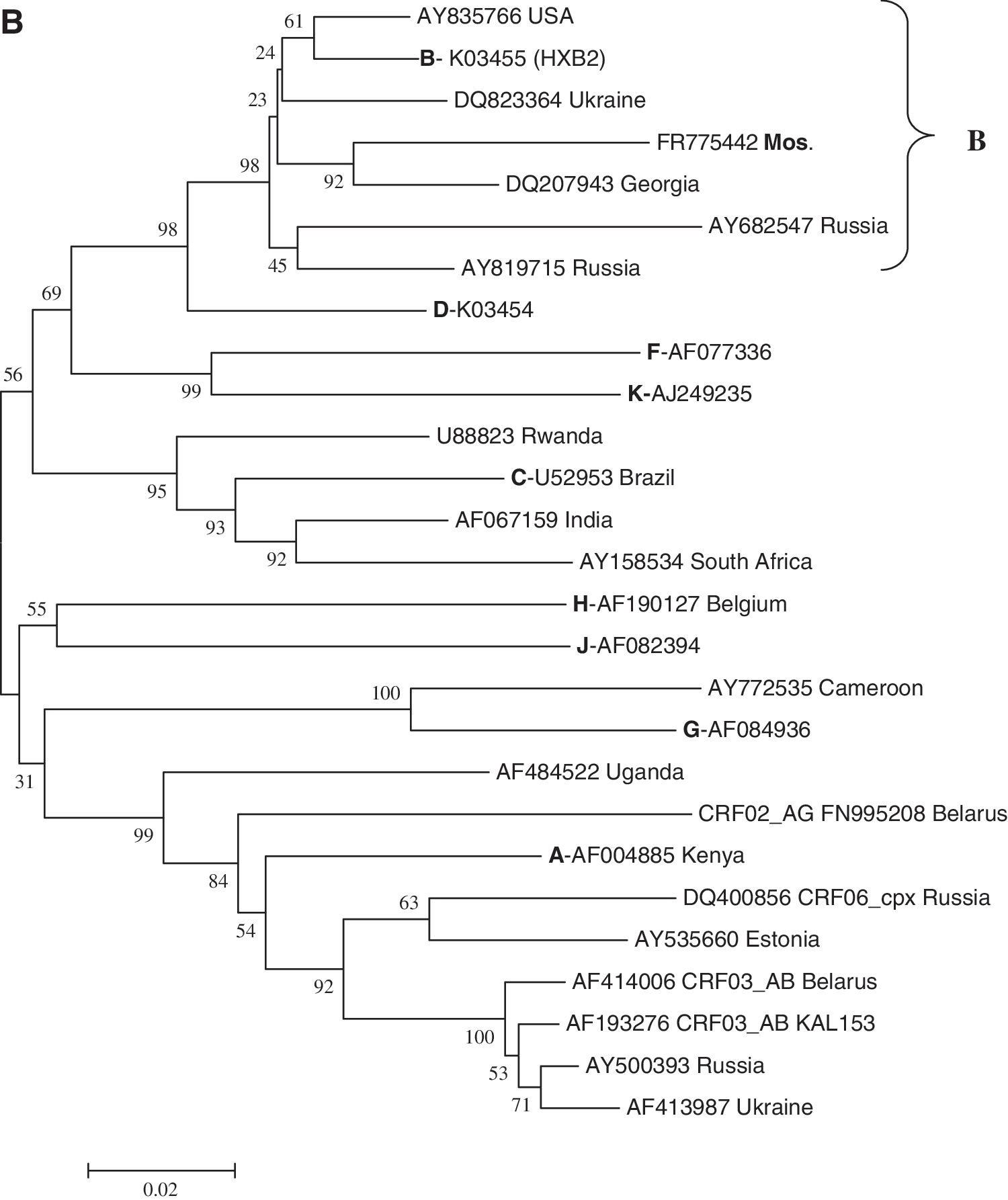
The comparison of sequences from the gag gene p17/p24 region of isolate Mos with HIV-1 reference sequences of subtype A demonstrates that the average p-distance was 0.129, and with reference sequences of subtype B was 0.075. The average p-distance on the gag gene (the Mos isolate) with CRF03_AB (AF414006.1, Belarus and AF193276.1 CRF03_AB KAL153) was 0.121 if compared with the 0.013 p-distance between reference sequences. Thus, on the basis of the gag gene, p17/p24 region analysis (the Mos isolate) has been inferred to HIV-1 subtype B. The phylogenetic analysis of the gag gene sequence from the Mos isolate is shown in Fig. 1B.
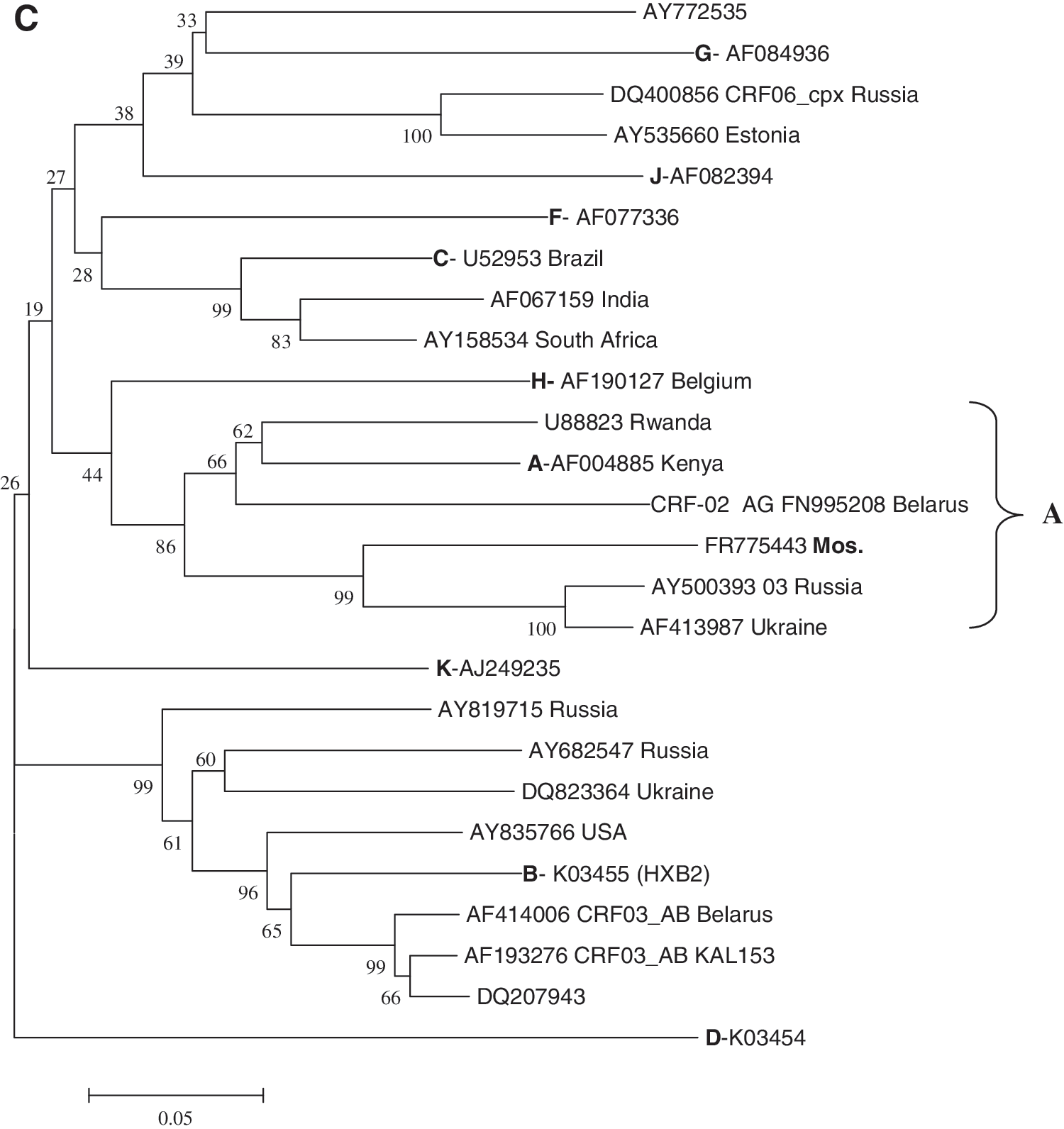
The analysis of Mos isolate sequences on the V3 loop gp120 gene env region HIV-1 has shown that the average p-distance with reference isolate subtype B was 0.323, and with subtype A was 0.155. The average p-distance sequence of the Mos isolate with reference isolates AF414006.1 and AF193276.1 (CRF-03_AB) was 0.308. Thus, on the V3 loop gp120 region of the env gene the isolate was identified as HIV-1 subtype A. The phylogenetic analysis of the env gene sequence from the Mos isolate is presented in Fig. 1C.
Thus, it has been shown that the Mos isolate is a unique recombinant form, but differs in genome structure from the earlier described CRF03_ AB (AgagBpolBenv). The new recombinant HIV-1 has the following structure: BgagApolAenv. Sequences of new HIV-1 unique recombinants in the gag, pol, and env genes were submitted to EMBL/GenBank/DDBJ under accession numbers FR775442.1, FN995656.1, and FR775443.1.
Footnotes
Acknowledgments
We thank Dr. Vera Ilyenkova and Ms. Alina Kevorkova for technical support.
Author Disclosure Statement
No competing financial interests exist.