




Abstract
Transmission of HIV from recently infected individuals contributes to the number of new cases of infection, but the extent to which it occurs from those who are unaware of their infection is not known. Phylogenetic analysis was performed on 209 cases of acute HIV subtype B infection detected between January 2005 and September 2010, most of whom (88%) were men who have sex with men. Only new cases with an evolving Western blot profile confirmed by detection of HIV RNA were included. Subjects whose known dates of seroconversion were within 1 month of at least one other phylogenetically linked case identified during the 6 years of the study were then examined to estimate the prevalence of onward transmission. Almost 30% of cases could have acquired their infection from another person undergoing seroconversion within the same month. Temporal increases in the number of phylogenetically related strains within several clusters were demonstrated during the study, although the rate of increase varied. Transmission of HIV from individuals undergoing seroconversion is an important contributor to the number of new infections identified every year and very likely occurs before they have knowledge of their infection. Clusters of related HIV strains can grow at a disconcerting rate, demonstrating that more focused public health efforts are required to minimize further HIV transmissions within sexual networks.
Introduction
D
We report here an investigation of HIV transmission prevalence involving individuals recently infected with subtype B viruses during the period January 2005 to September 2010 in Victoria Australia, a state with a population of approximately 5 million. In this study, we focused on analyzing onward transmission from recently infected cases during the period of their seroconversion. We also investigated annual changes occurring within larger clusters identified by phylogenetic analysis of the total study population. By analyzing only very recently infected cases, most if not all of whom were likely to have been unaware of their infection, and investigating the temporal expansion of sexual networks in which they occurred, the need for an enhanced public health response to the issue of onward transmission can be highlighted.
Materials and Methods
Study participants
A total of 209 individuals who were acutely infected with HIV between 2005 and September 2010 and who had baseline drug resistance genotyping performed as part of clinical care were investigated. This number represented approximately 40% of the primary HIV infections estimated to have occurred in Victoria during that time. 9 The individuals studied here are generally not transient. Their rate of partner change is not known but in a similar group (MSM in Sydney) relationship breakups were estimated to occur in approximately 26–30% of couples annually (A. Grulich, personal communication). Only cases with an evolving Western blot (WB) profile (indeterminate group 3 or 4) 10 who also tested positive for HIV RNA on the same blood sample were included. All subjects were infected with subtype B HIV strains and developed a full WB profile in subsequent samples. Evidence for and the prevalence of onward transmission in these acutely infected patients were sought by restricting the time between the sample collection date of a case and that of at least one other phylogenetically related individual to no more than 1 month (31 days). This restricted time interval was chosen to provide a lower limit conservative estimate of the prevalence of onward transmission.
Sequencing, phylogenetic analysis, and subtyping
Phylogenetic and subtype analysis was undertaken on the 209 patients using pol sequences derived from routine ARV drug resistance genotyping using methods previously described. 11 Patients provided written consent for blood collection and sequencing of pol for drug resistance testing. Phylogenetics was performed anonymously from patient identifiers. Briefly, a 1035-bp product spanning the entire coding region of the protease gene and the first 246 codons of reverse transcriptase was amplified from HIV-1-specific RNA derived from plasma, and sequenced using ABI Prism reagents, hardware, and software (Applied Biosystems, Foster, CA). Sequences for phylogenetic analysis were manually aligned using BioEdit. 12 Phylogenetic reconstruction was performed using distance-based (F84) and neighbor-joining methods in the Phylip suite of programs. 13 The transition transversion ratio calculated using MEGA version 3.1 14 and gamma parameter alpha estimated using Tree Puzzle were incorporated in the algorithm to optimize tree topology. Bootstrap analysis of the entire dataset was performed on 1000 replicates. Trees were viewed and edited for publication purposes using FigTree version 1.3.1 15 and Dendroscope version 1.3. 16 The average genetic distances between viral sequences within a cluster were estimated using MEGA. 14 Clusters of HIV pol sequences were established on the basis of high bootstrap support (>95%) and an average distance between the viral sequences in each cluster of less than 0.025 substitutions per site. Subtype assignment was based on the Stanford 17 and Los Alamos 18 databases.
Investigation of onward transmission and temporal changes in cluster size
Cases were considered to be potentially associated with onward transmission if their indeterminate WB sample was collected within 1 month (not more than 31 days) of that of another case within the same phylogenetic cluster. This duration was chosen because the time span elapsing between infection and symptoms of an HIV seroconversion illness would not normally allow for the provision of positive test results within a period of 1 month. To demonstrate cumulative temporal changes occurring within larger clusters (those found to contain at least four related sequences in 2010), the sequences involved were reanalyzed each year, starting from 2005.
Results
Participants
The 209 subtype B-infected patients studied included 203 males (97%) and six females, with an age range from 18 to 79 years (average 38 years). When the risk factor for exposure was available, the majority of male cases [168, (83%)] were associated with male-to-male transmission; three of these were also associated with intravenous drug use (IVDU). Heterosexual transmission as a likely mode of exposure in males was correspondingly rare [7, (3.4%)] with one of these also associated with IVDU. The six females reported heterosexual contact as their risk factor for infection.
Onward transmission and annual growth within transmission clusters
A phylogenetic tree was constructed from all 209 pol sequences derived from patients undergoing seroconversion. By this analysis, 94 (45%) sequences were linked to that of at least one other individual in the total study population, resulting in the identification of 31 clusters involving between two and 11 individual sequences (Figs. 1 and Fig. 2a). Of the 94 sequences identified, 11 clusters involving 28 (29.8%) sequences were associated with individuals who had indeterminate WB samples collected within no more than a month of each other. Within these clusters, the HIV viral load (VL) measurements on the associated plasma samples were generally greater than 4 log10 of virus. In eight clusters, the range of VLs in the associated plasma samples was less than 1 log10 of RNA copies/ml. However, in three clusters there was a difference of greater than 1 log10 of RNA copies/ml between sequences, including a cluster involving three cases, two of them with plasma VLs greater than 4 log10 RNA copies/ml and one with a VL of less than 400 RNA copies/ml.
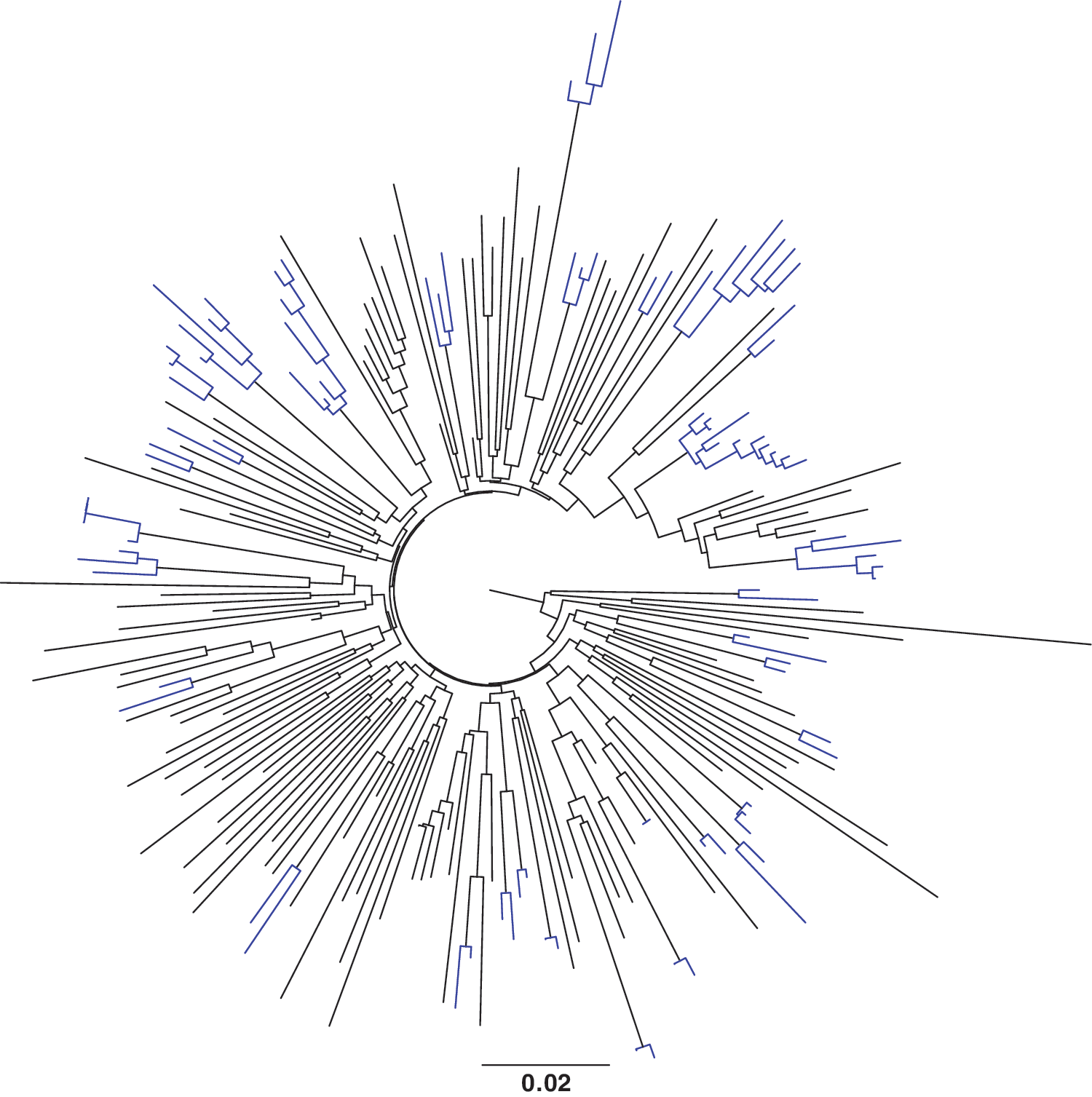
Phylogenetic analysis of pol sequences derived from 209 patients undergoing seroconversion showing 31 clusters involving 94 individuals (highlighted in blue).
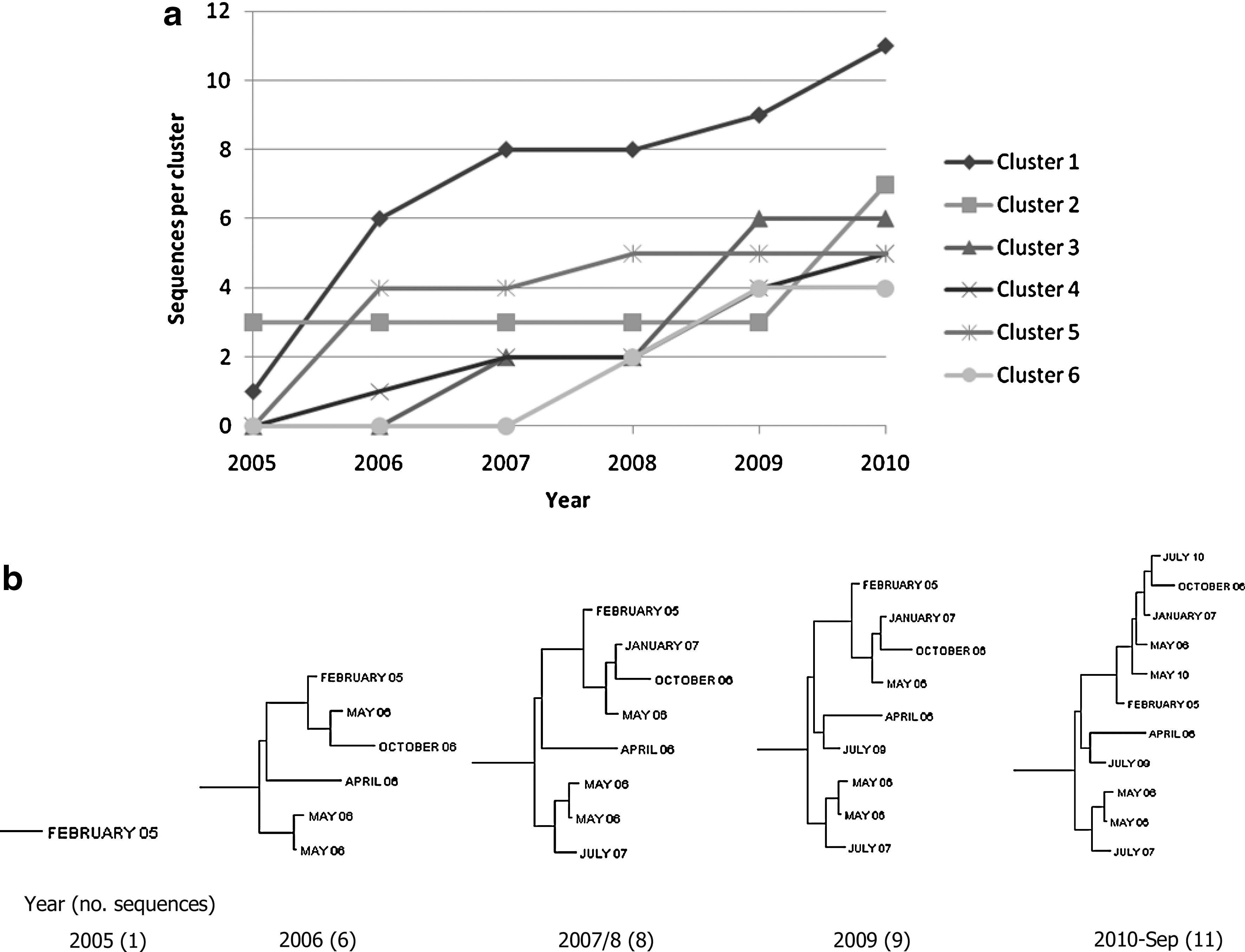
Clusters containing at least four related sequences in 2010 were then reanalyzed phylogenetically on a cumulative annual basis starting in 2005 to determine any temporal changes (increase, decrease, or no change) in the numbers of linked sequences. The results for those clusters analyzed are shown in Fig. 2a. In one of them (cluster 1), the pol sequences associated with 11 cases in September 2010 were first detected in a single patient infected in 2005 (Fig. 2b). Cluster sizes did not always increase on an annual basis, and most had periods of at least 2 years when the number of related sequences in them remained static, before increasing again. In particular, cluster 2 (Fig. 2a) contained only three related sequences between 2005 and 2009, but gained an additional four sequences in 2010.
Discussion
This analysis involved approximately 40% of those individuals identified with primary HIV infection living in Victoria between 2006 and 2010. 9 We investigated onward transmission under very restricted conditions and believe a prevalence of 30% is a reliable estimate of this phenomenon. We confined our study to cases of seroconversion because these individuals were unlikely to be aware they were infected at the time of the transmission event, even if many of them experienced a seroconversion illness, which in a significant proportion of recently infected individuals is usually of sufficient severity for medical treatment to be sought and HIV testing performed. 19 The period elapsing between the time of infection and those symptoms would not normally allow for the provision of positive test results within approximately 1 month. In our analysis we therefore excluded phylogenetically linked cases whose evolving WB specimens were collected more than 31 days apart.
Perhaps coincidentally, the prevalence we found was similar to that reported from the United Kingdom, where rates of between 25% and 34% have been reported, despite the analyses being undertaken on individuals thought to have been infected for up to 6 months. 20,21 Of note, a previous modeling study in Australia estimated that undiagnosed MSM with primary infections were responsible for 18.6% of all new infections. 22 Elsewhere, prevalences greater than 50% have been reported in a cohort of patients with primary HIV infection in Canada 7 and in Singapore. 8 Prevalence rates of onward transmission can be influenced by factors including the transmission risks operating in diverse geographic locations and the duration of infection of the cases included. For example, low rates have been reported in a European-wide study involving relatively small numbers of patients from each country. 6 This approach may have resulted in an underestimate of prevalence because an insufficient number of patients from discrete geographic locations were studied to enable detection of sexual networks. In contrast, while a much higher prevalence was reported in the Canadian patients, 7 the mean interval between the dates of infection of those implicated was 15 months, suggesting that in some cases the transmitter was more likely to be chronically infected than acutely infected.
Phylogenetic analysis of HIV strains derived from individuals in discrete populations is commonly used to identify clusters of individuals infected with related viral strains that likely represent distinct sexual networks. 21,23,24 Although the cases associated with these clusters may not necessarily represent direct transmission from one to the other, their identification has been used to support the premise that complex sexual networks are a significant source of new HIV infections within these populations, and that public health efforts should be directed toward reducing further transmissions from them. Previous studies in Victoria have shown that unprotected anal intercourse is the most important behavior risk for HIV infection and that this is influenced by the number of sexual partners, whether these partners were met at sex venues and whether alcohol was consumed prior to sexual activity. 25 The slow but significant temporal growth of several transmission clusters identified in our study underscores the need for specifically targeted intervention programs. Testing on a voluntary basis of people frequenting locations where cases are known to be concentrated has been suggested as a means to identify individuals who are at risk of transmitting the virus because they are unaware of their infection, 26 and in a practical example of this, the implementation of such testing in New York City bathhouses identified a small but significant number of men who were acutely or recently infected. 27
To our knowledge this is the first study of onward transmission restricted to patients in the process of seroconversion. The results show that this form of transmission in MSM in Australia is significant, even when using a conservative estimate involving individuals at the earliest measurable time point of their infection. Onward transmission involving movement of MSM-associated cases into the heterosexual community and non-MSM risk groups (females and IVDUs) is rare but deserves formulation of specific public health education strategies. It will be important in the future to assess the impact of onward transmission in patients infected with non-subtype B strains, as this is a growing population in this country. Our study supports previous investigations that provide a scientific rationale for enhanced testing of at-risk individuals to identify acute infections. Such a strategy may provide the opportunity for early treatment interventions if they are warranted as well as continued education targeted at limiting further transmissions.
Sequence Data
Pol sequences derived from the 209 seroconverters used herein have been assigned the following GenBank accession numbers: JF895188 to JF895396.
Footnotes
Acknowledgments
We thank Drs. Mike Catton and Alan Breschkin for their useful comments on the manuscript.
Author Disclosure Statement
No competing financial interests exist.