




Abstract
The exposure to human immunodeficiency virus type 1 (HIV-1) does not always result in infection. Indeed, there are individuals who have been repeatedly exposed to HIV-1 but do not exhibit clinical or serological evidence of infection; they are known as HIV-exposed seronegative individuals (HESN). To determine if secretory leukocyte protease inhibitor (SLPI), a soluble factor secreted by epithelial cells lining mucosal surfaces that showed anti-HIV activity in vitro, was associated with natural resistance to HIV infection, we measured by real time RT-PCR the expression of SLPI in oral mucosa of a cohort of Colombian HESN, in chronically HIV-1-infected individuals and in healthy controls. The HESN expressed significantly higher levels of SLPI mRNA than healthy controls (p=0.033) and chronically infected subjects (p=0.011). These findings suggest an association between SLPI expression and the natural resistance to HIV-1 infection exhibited by our HESN cohort.
Introduction
The natural history of human immunodeficiency virus type 1 (HIV-1) infection is heterogeneous, if one considers the variability in the acquired immunodeficiency syndrome (AIDS)-free period exhibited by infected individuals. Likewise, individuals have been reported who are frequently exposed to HIV-1 by sexual, parenteral,or vertical routes, but do not exhibit serological evidence of infection, or any signs or symptoms of immunodeficiency; they are known as HIV-exposed seronegative individuals (HESN). 1
Although the efficiency of sexual HIV-1 transmission is low (<1%), the high frequency of unprotected sex and high-risk contacts are involved in more than 80% of HIV-1 transmission. 2 Although much less efficient, transmission by oral sex also occurs. 3 However, HESNs have revealed the existence of mechanisms of natural resistance against HIV-1 transmission, and several studies have determined various mechanisms involved in this resistance, such as cellular immunological factors, host genetic variants, as well as soluble factors that limit or prevent viral infection. 1
Among the soluble factors with demonstrated anti-HIV-1 activity, secretory leukocyte protease inhibitor (SLPI) is an antiprotease also associated with natural resistance to other infections. 4 SLPI is a soluble component secreted primarily by epithelial cells lining mucosal surfaces and skin, by neutrophils, and by lipopolysaccharide-stimulated macrophages 5 ; its concentration in saliva is relevant. 6 It was previously shown that HIV-1 stimulates production of SLPI in oral epithelial cells by interacting with the viral glycoprotein gp120, impairing the establishment of infection. 7 In addition, McNeely et al. showed that recombinant SLPI or SLPI derived from saliva protected human monocyte-derived macrophages and CD4+ T cells against HIV-1 infection, 8 an inhibitory effect that occurs prior to viral reverse transcription. 9
To explore a potential role of SLPI in protecting against HIV-1 infection, we measured the SLPI mRNA expression in oral mucosa of a cohort of Colombian HESN.
Materials and Methods
Study population and samples
Twenty-eight HESN individuals (male 17 vs. female 11; age range: 17–49 years), 37 chronically HIV-1-infected subjects (seropositive, SP; male 16 vs. female 21; age range: 17–46 years), and 54 adult healthy controls (HC, 23 male vs. 31 female, age range: 19–54 years) were evaluated. The inclusion criteria for HESN subjects were similar to previously reported 10 ; briefly, our HESN subjects have been maintaining unprotected oral and anal/vaginal sexual intercourse with an SP individual more than five times in the previous 6 months, or an average of two times weekly for over 4 months within the last 2 years, and had a negative HIV-1/2 ELISA test within 1 month before the sampling. None of the HESN individuals had a history of intravenous drug use. The SP individuals were chronically HIV-1-infected subjects with an HIV-1 infection confirmed by western blot (median CD4: 333 cells/μl, range min-max: 17– 900 cells/μl; median viral load: 400 copies/ml, range min-max: 25–210,000 copies/ml); they were asymptomatic and eight SP individuals were not receiving highly active antiretroviral therapy (HAART). HC individuals were adult volunteers with ethnic backgrounds similar to the HESN and SP individuals who have had less than two sexual partners in the past 2 years, consistent use of condoms (over 50% of sexual intercourses), and no history of piercing, tattoos, or transfusions. Subjects with oral bleeding or infections clinically apparent at the time of sampling were excluded. Importantly, 80% of the total individuals reported unprotected active oral sex with their regular partner.
A questionnaire for risk behavior was filled out at the time of sampling and all individuals filled and signed an informed consent approved by the Bioethical Board for Human Research from Universidad de Antioquia, prepared according to the Colombian Government Legislation, Resolution 008430 of 1993.
Fifteen milliliters of peripheral blood were collected in EDTA tubes to confirm the HIV serological status by ELISA. Oral mucosa samples were obtained by means of a cytobrush; as many cells as possible were collected by rubbing the brush against the buccal mucosa. All samples were stored in RNA later buffer (QIAgen, Valencia, CA) at −70°C until use.
Real time RT-PCR assay to quantify SLPI mRNA
RNA was extracted using TRizol Reagent (Invitrogen, Carlsbad, CA) following the manufacturer's instructions. The amount and purity of RNA were determined by spectrometry at 260/280 nm. Isolated total RNA was treated with DNase I (Fermentas, St. Leon-Rot, Germany) to eliminate genomic DNA. The copy DNA was synthesized using the SuperScript III kit (Invitrogen) in accordance with the manufacturer's instructions. Each 20 μl of real-time PCR mixture consisted of 2 μl of cDNA, 1×of Maxima SYBR Green/qPCR Master Mix (Fermentas), and primers (0.4 μM each). The primer sequences and product size for SLPI were previously reported 11 : forward (FW) 5′GATGTTGTCCTGACACTTGTGG3′, reverse (RV) 5′CTTTCACAGGGGAAACGCAGG3′. Cytokeratin-19 (CK-19) RNA was used to normalize the RNA content in each preparation. The primer sequences for CK-19 were FW 5′ACCATTGAGAACTCCAGGATTGTC3′, RV 5′CTCATGC GCAGAGCCTGTT3′. The cycling profile for SLPI and CK-19 was 95°C for 10 min followed by 45 cycles of 95°C for 10 s and 63°C for 60 s. A melting curve to confirm the specificity of the PCR product was included. All real-time RT-PCR amplifications and data acquisition were performed using the CFX96 real-time system (Bio-Rad, Hercules, CA), software CFX Manager Version: 1.5.534.0511 (Bio-Rad).
Data analysis
To compare data between two groups, a nonparametric test (Mann–Whitney U two-tailed test) was performed. A p value<0.05 was considered to be statistically significant. The statistical tests were performed using the GraphPad Prism version 5.0 (GraphPad Software, CA).
Results and Discussion
Several soluble factors with anti-HIV-1 activity have been described, and a higher expression of these proteins has been associated with a lower risk of acquiring HIV-1 or of developing AIDS. 6 To determine if SLPI, a factor with anti-HIV-1 activity, is associated with resistance to this viral infection, we evaluated the SLPI gene expression in oral mucosal samples by real-time PCR. SLPI expression in HESNs was significantly higher compared with HCs and SPs [median 1.35 (HESNs) vs. 0.94 (HCs), p=0.033, and 0.76 (SPs), p=0.011]. No differences were observed between SPs and HCs (p=0.768) (Fig. 1). These data suggest that SLPI could be one of the factors associated with natural resistance to HIV-1 infection.
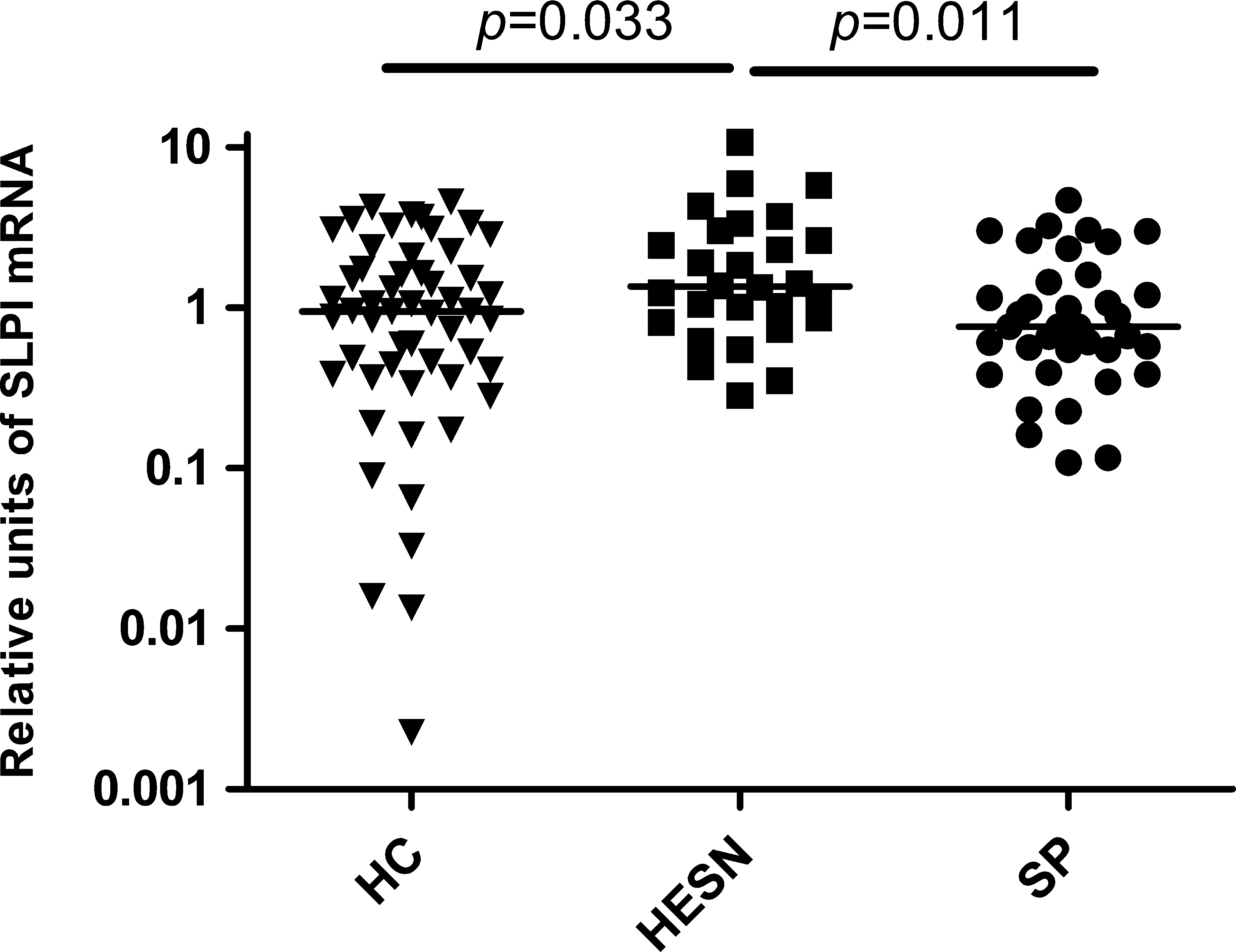
Secretory leukocyte protease inhibitor (SLPI) expression in oral mucosa of HIV-exposed seronegative (HESN) and seropositive (SP) individuals and of healthy controls (HC) by real-time PCR. RNA from oral mucosa samples was extracted and analyzed by real-time PCR for SLPI expression, using the housekeeping gene CK-19 to normalize the RNA content. Results are presented as logarithm. Statistical comparison between groups was performed using a Mann–Whitney U test with a confidence level of 95%. Significant differences are indicated at the top of the figure (*p<0.05).
Although few authors have reported similar levels of SLPI expression in oral mucosa between HC and HESN, 12,13 several studies have found a strong association between SLPI expression and protection against HIV-1 infection. 6,14,15 Higher salivary SLPI levels were associated with a decreased risk of HIV-1 infection among infants who were exposed to HIV-1 via breast-feeding. 6 Similarly, a study carried out by Pillay et al. (2001) demonstrated higher SLPI levels in vaginal fluid samples of HIV-1-positive women whose babies were born uninfected than those from transmitting women, 15 suggesting that SLPI protects against HIV-1 vertical transmission. In addition, Novak et al. showed that decreased SLPI levels during bacterial vaginosis infection in HESN women are related to an increased risk of acquiring the HIV infection. 14 Taken together, all these results suggest that higher expression of SLPI in mucosa from HESNs could be related to the inhibition of viral infection.
Interestingly, we found higher SLPI mRNA expression in oral mucosa of HESN compared to SP. Although previous reports indicated that the virus induces SLPI expression, this finding could be explained by the immunosuppressive state induced by the virus; in fact, some studies have demonstrated that during HIV infection, epithelial cells exhibit several alterations. For instance, renal, oral, tubular, and mammary epithelial cells can be infected by HIV-1, inducing growth retardation, lower survival, and increased apoptosis via caspase activation and Fas up-regulation. 16 –19 In addition, these low levels of SLPI could have previously influenced the susceptibility to HIV infection in this group. However, it is possible that some genetic variants in the SLPI gene could explain the SLPI levels in HESN, HC, and SP, an issue that requires further studies. Studies determining the mRNA and protein levels of SLPI in different mucosal sites in the same individual could help to clarify this issue. Finally, an additional ideal experiment would include the determination of SLPI production in vitro by epithelial cells derived from HESN, in response to HIV-1 stimuli.
The mechanisms involved in the antiviral effect of SLPI are not well understood. Initially, it was thought that the effect was mediated by the interaction of SLPI with viral proteins, in particular with gp120. However, a study performed by McNeely et al. (1995) showed that SLPI does not bind to the viral proteins gp160 or gp120 or to HIV-1 protease. 8 The mechanism appears to be mediated by interaction with target cells. It was previously described that annexin II, a molecule expressed on human macrophages membrane, binds to the host protein phosphatidylserine expressed on the HIV-1 envelope, promoting viral binding and entry into target cells; in fact, it was shown that annexin II-deficient cells are less susceptible to HIV infection in vitro. 20 SLPI binds to annexin II, at the macrophage membrane, inhibiting the interaction of this cell subpopulation with HIV viral particles, and therefore blocking HIV-1 infection. 21
In conclusion, the higher expression of mRNA for SLPI in our HESNs suggests its association with natural resistance to HIV-1 infection; however, additional studies are required to further address this issue, particularly studies including the detection of SLPI at the protein level and the evaluation of other tissues, such as genital or anal mucosa, in larger cohorts of HESN subjects.
Footnotes
Acknowledgments
This work was supported by “sostenibilidad 2009-2011” from the University of Antioquia, Banco de la República, and Colciencias (grant 111534319143). Natalia Taborda was supported by a fellowship from Colciencias, Colombia.
Author Disclosure Statement
No competing financial interests exist.