




Abstract
This study among antiretroviral-experienced prisoners from central western Brazil investigated mutations associated with secondary resistance to nucleoside/nonnucleoside reverse transcriptase inhibitors (NRTI/NNRTI), protease inhibitors (Stanford HIV-1 Resistance/International Aids Society Databases), and HIV-1 subtypes (REGA/phylogenetic analyses/SimPlot). Twenty-seven prisoners from three prisons (16 males and four females from Mato Grosso do Sul State and seven males from Goiás State) had HIV-1 protease and reverse transcriptase fragments sequenced after nested PCR. Median age was 35 years. Seven males and two females were intravenous drug users, three males referred homosexual practice. Resistance mutations were present in 37% (10/27): NRTI+NNRTI mutations (n=5), NRTI mutations (n=3), multidrug-resistant mutations (n=2). Subtype B (48%), subtype C (11%), B/F1, B/C, and F1/B/C recombinants (40.7%) were detected. Possible intraprison transmissions were identified: two intravenous drug user females (subtype C); two clusters among homosexual males (subtype B and B/F1). High resistance rate and possible intraprison transmission highlight the need for improved prevention, counseling, and treatment strategies for prisoners.
C
Especially in developing countries, health and patient management inside correctional institutions are generally poor with limited access to prevention, diagnosis, and treatment programs. Among prisoners the adherence to highly active antiretroviral therapy (HAART) based on nonnucleoside/nucleoside reverse transcriptase inhibitors (NNRTI/NRTI) and protease inhibitors (PI) remains a challenge. High-risk behaviors and illicit drug consumption are associated with low adherence, which may lead to the selection of mutations associated with resistance. Drug resistance is considered the main reason for the failure of HAART over time.
The molecular epidemiology of HIV-1 in Brazil is characterized by the prevalence of subtype B, except in the south, where subtype C predominates. “Pure” HIV-1 subtypes F1 and subtype C have been sporadically identified in different geographical regions. 6 A growing number of recombinants including circulating recombinant forms (CRFs) and unique recombinant forms (URFs), involving primarily HIV-1 subtypes B/F1 or B/C, have been reported. 7 –9
Knowledge about the antiretroviral (ARV) resistance mutations and HIV-1 subtypes among high-risk and hard-to-reach groups, such as prisoners, can lead to adequate prevention and intervention programs. This study among subgroups of treatment-experienced inmates infected with HIV-1 describes the prevalence of secondary resistance to protease (PR) and reverse transcriptase (RT) inhibitors. HIV-1 diversity and phylogenetic links are also reported.
This study included 27 prisoners with HIV-1 infection, prescribed with ARV, recruited between 2008 and 2009 at three prisons located in two different states from central western Brazil. Sixteen male patients were recruited at “Presídio de Segurança Máxima” and at “Instituto Penal” in Campo Grande city, capital of Mato Grosso do Sul State/MS. Four females were recruited at “Presídio Feminino Irmã Irma Zorzi” in Campo Grande/MS. In Goiás State/GO, seven male prisoners were recruited at “Casa de Prisão Provisória/Complexo Prisional de Aparecida de Goiânia.” This study group represented between 30% (in the male institutions from MS and GO States) and 60% (in the female institution from MS State) of the total prisoners infected with HIV-1 during the recruitment period. This study was approved by local review boards “Comitê de Ética em Pesquisa da Universidade Federal do Mato Grosso do Sul” (protocol #1143) and “Comitê de Ética em Pesquisa Médica Humana e Animal da Universidade Federal de Goiás” (protocol #073/05). Consent forms were signed by all participants.
Plasma RNA was extracted and reverse transcribed to obtain complementary DNA. The entire HIV-1 PR and approximately 750 bp of RT fragment were amplified by nested polymerase chain reaction (PCR). The amplified products were directly sequenced in an automatic sequencer as previously described. 10
HIV-1 subtypes were identified using REGA genotyping tool (version 2.0) and phylogenetic inference. 11 The phylogenetic trees were performed by the neighbor-joining method under Kimura's two-parameter correction (1000 bootstrap) using MEGA4 software. Bootstrap values above 70% were considered significant. Isolates suggestive of HIV-1 intersubtype recombination in PR/RT fragments were analyzed by SimPlot 3.5.1 software (200 bp window/20 bp increments) and by phylogenetic analyses of individual fragments assigned to different subtypes. 12
Phylogenetic links inside prisons were investigated by analyses including local HIV-1 sequences from patients living outside prisons. The GenBank accession numbers of local sequences from Goiás State were FJ548787–FJ548805, FJ548808–FJ548818, FJ548820–FJ548823, FJ594127–FJ594134, FJ594136–FJ594177, and FJ594180–FJ594185. 10 GenBank accession numbers of sequences from Mato Grosso do Sul State were JF342273–JF342274, JF342276–JF342291, JF342293, JF342296–JF342297, JF342299–JF342314, and JF342317–JF342321 (unpublished). The unpublished sequences from MS State were generated by our group and are amongst the first sequences from this State deposited in GenBank.
The mutation susceptibility profile in PR/RT fragments was analyzed by the Stanford HIV Drug Resistance Database and International AIDS Society Database-USA (accessed February 2011) as previously described. 13
Frequencies and medians of main variables were assessed using Statistical Package for the Social Sciences (SPSS) software for Windows version 13.0 (Chicago, IL).
A total of 20/27 prisoners were from MS State: 16 males and 4 females. The median age of male patients was 34 years (range 21–52); 4/16 reported intravenous drug use and 3/16 were men who have sex with men. The median of CD4 cell counts was 232.5 cells/μl (range 227–664) and the median of viral load was 26,263.5 copies/ml (range 2009–243,422). Among female prisoners the median age was 33 years (range 27–48), the median of CD4 cell counts was 243.5 cells/μl (range 241–262), and the median of viral load was 5833 copies/ml (range 375–102,414). Two of these patients reported intravenous drug use. Regarding prisoners from Goiás State the median age was 40 years (range 28–58), the median of CD4 cell counts was 186 cells/μl (range 57–405), and the median of viral load was 30,530 copies/ml (range 2005–303,496). Three of these patients reported intravenous drug use and the others reported heterosexual risk. Altogether 10/27 (37%) of the infected prisoners prescribed with ARV therapy presented resistance mutations. The most frequent resistance mutations observed were the K103N NNRTI mutation (7/10), followed by M184V (6/10), M41L NRTI mutations (4/10), and K101Q NNRTI mutations (4/10). Resistance mutations associated with two ARV classes predominated (NRTI+NNRTI=5/10). Three out of 10 patients had resistance mutations associated with NRTI only and 2/10 patients were considered multidrug resistant due to resistance mutations associated with all three classes of ARV (NNRTI+NRTI+PI).
The phylogenetic classification of prisoners' HIV-1 isolates in PR/RT fragments showed 48% (13/27) subtype BPRBRT and 11% (3/27) subtype CPRCRT. A total of 41% (11/27) of the isolates were diverse recombinants: F1PR/BRT (n=5), BPR/F1RT (n=2), F1BPR/BRT (n=1), F1BPR/BCRT (n=1), B PR/BCBRT (n=1), and CPR/CBC RT (n=1). Phylogenetic analyses with local sequences from patients living outside prisons indicated three groups of isolates, which remained clustered with high bootstrap values. The closely related HIV-1 subtype C BRMS28/BRMS44 isolates from two intravenous drug user female prisoners may represent intraprison transmission cases (Fig. 1). The same is true for HIV-1 subtype B BRMS97/BRMS99 and for BRMS206/BRMS257 isolates, which are B/F1 recombinants detected in the male correctional institution in MS State (Fig. 2). These analyses indicated that these clusters with high support values identified among prisoners do not seem to result from local geographic grouping and may indicate possible intraprison transmission links. Phylogenetic trees including prisoners' isolates and local HIV-1 sequences from GO State did not reveal any cluster with high support value.

Phylogenetic analyses of HIV-1 in the protease (PR) and reverse transcriptase (RT) fragments among female patients from Campo Grande/MS. The isolates characterized in this study are given in bold and the cluster is marked with a closed circle (
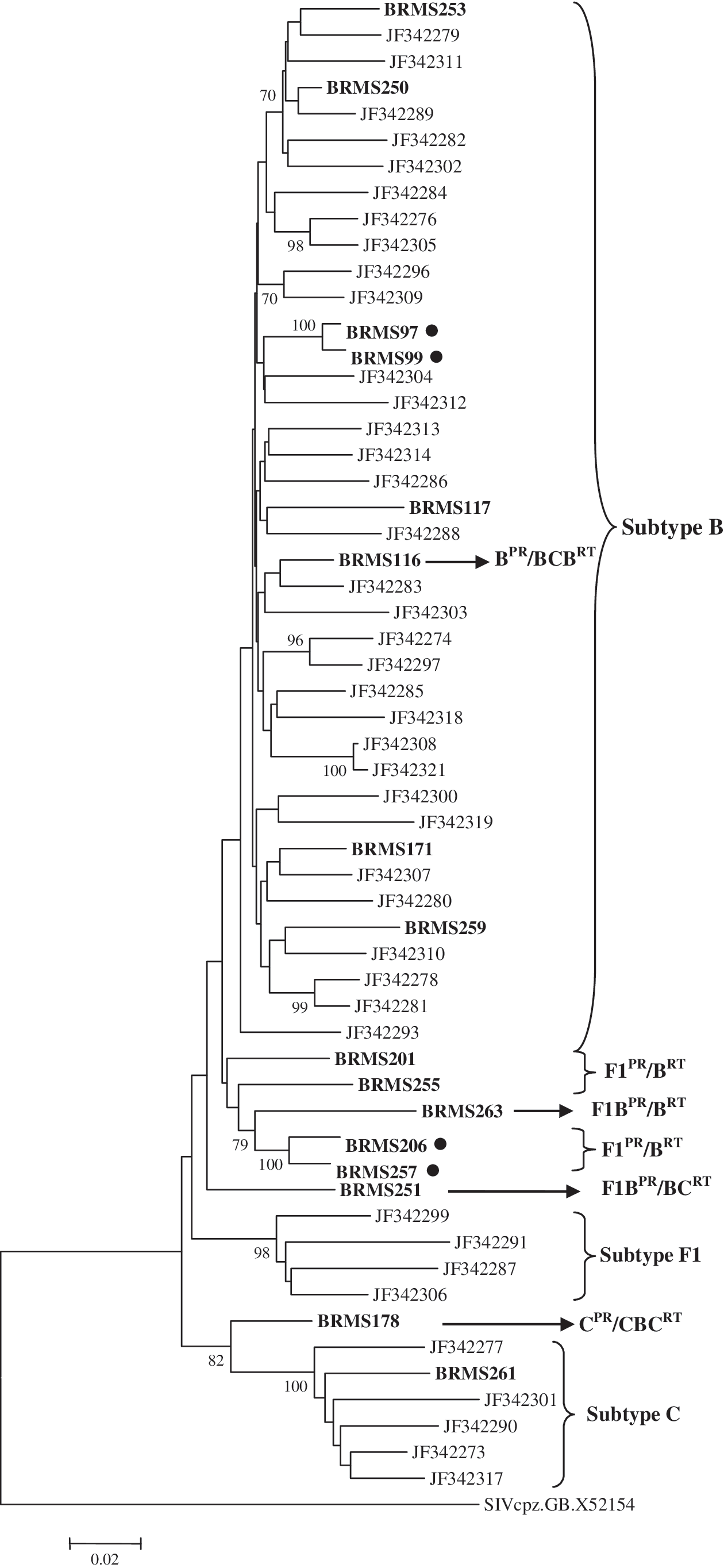
Phylogenetic analyses of HIV-1 in PR and RT fragments among male patients from Campo Grande/MS. The isolates characterized in this study are given in bold and the clusters are marked with a closed circle (
This study describes remarkable molecular features including ARV resistance mutations and HIV-1 molecular epidemiology among subgroups of high-risk and hard-to-reach inmates recruited in central western Brazil. Especially in developing countries, prisons have been recognized as hotspots of several STD, including HIV-1, due to overcrowding, poor health assistance, and high-risk behaviors.
The high prevalence of secondary drug resistance observed among prisoners prescribed with ARV is compatible with poor compliance to drugs, which is usually frequent among high-risk behavior groups. Apprehension and stress inside prisons may contribute to nonobservance or discontinuation of treatment. 3 Additionally, some prisoners may deliberately discontinue ARV to gain legal benefits from deteriorating health status such as anticipated release, temporary or definitive suspension of imprisonment, deferral of detention, and home arrest, depending on the country's legislation. In this study the K103N mutation was the most frequent resistance mutation; K103N causes resistance to efavirenz (EFV), which is currently the main NNRTI used in Brazil. No information was available about the ARV regimen prescribed to these prisoners, limiting the analyses of the resistance profiles. The rate of mutations associated with drug resistance observed in this study (37%) was similar to resistance among treatment-experienced inmates from Spain. 14
Several prisoners reported intravenous drug use, especially from MS State, which is a known entry/traffic route of drugs from Bolivia and Colombia into Brazil. Intravenous drug use is an important exposure category in this area. A possible transmission link was observed among two female prisoners who are intravenous drug users. Two male prisoners from Goias State (BRGO805 and BRGO806) who reported drug injection presented drug resistance mutations in the RT fragment.
The pol phylogenetic analyses from this study indicated three clusters of isolates suggestive of intraprison transmission links. These isolates remained clustered with high support values in phylogenetic trees including sequences from local patients outside prisons. Only four females of one correctional institution from MS State were included, nevertheless two of them, reporting intravenous drug use, shared HIV-1 subtype C virus with high support value. Sharing of needles is known to be common inside prisons. Possible transmission links among intravenous drug users illustrate why illicit injecting of drugs represents a potentially explosive healthcare problem in prisons.
In the male prison from MS State, two clusters, one among homosexual prisoners, also suggest intraprison transmission links. In this study none of the cases suggestive of intraprison transmission links harboring HIV-1 with drug resistance. Molecular studies showing intraprison transmission clusters of HIV-1 were well described in Scotland. 4,5 Clonal analysis of the viruses suggestive of intraprison transmission would certainly contribute to elucidate these links. Among prisoners a higher prevalence of HIV-1 subtype C was detected compared to a previous regional study. 15 Moreover, subtype C viruses identified in this study formed a monophyletic cluster with sequences from the southern, indicating its spread toward inland western Brazil. A high percentage of recombinant viruses (41%), mainly B/F1, was observed in this study. Only full-length or near-full-length sequencing can indicate the circulation of new or already described CRFs or URFs among prisoners. Coinfection and superinfection with different HIV-1 subtypes among high-risk patients are compatible with higher chances of recombination events. Molecular data identifying the entry and dissemination of subtypes among special high-risk subgroups, such as prisoners, are important for the surveillance of HIV-1 infection.
We acknowledge that our sample size is not representative of the entire inmate population in Brazil. However, the remarkable HIV-1 genetic diversity, the diverse recombination patterns, the high rate of secondary resistance, and the possible intraprison transmission links described in this study raise important public health concerns. Moreover, our data highlight the need for routine surveillance of HIV-1 infection including resistance genotypic tests for prisoners by the public health institutions. Considering the high disease burden and risk behaviors inside correctional facilities and the dynamic relationship of prisoners with the outside community, great benefits could be achieved from specific programs aimed at STD, specially HIV prevention, counseling screening and treatment.
Sequence Data
GenBank accession numbers of the sequences presented in this study are HQ831450–HQ831476.
Footnotes
Acknowledgments
The authors thank all the educators and social workers from the prisons from which patients were recruited for their administrative support and technical assistance. This work was supported by United Nations Educational, Scientific and Cultural Organization/UNESCO and AIDS National Program, Brazilian Ministry of Health (Grant 310-06). M.M.A. Stefani is a recipient of a fellowship from the National Counsel of Technological and Scientific Development/CNPq (Grant 304869/2008-2) and L.P.V. Cardoso (Grant 141820/2006-3) and A.A. Silveira (Grant 141211/2008-3) were supported by scholarships from CNPq.
Author Disclosure Statement
No competing financial interests exist.