




Abstract
The simian foamy virus (SFV) has been reported to be transmissible among humans occupationally exposed to nonhuman primates. Nevertheless, epidemiological and genotypic data on the SFV in Macaca mulatta and zookeepers in China are limited. In the present study, SFV proviral DNA was detected in 74 blood samples from M. mulatta and 12 saliva specimens from zookeepers by nested polymerase chain reaction. A total of 29 blood samples from M. mulatta (29/74, 39.19%) and two saliva specimens from zookeepers (2/12, 16.67%) were positive. The phylogenetic analysis indicated that these SFV strains shared the highest homology with Macaca fascicularis (93.4%). The two SFV strains infected human beings, and shared the highest homology of 98.6% with each other as well as 90.8–99.5% with M. mulatta. The investigation revealed the high prevalence of the SFV in M. mulatta in China and its zoonotic transmission to humans.
S
SFV infection in monkeys is highly endemic in Asia, 5 but epidemiological and genotypic data on the SFV in China are limited. In the present study, a molecular epidemiological study of SFV infection was conducted in a zoo in Yunnan province, China. A total of 74 peripheral blood specimens were collected from semi-free-ranging captive Macaca mulatta. To assess the risk of SFV transmission to humans occupationally exposed to nonhuman primates, 12 saliva specimens were obtained from zookeepers. All fresh samples were stored at −80°C until use.
DNA was isolated from blood or saliva using a DNA extraction kit (Axygen) according to the instructions of the manufacturer. The polymerase gene of the SFV, which is highly conserved among Asian, African, and New World monkeys and apes, 1,9 was amplified by nested polymerase chain reaction (nPCR) using previously described primers. 10 The outer primers were F1: 5′-GCCACCCAAGGGAGTTATGTGG-3′ and R1: 5′-GCTGCACCCTGATCAGAGTG-3′; the inner primers were F2: 5′-CCTGGATGCAGAGTTGGATC-3′, and R2: 5′-GAAGGAGCCTTAGTGGGGTA-3′. The expected nPCR product was 425 base pairs (bp). The nPCR protocol was performed at 94°C for 3 min, followed by 94°C for 30 s, 58°C for 30 s, and 72°C for 30 s, repeated for 35 cycles, and then 72°C for 7 min. PCR products were detected by electrophoresis on agarose gel containing 0.5 μg/ml ethidium bromide and sequenced in a DNA analyzer (Applied Biosystems 3730 DNA Analyzer, USA).
Among the 74 blood samples from M. mulatta, 39.19% (29/74) were positive for SFV proviral DNA, which is consistent with the 31.25% (10/32, χ2=0.507, p=0.476) in chimpanzees in Central Africa. 11 About 29 SFV strains isolated from M. mulatta were unique, and were submitted to GenBank with accession numbers JF746845–JF746873.
The prevalence of SFV infection by M. mulatta in zookeepers was 16.67% (2/12), consistent with the 2.6% (8/305, χ2=6.219, p=0.063) in Asia, 12 as well as the 5.3% in Research Centers and zoos in North America (10/187, χ2=2.067, p=0.184). 7 However, the positive rate was significantly higher than the 1.7% (4/231, χ2=8.897, p=0.039) infected with the SFV of baboon or African green monkey. 8 The two SFV isolates from infected human beings in the present study were submitted to GenBank with accession numbers JF818125 and JF818126.
These nucleotide sequences were aligned with reference sequences using MEGA 4.0 software (version 4.0,
The homology of all SFV isolated strains was 90.6–99.8%. The homologies of SFVs isolated from Macaca fascicularis (AY686197; 89.9–93.4%) and Macaca nemestrina (AY686196; 91.1–93.4%) were compared (Fig. 1) with reference SFV isolates. The homology was 88.9–91.3% for SFV-1 and SFV-2 (X54482 and X83290), 75.1% for SFV-3 (X83295), 67.1–69.6% for SFV-6 (X83296) and SFV-7 (X83297), 61.4% for SFV-8 (X83298), 76.9% for SFV-10 (AF049083), as well as 69.4% for SFV-11 (AJ556783).
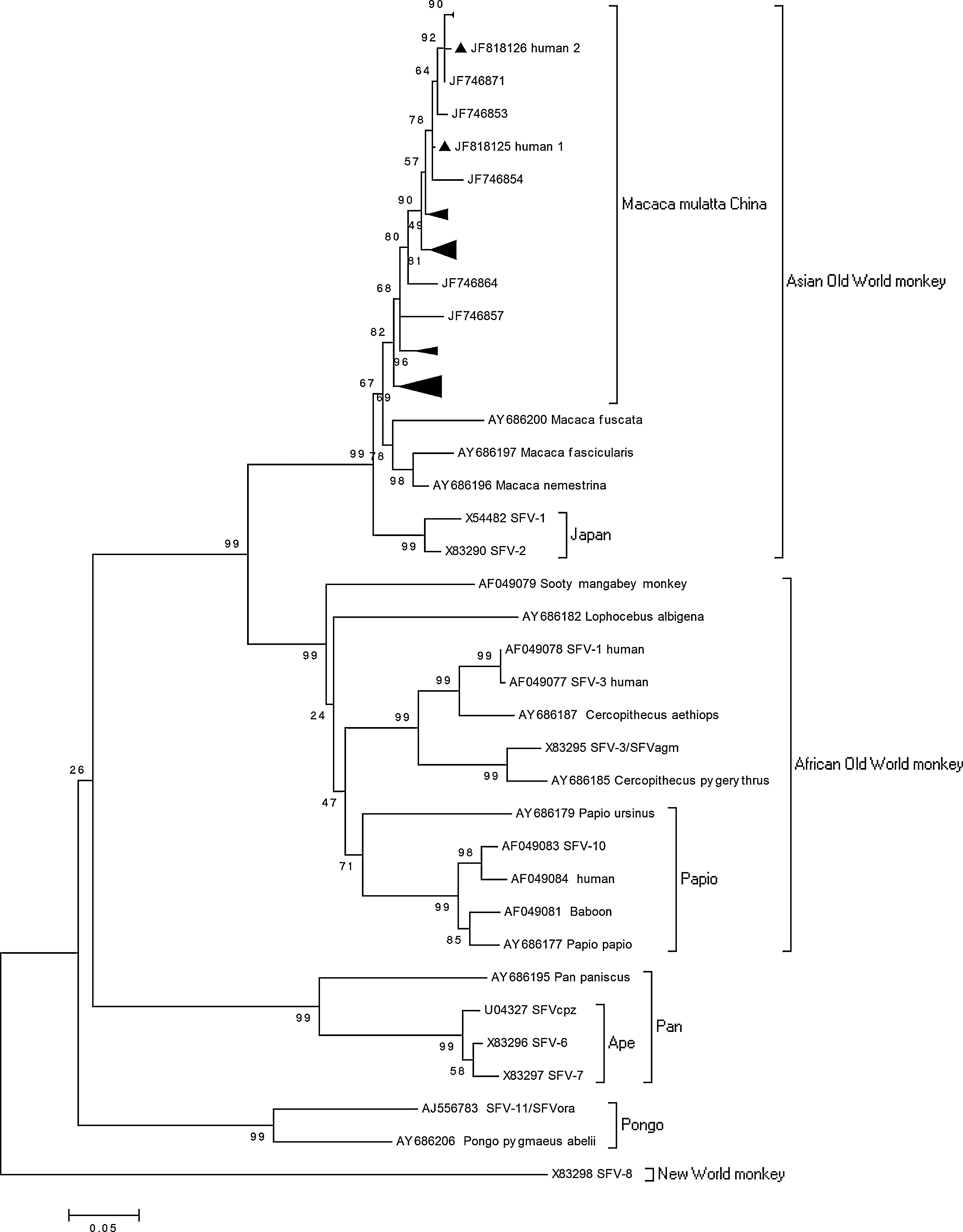
Phylogenetic analysis based on the polymerase (425 bp) sequence of 31 isolates in this study and another 24 references of simian foamy viruses (SFVs) using the neighbor-joining method. The tree was evaluated using the interior branch test method with Mega 4 software. Percent bootstrap support is indicated at each node. The scale bar represents nucleotide substitutions per base. GenBank accession numbers and species are indicated. The SFV isolate-infected humans identified in this study are marked with a triangle.
The phylogenetic analysis clearly illustrated the clustering of all SFV sequences isolated from M. mulatta. These isolated SFV sequences clearly belonged to Asian Old World monkey foamy viruses, and formed clusters with SFVs from M. fascicularis as well as M. nemestrina (Fig. 1), in agreement with previous studies. 6
Simian retroviruses are thought to be precursors of all human retroviral pathogens. 13 People requiring close contact with nonhuman primates may be high risk for retroviral zoonosis, especially SFV zoonosis. Direct contact with the body fluids (mainly blood or saliva) of nonhuman primates is the transmission mode of SFV, 6,7,14 but the possibility of human to human transmission is uncertain. 2,15 Zookeepers, hunters, or laboratory workers who are occupationally exposed to nonhuman primates have been reportedly infected by SFVs. 14 The potential risks of SFV transmission via blood transfusions among SFV-infected humans have also been reported. 14,15
In the present study, two workers infected with the SFV were occupationally exposed to nonhuman primates for more than 3 years and were bitten or spat at by M. mulatta more than once. However, both have not shown any symptoms specifically associated with SFV infection, as established in previous reports. 7 Although persons infected with the SFV may be asymptomatic, the danger of this viral infection must not be underestimated because available evidence is insufficient (i.e., limited number of cases and short duration of follow-up). Clinical information on infected individuals and the pathogenic mechanism of SFV warrant further studies.
In conclusion, SFV is highly prevalent in M. mulatta in China, and cross-species transmission to humans occupationally exposed to nonhuman primates is possible.
Footnotes
Acknowledgments
This study was supported by National High Technology Research and Development Program 863 (2006AA020902).
Author Disclosure Statement
No competing financial interests exist.