




Abstract
The tax gene of human T-lymphotropic virus type 1 (HTLV-1) diverges among isolates according to geographic regions and has been classified into two genotypes: taxA and taxB. In Brazil, taxA is the most prevalent genotype in symptomatic and asymptomatic carriers. Few studies have been conducted in HIV-infected patients. The present study characterized the tax gene (1059 bp) in 13 Brazilian HIV-1/HTLV-1-coinfected patients from the south and southeast regions. The results confirmed the transcontinental HTLV-1 subgroup A of the Cosmopolitan subtype and showed high nucleotide similarity both among Brazilian sequences and in relation to the ATK prototype (99.5% and 99.2%, respectively). Six nucleotide substitutions were highly conserved among isolates, ranging from 76.9% to 100%: C7401T, T7914C, C7920T, C7982T, G8231A, and A8367C. The presence of the Brazilian molecular signature of genotype taxA was confirmed in all of the isolates, and they clustered into two Latin American clusters, which confirms the double introduction of HTLV-1 in Brazil.
H
HTLV-1 is widespread in the northeast region of Brazil, 3,4 and studies on its origin and dissemination showed that HTLV-1 was recently introduced in this region, most likely through the post-Columbian migrations of the African slave trade between the sixteenth and nineteenth centuries. 5,6 HTLV-1 has also been detected in other regions of the country, but with a smaller percentage of cases than in the northeast. 4 The molecular characterization of HTLV-1 in Brazil showed that the Cosmopolitan subtype (a) of transcontinental subgroup A was prevalent, although historical data indicated that the slave trade movement originated from west Africa, where only the western African subgroup (C) circulates. 7,8 One study on the genetic background of HTLV-1-infected individuals from Brazil confirmed the introduction of HTLV-1 by infected individuals from the southern region of Africa. 7
Brazil also has the largest Japanese population outside of Japan, almost 1.5 million, and 1 million live in São Paulo (southeastern Brazil). 9 Therefore, the introduction of the Japanese HTLV-1 subgroup B in this geographic area could be hypothesized. In fact, this subgroup was detected in some individuals from southeastern Brazil. 10
On the basis of the molecular analysis of the tax gene, HTLV-1 strains were classified into two genotypes, taxA and taxB, whose association with clinical disease was suggested. 11
Although there are few studies on tax molecular characterization in Brazil, one study with a large number of individuals (symptomatic and asymptomatic carriers) from São Paulo and Rio de Janeiro (southeast) characterized the entire tax gene and demonstrated a Brazilian molecular signature (five nucleotide substitutions in relation to the ATK prototype: C7401T, T7914C, C7920T, C7982T, and G8231A) characteristic of the taxA genotype. 10 Corroborating these data, another study from São Paulo showed the same pattern of mutations and a lack of association between the tax genotype and disease progression. 12
In addition to some regions of Brazil being considered endemic for HTLV-1 infection, 4 Brazil is considered epidemic for HIV/AIDS, with prevalence rates of 0.3% to 0.6% 13 ; as a result, HIV/HTLV-1 coinfection has been described in this country, with prevalence rates varying according to the geographic area. For example, in the cities of Salvador (northeastern Brazil), Santos (southeastern Brazil), and Londrina (southern Brazil), HTLV-1 prevalence rates of 17.1%, 6.0%, and 0.8%, respectively, were detected in HIV-coinfected individuals. 14 –16
To gain further insight into the history of HTLV-1 in Brazil, especially in the at-risk population infected by HIV-1 in the south and southeast regions, we conducted the present and preliminary studies. A few years ago, we determined the prevalence of HTLV-1 and HTLV-2 in patients with HIV/AIDS from Londrina and its vicinities in the south of Brazil and detected HIV/HTLV-1/2 coinfection in 6.4% of cases 16 ; subsequently, we characterized HTLV-1 isolates from southern and southeastern Brazil using the LTR and env regions 17 and confirmed the HTLV-1a Cosmopolitan subtype, subgroup A, which clustered into two Latin American clusters.
In the present study, another genomic region (tax) was analyzed for the molecular signature described in Brazilian isolates. The study population consisted of 13 patients with HIV/AIDS who were coinfected with HTLV-1 from Londrina and its vicinities (BRLO) and São Paulo (BRSP).
17
Five patients are from Londrina (five men) and eight are from São Paulo (five women and three men). DNA samples were extracted from peripheral blood leukocytes, and the tax region was amplified using a previously described modified protocol,
11
in which PCR was optimized using the GoTaq Colorless Master Mix (Promega Corporation, Madison, WI) to improve stability. Fragments of 1119 bp were obtained, and 1059 bp were sequenced with an ABI 3130 Genetic Analyzer (Applied Biosystems, Foster, CA). All of the sequencing chromatograms were assembled and edited with Sequencher 4.7 software. Multiple alignments were performed using the Clustal W multiple-sequence alignment tool from BioEdit Sequence Alignment Editor, version 7.0.5.3, software with a reference set available in the GenBank database (
HTLV-1 subtyping was screened with the NCBI Genotyping (
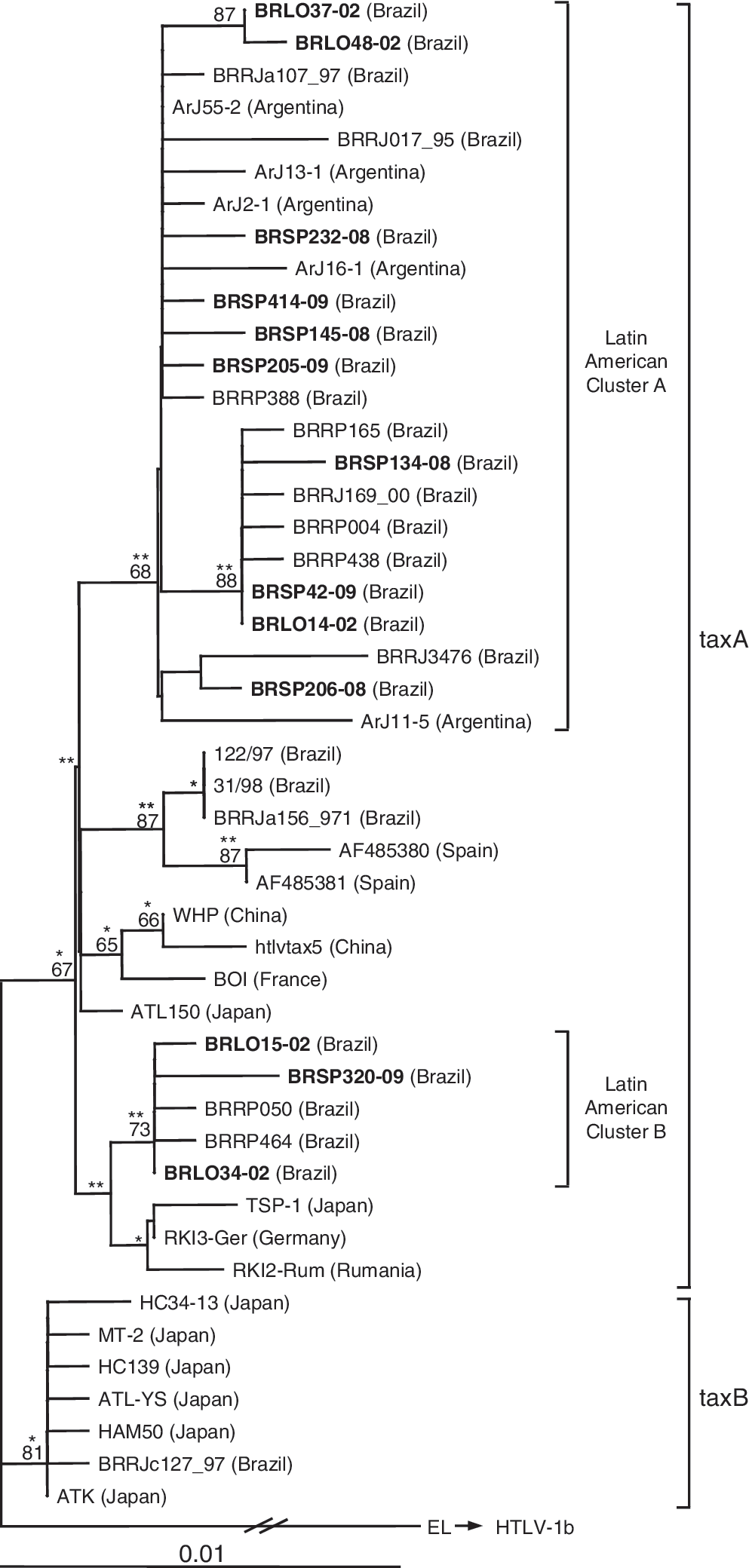
Phylogenetic tree constructed by the neighbor-joining method using the PAUP v4b10 software for the partial tax region of 977 bp (position 7378–8354 relative to the ATK prototype) of human T-lymphotropic virus type 1 (HTLV-1) of 49 isolates, including sequences from the south and southeast regions of Brazil (GenBank AN JN887698–JN887710) in bold, generated with the TrN+G model. Bootstrap values above 65% and zero length using the likelihood ratio test with p<0.001 (**) and p≤0.05 (*) in key branches are depicted. The HTLV-1 EL isolate was used as the outgroup.
Of note, the previous molecular analysis of the LTR and env regions of such isolates characterized these strains as belonging to the HTLV-1a Cosmopolitan subtype, transcontinental subgroup A, clustering into two branches of Latin America, 17 the same branches detected in the present study (Fig. 1). These findings strengthen the suggested concept of the different introduction of HTLV-1 in Brazil 3,5 –8,10,17 and among HIV-coinfected patients.
Nucleotide similarity estimations showed a similarity of 99.5% among all of the study sequences and when they were stratified into two groups: one from São Paulo and the other from Londrina and its vicinities. The analysis of sequences in relation to the ATK prototype showed a nucleotide similarity of 99.2%. Interestingly, the comparative analysis of HTLV-1 isolates from Chile with the ATK prototype showed 99.6% nucleotide similarity in the tax region. 18 Because Brazil and Chile are located in Latin America, these results could suggest an earlier introduction of HTLV-1 in Brazil.
Six nucleotide substitutions were highly conserved among the 13 new Brazilian sequences in relation to ATK: C7401T and T7914C in 76.9% of the sequences (except for Latin American cluster B) and C7920T, C7982T, G8231A, and A8367C in 100% of the sequences. These data are presented in Table 1 and confirm the molecular signature previously described in Brazilian sequences of HTLV-1. 10,12 Two of the nucleotide substitutions at positions C7982T and G8231A resulted in amino acid changes of A2661V and S2744N.
aa, amino acid.
It is important to note that the protocols selected and optimized for the PCR, nested PCR, and sequencing in the present study amplified a large segment of the tax gene, which only lacks the three initial tax nucleotides. These three nucleotides characterize the start codon of Tax (amino acid methionine) and are located at the beginning of the viral envelope gene.
In conclusion, despite the continental size of Brazil, the different social habits and risk factors of its population, and the regional differences in the genetic background of individuals, the same molecular signature of genotype taxA was detected in HTLV-1 strains isolated from HIV-1-coinfected patients from the south and southeast regions. The hypothesis of multiple introductions of HTLV-1 in Brazil was also confirmed in the present study.
Sequence Data
The GenBank accession numbers for the HTLV-1 tax sequences included in the phylogenetic study are as follows: ATK (J02029), TSP-1 (M86840), BRRJ017_95 (DQ323833), BRRJl69_00 (DQ323845), BRRJc127_97 (DQ323840), BRRJ3476 (DQ323834), BRRJa107_96 (DQ323835), BRRP388 (DQ323855), BRRP165 (DQ323875), BRRJa156_971 (DQ323836), BRRP004 (DQ323870), BRRP438 (DQ323862), BRRP050 (DQ323850), BRRP464 (DQ323883), ArJ13-1(DQ227134), ArJ2-1 (DQ227130), ArJ16-1 (DQ227135), ArJ11-5 (DQ227158), ArJ55-2 (DQ227189), BOI (L36905), WHP (AF259264), htlvtax5 (AF226593), ATL150 (AB036376), RKI3-Ger (AF042071), RKI2-Rum (AF003012), HC34-13 (AB045549), MT-2 (AF292000), HC139 (AB045520), ATL-YS (U19949), HAM50 (AB045481), (AF485380), (AF485381), 31/98 (AF133525), 122/97 (AF133524), EL (M67514).
The GenBank accession numbers of the HTLV-1 tax sequences obtained in our laboratory and included in the phylogenetic analysis are as follows: BRLO14-02 (JN887698), BRLO15-02 (JN887699), BRLO34-02 (JN887700), BRLO37-02 (JN887701), BRLO48-02 (JN887702), BRSP134-08 (JN887703), BRSP145-08 (JN887704), BRSP206-08 (JN887705), BRSP232-08 (JN887706), BRSP42-09 (JN887707), BRSP205-09 (JN887708), BRSP320-09 (JN887709), BRSP414-09 (JN887710).
Footnotes
Acknowledgments
This study was supported by the Ministério da Ciência e Tecnologia/Conselho Nacional de Desenvolvimento Científico e Tecnológico (MCT/CNPq), Brazil (Universal Grant 481040/2007-2), a fellowship to A.C.A. (Grant 303328/2009-6), Coordenação de Aperfeiçoamento de Pessoal de Nível Superior (CAPES), Brazil (Ph.D. fellowship to M.C.M.), and Instituto Adolfo Lutz (Grant 39/07). The authors thank Karoline Rodrigues Campos for her technical support.
Author Disclosure Statement
No competing financial interests exist.