




Abstract
Tests for the detection of the humoral immune response to HIV-1 have to be standardized and established, demanding regional efforts. For this purpose the neutralizing antibody (NAb) assay for HIV-1 in TZM-bl cells was introduced in Brazil. Twenty plasma samples from HIV-1-infected individuals were assayed
T
The most recent HIV/AIDS vaccine trial combined two vaccines designed to stimulate both humoral and cellular immunity, and protected 30% of the vaccinated individuals. In this trial the samples were screened for the presence of anti-gp120 B/E and p24 antibody-binding, NAb, interferon-gamma (IFN-γ) ELISpot and (IFN- γ)/interleukin (IL)-2 intracellular cytokine staining. 9 In the TZM-bl Nab assay only tier 1 env-pseudovirus (psV) were neutralized. 10 This demonstrates that the development of a protective vaccine will require more than current strategies for generating anti-HIV responses.
The contribution of NAb to the prevention of disease progression after the establishment of infection is still doubtful, and the long-term presence of protective NAb when viremia is undetectable can only be explained by low, fluctuating levels of Nab-inducing antigens. 11 In fact, an association between high plasma viral RNA load and a stronger neutralizing antibody response has been observed, 12 although other studies have shown that broadly neutralizing antibody responses are stronger and more frequent in long-term nonprogressors (LTNP). 13
Recently, a highly reproductive methodology using TZM-bl cells (cells that carry an HIV-1-tat-inducible luciferase reporter gene)/env-pseudovirus (different env gene on a standard backbone) was developed, which allows the evaluation of NAb in international comparisons. 14 –16 In our study, we introduced the NAb assay using TZM-bl cells and aimed to evaluate broadly neutralizing antibodies in Brazilian HIV-1-infected individuals with distinct rates of HIV disease progression in parallel to the standard peripheral blood mononuclear cell (PBMC) HIV-1 neutralization assay employing the commonly used reference strain HIV-1 IIIB.
Plasma was obtained from 20 patients at the Evandro Chagas Clinical Research Institute/Fiocruz (18 samples) or Central Laboratory of Public Health of the Porto Alegre (2 samples), collected between 2006 and 2009. The subjects were stratified according to Casado et al.,
17
which considered 10 samples as progressors (P) and 10 as long-term nonprogressors (LTNP) (Table 1). The study was approved by the Fiocruz Ethical Committee (approval #240/04). All plasma specimens were heat-inactivated at 56°C for 60 min. The samples were evaluated in triplicate by TZM-bl NAb and PBMC assays according to the protocol received from the Bill and Melinda Gates Foundation Collaboration for AIDS vaccine discovery (CAVD) project Global HIV Vaccine Enterprise (
P, progressor; LTNP, long-term nonprogressor; NC, viremic noncontroller; EC, elite controller; VC, viremic controller; F, female; M, male; MSM, men who have sex with men; Het, heterosexual; IDU, intravenous drug user; NA, not available; AZT, zidovudime; EFV, efavirenz; 3TC, lamivudine; –, antiretroviral-naive individuals.
Pools of antiretroviral-naive plasma samples were separated by HIV-1 subtype/variant: subtype B (GPGR amino acid sequence at the top of the V3 loop), B/Bbr (GWGR at the top of the V3 loop), and subtype F1, randomly selected in a previous study 18 ; MAb 2F5 and soluble CD4 (sCD4) inhibitor were used as controls. The MAb and sCD4 were tested at starting concentrations of 20 μg/ml and 15 μg/ml, respectively, followed by five 2-fold dilutions. Locally collected normal human plasma pools were used as negative controls in the analyses. All samples were used to standardize the neutralization technique in TZM-bl NAb, with psV of subtype B (SF162.Ls, WITO4160.33, PVO.4, PRhpa42597, Rejo4541.67, QH0692.42, Trjo4551.67) and C (ZM53M.PB12). Plasmids were expanded in Escherichia coli Top10 or DH5α, extracted using the Wizard Plus SV Minipreps DNA purification System (Promega, Madison, WI) and quantified in a Nanodrop (Wilmington, DE) spectrophotometer. To produce psVs, stocks were prepared from transfected 293/T17 cells (ATCC, Manassas, VA) as described by Li et al. 16 The TZM-bl (JC53-BL) cells were expanded, tested for Mycoplasma, and stored following the instructions of the Global HIV Vaccine Enterprise (GHVE). 16 Titration of psV infectivity (TCID50%) in TZM-bl was performed following GHVE procedures.
The production of luciferase was evaluated after the addition of the luciferase substrate (Bright Glo reagent/Roche, Madison, WI) and luminescence was measured in a Victor 3 luminometer (PerkinElmer Life and Analytical Sciences, Shelton, CT) and evaluated following the GHVE protocol. The psV (200 TCID50) were incubated with five dilutions of each plasma, added to TZM-bl cells in the presence of DEAE-dextran (20 μg/ml, noncytotoxic concentration). Inhibition of infection was given, after subtraction of background values, by the difference in relative luminescence units (RLU) between the positive control (100% infection—only psV and cells) and RLU measured in the sample wells, determining the dilution of plasma that inhibited 50% of psV infection, after adjusting the values by linear regression and 95% confidence intervals, using the statistical program GraphPad Prism (version 5.01). Neutralizing antibody titers were expressed by the reciprocal of plasma dilutions required to reduce RLU by 50%. Concentrations above the 1:20 dilution were considered negative. To consider the neutralization test as valid, observed values of standard deviations between the points of viral control up to 10% were considered.
A total of eight psV (seven Tier 2 and one Tier 1, according to Seaman et al. 19 ) were used to first assess the samples. It can be inferred that the psV HIV SF162.Ls has a higher susceptibility to neutralization by the reference inhibitors (CD4s and MAb 2F5), as reported before, 20 followed by psV HIV pRejo4541.67 (Table 2).
PBMC, peripheral blood mononuclear cell.
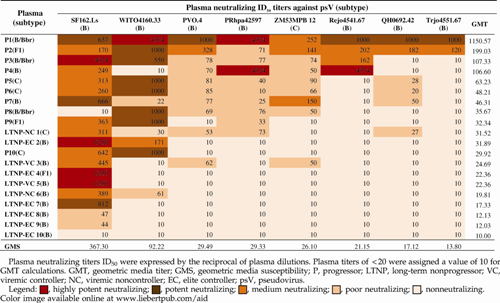
The plasma samples grouped themselves by geometric mean titer (GMT); of these 10% had titers >1:1000 designated as highly potent neutralizing. Eighty matrix points for LTNP plasma were tested (10 plasma×8 psV); of these 17 points (21.2%) had neutralizing titers between 1:50 and 1:6250. The psV SF162.Ls was sensitive to nine plasma samples and the psV WITO4160.33 was sensitive to three samples (one LTNP-EC and two LTNP-NC).
Among progressors (P), 55 (62.5%) had neutralizing titers from 1:20 to 1:4374 dilutions (Table 3). Two samples were exceptionally potent and broad in their neutralizing capacity (100%). Eight samples (80%) were found to neutralize 50% of the psVs; sample P1 (B/Bbr) showed the highest cross-neutralization ability when compared to the other plasma, achieving a GMT of 1150 with neutralization titers above 1:4000 against psV WITO4160.33 and psV HIV PRhpa4259.7 and the other env-pseudotyped viruses with titers above 1:1000. The plasma of individual P2 (F1), although not reaching such high titers, neutralized all psVs with titers ranging from 1:71 to 1:1000. The other plasma samples showed neutralizing titers varying from 1:1000 to not neutralizing (<1:20).
The TZM-bl technique is an important tool in the evaluation of neutralizing antibodies, being highly reproducible with a lower biological risk due to the use of psV. 20 However, psVs present a great susceptibility to neutralization, with much higher plasma titers when tested in the TZM-bl NAb assay, and this may lead to an overestimation of the protective response generated by neutralizing antibodies. On the other hand, an underestimation may be associated with an inability to synthesize viral DNA in infected cells due to the presence of antiretrovirals in low-dilution samples, indicating the addition of a positive control, as VSV-G/HIV psV, in the neutralization anti-HIV panel in future studies.
Also of great importance would be the correlation of test results with a protective effect in vaccinated healthy subjects. 21,22 This is most important as several studies have shown differences in results between PBMC and TZM-bl NAb/psV assays. 2,20,23,24 Therefore, the neutralization of HIV-1 IIIB with normal human peripheral blood mononuclear cells (PHA-PBMC NHu - 105 cells/well) was performed. The cells were phytohemagglutinin activated and infected after preincubation with the plasma samples (including controls) with 10–50 infective units of the reference X4 HIV-1 IIIB and quantification of the HIV-1 p24 antigen as described previously. 25 Approximate plasma concentrations needed for neutralizing 90% of the viral input were derived from linear regression curves (MicroCal Origin Software Inc, Northampton, MA). Of 10 samples from LTNP, 40% (4/10) had neutralizing activity in the PBMC assay as did 60% (6/10) of progressor individuals, with titers ranging from 1:30 to >1:160. It is also noteworthy that X4 HIV-1 IIIB, although originally a viral isolate, no longer exhibits characteristics of a primary isolate, increasing the bias toward their representation in vivo. This isolate was chosen as many of the neutralization studies available for Brazilian plasma employed this virus, thereby allowing comparison of results. The TZM-bl NAb assay demonstrates a sensitivity of 95% and 60% concordance with the PBMC assay according to Polonis et al. 2 However, the NeutNet project recommends that both tests be performed until agreement is reached on which in vitro assay best correlates with protection in vivo. 20 The comparison of the neutralization potency of different reagents in the TZM-bl NAb/psV assay with results from the PBMC neutralization assay showed a discrepancy in the titration of plasmas as described by other studies. 2,20,23,24
A difference between pools of plasma from individuals infected with the same subtype (B or F1) or variant of the HIV-1 B subtype (B/Bbr) was observed (Fig. 1). However, the B/Bbr (GWGR) pool showed high neutralization titers in both techniques. The Mann–Whitney test was used to determine if neutralization titers against HIV-1 IIIB and psVs differed between HIV-1 subtype plasma pools and p values of<0.05 indicated statistical significance (GraphPad Prism version 5.01). The pool of B/Bbr plasma had a neutralization capacity similar to subtype F1 (p value=0.2114), and was higher than the pool of B plasma versus F1 (p=0.0337) or B versus B/Br (p=0.0017); therefore in order of potency neutralizing the results are B/Br pool=F1 pool>B pool. In Brazil, subtype B infections are characterized by high frequencies of viruses with GWGR in the env gene (HIV-1 B/Bbr subtype/variant). 26 Some studies have associated this genotype with a slower disease progression. 27 Additionally, Casseb et al. 28 observed an avidity of the anti-V3 (GWGR) antibodies greater than in GPGR patients and Bongertz et al. 6 revealed that the genotype B/Bbr was able to induce a greater response against peptides V3-GWGR than the opposite. Corroborating, we observed that the humoral immune response to HIV-1 was broader for Bbr pools neutralizing psV B and HIV-1 IIIB (GPGR). This indicates that the proline-to-tryptophan substitution on top of the V3 loop may interfere with pathogenicity and immunogenicity.

Neutralizing activity of pooled subtype B, F1, or variant B/Bbr plasma for each of the env-pseudoviruses and HIV-1 IIIB. Color image available online at
A higher breadth and magnitude of the anti-HIV-1 Nab was observed in the P plasma from Brazilian individuals infected with the locally prevalent HIV-1 subtypes, with GMT 10 times greater than LTNP individuals. The majority of plasma from LTNP in both tests showed a less broad neutralization, suggesting that the low levels of replication that occur in these patients may lead to a more limited viral diversification and low antigen stimulation preventing a high-titer broad antibody response. Van Giels et al. 29 observed an association between high plasma viral RNA load and low CD4+ cells and the development of cross-reactive neutralizing activity; however, no correlation between the presence of cross-reactive neutralizing activity and the clinical course of infection was demonstrated.
In conclusion, 44% of plasma had the ability to neutralize the psVs in the NAb TZM-bl assay and 55% neutralized strain HIV-1 IIIB in the PBMC assay. These interesting neutralization percents with Brazilian plasma reveal the type of antibody response that could promote the design of improved vaccines correlating with epitope specificity of antibodies induced during infection.
The data presented in this study may contribute to the selection of candidate vaccines in preclinical and clinical studies in Brazil. Although the induction of HIV-1 neutralizing antibodies remains a major scientific challenge in vaccine development, the success of the introduction of these reference assays encourages the participation of Brazil in future comparative assessments of anti-HIV-1 neutralizing antibodies.
Footnotes
Acknowledgments
We are grateful to the Collaboration for AIDS Vaccine Discovery (CAVD) funded by the Bill and Melinda Gates Foundation (grant 38619) Global HIV Vaccine Enterprise (GHVE) Central Service Facilities (CSFs), specifically Dr. D. Montefiori's Vaccine Immune Monitoring Center (VIMC) (grant 383-0920). We thank the NIH AIDS Research and Reagent Program for the donation of HIV-1 psVs and TZM-bl cells (#8129). Monoclonal antibody 2F5 and soluble CD4 (sCD4) were kindly donated by the National Institute for Biological Standards and Control with funding from the Project Neut Net–EC FP6-2003-LifeSciHealth contract no. LSSP-CT-2004-012190. We also thankful for the donation of normal human buffy coats by the University Hospital Clementino Fraga Filho/UFRJ and Dr. Luciene C. Scherer of the Central Laboratory of Public Health of the Porto Alegre, RS. We are grateful to all individuals for donating blood to enable us to carry out this study.
This study was supported by the Brazilian Ministry of Health (# 147/08 DST/AIDS–UNESCO/IOC-/LABAIDS). The Bill and Melinda Gates Foundation Collaboration for AIDS vaccine discovery (CAVD) project Global HIV Vaccine Enterprise (grant 38619) financed the training and materials for use in the TZM-bl NAb assay.
Author Disclosure Statement
No competing financial interests exist.