




Abstract
A common idiotype of anti-HIV antibodies (Abs), designated as 1F7, was recently observed on anti-HIV broadly neutralizing Abs (BnAbs). The presence of the 1F7-idiotype on BnAbs suggests that continuous selection of 1F7-idiotypic Abs may allow these clones to achieve the somatic hypermutation necessary for broad neutralization. As the selection of type-specific BnAbs occurs in the setting of infections with a wide array of HIV subtypes, we investigated Abs from subjects infected with diverse subtypes for the selection of 1F7-idiotypic Abs. We observed the 1F7-idiotype on antiviral Abs in infections with various HIV subtypes. Furthermore, gp140-specific 1F7-idiotypic Abs recognized the gp140 antigens from several HIV subtypes. These results demonstrate that the 1F7-idiotype is a common characteristic of Abs from infections with diverse HIV subtypes, and suggests that early cross-reactivity of 1F7-idiotypic clones may act in conjunction with somatic hypermutation to produce BnAbs.
P
According to the repertoire freeze hypothesis, after escaping the effector functions of Abs directed against early viral variants, ACV retain sufficient binding capacity for these Abs to suppress induction of new Ab responses that could potentially control viral replication. 4 Instead, original antigenic sin allows memory B cells and Abs produced by Ab-secreting cells to outcompete naive B cells for antigen. 5 This leads to recall responses, which induce additional rounds of somatic hypermutation and affinity maturation in previously selected cells. 6,7 This hypothesis is supported by several lines of evidence including the observation that anti-HIV Abs from chronic infection exhibit extensive mutations. 8 Furthermore, humoral immune responses against HIV in humans and against other viruses, such as simian immunodeficiency virus (SIV) and the chimeric simian human immunodeficiency virus (SHIV) in macaques, are characterized by Abs expressing a common idiotype, designated as 1F7. 9,10 This idiotype appears on anti-HIV Abs during primary infection and persists throughout chronic infection. 11 Maintenance of these Abs appears maladaptive for ongoing Ab-mediated ACV neutralization, as depletion of 1F7-idiotypic Abs in SHIV-infected Rhesus macaques allows novel anti-SHIV Abs to arise that better neutralize ACV. 12,13
Although previous data suggest that idiotypic-driven repertoire freeze has a detrimental effect on the ability of humoral immune responses to contribute to the control of ACV, a greater understanding of this phenomenon may help elucidate the mechanisms required to induce protective anti-HIV Ab responses. Approximately 25% of HIV-infected individuals produce Abs capable of neutralizing a broad spectrum of viral isolates. 14 Although these broadly neutralizing antibodies (BnAbs) are incapable of slowing progression to AIDS, 15 when purified and passively transferred to Rhesus macaques prior to SHIV challenge, they protect against viral infection. 16 –19 At least six of these BnAbs express the 1F7-idiotype. 11 Many BnAbs demonstrate extensive somatic hypermutation, a phenomenon associated with their broad neutralization of HIV. 20,21 Carriage of the 1F7-idiotype on BnAbs suggests that repertoire freeze-induced maintenance and continued selection, somatic hypermutation, and affinity maturation may play a key role in the development of their broadly neutralizing capability. Although the evolution of 1F7-idiotypic Abs into BnAbs most certainly involves these processes, the preferential selection of 1F7-idiotypic Abs to ultimately develop into the BnAbs that neutralize diverse HIV strains could also reflect the ability of less extensively mutated Abs within this repertoire to recognize regions that are conserved across several HIV variants. If so, 1F7-idiotypic Abs should be generated in the setting of infection with any or most of multiple different HIV clades, and antigen-specific Abs within the 1F7-idiotypic repertoire should exhibit some degree of cross-reactivity between different HIV subtypes.
To evaluate the hypothesis that 1F7-idiotypic Abs are a common feature of infections with several HIV subtypes, we assessed plasma-derived anti-HIV Env Abs for the presence of the 1F7-idiotype using a previously described ELISA. 11 Briefly, plates were coated overnight at 4°C with 200 ng/well of HIV-1Bal gp120 (NIH AIDS Research and Reference Reagent Program, Division of AIDS, NIAID, NIH) or HIV-1 gp41 (Prospec-Tany Technogene Ltd.) in coating buffer (15 mM Na2CO3; 35 mM NaHCO3). The following day, plates were washed three times with phosphate-buffered saline (PBS); 0.1% Tween-20, and blocked for 1 h at 37°C with 200 μl/well of PBS; 0.1% Tween-20; 5% bovine serum albumin (BSA). After three washes, 100 μl of plasma at a 1:50 dilution in PBS, 0.1% BSA, 0.2% Tween-20, and 0.5% NP-40 were added to wells for 90 min at 37°C. The following sequential additions were made with six washes between each step: (1) 200 ng/well 1F7 (a kind gift from Dr. Heinz Kohler, University of Kentucky) or isotype control TEPC183 (Sigma-Aldrich) for 90 min at 37°C, (2) 100 μl/well horseradish peroxidase (HRP)-conjugated goat antihuman IgG or HRP-conjugated goat antimouse IgM (Jackson Labs) for 1 h at 37°C, and (3) 3′3′5′5′-tetramethylbenzidine substrate (Sigma-Aldrich) for 30 min at room temperature in the dark. Color development was stopped with 50 μl/well of 1 M H2SO4 and plates were read on a Victor X5 Plate Reader (Perkin Elmer). Samples were considered positive for the 1F7-idiotype when the average OD obtained for wells incubated with the anti-1F7-idiotypic Ab was more than two times the average OD obtained for wells treated with the TEPC183 isotype control. Plasma samples obtained from 26 individuals in the Montreal Primary Infection (PI) Cohort (n=17 were infected with subtype B and n=9 with non-subtype B HIV-1), as well as 10 plasma samples from non-subtype B-infected patients enrolled at the Centre National Hospitalier Universitaire de Cotonou, Benin were tested for HIV-specific Abs bearing the 1F7-idiotype. All participants provided informed consent and the institutional review board of all participating sites approved this study.
Assessment of plasma-derived anti-HIV Env Abs for the 1F7-idiotype revealed that the idiotype is common to infections with diverse HIV subtypes. We detected the 1F7-idiotype on anti-gp120 and anti-gp41 Abs from 16/17 and 17/17 HIV-1 subtype B-infected individuals, respectively (Fig. 1A). Among the individuals infected with HIV non-subtype B viruses were those infected with AB, AD, AE, AG, A/AG, AE/K, AG/K, CRF06, CRF011/F, C, F, and G subtypes. The 1F7-idiotype was detected on anti-gp120 and anti-gp41 Abs from 15/19 and 18/19 individuals, respectively (Fig. 1B). Figure 1C illustrates the breakdown of the detection of the 1F7-idiotype on Abs from individuals infected with each clade.
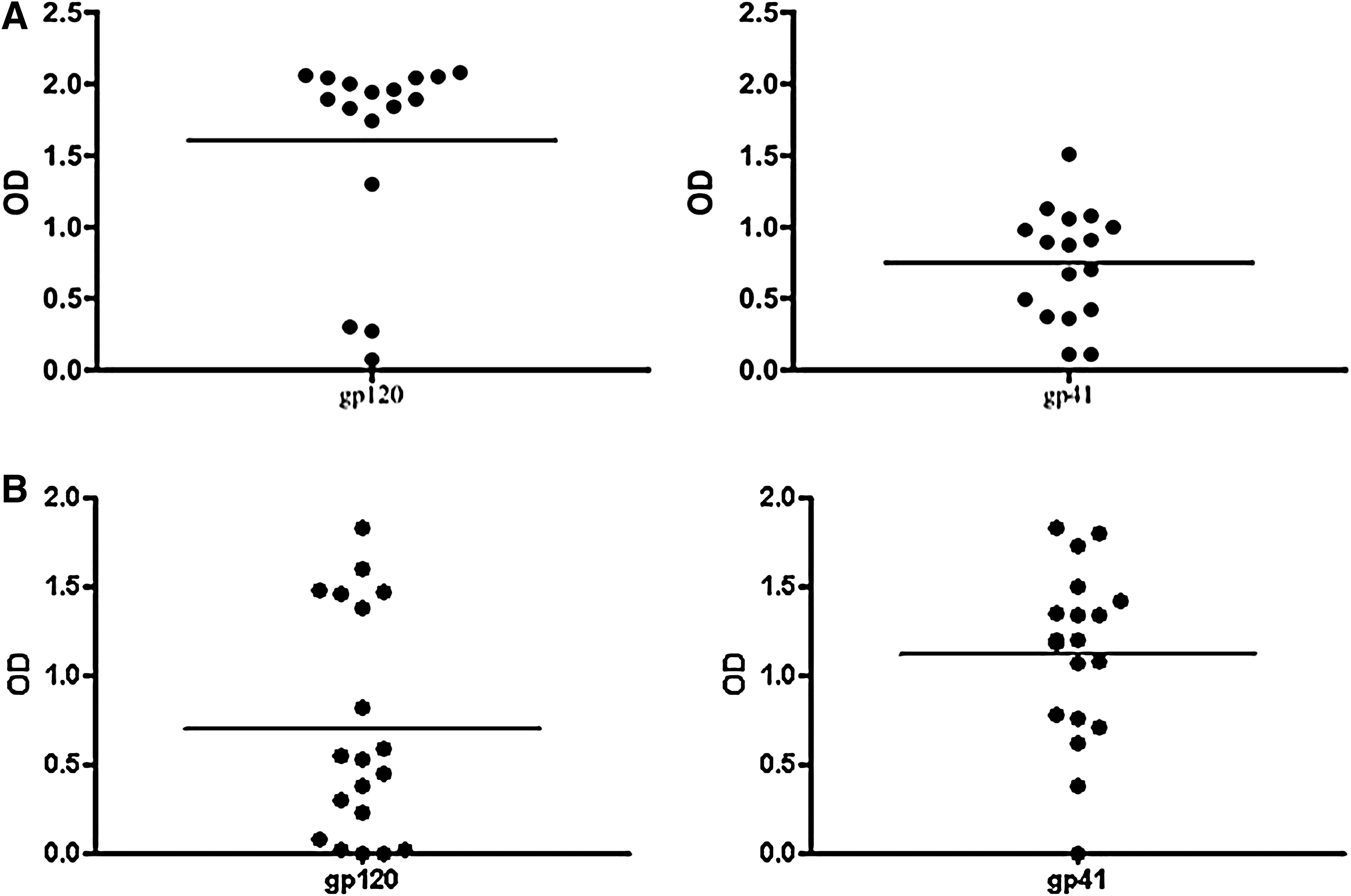
Investigation of 1F7-idiotype expression on antibodies (Abs) induced by infection with multiple HIV subtypes. Plasma samples from 17 individuals infected with HIV subtype B

We next determined whether HIV Env from subtype B induced and selected Abs capable of recognizing epitopes that are relatively conserved between HIV subtype B variant and non-subtype B Env glycoproteins. We screened plasma samples from five HIV subtype B-infected individuals, who were attending the Melbourne Sexual Health Clinic (Melbourne, Australia), for the presence of Abs recognizing gp140 from various HIV subtypes, including subtypes A, AE, and B. As well, we screened these cross-clade reactive Abs for the presence of the 1F7-idiotype. Procurement of the gp140 from subtypes A, AE, and two B viruses has been previously described. 22 The only difference between the ELISA protocol utilized for these experiments and the one used for the experiments depicted in Fig. 1 is the antigens coated on the plate. All five individuals had Abs that reacted with the four HIV gp140s tested (Data not shown). Subtype cross-reactive Abs bound to each of these gp140 antigens were 1F7-idiotype positive (Fig. 2). These results demonstrate that infection with a single HIV subtype can induce Env-specific 1F7-idiotype-positive Abs that can recognize Env epitopes from diverse HIV subtypes. As these Env-specific 1F7-idiotypic Abs developed in the absence of exposure to these other HIV subtypes, the 1F7-idiotypic Abs can recognize Env epitopes conserved across multiple HIV subtypes.
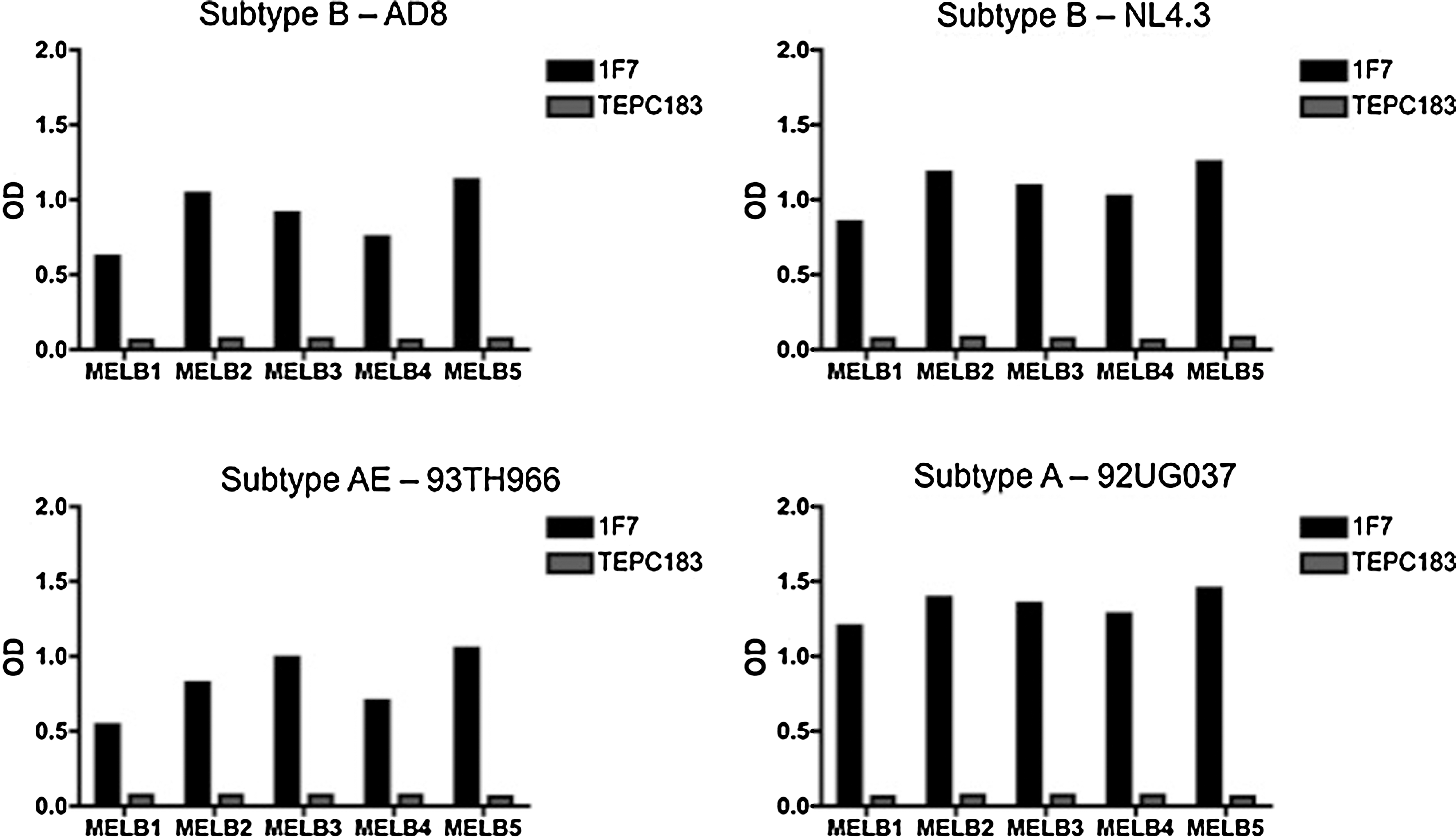
Investigation of 1F7-idiotype expression on anti-HIV Env glycoprotein antibodies (Abs) exhibiting cross-clade reactivity. ELISA plate wells were coated with 200 ng/well of gp140 proteins from HIV clades A (strain: 92UG037), A/E (strain: 93TH966), and B (strains: AD8 and NL4.3). Plasma samples from five HIV subtype B-infected individuals were added to the wells followed by the anti-1F7-idiotypic murine IgM or the TEPC183 isotype control. The binding of murine IgM was detected with an HRP goat antimouse IgM Ab. The bar graphs depict the relative levels of binding of anti-1F7-idiotypic and TEPC183 Abs to gp140-bound plasma-derived Abs from five HIV subtype B-infected individuals.
This study is the first to demonstrate the presence of the 1F7-idiotype on Abs induced during infection with diverse HIV subtypes. This observation is important for understanding the ability of HIV to evade humoral immune responses. A common feature of infections with diverse HIV subtypes is the inability of the humoral immune response to efficiently respond to actively replicating ACV. 1,2 1F7-idiotypic Abs develop in primary infection and are maintained and expanded during chronic infection. 11 It has been proposed that the persistence of 1F7-idiotype-positive Abs against early viral variants negatively impacts the induction of Abs able to contribute to the control of ACV. This contention is supported by data demonstrating that suppression of 1F7-idiotypic Abs allows development of new Abs better able to neutralize ACV. 12,13 As such, the observation that 1F7-idiotypic Abs are present in infections with diverse HIV subtypes suggests that the repertoire freeze associated with the presence of the 1F7-idiotype on antiviral Abs may be an important factor limiting the efficacy of humoral immune responses in a wide array of HIV infections.
This report also supports the contention that Env-specific 1F7-idiotypic Abs induced during infection with one HIV subtype are capable of recognizing epitopes on Env from other subtypes. The first evidence of this phenomenon was provided by the demonstration that a series of six BnAbs bear the 1F7-idiotype. 11 Here, we show that 1F7 recognizes Abs within the general polyclonal antiviral Ab response to multiple HIV subtypes. This observation offers insight into pathways and selection mechanisms, such as early cross-clade cross-reactivity, repeated selection within an idiotypic framework, and high levels of somatic hypermutation, that may be involved in generating potentially protective Ab responses.
Although the phenomenon of repertoire freeze is undesirable during chronic viral infection, the observation that 1F7-idiotypic Abs are reactive with Env from different HIV clades and that BnAbs develop from the 1F7-idiotypic node suggests that a greater understanding of repertoire freeze may aid in understanding how BnAbs develop during the natural history of HIV infection and how to induce protective Abs via vaccination. We hypothesize that early 1F7-idiotypic Abs represent precursors to BnAbs, and that repeated rounds of selection and somatic hypermutation drive their development into BnAbs. Future experiments simultaneously mapping the evolution of viruses and 1F7-idiotypic Abs in individuals who develop BnAbs would test this hypothesis.
This study demonstrates that Abs raised during diverse HIV infections are selected from a common idiotypic node. These results suggest the phenomenon of idiotypic-driven repertoire freeze is common among infections with diverse HIV-1 subtypes. Idiotype-associated repertoire freeze may serve as a pragmatic framework for understanding both the ability of HIV to evade humoral immune responses and the selection of potentially protective Abs. As BnAbs have been demonstrated to develop from the 1F7-idiotypic repertoire, vaccine constructs should be designed to select and develop antiviral Abs from this repertoire. Understanding the role of 1F7-idiotypic repertoire freeze in selecting anti-HIV Abs may contribute toward the design of an effective HIV vaccine, as broadly reactive Ab responses appear inextricably linked to this repertoire.
Footnotes
Acknowledgments
This work was supported by Canadian Institutes for Health research grants MOP-79515, MOP-93770, and HPR-85528 and the Fonds de la Recherche en Santé du Québec (FRSQ) AIDS and Infectious Disease Network. J-P.R. and N.F.B. are members of the Research Institute of the McGill University Health Centre, an institution funded in part by the FRSQ. M.S.P is supported by a CIHR Vanier Scholarship, and was a visiting scholar at the University of Melbourne with the support of a CIHR Michael Smith Foreign Study Supplement.
Author Disclosure Statement
M.S.P. and M.D.G. are both members of the scientific advisory board for Network Immunology Incorporated.