




Abstract
The Korean subclade of subtype B (KSB) is the most prevalent HIV-1 strain found in Korea. To date, only two near full-length HIV-1 sequences from Korean patients have been reported. Here, we analyzed a total of 24 near full-length genomes of HIV-1 strains that were isolated from 17 antiretroviral therapy (ART)-naive patients and four ART-exposed patients. Proviral DNA from peripheral blood mononuclear cells was PCR amplified and directly sequenced. Phylogenetic analyses were used to classify viruses from 19 patients as KSB, from one patient as subtype B, from one patient as subtype D, and three viruses from one patient as CRF02_AG. All KSB viruses demonstrated TAAAA instead of TATAA at the TATA box in the LTR. Of the 19 KSB patients, their sequence identities at the nucleotide level ranged from 89.8% to 97.1% from the lowest env gene to the highest pol gene. Other than the CRF02_AG viruses, no recombination events were noted in any of the 19 KSB patients, which is consistent with our previous studies on the pol, vif, and nef genes. Except for one strain, all of the strains were classified as non-syncytium-inducing strains. This is the first report to describe near full-length KSB.
S
Among various subtypes and CRFs in Korea, domestically infected Korean individuals are mainly infected with the Korean subclade of subtype B (KSB) at the level of the env, nef, pol, and vif genes. 1 –6 KSB sequences were first detected in homosexual Korean HIV-1 patients in 1988. 1 Our previous studies show that these KSB sequences represent a subclade of the globally represented subtype B, indicating a founder effect. All of these KSB sequences were found in domestically residing homosexual and heterosexual men and women who did not have sexual contact with foreigners. 4
To date, only two near full-length KSB sequences have been reported by our team. 7,8 Here, we analyzed 24 near full-length sequences from 21 HIV-1-infected Korean individuals (Table 1) and performed phylogenetic analyses. 9 –12 Sequence amplification of 11 overlapping fragments [each about 1 kilobase pair (kbp)] from peripheral blood mononuclear cell (PBMC) DNA using nested PCR, followed by direct sequencing of the products, was performed as previously described. 7,8
The number or expression in parentheses was used in the previous study.
Highly active antiretroviral therapy.
Not determined.
Compliance with Korean red ginseng (KRG) intake was defined as poor, or the duration of KRG intake was short.
Patient KBH had taken KRG from April 1993 to August 2004 (10,800 g of KRG supplied). Thereafter, follow-up was stopped. CD4+ T cell count increased from 199/μl to 473/μl for the period.
Sequences were aligned with the HIV-1 subtype reference set from the HIV Sequence Database (
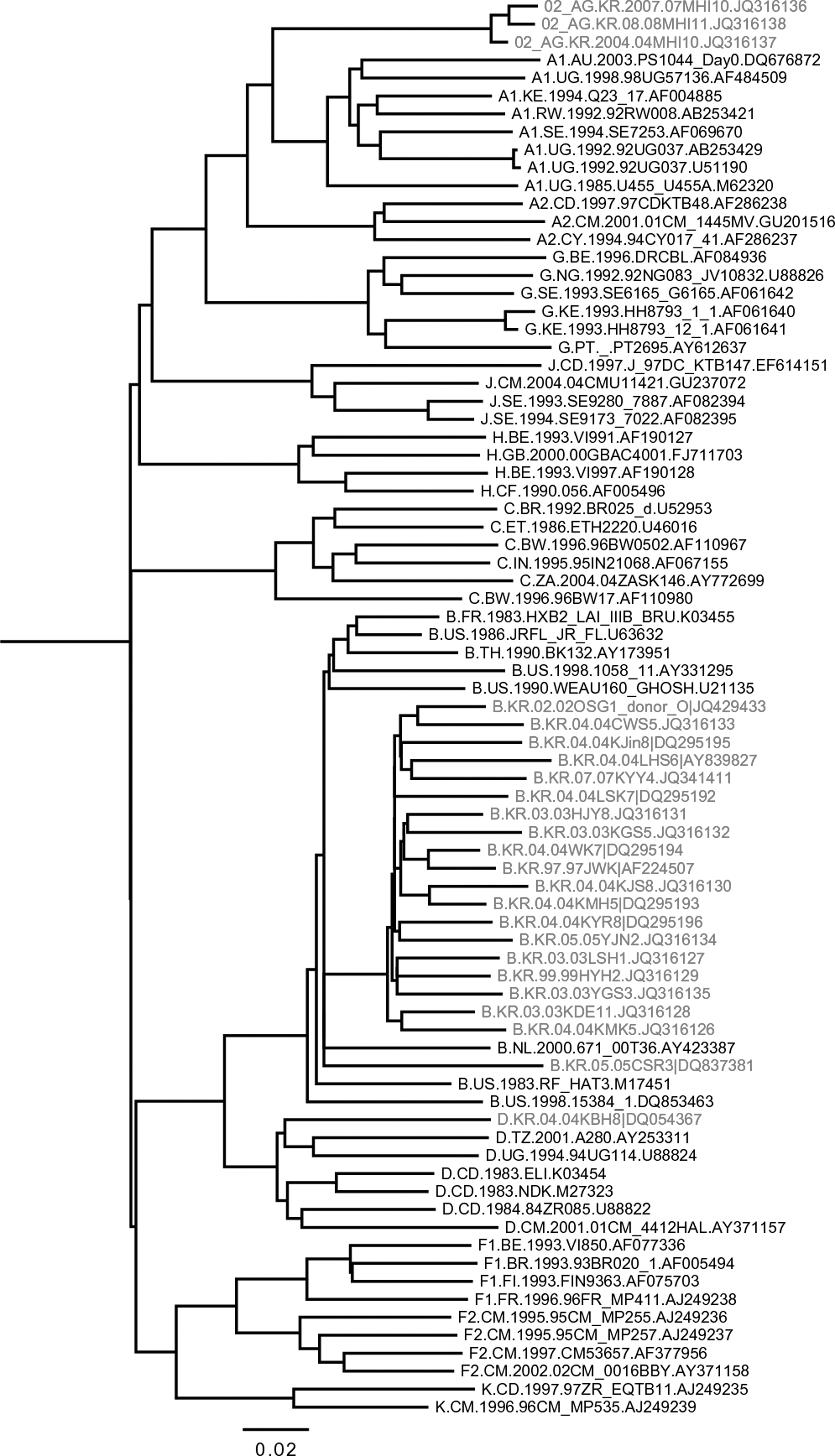
Phylogenetic tree analysis of the near full-length genomes of 19 KSB, 1 subtype D (04KBH8), 1 subtype B (05CSR3), 3 CRF02_AG (MHI), and reference HIV-1 sequences. Patients 04WK7, 03KGS5, and 03HJY8, 04CWS5 and 02OSG1, and 04KMH5 and 04KJS8 were epidemiologically linked patients, respectively.
Clinical characteristics including changes in CD4 T cell count, RNA copy, Korean Red Ginseng (KRG) therapy, and frequent genetic defects in the nef and 5′-LTR/gag in the first 10 patients in Table 1 were described elsewhere. 9,10 In brief, all patients were treated with KRG for a significant period. Consequently, they were defined as long-term slow progressors whose annual decrease of CD4 T cells was less than 20/μl. 9 Clinical characteristics and frequent genetic defects in the 5′-LTR/gag genes in the second set of seven patients in Table 1 have been previously described. 10,11 Two hemophiliac patients (KDE and KMK) in Table 1 were described as HP-9 and HP-13, respectively. 12 The last two patients were not reported elsewhere. Interestingly, three patients (CSR, MHI, and KYY) have survived for 25, 24, and 20 years in the absence of highly active antiretroviral therapy (HAART), respectively, because they have been prescribed KRG for >10 years.
The average nucleotide sequence identity of the coding regions in the 19 KSB patients was 93.7%, and the nucleotide sequence identity between the earliest sequence (AF224507) of the 19 KSB patients and the 1984 reference strain HXB2 (K03455) was 92.5%. The average pairwise nucleotide sequence identity in the coding regions between KSB sequences and the non-KSB subtype B sequences is 91.4%. The sequence identity at the nucleotide level between two patients who were husband (04KMH5) and wife (04KJS8) and between OSG and CWS who were donor and recipient were 95.1% and 93.2%, respectively. These epidemiologically linked cases provide the highest sequence identity of the 19 KSB patients who were investigated.
We also checked to determine if the KSB sequences recombine with other various subtypes using data provided by the Recombinant Identification Program of the Los Alamos National Laboratory (
Six patients were found to have a premature stop codon in at least one gene (Table 2). All of the premature stop codons were identified at tryptophan codons. Specifically, patient LSH was found to have a stop codon in the tat gene. Patients KYY and OSG were found to have a stop codon in the rev gene. Patients 97Jwk (AF224507; 97JWK position 4171 TGG trp→TAG stop) and YGS (DQ295195; 03YGS3 position 2766 TGG trp→TAG stop) were found to have stop codons in the pol gene in 1997 and 2003, respectively. 7 Using genotyping for the env gene C2/V3 region, patient KMK was predicted to carry a syncytium-inducing (SI) strain. His CD4+ T cell count was 424 cells/μl in May 2005. Subsequently, his CD4+ T cell count rapidly decreased to <100 cells/μl within 2 years. Viruses from all other patients, except this case, were predicted to be non-SI strains.
Described as an insertion or duplication, except for the findings shown in Fig. 2.
LTR, long terminal repeat.
Four patients received antiretroviral therapy (e.g., ART, HAART) prior to this study. Patients KJS and OSG took HAART for a month in 2002 and 1999, respectively. Three patients were found to carry drug-resistant mutations. Specifically, patient MHI infected with a CRF02_AG virus was found to carry the nonnucleoside reverse transcriptase inhibitor (NNRTI) resistance mutation N348I in most sequences, although he was not receiving ART. Patient LHS had taken indinavir, ddI, and 3TC since April 2001 following the diagnosis of AIDS, and has since been found to carry many resistance mutations. 8 Patient YGS had never received ART; he was found to carry NNRTI-V108I and P236L by G-to-A hypermutations (AY347691), but not in the complete genome sequence (JQ316135).
Several patients were found to have novel insertions, duplications, or deletions (Table 3). However, it is not necessary for us to describe all of the variations. For example, patient LHS (AY839827) was found to have a novel 14-bp insertion in the 5′-LTR region (between base pairs 581 and 582 in HXB2) in June 2004 (Fig. 2A). The same insertion had already been detected in February 2001 (EF370323 and EF370325). Regarding the pol gene, patient KJS (JQ316130) was found to have a 24-bp insertion (between base pairs 2161 and 2162) in two amplicons in August 2004 (Fig. 2B). Thereafter, the same insertions were detected in consecutive samples. However, an earlier sample (HQ026504; diagnosed in 1992), and a sample from his spouse KMH (DQ295193), did not reveal the same insertions.

Alignment of partial nucleotide sequences from 19 Korean patients diagnosed with Korean subclade B (KSB), demonstrating novel insertions compared with two reference sequences (HIVpNL43-M19921 and HXB2-K03455) from GenBank. Dots and hyphens denote the same and deletion compared with the NL 4-3 reference sequence shown on the top line, respectively. All KSB strains, except one sequence (LSK), demonstrated a 3-bp deletion between nucleotides 6259 and 6260.
Patient LSK (DQ295192) was found to have a novel 9-bp insertion (between base pairs 5829 and 5830; Fig. 2C), in addition to the insertion of nucleotide A into the pol gene. Patient LSH was also found to have a 24-bp insertion (between base pairs 6284 and 6285) in the initial part of the env gene (Fig. 2D) and a 6-bp deletion from the nef gene. Regarding the gag gene, patients KMK (JQ316126), LSK (DQ295192), and KJS (JQ316130) were found to have 9-bp insertions (between base pairs 1167 and 1168) in many samples. Patient CWS was also found to have a 9-bp insertion in the initial part of the V3 loop (6992-CAATAAAAA-7000), and a 3-bp deletion was found in the terminus of the V3 loop. Patients CSR and KBH were found to have 9-bp deletions (amino acid at position 9–11) after the myristoylation site and 15-bp deletions from the nef gene, respectively. In particular, we obtained seven amplicons of the nef gene from the earliest sample from patient CSR, which was obtained in April 1991. Three, two, and two amplicons were classified as wild type or 6- or 9-bp deletions, respectively. Most sequences contained 9-bp deletions, indicating that the deletions might have been associated with slowly progressive strains, especially considering the lack of ART for 25 years since diagnosis in 1987.
This is the first study to describe several complete KSB genomes, which is the dominant epidemiological strain of HIV-1 that has spread in Korea since 1992.
Sequence Data
The GenBank accession numbers are AF224507, AY839827, DQ054367, DQ295192-96, DQ837381, JQ316126-38, JQ341411, and JQ429433.
Footnotes
Acknowledgments
This work was supported by a grant from the Korean Society of Ginseng, which was funded by the Korea Ginseng Corporation (2011–2012).
The funder had no role in study design, data collection and analysis, decision to publish, or preparation of the manuscript.
Author Disclosure Statement
No competing financial interests exist.