




Abstract
In recent years, the men who have sex with men (MSM) population has seen the fastest growing prevalence of HIV transmission in China. In addition, coinfection through sex and intravenous drug use is a major problem in HIV prevention and control. Recent studies have also revealed that three major viral strains (CRF07_BC, CRF01_AE, and subtype B) have been cocirculating among MSM in Sichuan, suggesting a high probability of generating new recombinants. This study reports a near full-length genome of a novel HIV-1 recombinant (MSM0720) between CRF07_BC and CRF01_AE. The analysis of MSM0720 shows that the genome is composed of at least 11 interlaced segments, including six CRF07_BC and five CRF01_AE segments, with CRF07_BC as the backbone; this is different from a previously identified CRF01_AE/07_BC recombinant strain in intravenous drug users from Jiangsu.
S
Recombination between HIV-1 subtypes is a significant mechanism that contributes to the genetic complexity of HIV-1, and new strains are frequently found in regions and populations where multiple subtypes are circulating. One such region is Sichuan province in southwestern China. Sichuan has one of the highest HIV prevalence rates in the country, with CRF07_BC and CRF01_AE as the two major circulating strains among its large men who have sex with men (MSM) population. 4 The coexistence of these two CRFs among MSM may facilitate the generation of new recombination forms. Here we identified and characterized a novel recombinant derived from CRF07_BC and CRF01_AE, which is highly different from a previously reported CRF01_AE/CRF07_BC recombinant from Jiangsu province. 5
Sample MSM0720 was collected in 2007 from a male patient residing in Sichuan province who was diagnosed as HIV-1 positive in 2006 and died in 2008. Epidemiological survey data show that the patient was married, but had been infected with HIV through homosexual behavior. For the near full-length genome (NFLG) amplification and sequencing, RNA was extracted from the patient's blood plasma sample using a QIAamp Viral Mini Kit (QIAGEN, Germany). RNA was then transcribed into cDNA using a Superscript III First-strand synthesis system (Invitrogen, USA). With the near-endpoint diluted cDNA template, the NFLGs were amplified with TaKaRa LA Taq (TaKaRa, Dalian, China) using the same nested polymerase chain reaction (PCR) amplification conditions in both of the two rounds, including an initial denaturation at 94°C for 2 min followed by 10 cycles of 94°C for 10 s and 68°C for 8 min 30 s, and then 20 cycles of 94°C for 10 s and 68°C for 8 min 30 s with the cumulative addition of 20 s at 68°C with each successive cycle, followed by a final extension at 68°C for 20 min. 6 The positive PCR products were purified using a QIAquick Gel Extraction Kit (QIAGEN, Germany) and sequenced by an ABI 3730XL sequencer using BigDye terminators (Applied Biosystems, Foster City, CA). The chromatogram data were cleaned and assembled using Sequencher v4.9 (Gene Codes, Ann Arbor, MI). A BLAST search was performed for the sequences using all sequences obtained in this laboratory as background, to check consistency with previous results and to identify and exclude possible cross-contamination events.
The standard subtype reference alignment file, which includes subtype A1, A2, B, C, D, F, G, H, J, P, CRF01_AE, CRF07_BC, and CRF08_BC, was downloaded from the Los Alamos National Laboratory HIV Database (
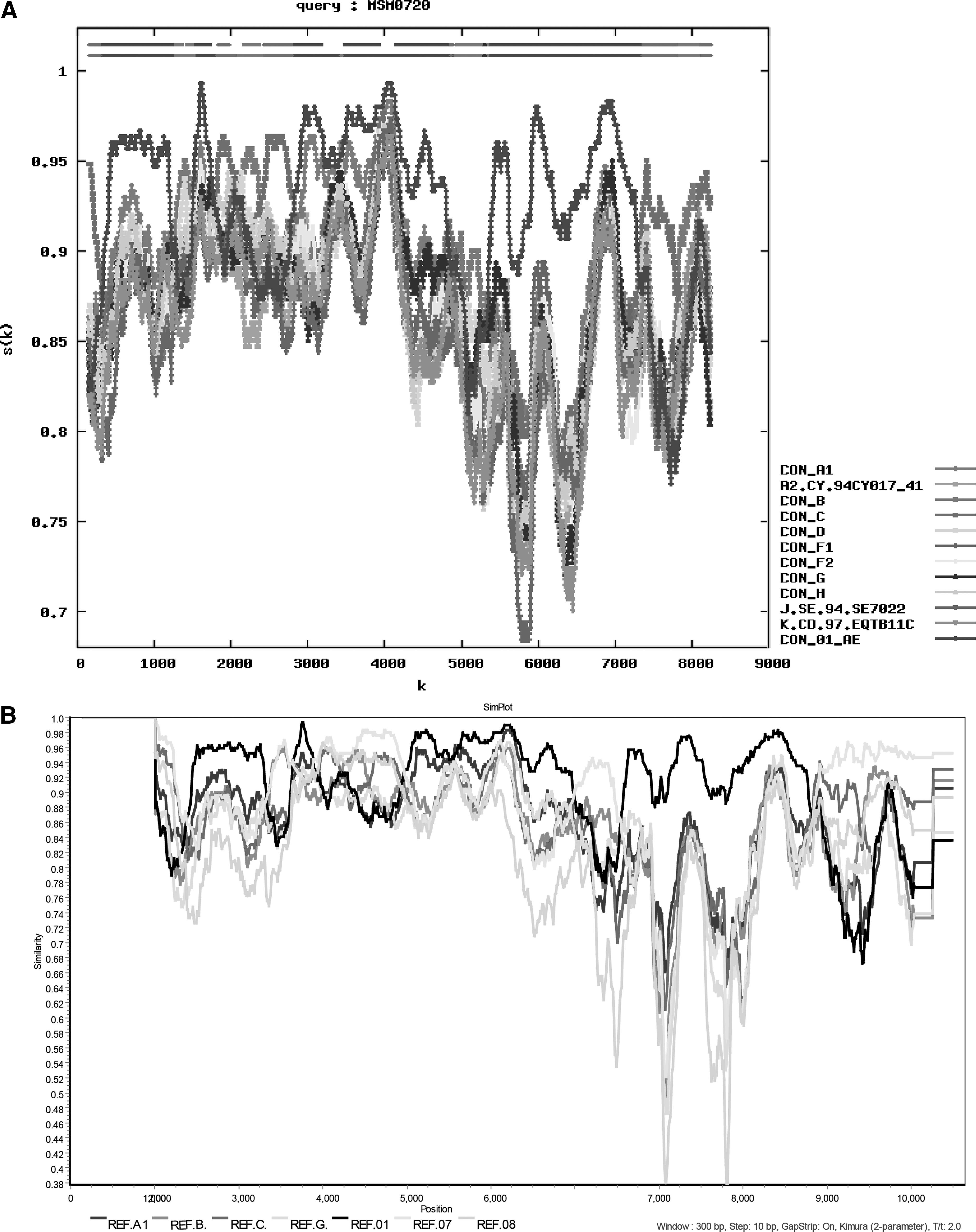
Recombinant Identification Program (RIP) and similarity plots analysis were performed for MSM0720 to identify parental subtypes.
MSM0720 contained at least 11 interlaced mosaic segments corresponding to CRF01_AE (II, IV, VI, VIII, and X) and CRF07_BC (I, III, V, VII, IX, and XI) (Fig. 2A). Five mosaic CRF01_AE segments and four CRF07_BC segments (I, V, IX, and XI) were well confirmed by phylogenetic trees with bootstrap value >0.7 (Supplementary Fig. S1; Supplementary Data are available online at
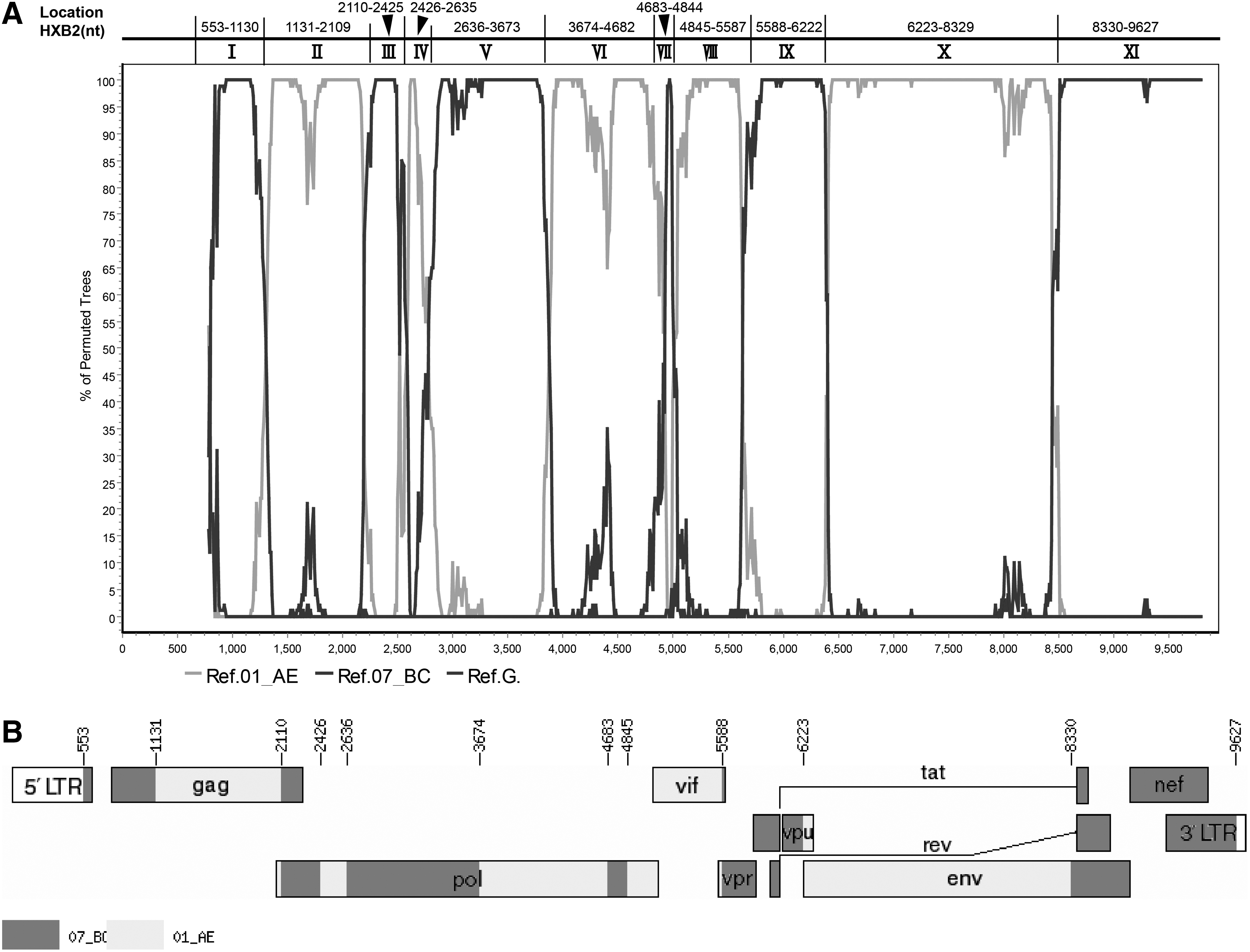
Bootscan plots and schematic representation of the MSM0720 near full-length genome's mosaic structure.
The breakpoints positions refer to the HXB2 coordinates, and were located by the HIV Sequence Locator (
CRF01_AE and CRF07_BC are two major HIV-1 circulating strains in Sichuan. Among MSM, the proportion of CRF01_AE and CRF07_BC is 54.5% and 31.2%, respectively. 4 In China, CRF01_AE is historically mainly associated with sexual transmission, while CRF07_BC accounted for a larger proportion among intravenous drug users (IDUs). The emergence of the 07_BC/01_AE recombinant strain in MSM indicates that there is cross-transmission between IDUs and those mainly at risk through sexual contact. Regarding this study, the patient who provided this sample has been married to a female partner for several decades. In China, due to a high degree of stigma and social pressure, a large number of MSM do not disclose their sexual orientation and have multiple sex partners, including female marital partners. Such situations facilitate the transmission of HIV-1 and increase the difficulty of HIV/AIDS prevention and control work. In addition, demographic data from the National AIDS Direct Reporting System show that HIV-1 infection in MSM is mainly found in young adults, approximately 22.5% of whom are college students. 2 Among these, 11.9% are detected through prescreening during voluntary blood donations. 2 As young students are currently the main donors of blood in China, this may pose challenges to blood safety.
The first CRF01_AE/CRF07_BC recombinant form in China was isolated from IDUs from Jiangsu province. 5 Here we characterize a new unique NFLG sequence isolated from MSM in Sichuan province, consisting of different recombinant breakpoints between the CRF07_BC and CRF01_AE strains. The emergence of such recombinants demonstrates increasing cross-transmission between previously segregated risk populations, and could further complicate the HIV-1 epidemic in the MSM population in Sichuan.
Sequence Data
The nucleotide sequence of MSM0720 has been submitted to GenBank with the accession number KC833436.
Footnotes
Acknowledgments
This work was supported by National Major Projects for Infectious Diseases Control and Prevention (grant 2012ZX10001008, 2012ZX10001002), the National Natural Science Foundation of China (grant 81020108030), and the State Key Laboratory for Infectious Disease Development (grant 2012SKLID103).
Author Disclosure Statement
No competing financial interests exist.
References
Supplementary Material
Please find the following supplemental material available below.
For Open Access articles published under a Creative Commons License, all supplemental material carries the same license as the article it is associated with.
For non-Open Access articles published, all supplemental material carries a non-exclusive license, and permission requests for re-use of supplemental material or any part of supplemental material shall be sent directly to the copyright owner as specified in the copyright notice associated with the article.
