




Abstract
We report here a novel HIV-1 B′/C recombinant isolate JL100091, identified from an HIV-positive female subject infected through heterosexual transmission in Jilin in 2006. The near full-length genome analyses of the novel recombinant (JL10091) showed that one subtype B′ region (3,085 bp) was inserted into the subtype C backbone, with two breakpoints observed in gag and pol genes. To our knowledge, this is the first detection of a novel HIV-1 B′/C recombinant in Jilin, which indicates ongoing transmission of networks among the heterosexual population in the region. The novel HIV-1 B′/C recombinant (JL10091) in Jilin originated from India subtype C and China subtype B′ may suggest potential transmission routes of HIV-1 in China. Further monitoring of the molecular epidemiology of the HIV-1 epidemic in Jilin will provide critical information for designing effective control and prevention measures against HIV transmission in the region.
C
Plasma was collected on July 12, 2010 from an HIV-positive female subject infected through heterosexual transmission in Jilin. The subject was confirmed as HIV-1 antibody positive on August 24, 2006 and the CD4+ T cell numbers were 449 and 459 cells/μl on June 29, 2010 and December 30, 2010, respectively, before and after the plasma was collected. Written informed consent was obtained from the subject at the time of sample collection. The study was approved by the institutional review board of the National Center for AIDS/STD Control and Prevention.
The NFLG sequence was obtained from plasma HIV-1 viral RNA, using the near-endpiont diluted cDNA template and single-genome amplification (SGA) methods with one set of primers previously described.
5
Amplicons were purified using the QIAquick Gel Extraction Kit (Qiagen, Valencia, CA) and sequenced directly by an ABI 3730XL sequencer using BigDye terminators (Applied Biosystems, Foster City, CA). All Sequenced data were cleaned and assembled using Sequencher v5.1 (Gene Codes Corporation, Ann Arbor, MI). The NFLG sequence was aligned against all HIV-1 group M reference sequences, obtained from the Los Alamos HIV Sequence Database (
Phylogenetic and subregion tree analyses were performed using the neighbor-joining method based on the Kimura two-parameter model implemented in MEGA v5.05. 7 After phylogenetic and subregion trees were constructed, some reference sequences were removed for visual clarity. Recombination breakpoints were determined using RIP and jpHMM (both of them are available from the Los Alamos HIV Sequence Database) and SimPlot v.3.5.1. 8 The breakpoint confirmation and origin of each region were analyzed by subregion tree analyses.
Phylogenetic analysis showed that the NFLG sequence of JL100091 (9,070 bp) clustered with CRF07_BC and CRF08_BC and one subtype C (95IN21068), with 99% bootstrap value, but formed a monophyletic branch distinct from them (Fig. 1). Both RIP and jpHMM showed that the NFLG sequence of JL100091 was composed of subtypes B and C, with one region of subtype B (3,085 bp) inserted into the subtype C backbone. In addition, jpHMM analysis revealed that the breakpoints corresponded to HXB2 nucleotide positions 1,185 and 4,270 approximately (Fig. 2). Subregion tree analyses confirmed the parental origin of each region of JL00091: region I (HXB2, 790 to 1,185), subtype C; region II (HXB2, 1,186 to 4,270), subtype B; and region III (HXB2, 4,271 to 9,411), subtype C (Fig. 3). The subtype B region (region II) was located at the right in the 5′ end of the p17 gene or 3′ start of the p24 gene and the 5′ end of the p31 gene. Subregion tree analyses also demonstrated that the subtype B region clustered with China subtype B lineage, with the support of 100% bootstrap value, indicating that the parental origin of the subtype B region was of China subtype B′ lineage. One subtype C region (region I) was clustered with 95IN21068 with 85% bootstrap value, and the other subtype C region (region III) was clustered with 95IN21068 and CRF08_BC, with the support of 99% bootstrap value, which indicated that the two subtype C regions originated in India, which is also the parental origin of CRF07_BC and CRF08_BC.
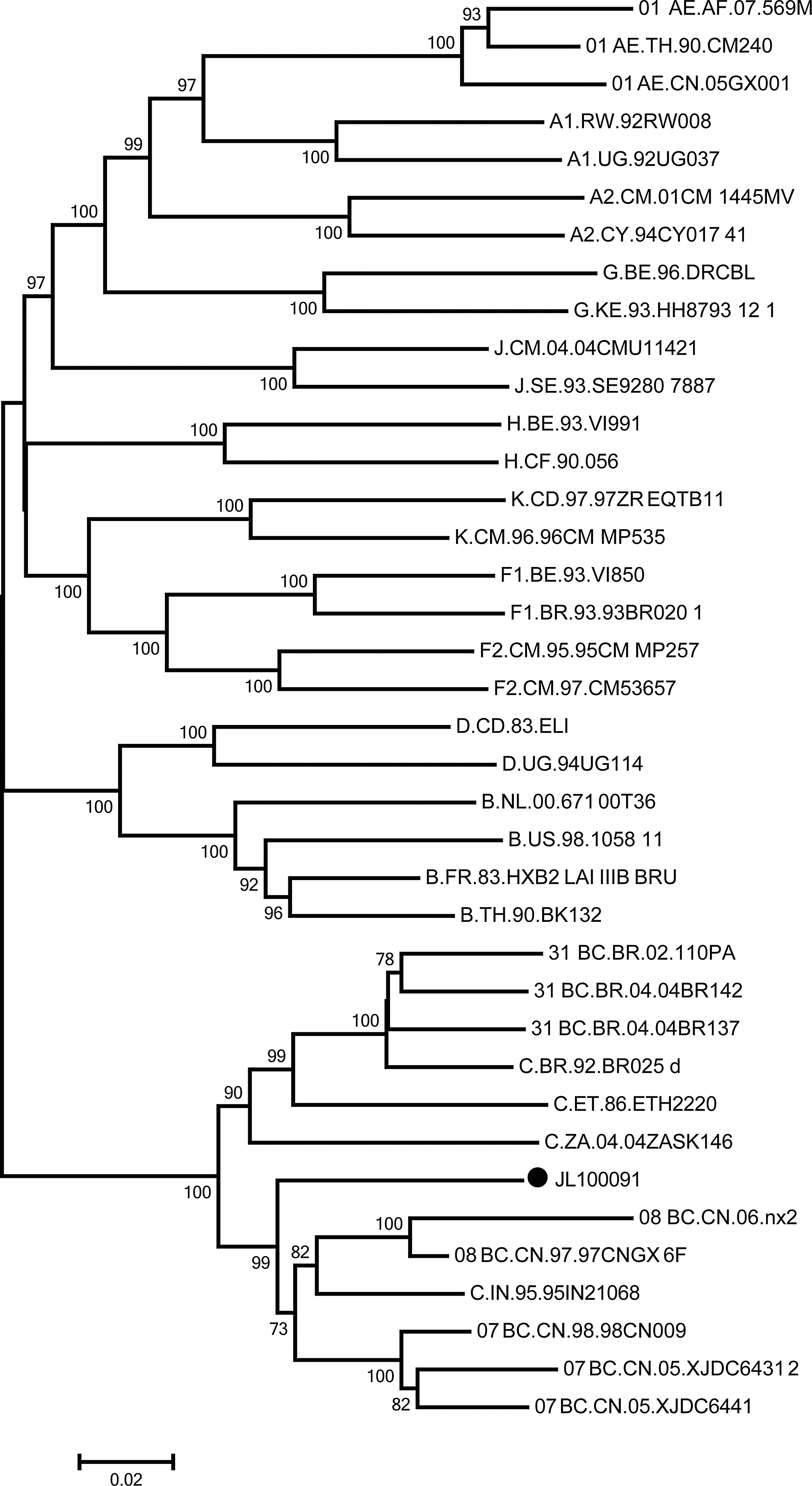
Phylogenetic analyses of the near full-length genome (NFLG) sequence of JL100091. All HIV-1 group M reference sequences were initially used to construct the neighbor-joining phylogenetic tree; some references were later removed for clarity. A solid circle (●) marks JL100091 throughout the article. The stability of the nodes was assessed by bootstrap analysis with 1,000 replications, and only bootstrap values above 70% are shown at the corresponding nodes. The scale bar represents 2% genetic distance.
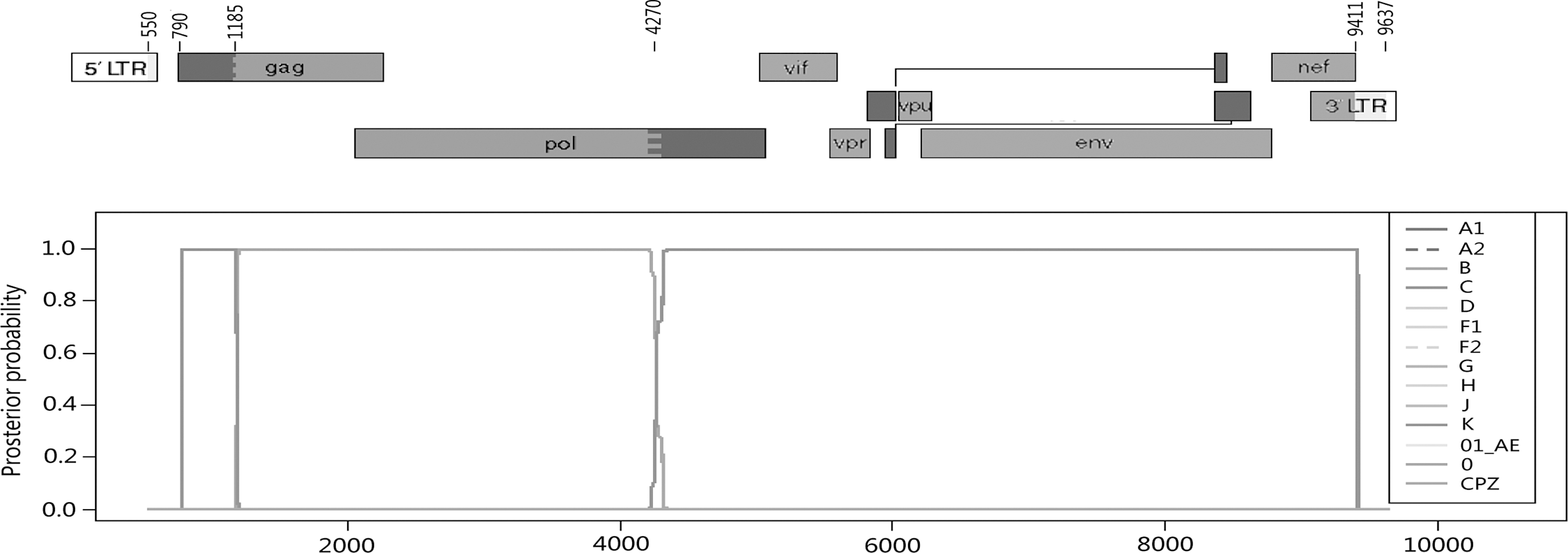
Recombinant identification analyses of JL100091. Genomic regions are indicated at the top of the plot with breakpoint and the start and end of the JL100091 NFLG sequence (HXB2 numbering). At the bottom, the posterior probability of the JL10091 is calculated by jpHMM.

In this study, it is important to note that we have described for the first time the NFLG sequence of a novel HIV-1 B′/C recombinant in Jilin, China. The new isolate, JL100091, consists of two breakpoints that combined one region of China subtype B′ origin into a backbone of subtype C lineage from India; region II was located right in the 5′ end of the p17 gene or 3′ start of the p24 gene and 5′ end of the p31 gene. Of interest, the routine HIV genotyping method by gag and env genes (the gag gene failed to amplify successfully) identified JL100091 as subtype C, but failed to define the genotype correctly, which may indicate that the HIV-1 epidemic in China is more complex than what we detected in the population and new challenges will occur in determining the HIV-1 genotype in molecular epidemiologic research.
The novel B′/C recombinant identified in this study had a different genomic structure from all recombinant forms in previous studies. This obviously increases the complexity of the HIV epidemic and may complicate the design of an HIV vaccine. Because there is a lack of data on the HIV-1 NFLG sequences in Jilin, it is necessary to increase the number of NFLG sequences to better elucidate the diversity of the HIV-1 genotypes. This will provide critical information for designing effective control and prevention measures against HIV transmission in the region.
Sequence Data
The NFLG sequence of JL100091 has been submitted to GenBank under accession number KF011493.
Footnotes
Acknowledgments
This study was supported by the National Science and Technology Major Projects for Infectious Diseases Control and Prevention (2008ZX10001-004, 2012ZX10001-002, and 2012ZX10001-08), the National Natural Science Foundation of China (81020108030 and 81261120379), an International Cooperative Grant (2009DFB30420), and an SKLID Development Grant (2012SKLID103).
Author Disclosure Statement
No competing financial interests exist.