




Abstract
We investigated the pol genotype in two phylogenetically and epidemiologically linked partners, who were both experiencing persistent low-level viremia during antiretroviral therapy. In one partner we identified a new residue insertion between codon 248 and 249 of the HIV-1 RNA reverse transcriptase (RT) coding region (HXB2 numbering). We then investigated the potential impact of identified mutations in RT and antiretroviral binding affinity using a novel computational approach.
H
Here, we describe the case of two phylogenetically and epidemiologically linked male partners (subjects A and B), who have sex with men (MSM) as a risk factor, and were infected with HIV-1 subtype B. These individuals were simultaneously experiencing persistent smoldering viremia (range 50 to 150 HIV RNA copies/ml, Roche Cobas) despite 36 months of ART (Fig. 1). For both individuals, pretreatment genotypic evaluation demonstrated a K103S mutation, which has been associated with nonnucleoside RT inhibitor (NNRTI) resistance, 5 and no mutations associated with major PI resistance. There was also no evidence of any RT insertions before initiation of ART.
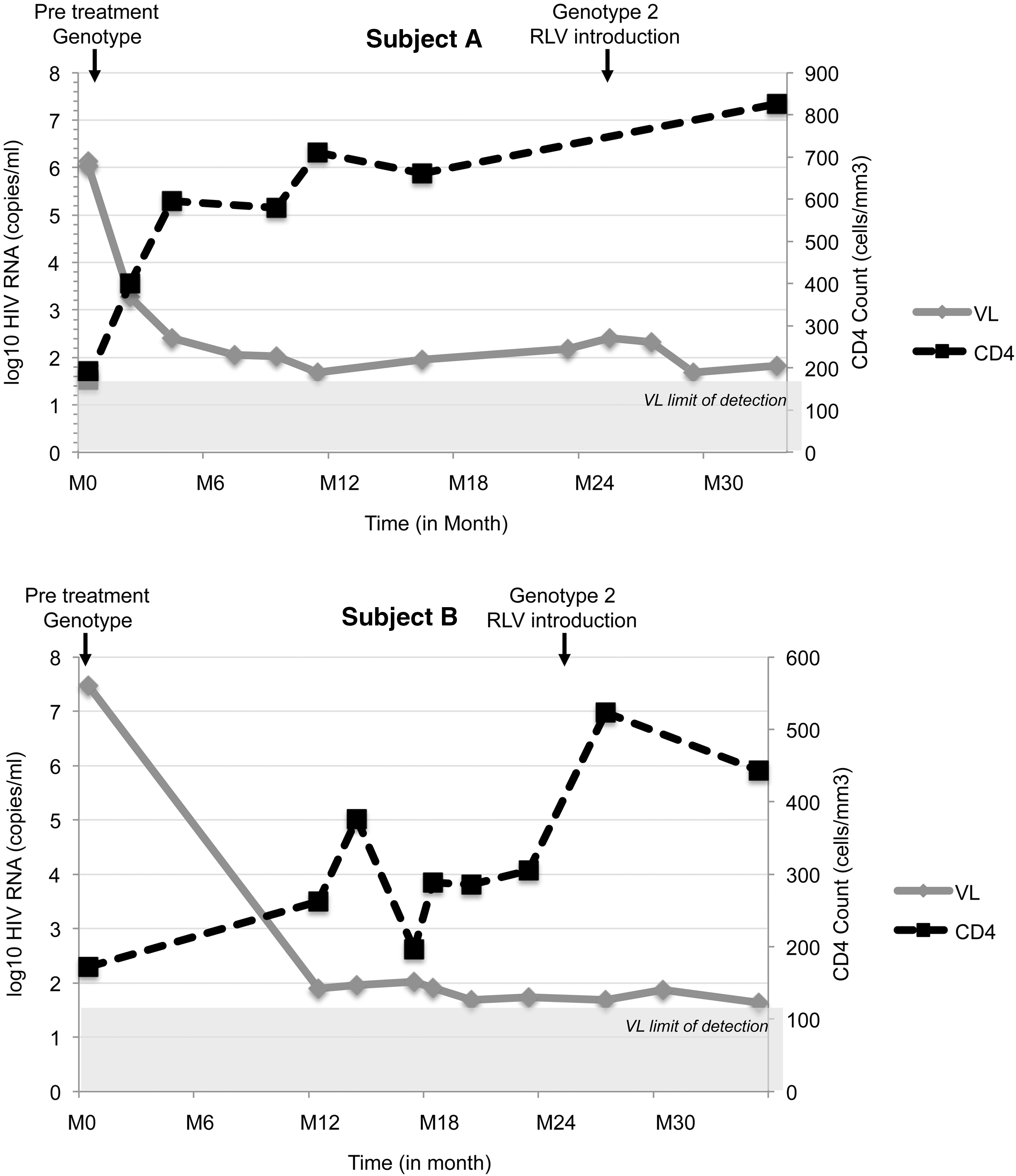
Description of subjects. CD4 cell counts and viral load (VL) are depicted with black and gray lines. Both subjects had the same treatment regimen initiated after pretreatment genotype, including AZT, FTC-TDF, and ATV rapidly switched to DRV. RAL was introduced after the second genotype. AZT, zidovudine; FTC, emtricitabine; TDF, tenofovir; ATV, atazanavir; DRV, darunavir; RAL, raltegravir. The VL limit of detection was 50 copies/ml (ROCHE Molecular Diagnostics COBAS AmpliPrep/COBAS TaqMan HIV-1 Test).
Both subjects were started on the same regimen consisting of two NRTIs (emtricitabine and tenofovir) and one ritonavir-boosted PR inhibitor (PI) (darunavir and ritonavir) (Fig. 1). Because of persistent replication in both partners, a second genotype testing was performed 24 months after ART initiation, which was similar to their pretreatment genotype. Specifically, the K103S mutation was still present and no mutation was associated with major PI resistance. However, in Subject A, a new single lysine insertion between codon 248 and 249 of the RT coding region (GenBank accession number JF1642525) (Fig. 2) was observed, but not for subject B. A phenotypic assay was not performed secondary to the viral loads being well below the required level of the commercial assay (Phenosense, Monogram Biosciences) in both individuals.

Partial reverse transcriptase sequences from both individuals A and B. Reverse transcriptase (RT) sequences obtained from the second genotype testing for subjects A and B were aligned to the HXB2 RT sequence. Amino acid positions are indicated (HXB2 numbering).
Sequence analysis of the second genotypes confirmed phylogenetic linkage between both individuals at both time points (pairwise distance=0.0065, bootstrap value 100%) (Supplementary Fig. S1; Supplementary Data are available online at
It was unclear if the amino acid insert in RT contributed to the persistent low level replication since only Subject A harbored this viral variant at a detectable level. To further investigate correlates between ongoing viral replication during ART and sequence features within these individuals and because phenotypic data were not available, we developed an original computational approach to evaluate potential impacts between sequence change and drug binding affinity (BA) of HIV-1 RT to available structures of NNRTIs [efavirenz (EFZ), nevirapine (NVP), etravirine (ETR), and rilpivirine (RPV)] and NRTIs [zidovudine (ZDV), tenofovir (TDF), and emtricitabine (FTC)] (Table 1).
Include in both subject's antiretroviral (ARV) regimen.
Values refer to the percentage of decrease of binding affinity (BA) in comparison to wild-type reverse transcriptase (RT) (based upon available HXB2 RT pdb structure 2HMI).
NRTI, nucleoside reverse transcriptase inhibitor; NNRTI, nonnucleoside reverse transcriptase inhibitor. Drugs tested and corresponding PDB structure (in parentheses) were EFV (efavirenz; 1FK9), NVP (nevirapine; 1S1U), ETR (etravirine; 1S6P), RLV (rilpivirine; 2ZD1), ZDV (zidovudine; 1RT3), TDF (tenofovir; 1TO5), and FTC (emtricitabine; 1TTD).
For this purpose, we modeled RT with or without K103S and the new RT K248 insert (specific to subject A) as well as RT-specific structures related to individuals A and B based upon sequences obtained from the second genotyping assays (Figs. 2 and 3). These analyses demonstrated close proximity of the K103S to the RT binding cleft, but not K248 insert (located in the polymerase region). Additionally, since amino acid substitutions or insertions can greatly impact the quaternary structure of RT and its interactions with drugs, 3,7 we investigated the effect of the K248 insert and K103S on the BA of RT to selected drugs. Briefly, we applied a structure-based molecular docking approach used for drug design. 8,9 To improve docking accuracy and overcome the problem of receptor flexibility, 10 we used an adapted version of AutoDock Vina docking software including the flexibility option. 11
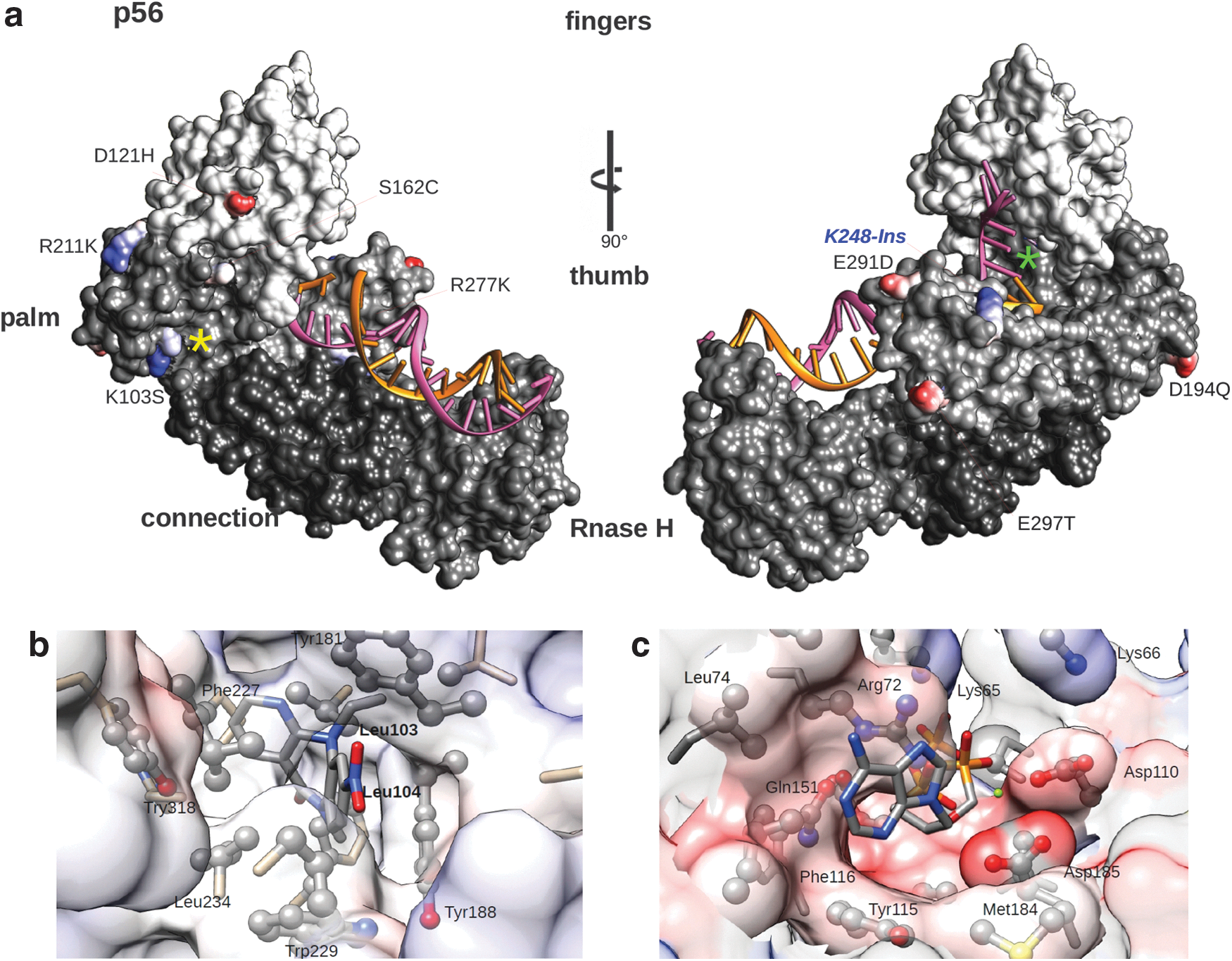
Molecular surface representation of HIV-1 reverse transcriptase (RT) p66 subunit bound to a dideoxy-terminated DNA. The major domains of RT are labeled in bold font and shaded in different tones of gray. The catalytically inactive p51 subunit is not shown for clarity.
Using this BA approach, we showed that a single K103S mutation on an HXB2 background was associated with a decrease of BA of HIV-1 RT to all NNRTIs [mean loss of BA of 11.2% (5.8 to 20.8)], consistent with previous reports of a decrease in HIV susceptibility to EFV and NVP with this mutation. 1 Interestingly, the K103S mutation was also associated with a decrease of BA of HIV-1 and all NRTIs [mean loss of BA of 14.8% (8.9 to 21.7)] (Table 1). Similarly, the single K248 insert was also associated with a decrease of BA between HIV-1 RT and all NNRTI and NRTI drugs evaluated [mean loss of BA of 11.1% (5.8 to 22.0) and 15.5% (8.2 to 28.3), respectively] (Table 1). We further analyzed the evolution of the BA of HIV-1 RT to both NNRTI and NRTI drugs using the complete sequences isolated from subjects A and B. Once again, we observed a decrease of HIV-1 RT BA to NNRTIs and NRTIs for subject A harboring both the K103S and K248 insert [mean loss of BA=13.5% (7.5–25.8)] and for subject B whose RT sequence includes K103S mutation [mean loss of BA=14.2% (6.9–24.2)]. The presence of both the K103S and the K248 insert did not have a cumulative effect on drug BA, illustrating the complexity of drug interactions in the context of a dynamic quaternary HIV-1 structure.
Altogether, these results suggest a potential effect of both the K103S mutation and the K248 insert on the BA of RT to NNRTIs and NRTIs. Relevant for this specific case, the K103S mutation and the K248 insert impacted BA to FTC with a mean loss of 25.0% (21.7–28.3) of the BA, possibly explaining the lack of viral suppression for these two subjects. While high-level virological failure of ART (>500 copies/ml) has been frequently associated with the development of drug resistance mutations, few data are available for low-level viremia during ART (viral loads between 50 and 500 c/ml). The emergence of the K248 insert observed in subject A while on ART confirms that drug resistance mutations can be selected in patients with low levels of viremia. 12
Unfortunately, the lack of remaining samples did not allow us to perform additional phenotypic experiments to further evaluate these observations. Taken together, we believe that those structural findings based upon sequence features could provide new insights regarding interactions between viral targets and ART. Furthermore, this study provides an additional method to investigate the mechanisms of drug susceptibility in conjunction with phenotypic assays or when such assays are unavailable. However, such conclusions about drug susceptibility mechanisms remain hampered by our lack of a complete understanding of the complexity of intermolecular interactions. 13
In summary, we report a novel single codon lysine insert at K248 in RT of HIV-1 clade B that emerged during smoldering viral replication in the setting of ART. We investigated how this insert and the also present K103S mutation could impact the BA between HIV-1 RT and a variety of antiretroviral medications. These evaluations provided some potential insights into the mechanisms of HIV drug resistance. Specifically, we observed how this newly reported K248 insert but also the K103S mutation could influence the BA between HIV-1 RT and all NNRTIs and NRTIs, and especially FTC. We believe that these results could suggest a relationship between loss of drug BA and drug efficacy and will help to further investigate the potential impact of others mutations. Characterizing such genotypes with a battery of methods, such as in vitro phenotypic assays, atomic-resolution X-ray structures, and more widely structure–function analysis, 14,15 which also includes computational models such as the one used here, may help in the development of newer antiretroviral medications that can treat new pathways of drug resistance.
Footnotes
Acknowledgments
This work was supported by the Department of Veterans Affairs and grants from the National Institutes of Health AI100665, AI080353, DA034978, AI36214, AI7462, AI69432, and AI47745 and the James B. Pendleton Charitable Trust. GenBank accession number JF1642525.
Author Disclosure Statement
The authors declare the following potential conflicts of interest: Horologic, Viiv, Biota, Chimerix, Merck, BMS, Gilead, Gen-Probe, Monogram, Sirenas, Prism, and Testing Talent Services.
References
Supplementary Material
Please find the following supplemental material available below.
For Open Access articles published under a Creative Commons License, all supplemental material carries the same license as the article it is associated with.
For non-Open Access articles published, all supplemental material carries a non-exclusive license, and permission requests for re-use of supplemental material or any part of supplemental material shall be sent directly to the copyright owner as specified in the copyright notice associated with the article.
