




Abstract
We identified a novel HIV-1 circulating recombinant form (designated CRF57_BC) from a total of four patients with no obvious epidemiologic linkage in western Yunnan (Dehong prefecture) in China. Two strains (09CN.YNFL37 and 10CN.DHFL17) were identified in this study. An additional two strains (341 and 1439) were found among strains reported in a previous study. CRF57_BC was composed of subtype B and subtype C, with one subtype B segment inserted into the gag region of the subtype C backbone. Subregion tree analysis showed that the B regions originated from a Thai B lineage and the C regions were from an India C lineage. The emergence of CRF57_BC may reflect the continual generation of various forms of intersubtype recombinants in western Yunnan.
HIV-1
Blood plasma from three HIV-positive patients (YNFL37, DHFL17) in Dehong prefecture, Yunnan was collected (Table 1). The patients were diagnosed as HIV-1 positive in 2009 and recruited as part of a national HIV-1 drug resistance survey in Yunnan. The study was approved by the institutional review boards of the National Center for AIDS/STD Control and Prevention of China. Near full-length genome (NFLG) amplification and sequencing were performed as previously reported.
4
Recombination breakpoints were determined using RIP and jpHMM (
NA, not available.
An extensive database search revealed that two recombinant strains, 341 and 1439, show high-level of homology with the two strains in this study
3,7
(Table 1). The four strains formed a distinct monophyletic cluster, distantly related to all known HIV-1 subtypes/CRFs (Fig. 1). Recombination analysis shows that the sequences were composed of subtypes B and C, with one region (II) of subtype B inserted into the subtype C backbone (I, III) (Fig. 2). The breakpoint positions refer to HXB2 coordinates, and were located by HIV Sequence Locator (

Phylogenetic tree analysis of the near full-length genome (NFLG) sequences of the four isolates. All HIV-1 group M reference sequences were used to construct the neighbor-joining phylogenetic tree. Node stability was assessed by bootstrap analysis with 1,000 replications, and bootstrap values above 0.7 are shown at the corresponding nodes. All CRF57_BC isolates in this study are marked gray. The scale bar represents 2% genetic distance.
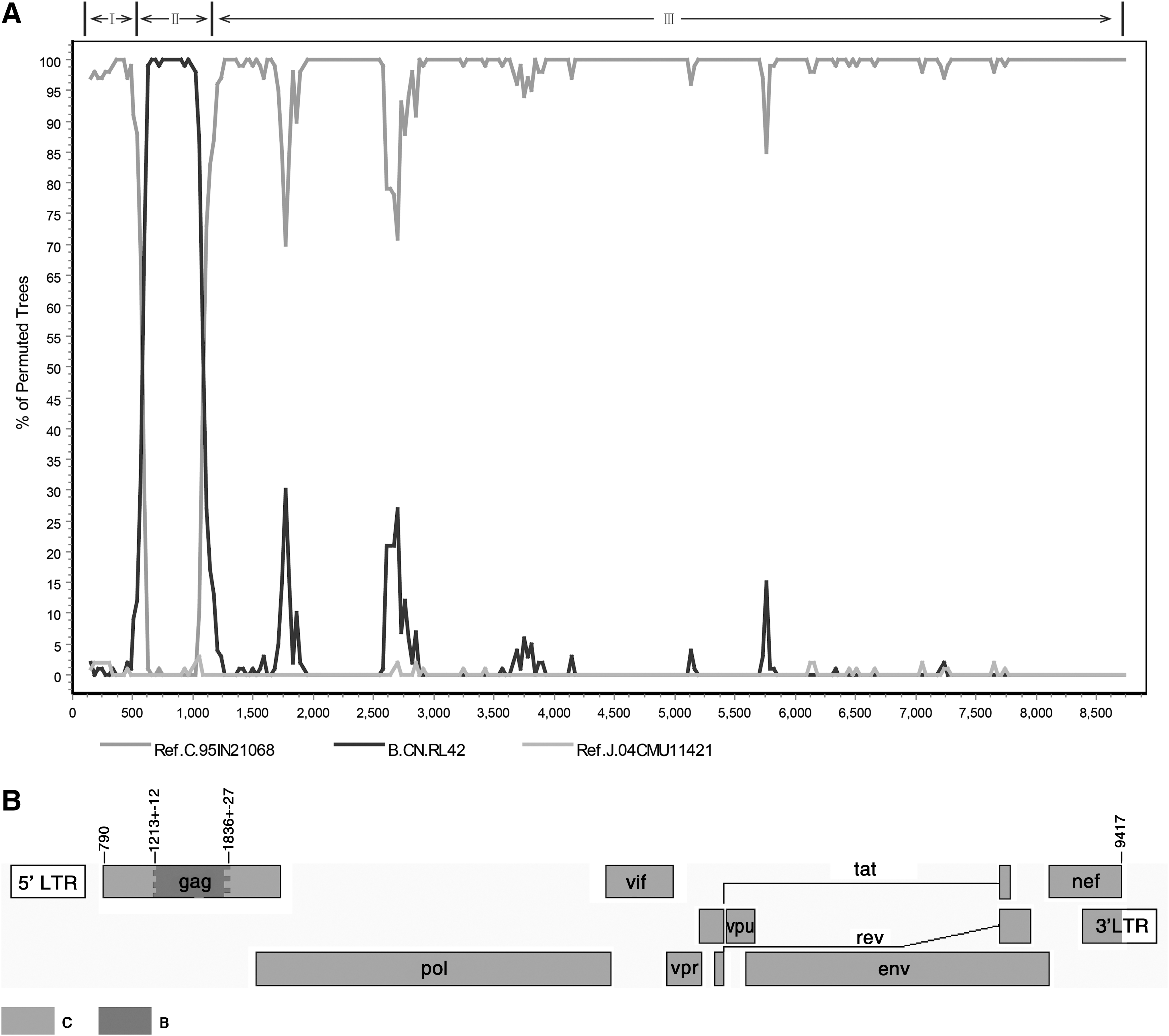
Recombination breakpoint analyses of CRF57_BC.

Phylogenetic analyses of three mosaic segments defined by bootscanning. The phylogenetic trees of the three mosaic segments were constructed with MEGA 5.0 using the neighbor-joining method. The subtype references of the M group are derived from the Los Alamos HIV Sequence Database. Node stability was assessed by bootstrap analysis with 1,000 replications, and only bootstrap values above 0.7 are shown at the corresponding nodes. The sequences of CRF57_BC are marked in bold black.
All of China's major prevalent HIV-1 strains are found in Dehong, Yunnan province, commonly considered the epicenter for HIV/AIDS in China. Previous studies have demonstrated that both CRF07_BC and CRF08_BC originated from Dehong prefecture 2,8 and were spread widely to other parts of the nation through drug trafficking routes. The coexistence of multiple strains along with a sustained active epidemic increases the probability of recombination. However, in contrast to the nationwide transmission of CRF07_BC and CRF08_BC, 1 the newly formed URFs and CRFs were found circulating on only a small scale in Dehong. This may be due to the relatively limited mobility of the local population, compounded by currently strict controls on drug trafficking that further impede high-risk contact and transmission through other means (e.g., heterosexual transmission).
In this study, we characterized a novel HIV-1 circulating recombinant form CRF57_BC, consisting of different recombinant breakpoints between the subtype B and subtype C strains, from three donors without obvious epidemiologic linkage in Dehong prefecture, Yunnan province, China. The emergence of the new CRF may further complicate the development of effective vaccines to limit the HIV-1 epidemic in China. In addition, whether recombination may confer selective advantages over parental viruses remains to be investigated.
Sequence Data
The nucleotide sequences of the two isolates 09CN.YNFL37 and 10CN.DHFL17 have been submitted to GenBank with accession numbers KC870044 and KF250400, respectively.
Footnotes
Acknowledgments
This work was supported by the National Major Projects for Infectious Diseases Control and Prevention Grants (2012ZX10001-008 and 2012ZX10001-002), the National Natural Science Foundation of China Grants (81020108030 and 81261120393), the State Key Laboratory for Infectious Disease Development Grant (2012SKLID103), and the International Development Research Center of Canada Grant (104519-010). We would like to thank Brian Foley from the Los Alamos National Laboratory for advice on CRF nomenclature.
Author Disclosure Statement
No competing financial interests exist.