




Abstract
Human immunodeficiency virus type 1 (HIV-1) subtype CRF01_AE is transmitted mainly by sexual activity in Guangxi, southwestern China. Other subtypes, including CRF07_BC, CRF08_BC, and subtype B, are also prevalent in this region. Cocirculation of multiple subtypes, as well as a high rate of drug use, creates favorable conditions for the emergence of recombinant viruses in Guangxi. In the present study, we identified a new HIV-1 unique recombinant form (CRF01_AE /08BC) transmitted from the infected index patient to his seronegative sexual partner. This is the first near full-length genome characterization of a CRF01_AE /08BC recombinant virus in Guangxi, and provides an important basis for future analysis on potential new recombinant transmission events.
G
Here, we identify a new unique recombinant form (URF) involving insertions of subtypes B and C fragments within the CRF01AE backbone. The sample is derived from a transmission event within an HIV-1 serodiscordant couple in Beihai city, near the southern border of Guangxi. HIV-1 nucleic acids were obtained from blood samples of both members of the couple, and the near full-length genome sequence was amplified in the index (initially infected) patient, while only the pol and env genes were amplified for the seroconverted patient. Pairwise genetic distance and epidemiologic records (data not shown) indicate that this transmission event is an intrafamily infection. The index patient's sample GXDY1299 was collected in November 2012 from a male patient living in the village near Beihai city, who was transmitted by sexual contact and later infected his spouse.
Amplification and sequencing procedures were performed as described previously.
4
Briefly, the near full length genome of GXDY1299 (9049 bp) was amplified from plasma RNA by reverse transcriptase polymerase chain reaction (RT-PCR). PCR products were sequenced by a total of 26 internal primers after purification. All of the sequences were cleaned and assembled using Sequencher v4.9 (Gene Codes, Ann Arbor, MI). A BLAST search was performed to exclude the possibility of cross-contamination.
4
The final 9,049 bp sequence was aligned with HIV-1 reference subtypes (A–D, F–H, J, K) and select CRFs (CRF01_AE, CRF08_BC) obtained from the Los Alamos HIV Database (
As shown in Fig. 1, the GXDY 1299 sequence is closely related to CRF01_AE reference sequences, but clustered outside of the monophyletic branch (Fig. 1).
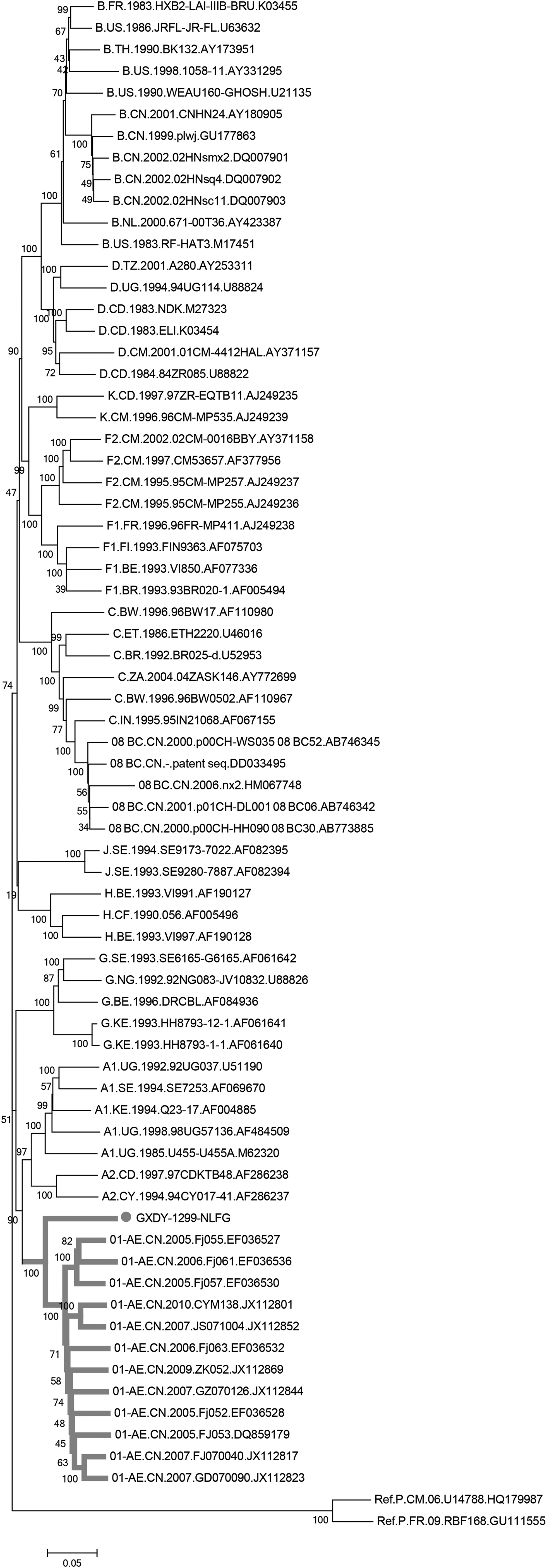
Phylogenetic analysis of the near full-length genome. A neighbor-joining tree was created with the GXDY1299 strain and standard reference strains representative of different HIV-1 group M subtypes (
The recombination analysis is performed by RIP (
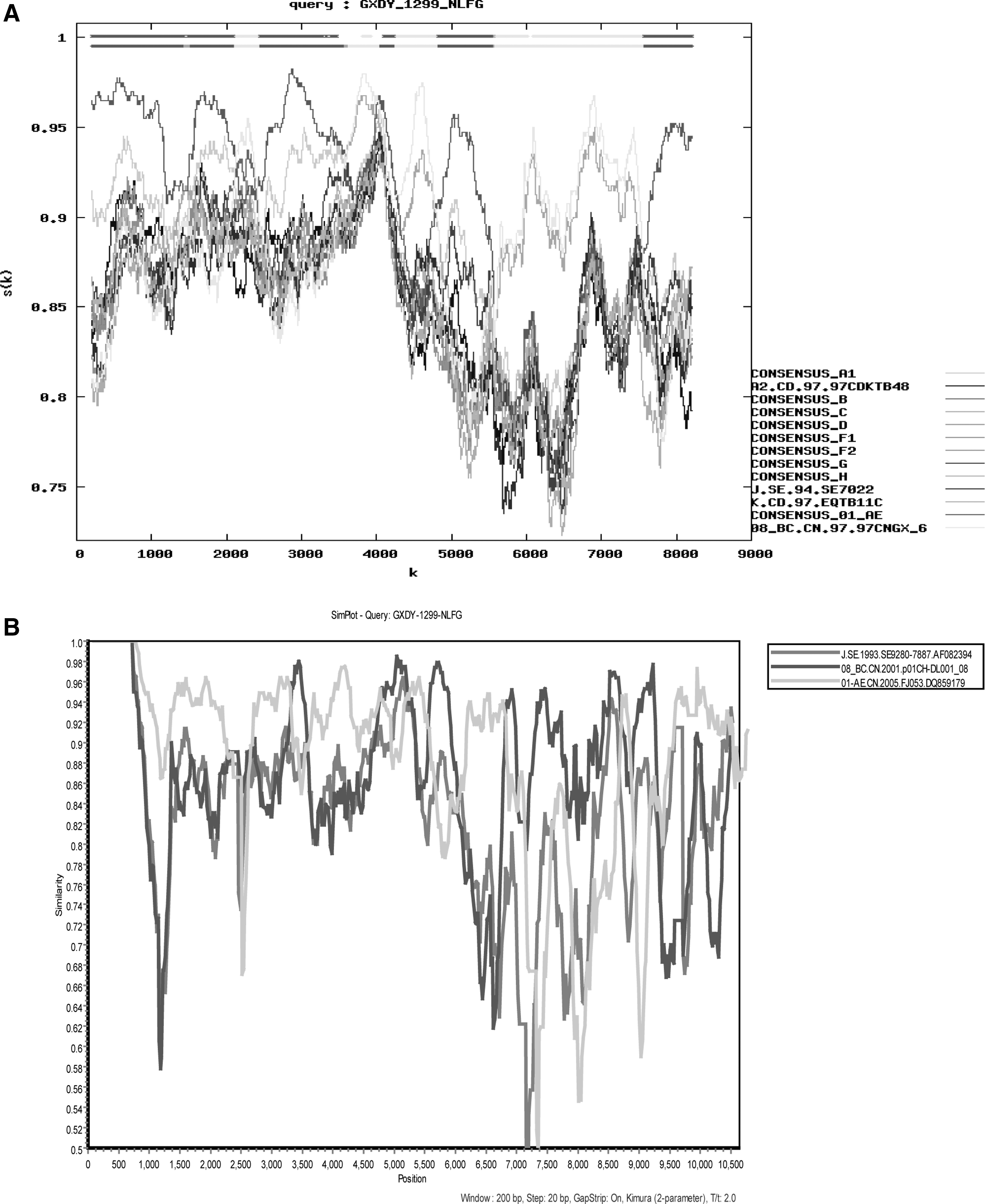
Recombinant Identification Program (RIP) and similarity plot analysis were performed for GXDY1299 to identify parental subtypes.
Bootscan analysis was subsequently performed to identify the recombination breakpoint. The query sequence GXDY1299 was bootscanned with reference sequences (CRF01_AE, CRF08_BC as parents, subtype J as outgroup). The parameters were a window size of 200, a step size of 20, and the neighbor-joining method using the Kimura two-parameter model with replicates of 100. Phylogenetic trees were constructed with MEGA 5.0 using the neighbor-joining method with 1,000 bootstrap replications to further trace the close subtype of the mosaic fragments. 7
From the bootscan result, GXDY1299 is composed of at least 11 interlaced mosaic segments, including CRF01_AE (I, III, V, VII, IX and XI) and CRF08_BC (II, IV, VI, VIII, and X) (Fig. 3A). Corresponding CRF01_AE, CRF08_BC segments were analyzed by phylogenetic trees for their evolutionary relationships to the respective subtype references (Supplementary Fig. S1; Supplementary Data are available online at
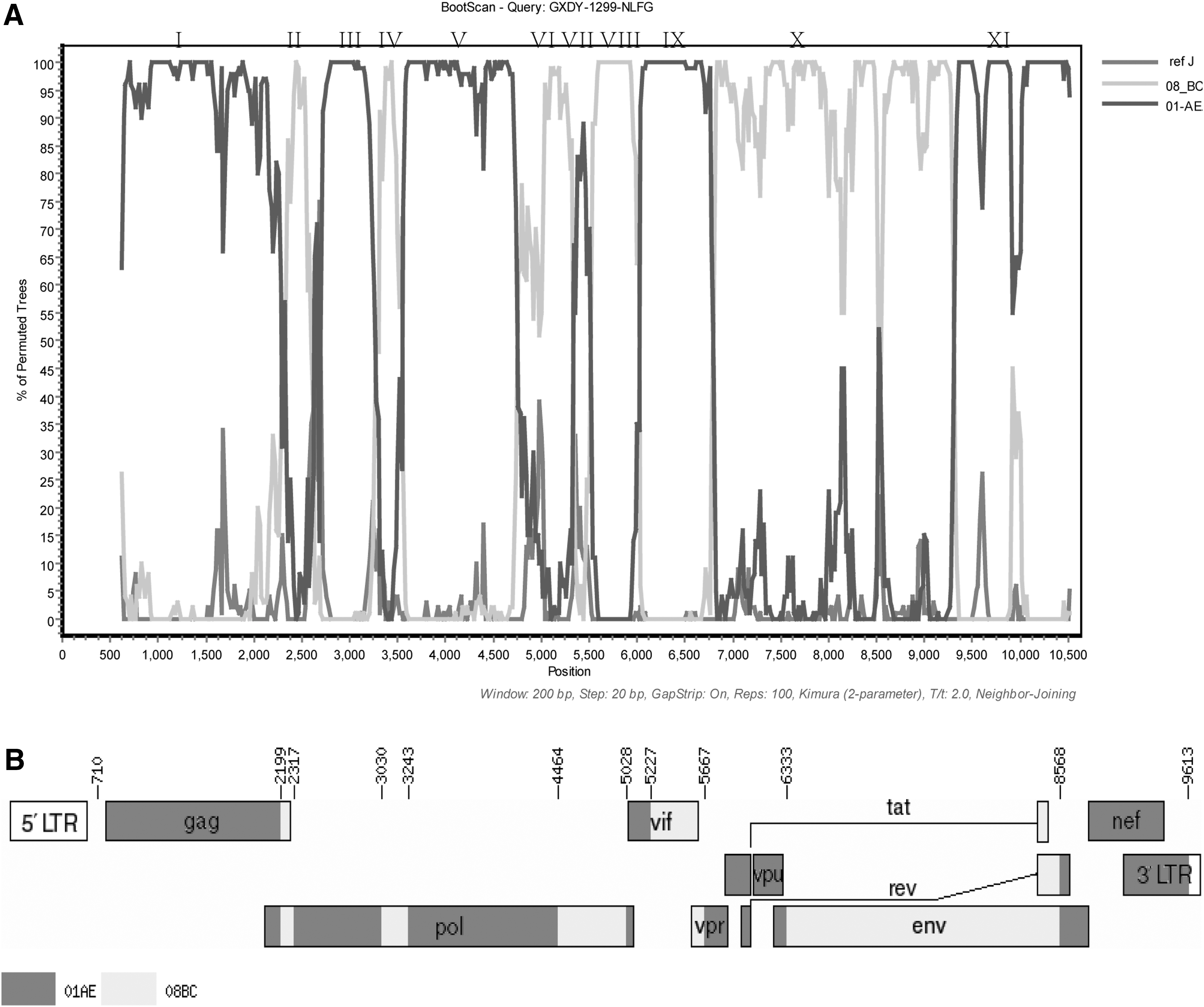
Bootscan plots and schematic representation of the near full-length genome's mosaic structure.
The breakpoints positions of the near full-length genome refer to HXB2 coordinates, and were located by the HIV Sequence Locator (
The recombinant GXDY1299 was discovered by analyzing a transmission event between a heterosexual couple in a stable marital relationship. From survey data, the index patient was infected via extramarital heterosexual contact with more than three people. The index patient and his spouse have no history of injection drug use, blood transfusion, or other HIV infection risk factors. It is most likely that this was a heterosexual transmission event. Interestingly, a recent molecular epidemiologic survey of Guangxi province identified four HIV-1 URFs using the 5′ half genome, one of which (identification number 2261) has the same breakpoints in the gag and pol segments as the sequence we report here. 1 It is highly possible that these sequences are from the same ancestor. Since the URF identified in that survey is not sampled from Beihai city, it is also likely that the novel recombination has become a CRF.
In sum, we have identified a new recombination form in Guangxi province that most likely incorporated elements from two major heterosexually transmitted subtypes, CRF01_AE and CRF08_BC. Although further confirmation is needed for the epidemiologic source of the GXDY1299 recombinant, it is highly likely to have originated through a commercial sexual transmission chain. More research on the recombinant form and transmission network may help provide relevant information for route- and network-specific interventions and subtype-sensitive vaccine designs.
Sequence Data
The nucleotide sequence of GXDY1299 has been submitted to GenBank with the accession number KF541292.
Footnotes
Acknowledgments
This research was supported by National Major Projects for Infectious Diseases Control and Prevention (grant 2012ZX10001008, 2012ZX10001002), the National Natural Science Foundation of China (grant 81020108030), and Chinese State Key Laboratory for Infectious Disease Development (grant 2012SKLID103).
Author Disclosure Statement
No competing financial interests exist.
References
Supplementary Material
Please find the following supplemental material available below.
For Open Access articles published under a Creative Commons License, all supplemental material carries the same license as the article it is associated with.
For non-Open Access articles published, all supplemental material carries a non-exclusive license, and permission requests for re-use of supplemental material or any part of supplemental material shall be sent directly to the copyright owner as specified in the copyright notice associated with the article.
