




Abstract
A novel HIV-1 circulating recombinant form (CRF) designated CRF65_cpx was recently characterized from three epidemiologically unlinked individuals infected through heterosexual contact in western Yunnan province of China. This is the first complex mosaic HIV-1 CRF, consisting of contributions from three or more different subtypes, identified in China. An additional full-length genome sequence with identical recombinant breakpoints was found among a previously reported recombinant strain from a man who had sex with a man in Anhui province of East Central China. The breakpoint analysis of the recombinants showed a complex genome organization composed of parental subtypes B′ (Thailand variant of subtype B), C, and CRF01_AE, with 13 recombination breakpoints observed in almost all structure genes of HIV-1. The generation of complex recombinant forms is likely due to cocirculation of multiple lineages of HIV-1 strains in high-risk populations in western Yunnan.
T
As the epicenter of HIV-1 transmission in China, the southwestern province of Yunnan is considered to be one such recombination hotspot. Over the past 20 years, many HIV-1 strains with different genotypes (B, C, CRF07_BC, CRF08_BC, CRF01_AE, and diverse patterns of URFs) were found in Yunnan. In 1989, HIV-1 subtype B′ (the Thai variant of subtype B) was first found among injection drug users (IDUs) in the southwestern region of Yunnan province. 5,6 In the mid-1990s, subtype C strains presumably introduced from India were also identified in IDUs from this region. 7,8 Cocirculation of subtypes B' and C in the same places and risk populations enables the generation of recombinants. Many B′C recombinants were identified in the following years. 9 –14 Two closely related and well-known CRFs (CRF07_BC and CRF08_BC) circulating in China are believed to have come from these recombinants. 15,16 In recent years, infections by CRF01_AE have been increasing, and mosaic strains containing CRF01_AE fragments have also frequently arisen in this area, 11,12,17 which complicates the HIV-1 epidemic in Yunnan. In this study, we detected a novel HIV-1 circulating recombinant form, designated CRF65_cpx, by near full-length genome (NFLG) analysis, from four individuals with obvious epidemiological linkages.
Three NFLG sequences (YNFL01, YNFL02, and YNFL05) were amplified and sequenced with the methods reported previously.
18
The patients were diagnosed as HIV-1 positive between 2009 and 2010 and recruited from a national HIV-1 drug resistance survey in Yunnan. The study was approved by the institutional review boards of the National Center for AIDS/STD Control and Prevention. Extensive searching of the Los Alamos HIV database (
NA, not available; MSM, men who have sex with men.
Recombination breakpoints were determined using RIP and jpHMM (
As shown in Fig. 1, the four strains formed a distinct and well-supported (bootstrap value=100%) monophyletic cluster, distantly related to all known HIV-1 subtype/CRFs. Recombination analysis shows that the sequences were composed of subtypes B, C, and CRF01_AE (Fig. 2). The breakpoints were defined by HIV Sequence Locator (
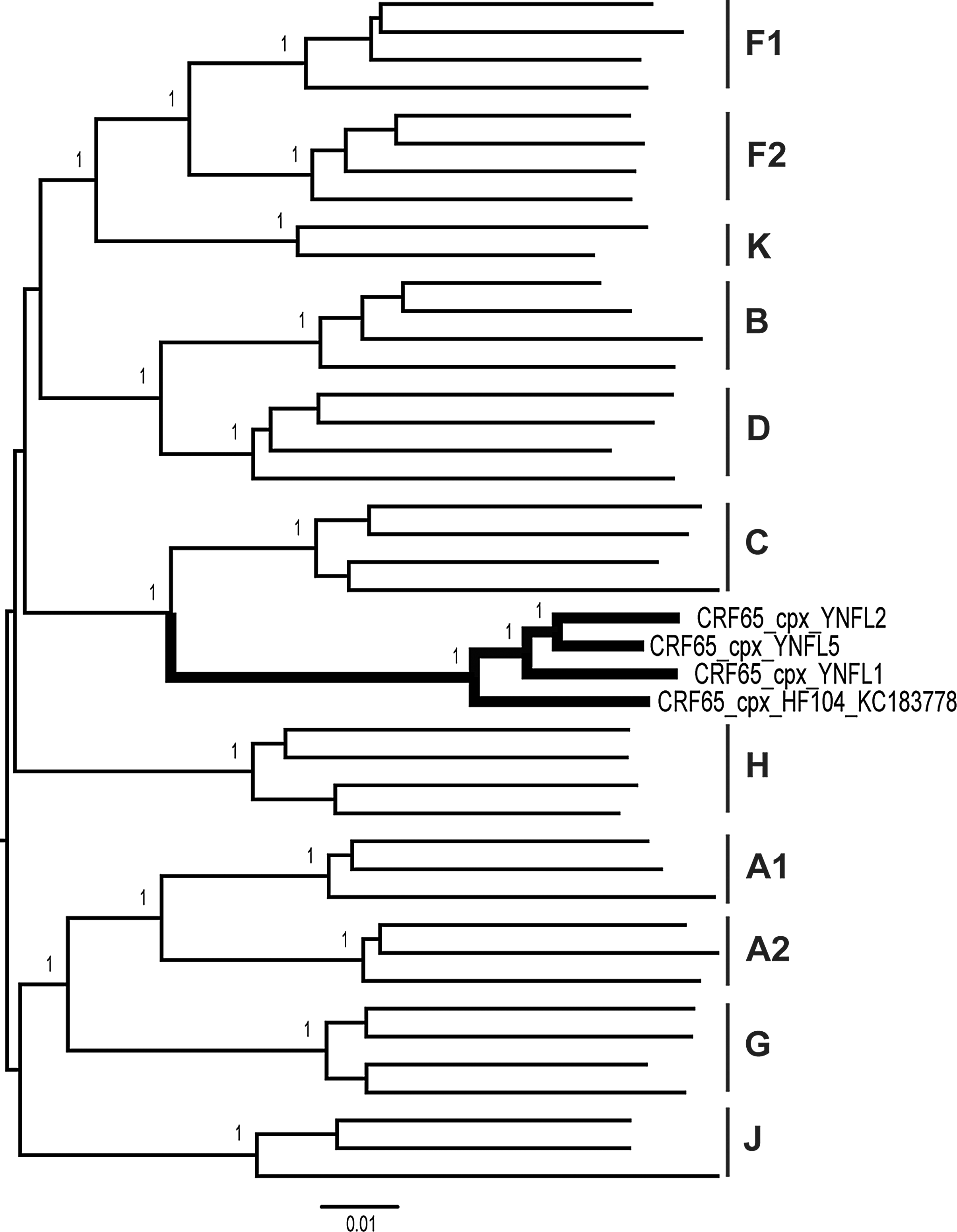
Phylogenetic tree analysis of the near full-length genome (NFLG) sequences of CRF65_cpx. All HIV-1 group M reference sequences were used to construct the neighbor-joining phylogenetic tree with the Kimura two-parameter model and 1,000 bootstrap replications test. The tree branches of CRF65_cpx are displayed as a bold line.
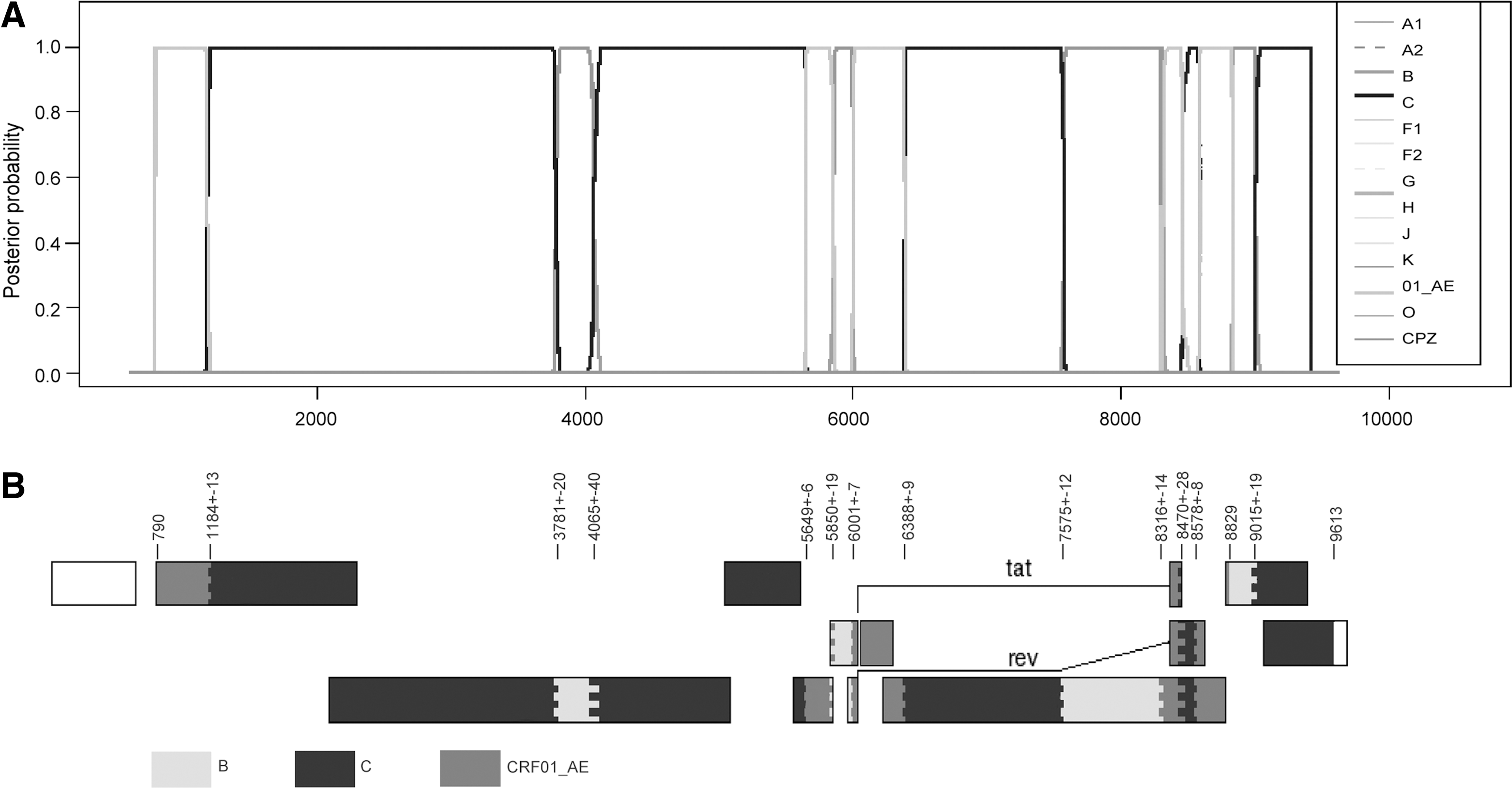
Recombinant analysis of the novel identified CRF65_cpx.
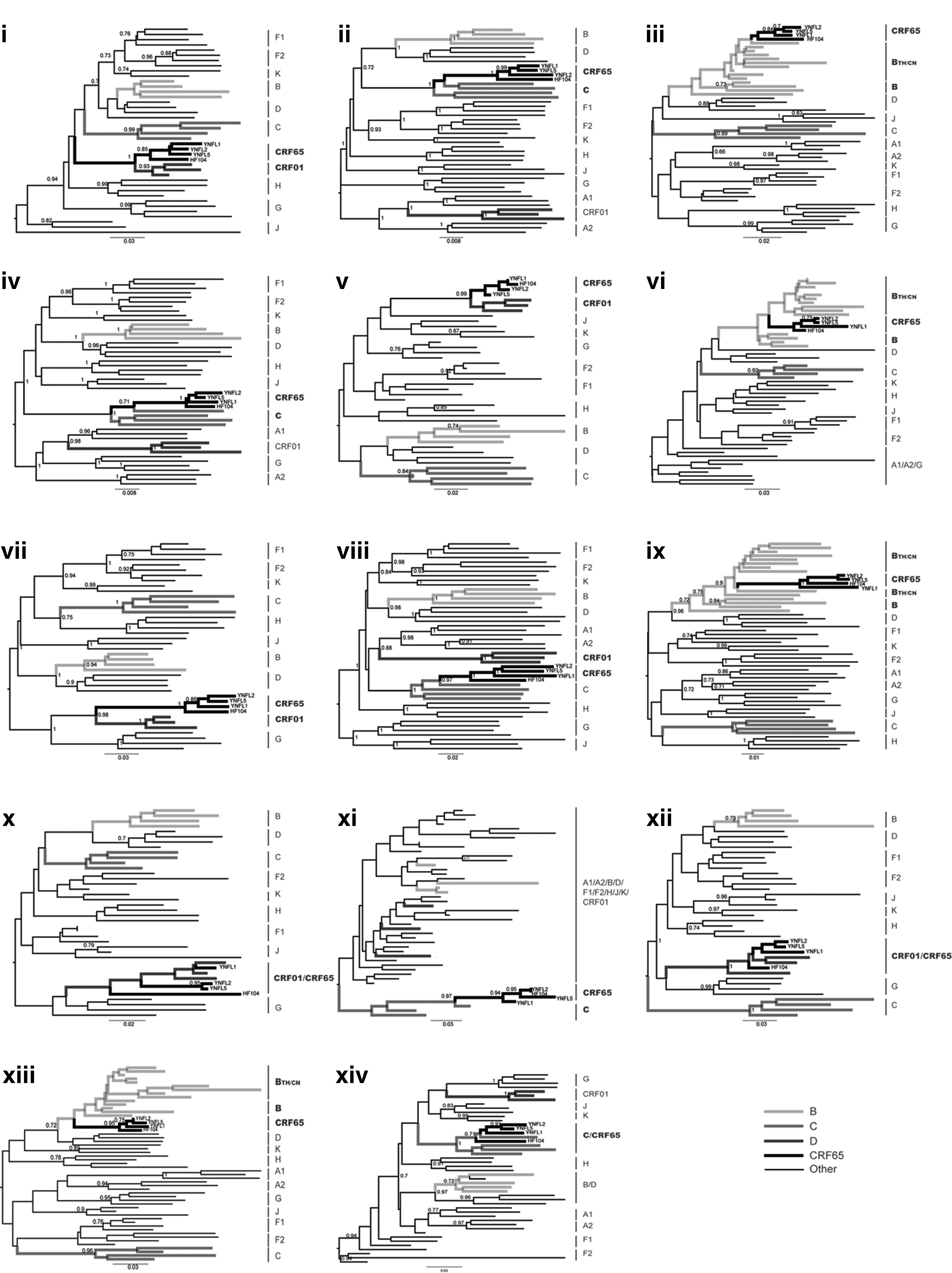
Subregion tree analysis of the novel identified CRF65_cpx. The phylogenetic trees of the 14 mosaic segments defined by bootscanning plot analysis were constructed with MEGA 5.0 using the neighbor-joining method. The stability of the nodes was assessed by bootstrap analysis with 1,000 replications, and bootstrap values of 0.7 and higher are shown. The subtypes of sequences are listed on the right side of the trees, and the sequences of subtype B, C, CRF01_AE and CRF65_cpx are bold marked, respectively. The scale bars are shown at the bottom of each tree.
Due to Yunnan's unique geographic position, history, and the social behavior patterns of local ethnicities, the region plays a very important role in the introduction and spread of HIV in China. 5,7,21 –24 From the earliest epidemic of subtype B in 1989, subtype C, CRF07_BC, and CRF08_BC appeared here one after another. 11,12 In more recent decades, CRF01_AE has seen widespread transmission nationally, 25 and recombinants containing CRF01_AE segments have been reported in different regions and populations. 9,19,26,27 In this study, we characterized a novel HIV-1 circulating recombinant form from three epidemiologically unlinked individuals infected through the heterosexual route in the western Yunnan province of China. Of note, we also identified another HIV-1 isolate from previous studies that shares the same breakpoint structure with new identified strains from a man who had sex with men in Anhui province approximately 2,000 km away. Further molecular epidemiological investigation is needed to identify the influence of CRF65_cpx on the HIV epidemic in China. The emergence of CRF65_cpx indicates the increasing complexity of HIV-1 genomes in China, which may complicate disease prevention and treatment efforts that depend on genotype-specific mechanisms such as vaccine development.
Sequence Data
The nucleotide sequence of the three isolates YNFL01, YNFL02, and YNFL05 has been submitted to GenBank with the accession numbers KC870027, KC870028, and KC870030, respectively.
Footnotes
Acknowledgments
This work was supported by the National Major Projects for Infectious Diseases Control and Prevention Grants (2012ZX10001-008 and 2012ZX10001-002), the National Natural Science Foundation of China Grants (81020108030 and 81261120393), the State Key Laboratory for Infectious Disease Development Grant (2012SKLID103), and the International Development Research Center of Canada Grant (104519-010). We would like to thank Brian Foley from the Los Alamos National Laboratory for advice on CRF nomenclature.
Author Disclosure Statement
No competing financial interests exist.