




Abstract
Injection drug use has been responsible for most HIV-1 transmission in Asia and has led to the generation and/or spreading of circulating recombinant CRF01_AE, CRF07_BC, and CRF08_BC, which are currently the predominant HIV-1 strains in China. Monitoring HIV-1 transmissions among injection drug users (IDUs) still provides critical information on HIV-1 prevalence and control. In the present study, we detected three HIV-1 sequences, BH048/057/066, from IDUs in Beihai city, Guangxi province, all of which share an extremely complex mosaic recombination pattern. CRF01_AE and CRF08_BC contributed to the rise of new recombinants, which contain CRF08_BC-derived env fragments with evidence of further evolution. Our data, combined with those of other studies, suggest that the BH048/057/066 recombinants represent early strains of a circulating recombinant form of HIV-1 in southern China. Information concerning such newly appearing variants is critical for both HIV-1 control and ongoing HIV-1 vaccine trials in Guangxi, China.
T
Previously, in Guangxi province, we successfully retrieved a total of 65 HIV-1 sequences from patients who were infected with HIV-1 through injection drug use. 6 Analysis of partial gag/pol and env fragments with the help of MEGA5 8 suggested that these strains belonged to existing subtypes such as CRF01_AE, CRF07_BC, and CRF08_BC, 6 with CRF08_BC and CRF01_AE being the predominant forms in southern China as seen in previous studies. 9 –11 However, three additional strains, termed BH048, BH057, and BH066, presented inconsistent subtyping results in the gag/pol and env regions (Fig. 1), suggesting the possible existence of HIV-1 recombination forms of CRF01_AE and CRF08_BC among these samples from IDUs in Beihai.
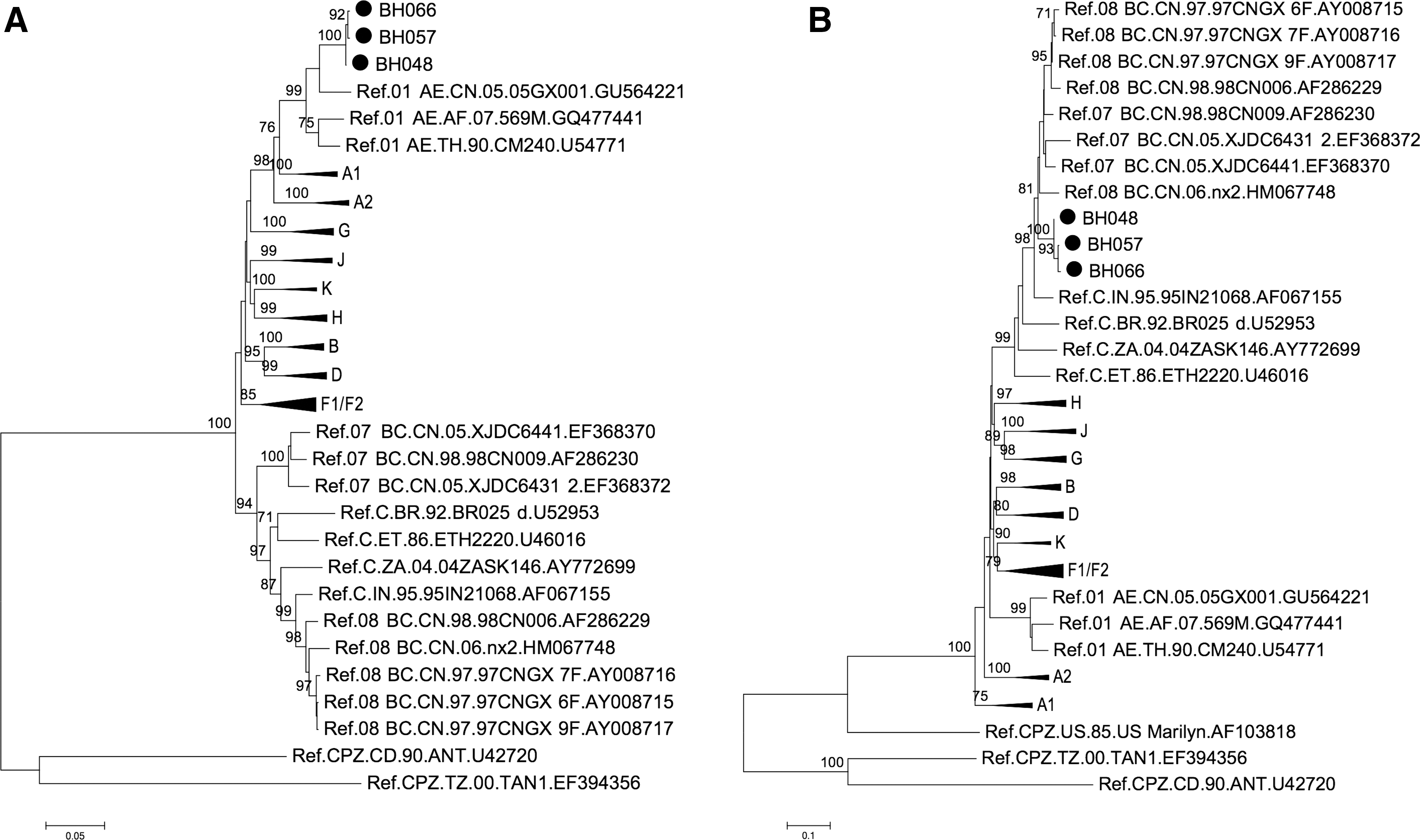
Phylogenetic analyses of HIV-1 sequences retrieved from Beihai city in China reveal possible recombination events.
To further confirm our recombination events, we performed single nested polymerase chain reaction (PCR) with the help of ExTaq DNA polymerase (TaKaRa, Japan) and successfully retrieved the 4-kb fragments between known gag/pol and env sequences of these HIV-1 strains. SimPlot (version 3.5.1) 12 was used to reveal the existence of recombination, and similarity tests (data not shown) were later done to confirm the recombination. The combined sequence of BH048 (covering HXB2 1850–7642) revealed a complex recombination pattern. Recombination between the parental subtypes (i.e., CRF01_AE and CRF08_BC) occurred several times along the sequence (Fig. 2A). Indeed, a mosaic pattern was observed in both gag and pol, which is different from bootscanning results of BH045 and BH046 that were sampled at the same time as BH048 but were previously determined to be CRF01_AE and CRF08_BC, respectively. 6 CRF08_BC contributed to vif and vpr, while CRF01_AE was the source of vpu and at least part of tat and rev (Fig. 2B). Interestingly, although it was genetically related to CRF08_BC, the env fragment 6392–7642 of BH048 still contained on average 167 nucleotide (or 54 amino acids among Env fragment 58–473) differences compared to the CRF08_BC strains circulating in China; the magnitude of the differences was similar to what appeared between subtypes C, CRF07_BC, and CRF08_BC (Table 1), suggesting that the BH048 env sequence might represent a significant variant of the CRF08_BC env fragment. Surprisingly, despite the evolved env fragments, bootscanning results for BH048/057/066 demonstrated an extremely similar recombination pattern among all three HIV-1 sequences (Fig. 2A).
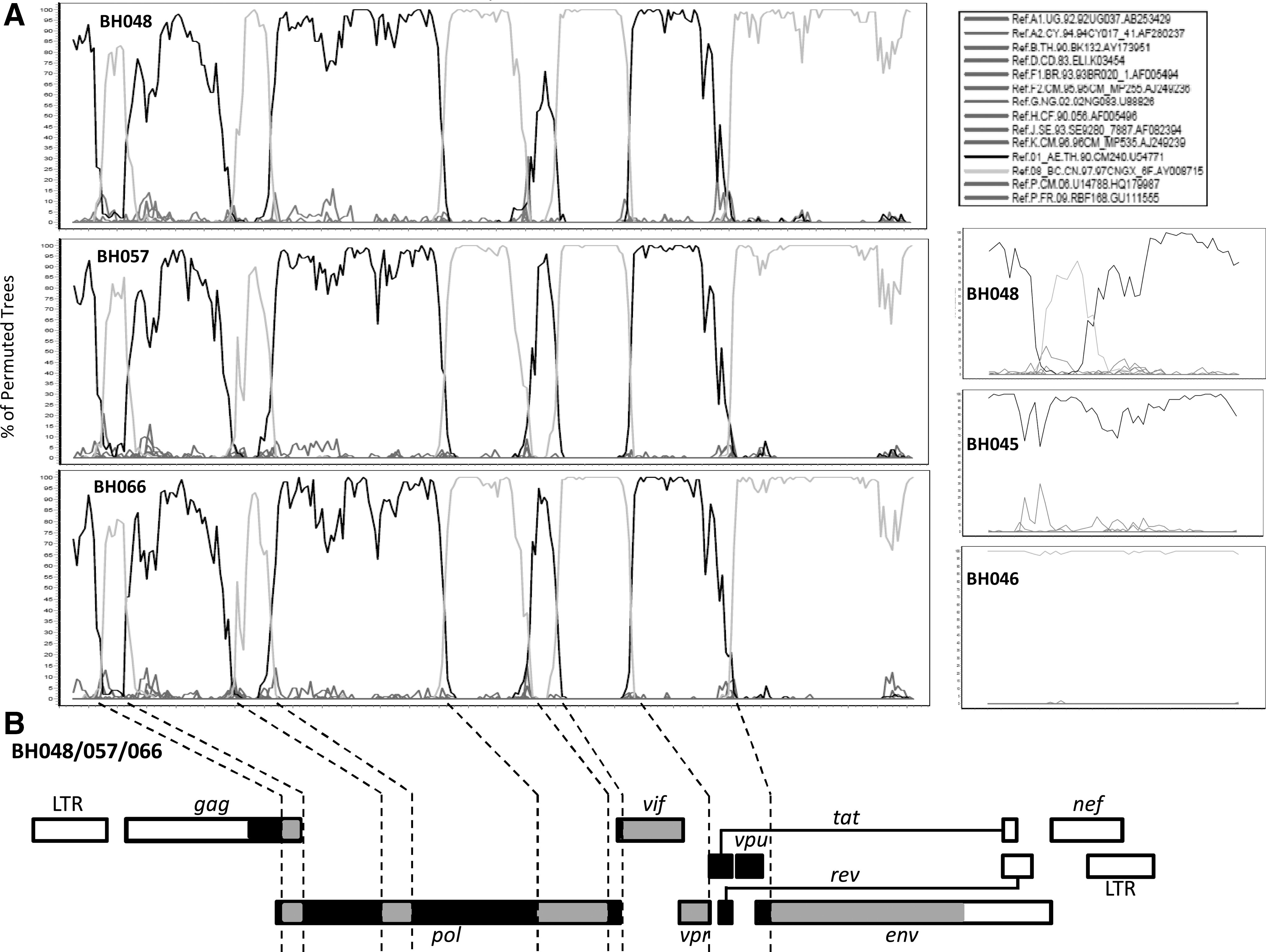
A novel recombination form of HIV-1 was detected in Beihai city.
Sequences corresponding to HXB2 6392–7642 in the RNA genome (or Env 58–473 in protein sequence). The analysis was performed with MEGA5. Data are shown as means±SD. Subtype C/CRF07_BC/CRF08_BC sequences circulating in China were retrieved from the HIV database at the Los Alamos National Laboratory (
Patients with BH048/057/066 (hereafter designated BH048) were all male and were in their 30s when the samples were obtained in 2008, but they shared no other common demographic characteristics, such as marriage status, occupation, or period of IDU. The only apparent connection among these people was their use of injection drugs. Therefore, we believed we might have discovered a new CRF of HIV-1 in Guangxi province, and we therefore checked the circulating status of BH048. Literature screening revealed that HIV-1 strain GXDY1299 13 and strain 2261 10 share an extremely similar recombination pattern with BH048, yet GXDY1299 and 2261 are transmitted through sexual contact, not injection drug use. Only 11 different nucleotides were detected between BH048 and 2261 in overlapping fragments 1850–5096. Thus, strains of BH048 are now circulating among IDUs and sexual contacts, two high-risk groups for HIV-1 transmission in China.
Recently, new HIV-1 recombination patterns have been reported in China 10,13 ; most of them, however, have been determined to be unique recombinant forms (URFs) that may not actually circulate. URFs are more easily detected among IDUs because of these individuals' high-risk activities, such as sharing needles. Here we report that we have also detected a novel recombinant form of HIV-1 among IDUs in the Guangxi province of China. CRF01_AE and CRF08_BC entered Guangxi province through different drug trafficking routes, 2 became locally dominant HIV-1 subtypes, 6 and have now merged again among IDUs to generate recombinant strains of BH048/057/066.
Alerts should be raised in response to the generation of this new recombinant form of BH048, which may be circulating. Evidence from the sequencing of partial or nearly full-length HIV-1 genomes indicates that the 2261 and GXDY1299 strains detected after 2009 share high-level similarity in terms of both nucleotide sequence and recombination pattern with BH048. Thus, our sequences represent an early form of this new HIV-1 CRF. More importantly, both GXDY1299 and 2261 were transmitted through heterosexual activity, indicating that BH048, which was generated among IDUs, has already started to be transmitted through sexual contact, currently a predominant pathway for HIV-1 transmission. Therefore, although the criteria for a novel CRF designation 14 have not been met, the extremely complex recombination pattern identically observed among all five sequences retrieved by three independent studies suggests that HIV-1BH048 has continued to spread during the past several years, has moved from one high-risk group to another, and is still responsible for novel infection events.
In addition, with the help of the HIV Drug Resistance Database at Stanford University (
Sequence Data
All HIV-1 sequences retrieved from this study have been submitted to GenBank, with accession numbers KF803577 to KF803579.
Footnotes
Acknowledgments
We thank the staff at the Centers for Disease Control and Prevention in Beihai city for sample collection, Drs. Haiyan Qi, Linzhang Li, and Fei Xu for technical assistance, and Deborah McClellan for editorial assistance.
Written consent was obtained from all participants involved in the study. This study was reviewed and approved by the institutional review board of Guangxi Medical University in Nanning, Guangxi, China.
This work was supported in part by funding from the Chinese Ministry of Science and Technology (2012CB911100 and 2013ZX0001-005) and the Chinese Ministry of Education (IRT1016); the Key Laboratory of Molecular Virology, Jilin Province (20102209), China; and a grant (2R56AI62644-6) from the NIAID.
Author Disclosure Statement
No competing financial interests exist.