




Abstract

HIV-1,
The formation of a virological synapse (VS) to transfer HIV from one cell to another is not fully understood. CD63 and other tetraspanins such as CD81 can be found at VS sites and it has been shown that tetraspanins regulate cell-to-cell transfer of HIV-1. 3 CD63 forms part of the tetraspanin-enriched microdomains (TEMs) and is recruited to the VS. 4 Using a yeast two-hybrid membrane protein system, the proximity ligation assay (PLA) and Förster resonance energy transfer (FRET) analyses, we recently demonstrated that CD63 interacts with the transmembrane glycoprotein of HIV-1 (gp41). Furthermore, we provided in situ evidence using PLA probes against CD63 and the 2F5 (gp41) epitope that CD63 interacts with gp41 predominantly at the virological synapse of Jurkat cells (Fig. 1). This interaction and the transfer of HIV-1 particles was monitored using an infectious molecular clone containing an internal GFP (iGFP) flanked by viral protease cleavage sites. 1 These results demonstrate that tetraspanin CD63 interacts with and accumulates in close proximity to gp41 during cell-to-cell transfer at the VS. We suggest that HIV-1 recruits CD63 to the VS where it can bind laterally to gp41 and cross the VS in order to circumvent the induction of fusion between infected and uninfected cells.
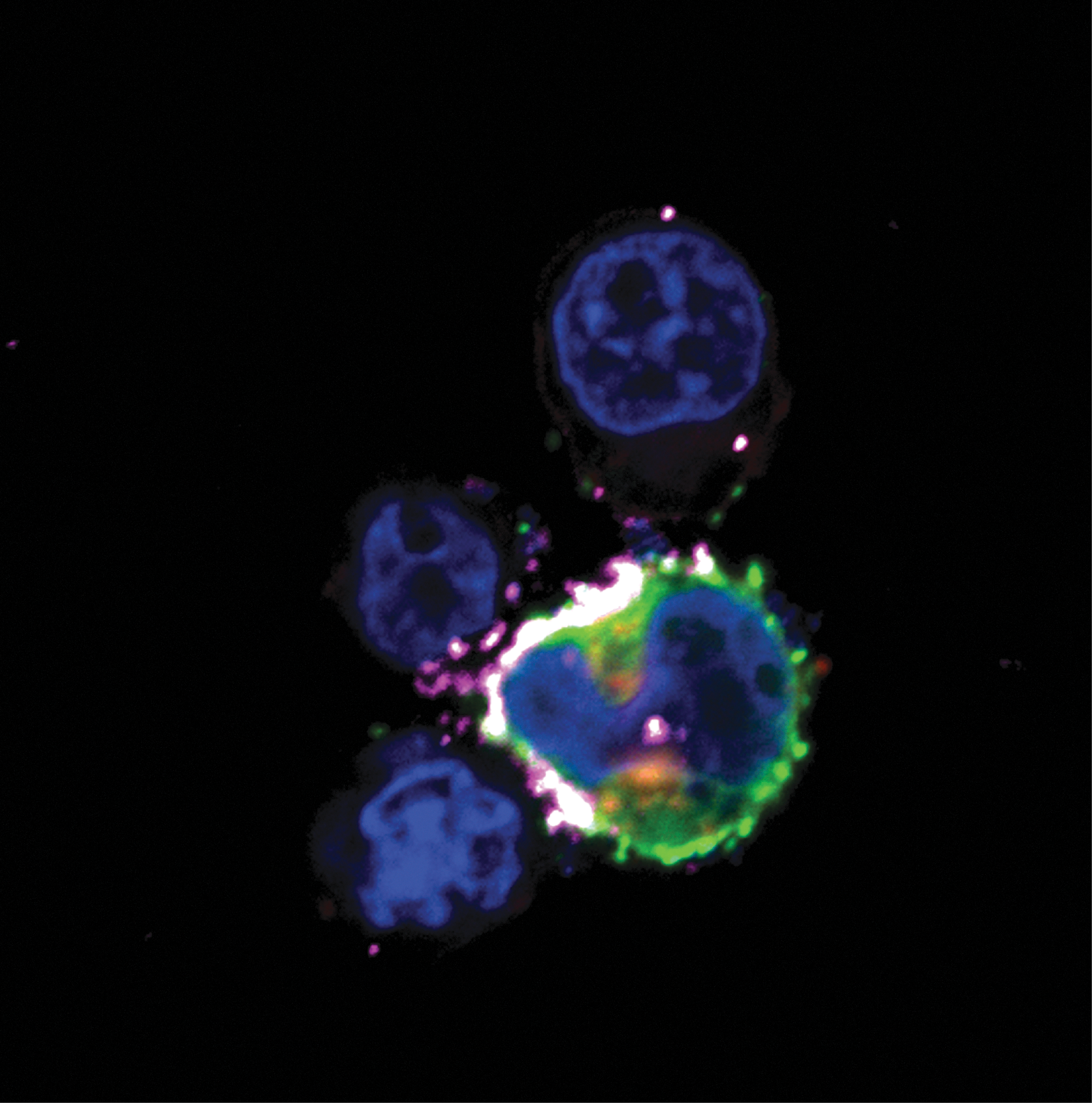
HIV-1 cell-to-cell transfer between infected and uninfected T cells (Jurkat cell line). Jurkat cells were nucleofected with the HIV-1 molecular clone HIVJR-FL Gag-iGFP (green) and with pCMV-CD63-mCherry (red). Cells were fixed after 24 h and a proximity ligation assay (PLA) for CD63 and the 2F5 (gp41) epitope (range indicator pink to white) was performed. The image demonstrates the PLA interaction dynamics between gp41 and CD63 at the virological synapse (VS). Nuclei were stained with DAPI (blue).
Footnotes
Acknowledgments
We thank Steve Norley for critical reading of the manuscript and Benjamin Chen for the HIVJR-FL Gag-iGFP molecular clone. This work was supported by the Peter and Traudl Engelhorn Foundation, Germany, and Jung Stiftung für Wissenschaft und Forschung, Hamburg, Germany.
Author Disclosure Statement
No competing financial interests exist.