




Abstract
CRF01_AE and subtype B are the two major HIV-1 clades circulating in China. Heterosexual transmission is the predominant route for the spread of HIV and heterosexuals often include men who have sex with men and intravenous drug users. Furthermore, many kinds of circulating recombinant forms (CRF) and unique recombinant forms (URF) between CRF01_AE and subtype B were recently identified in Southeast Asia. Therefore it is inevitable that the new recombinant of CRF01_AE/B will emerge among them. Here we identified a novel recombinant of CRF01_AE/B, isolated from heterosexuals, which has a distinctly different genome structure from other CRF01Bs and URFs reported before. The analysis of the near full-length sequence of JS2011001 shows that it is composed of at least five interlaced CRF01_AE and B segments. Recently, many kinds of URFs and CRFs began to prevail within a short period in China, which implies that a mix of HIV-1 infections is common in China and more attention should focus on it.
HIV-1
Jiangsu Province located in eastern China, has more than 80 million residents. The first HIV-1 case was recorded in 1992. At that time, intravenous drug users (IDUs), plasma blood donors (PBD), and recipients of blood transfusions (BT) constituted the major routes of infection. By the end of September 2013, 11,635 HIV-1-positive cases were reported. Among the HIV-1 cases diagnosed in 2013, 95.2% of them acquired HIV through sexual transmission. Since 2012 the proportion of homosexual transmissions between men and men has exceeded heterosexual transmissions. Our previous study showed that HIV-1 circulating in Jiangsu Province was mainly caused by CRF01_AE, CRF07_BC, and B, which accounted for 31/6%, 25.0%, and 19.7%, respectively. 3
Human immunodeficiency virus (HIV) evolves by a rapid accumulation of mutations and recombination between intersubtypes or intrasubtypes. Recently, many CRFs between CRF01_AE and subtype B, subtype B and subtype C, and CRF01_AE and subtype C were identified in succession in Southeast Asia. 4 –15 In these studies, all recombinants of CRF01_AE/B recently isolated from China were isolated from the men who have sex with men (MSM) population. 7,16 The novel recombinants of B/C were isolated from Yunnan Province where intravenous drug use is the predominant transmission route. 6,8,14 In Jiangsu Province, heterosexual transmission was the predominant route before 2012. To determine whether the new recombinant occurred among people at risk of heterosexual transmission, we enrolled HIV-1-positive people who became HIV infected through heterosexual transmission before 2012.
After obtaining the written consent information, 5 ml of whole blood was drawn using an EDTA-K3 vacuum tube (Becton Dickinson, Franklin Lakes, NJ). The plasma sample was separated by centrifuge at 3,000 rpm for 15 min. HIV-1 antibody was screened using an ELISA kit (BioMerieux Ltd., Marcy l'Etoile, France) and the positive samples were confirmed using a Western blot assay (Genelabs Diagnostics Pte Ltd., Singapore). Viral RNA was extracted from 140 μl of plasma with the QIAamp Viral RNA Mini Kit (Qiagen, GmbH, Hilden, Germany) and reverse transcribed into cDNA using the SuperScript First-Strand Synthesis System for reverse transcriptase polymerase chain reaction (RT-PCR) (Invitrogen, Carlsbad, CA) according to the manufacturer's instructions. The HIV near full-length sequence was amplified according to previously described methods. 17 PCR products were purified using a gel extraction kit (Qiagen, GmbH, Hilden, Germany), then sequenced on an ABI 3730X DNA analyzer using Bigdye terminators (Applied Biosystems, Foster City, CA). The sequences were blasted with all the sequences obtained in the laboratory to confirm and avoid possible cross-contamination.
DNA sequences were assembled using Contig software. The sequences were blasted with all the sequences obtained in the laboratory to confirm previous results and to avoid possible cross-contamination. Nucleotide sequences were aligned manually using MEGA version 6.0, with HIV-1 reference subtypes and CRFs from the HIV database (
Using phylogenetic analysis, the near full-length sequence of JS201101 forms a monophyletic branch supported by a bootstrap value of 95%, separate from other global subtypes and known CRFs in the world (Fig. 1). SimPlot analysis reveals that the breakpoints corresponded to HXB2 nucleotide positions 1375, 1895, 2495, and 2736 (Fig. 2). Phylogenetic analysis of the subgenomic fragments confirms the four breakpoints identified (Fig. 3). The genomic fragments 769 to 2144, 2145 to 2665, 2666 to 3505, and 3505 to 9181 branched with references CRF01_AE, B, CRF01_AE, B, and CRF01_AE, respectively. The breakpoints are completely different from CRF01B reported before.
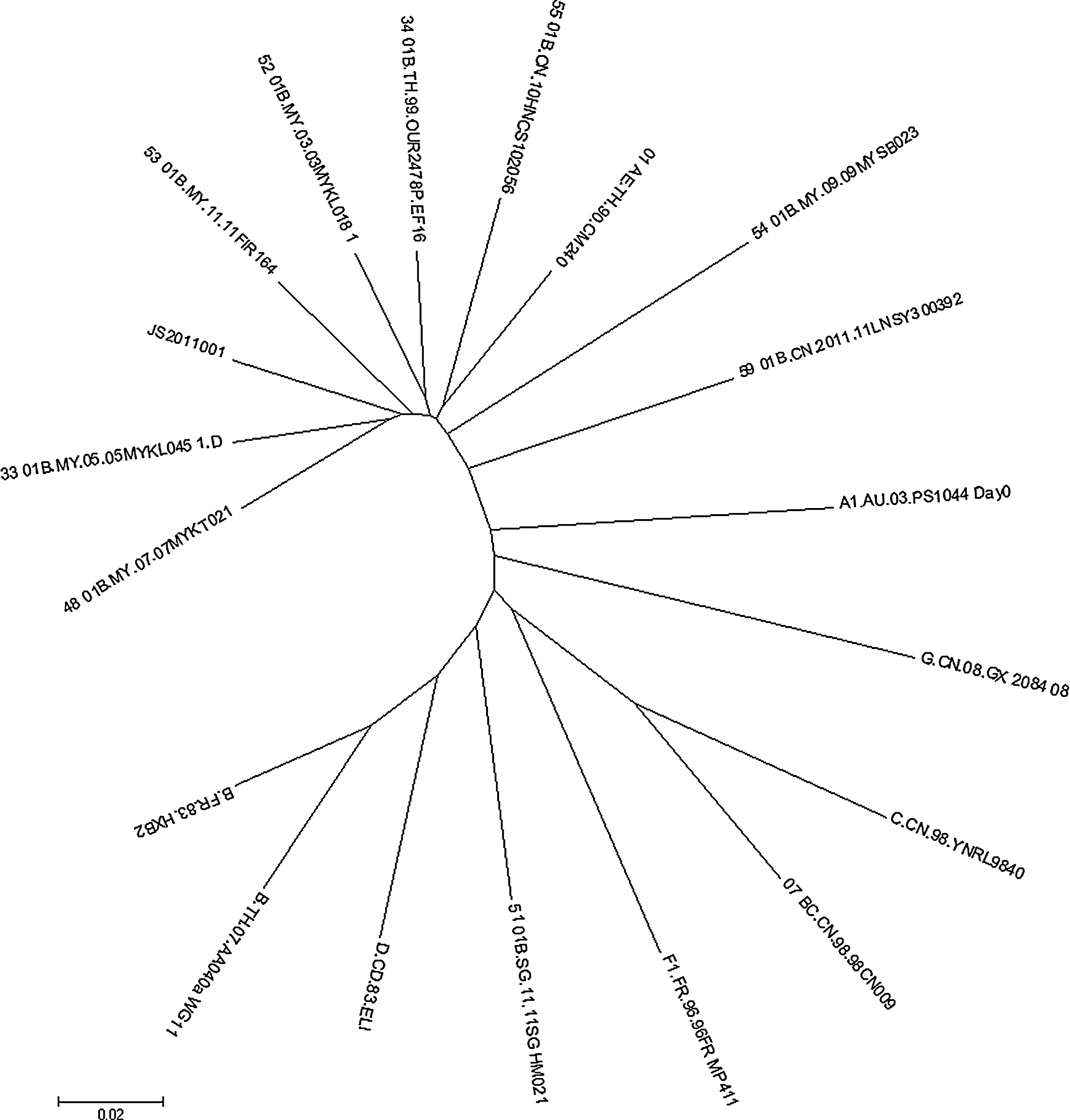
The phylogenetic tree of near full-length sequences showing the relationship of JS2011001 and other circulating recombinant forms and subtypes of HIV-1 previously identified.

Bootscanning analysis of a near full-length sequence of JS2011001.
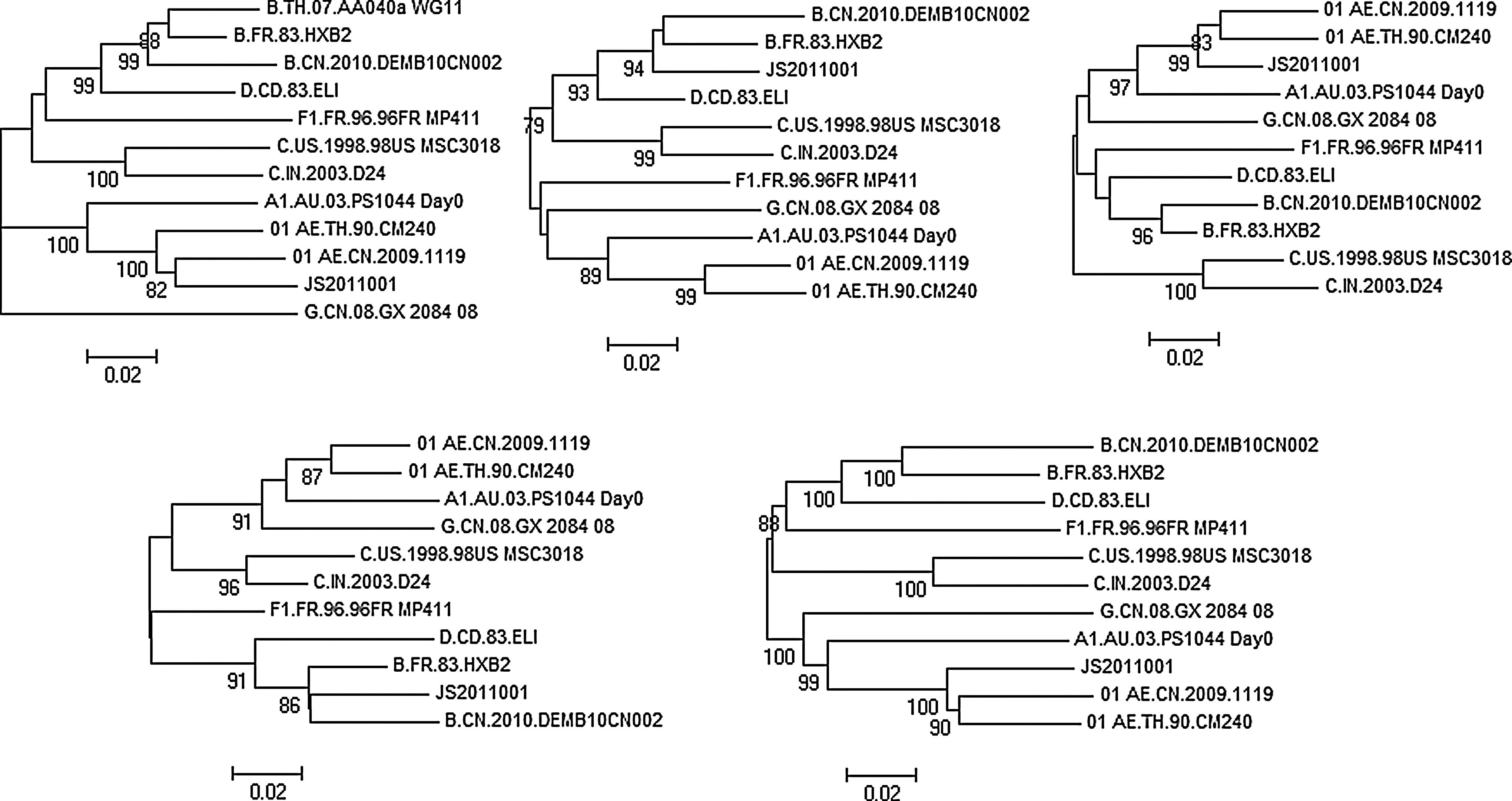
Phylogenetic analyses of five mosaic segments defined by bootscanning. The phylogenetic trees of five mosaic segments were constructed with MEGA 6.0 using the neighbor-joining method. The stability of the nodes was assessed by bootstrap analysis with 1,000 replications, and only bootstrap values of >75 were shown at the corresponding nodes.
In genomic regions I, III, and V, JS2011001 forms a cluster distinct from the reference CRF01_AE, supported by strong bootscan values of 100%, 99%, and 100%, respectively. In genomic regions II and IV, JS2011001 forms a cluster distinct from the reference subtype B, supported by strong bootscan values of 94% and 86%, respectively.
From 2012 to the present, many CRFs were reported in China, which included CRF01_AE/CRF07_BC, CRF01_AE/B, CRF01_AE/B′/C, the novel CRF01_AE/CRF08_BC, and the novel CRFB/C. 1,4,6,8,9,14 –16,18 Of course, there may be some CRFs or URFs that are still not identified. In a short time, many new CRFs and URFs circulated in China. There is still no evidence showing that these CRFs or URFs were introduced from other regions outside China. If they formed among HIV-positive people living in China, it would imply that a mix of infections involving the various HIV subtypes is frequent in China. However, there are few data describing HIV superinfection among various risk groups. The emergence of new recombinant forms of various HIV subtypes will increase the diversity of HIV in the genome and virus structure, which increases the challenge of developing an HIV vaccine and antivirus drugs. Therefore, it is urgent to survey the mix of infections of various HIV subtypes among HIV-positive people living in China and take effective measures to prevent it.
In summary, here we describe a novel recombinant form of HIV-1 between CRF01_AE and B isolated from an individual at risk of heterosexual transmission. The phylogenetic analysis showed that this recombinant form is distinct from the CRFs and URFs previously reported.
Sequence Data
The near full-length genomic sequence of JS2011001 has been submitted to GenBank with accession number KM111555.
Footnotes
Acknowledgments
This work is supported by the Jiangsu Province's Key Provincial Talents Program (RC2011083) and the National Natural Science Foundation of China (NSFC81373125 and NSFC81302466).
Author Disclosure Statement
No competing financial interests exist.