




Abstract
The predominant circulating HIV-1 strains in South America are subtype B and B/F recombinants with different distributions among countries. However, the emergence of other subtypes is a matter of concern and needs continuous monitoring. We identified three different A/G recombinants in Argentina, two of them in vertically infected children from unlinked mothers and one in an adult female. HIV-1 pol sequences from the children showed novel A/G recombination patterns and no phylogenetic relationship with previously reported South American A/G sequences. The third A/G recombinant was a CRF06_cpx with African origin. The detection of new or unusual subtypes is important to avoid false-negative PCR HIV-1 early diagnosis due to detection failures and for future vaccine development.
T
Africa is the origin of the HIV-1 epidemic and therefore harbors almost all the variety of HIV-1 subtypes. Recombinant forms are responsible for almost 10% of all HIV-1 infections in this continent, and the main recombinant forms are mosaic structures containing subtypes A and G, including CRF02_AG and CRF06_cpx. CRF02_AG predominates in West and West Central Africa, accounting for>50% of the total infections by recombinant HIV-1 strains. CRF06_cpx is second in prevalence, responsible for around 6% of the infections by recombinant strains in Africa, and involves recombination events between subtypes A, G, and at least another two subtypes (J and K). 4 These genetic forms were identified early in the epidemic, and had a limited spread outside the African continent. However, the prevalence of CRF02_AG has been increasing in past years in Africa and Europe, mainly in Italy because of migrations from the sub-Saharan region. 5
In South America, HIV-1 subtypes are mainly B and BF recombinants. The number of A/G mosaic forms identified is very small, currently reaching a total of 41 GenBank submissions (2 full-length and 39 partial HIV-1 gene fragments). The first A/G recombinants characterized as CRF02_AG by full-length sequencing were found in a heterosexual couple from Ecuador. 6 Between 2003 and 2011, another 18 CRF02_AG strains were found in Ecuador and Brazil based on the analysis of the HIV-1 pol genomic fragment. 7,8 Since 2008, HIV-1 gene fragments similar to the CRF06_cpx strain were found in four individuals from Venezuela, 9 four from Colombia, one from Bolivia, and one from Argentina. 10 Parental HIV-1 subtypes A and G in South America are even less frequent than A/G recombinants and up to the present time, no full-length sequence from South American A or G pure HIV-1 strains has been reported.
Our aim was to investigate the recombination patterns and phylogenetic relationship of three different A/G recombinant strains found in two vertically infected children and an adult female from Paraguay but living in Argentina. The study was reviewed and approved by the Ethics Committee of the Garrahan Hospital and the Ethics Committee of the Durand Hospital for children and adults, respectively. An HIV-1 pol gene fragment of around 1,100 pb encompassing the whole p6gag, protease (PR) pol, and codons 1–220 of the reverse transcriptase (RT) pol was amplified from plasma samples from two epidemiologically unlinked HIV-1 vertically infected infants (5707 and 4707) born in 2009 and 2013 in the cities of Pergamino and Salto (223 and 183 km from Buenos Aires city, respectively), and from one adult female (FFCA) born in Paraguay.
The HIV-1 pol segment was sequenced with the automated sequencer ABI 3130 (Applied Biosystems), and sequences were aligned using the Gene Cutter Tool 11 for phylogenetic and recombination analyses. The phylogenetic trees were inferred by the maximum likelihood (ML) method with the MEGA v6.0 program, under the GTR+G 12 nucleotide substitution model inferred according to the Akaike Information Criterion (AIC) statistics obtained with the jModelTest v0.1 program. 13 Recombination breakpoints were identified with bootscan analysis by SimPlot software v2.5 14 and confirmed with the RIP tool from the Los Alamos Database. 15
The HIV-1 subtype of the newly characterized HIV-1 strains was investigated by comparison to HIV-1 reference sequences through phylogenetic analysis of HIV-1 pol fragments. Figure 1a shows that sequences from the adult woman (FFCA_L691) and her partner (MMaPR_L690) formed a well-defined group with 100% bootstrap support with the CRF06_cpx reference strains. Clustering within the CRF06_cpx group was also observed for a 680-bp V2-C5 env fragment (Supplementary Fig. S1; Supplementary Data are available online at
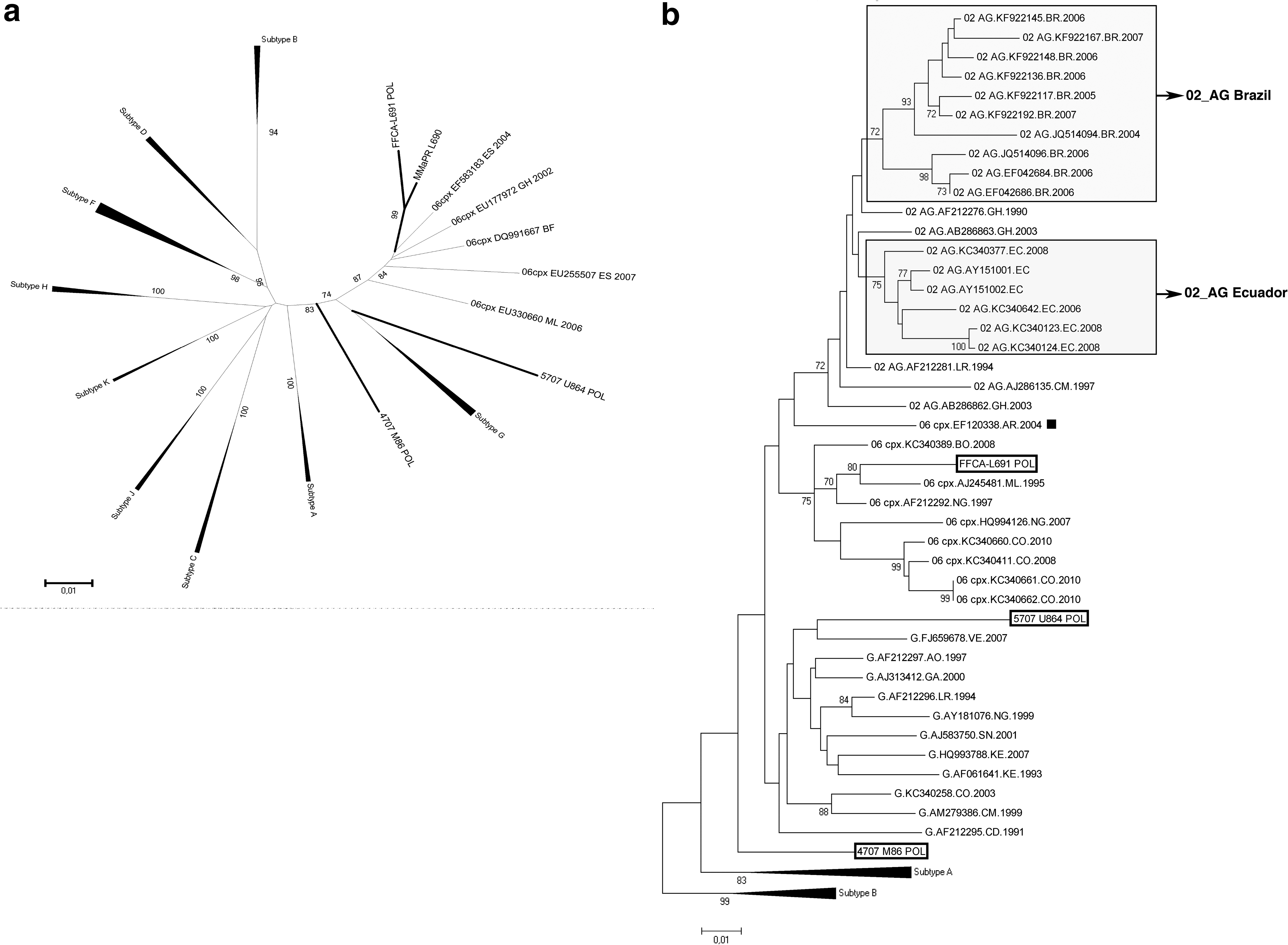
Maximum likelihood phylogenetic trees of the HIV-1 pol region, encompassing the protease and part of the reverse transcriptase of newly identified A/G recombinants from Argentina and subtype reference strains. Bootstrap support values are represented at the nodes for each cluster.
None of the sequences obtained from the vertically infected children clustered with the CRF02_AG or CRF06_cpx reference strains. 5707_U864 was phylogenetically related with a low bootstrap value (70%) to a subtype G sequence from Venezuela, while 4707_M86 did not show any close phylogenetic relationship with previously reported South American A, G, or A/G recombinant strains.
Within the CRF06_cpx group, sequence FFCA_L691 showed greater similarity to African CRF06_cpx sequences than to CRF06_cpx sequences from South America, in agreement with the fact that FFCA acquired the infection through her partner (MMaPR), an immigrant from Sierra Leone, Africa. In our phylogenetic tree, CRF06_cpx sequences from Colombia and Bolivia form a well-defined group with CRF06_cpx reference strains from Africa, but sequence 06cpx.EF120338.AR.2004 previously identified in an adult female from Argentina 10 branched outside the CRF06_cpx group.
To identify and characterize intersubtype recombination breakpoints in the two newly identified pol sequences present in children, sequences were individually analyzed for recombination patterns with consensus references by bootscan analysis with SimPlot 2.5 (Fig. 2a and b). Only A and G subtypes were present in both 5707_U864 and 4707_M86 sequences. However, recombinant breakpoints differed between them. In 4707_M86 the subtype A segment spans approximately 413 nt from position 2114 to 2527 of HXB2 (GenBank Accession Number K03455). In 5707_U864 the subtype A fragment is smaller (approximately 200 nt, positions 2580 to 2778). The small subtype A insertion probably accounts for the low bootstrap support observed for 5707_U864 within the subtype G cluster in the phylogenetic tree (Fig. 1b).
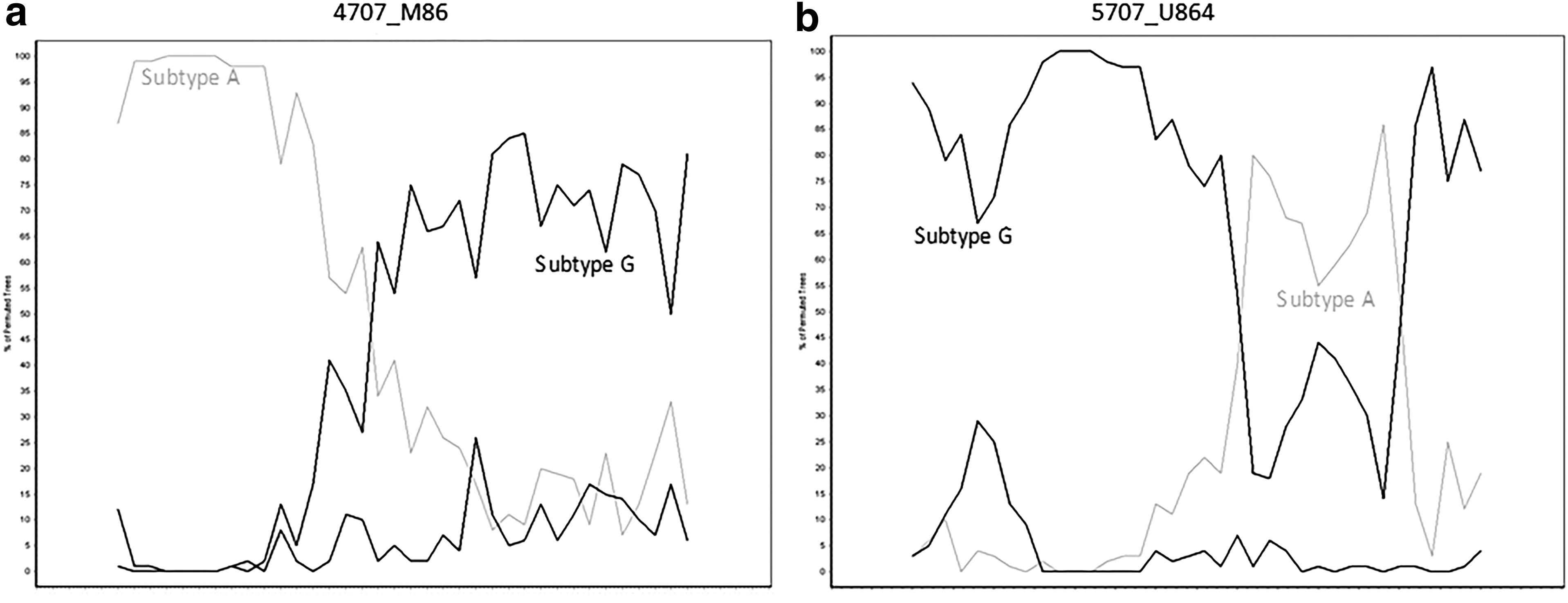
Bootscanning plot of
Similar results were obtained with the RIP tool, and subtype assignment was confirmed by phylogenetic analysis of each segment (Fig. 3a and b). None of the sequences shared a recombination breakpoint with CRF02_AG. The HIV-1 pol sequence was also available from the mother of 5707, and showed 100% identity to the one found in the child, demonstrating for the first time in Argentina local transmission of novel HIV-1 A/G recombinant strains.
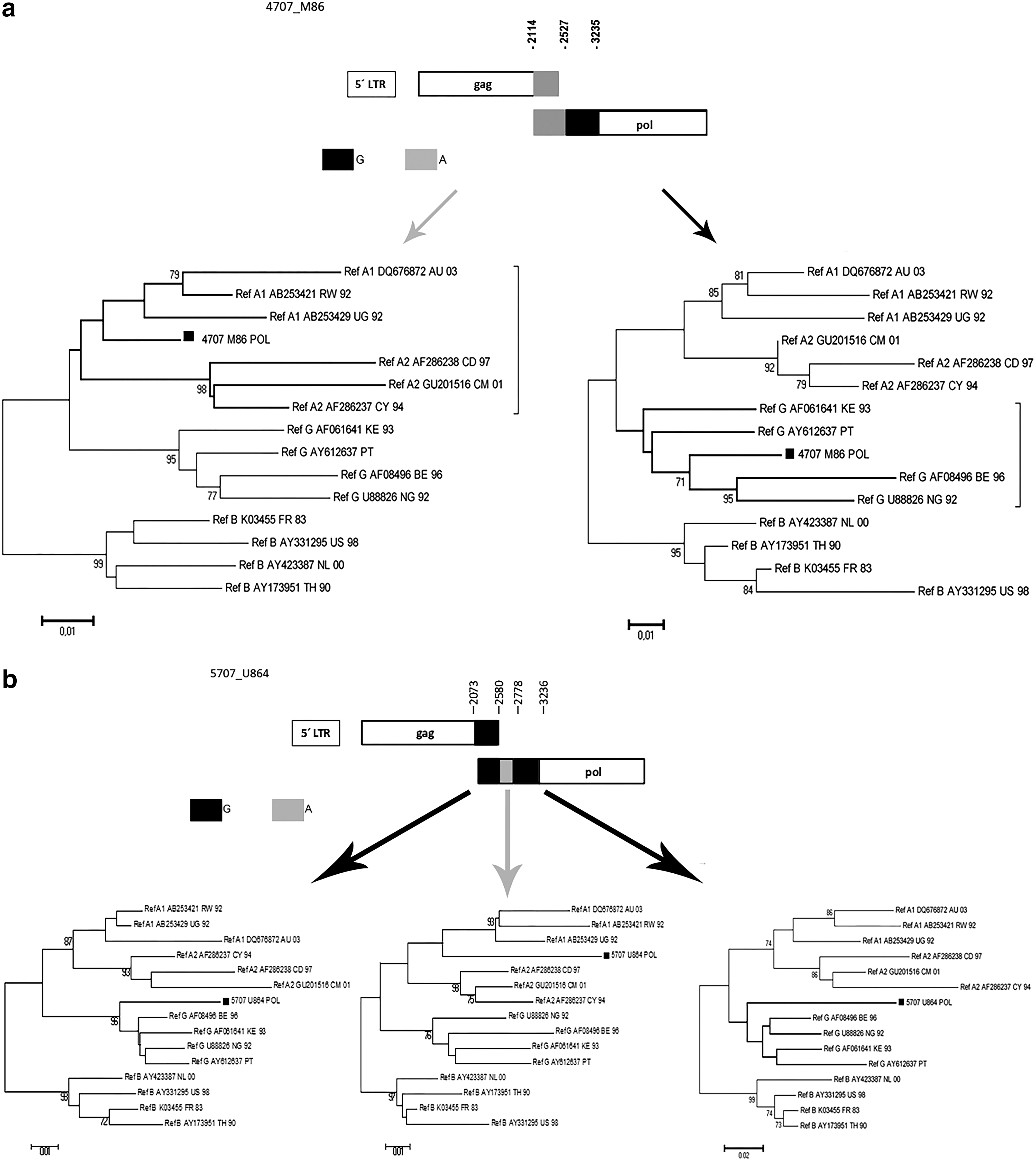
Schematic representation of the recombination pattern of
In conclusion, we describe the local circulation of three different A/G recombinants in Argentina: two novel URFs_AG in children and a CRF06_cpx in an adult female and her African partner.
Previously, CRF06_cpx had been identified in four South American countries, including Argentina, where a single CRF06_cpx was reported in an adult woman. However, this sequence was distantly related to the CRF06_cpx strain found in our study, which conformed a well-defined cluster together with other CRF06_cpx strains from Africa, Colombia, and Bolivia. Therefore, it is possible that the previously reported CRF06_cpx strain is in reality a URF_AG that shares no phylogenetic relationship to the novel recombinant A/G strains described in this study.
It has been proposed that recombinants of subtypes A and G possessing breakpoints different from CRF02_AG are commonly generated from dual infections. 16 Due to the almost complete absence of parental A and G subtypes in our country, except for a few scattered cases, 17 the presence of novel recombinant forms in children from Argentina probably represents independent introductions of URFs_AG, rather than local recombination events.
Failures in HIV-1 detection by nucleic acid-based methods are one of the biggest problems caused by unusual subtypes, 18 as we had previously reported for subtypes A and F. 19 Our test for HIV-1 diagnosis in newborns, an in-house multiplex nested PCR, targets two HIV-1 genomic regions (gag and env) for increased sensitivity in the detection of unusual subtypes. However, diagnostic problems were also observed in children infected with the A/G recombinants reported in this study. The diagnostic PCR performed at 1 month for child 5707 tested negative due to lack of amplification of both the gag and env gene fragments, while child 4707 tested positive with amplification of the gag fragment alone. In both cases, HIV-1 infection was confirmed with a plasma viral load>100,000 RNA copies/ml (Roche Cobas TaqMan) and amplification of the HIV-1 pol fragment used for the HIV-1 genotypic drug resistance test.
Other implications of uncommon HIV-1 strains include (1) reduction in the sensitivity of the detection of the p24 antigen due to differences in viral epitope recognition by monoclonal antibodies used in the assay, 20,21 (2) potential differences in disease progression, 22 and (3) impairments of vaccine efficacy in clinical trials.
Our results emphasize the importance of continuous surveillance of HIV-1 genetic diversity for the early detection of new emerging viral clades in the population and their spread, given the unknown impact on transmissibility, pathogenicity, and relevance in future vaccine development.
Footnotes
Acknowledgments
Supported by CONICET PIP 11220090100188, the National Agency for the Promotion of Science and Technology (Agencia Nacional de Promoción Científica y tecnológica) (Grant PICT 2011-2235). The authors would like to thank Gustavo Icardi and Silvina Juarez for technical support and Debora Mecikovsky for review of the clinical records.
Author Disclosure Statement
No competing financial interests exist.
References
Supplementary Material
Please find the following supplemental material available below.
For Open Access articles published under a Creative Commons License, all supplemental material carries the same license as the article it is associated with.
For non-Open Access articles published, all supplemental material carries a non-exclusive license, and permission requests for re-use of supplemental material or any part of supplemental material shall be sent directly to the copyright owner as specified in the copyright notice associated with the article.
