




Abstract

S
Many critical questions about CTLs and HIV-1-infected target cell's interface can be addressed only by using superresolution imaging. Here we examined cytotoxic IS and the loading and delivery of perforin at IS by superresolution structured illumination microscopy (SIM). To compare the perforin loading and delivery at IS between TCR clonotypes, we first imaged the IS under conventional widefield fluorescence microscopy (Fig. 1A). The polarized lytic granule stained by perforin (a marker for lytic granules) was released at the cytotoxic immunological synapses and delivered into HIV-1-infected GXR [a green fluorescent protein (GFP) reporter T cell line, derived from the human lymphoblastoid CD4+ T cell line CEM, that fluoresces green after infection with HIV-1] cells after the mixture of HIV-1-specific CTLs with HIV-1-infected GXR for 30 min. However, conventional widefield fluorescence microscopy cannot distinguish the accumulated lytic granules at IS, as shown in the lower panel of Fig. 1A.
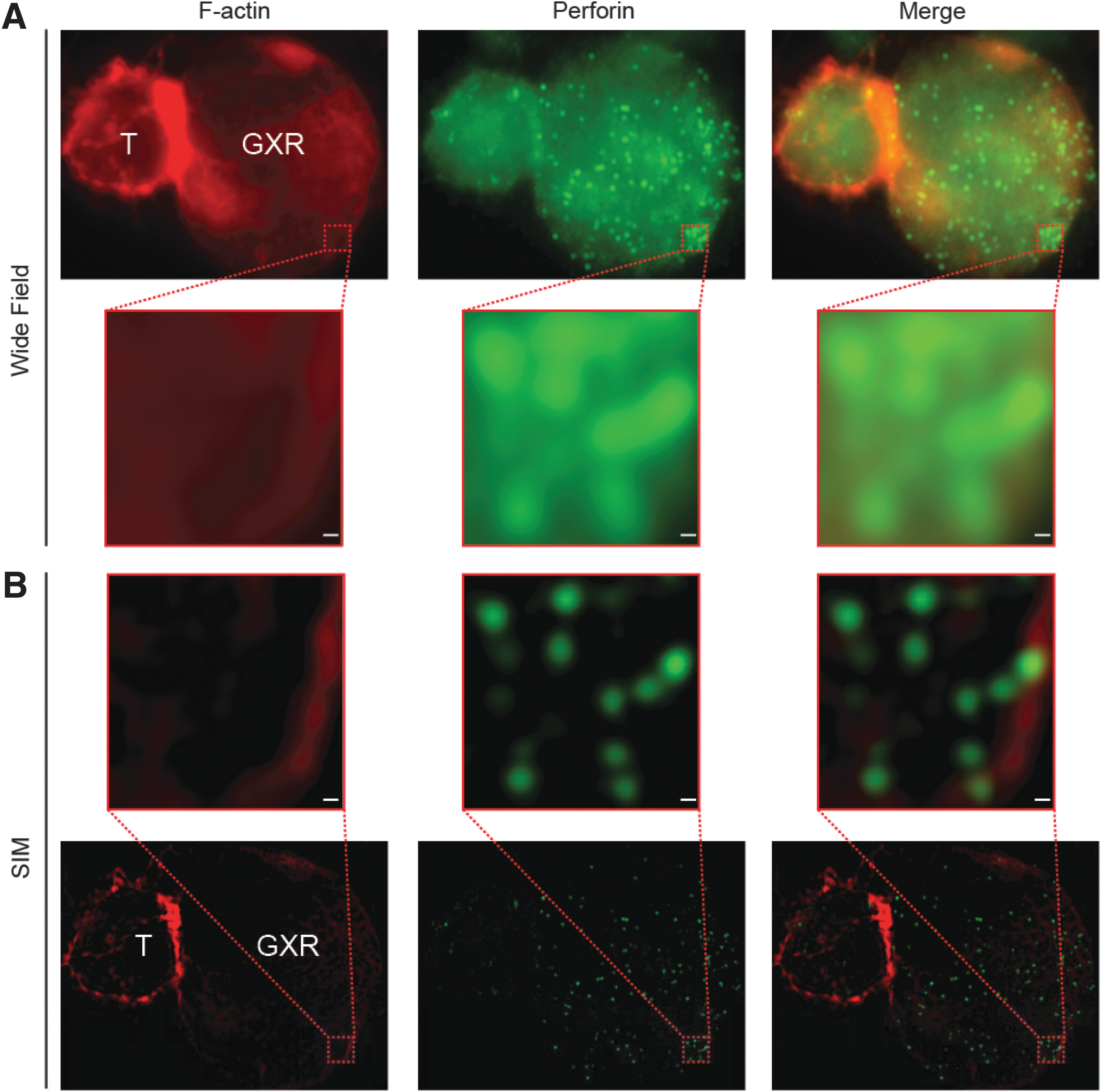
Comparison of perforin imaging between widefield fluorescence and structured illumination microscopy (SIM). HIV-1 KK10-specific cytotoxic T-lymphocyte (CTL) clone cells were mixed with HIV-1-infected HLA-B*27-expressing GFP reporter GXR cells for 30 min. Cells were fixed and stained with monoclonal antibody against perforin and followed by Alexa Fluor dye-conjugated secondary antibodies. F-actin was stained with phalloidin-Alexa Fluor 647. Three-dimensional images were collected on a Zeiss ELYRA superresolution microscope using a plan apochromat 63×1.4 oil immersion objective. The middle panels are the same region in the target cells under widefield fluorescence microscopy
To distinguish the accumulated lytic granules, we used superresolution SIM (Zeiss ELYRA) to visualize the individual lytic granules. SIM clearly dissects the number and size of lytic granules at IS (lower panel of Fig. 1B). This is the first superresolution image of HIV-1 cytotoxic IS, which allows us to determine the structure and function of HIV-1-specific CTL IS in greater detail and yields critical insights into how these findings relate to viral control.
Footnotes
Author Disclosure Statement
No competing financial interests exist.