




Abstract
The prevalence of HIV infection in different Russian regions is nonuniform. In the Tomsk region (TR), 2020 HIV new infection cases were recorded in 2013, the morbidity having increased 5.9-fold as compared to 2012. In total, 64 blood plasma samples from primary HIV cases have been examined. HIV-specific fragments of the pol gene have been obtained for 61 samples (of protease for 58 and of integrase for 23) and of the env gene V3 region for 40 samples. Phylogenetic analysis of the determined HIV-1 sequences has detected CRF63_02A1 in 55 (90.2%) cases, whereas HIV subtype A1, characteristic of Russia, has been observed in only three (4.9%) patients. Three (4.9%) cases contain CRF63_02A1/A recombinant variants. This article demonstrates that a drastic activation of the epidemic in the Tomsk region is accompanied by a rapid spreading of the recently described HIV-1 CRF63_02A1, which we detected in the Novosibirsk region outbreak of 2008.
Introduction
T
Materials and Methods
In total, 64 patients living in Tomsk and the Tomsk region were examined. Blood samples as well as clinical and epidemiological data were collected at the Tomsk Regional Center for Prevention and Control of AIDS. Blood samples were related to demographic and clinical data by anonymous codes according to the Ethical requirements of the Russian Federation. All the procedures involving human objects were conducted in accordance with the ethical standards of the responsible committee on human experimentation (institutional and national) and with the Helsinki Declaration of 1975, as revised in 2000.
RNA was extracted from the blood plasma; virus-specific fragments were isolated and sequenced as earlier described.
4
For theoretical analysis, reference nucleotide sequences of the main HIV-1 subtypes and recombinant forms were selected using the Los Alamos HIV Sequence Database (
Results
Clinical and epidemiological information
The blood plasma samples of 64 newly diagnosed cases of HIV infection were collected from December 2013 to March 2014. Of these patients, 51 lived in Tomsk and 10 lived in rural districts of the Tomsk region. Three patients came to Tomsk from other areas (55Tomsk from Novosibirsk, 2Tomsk from Moscow, and 47Tomsk from Irkutsk); the HIV infection of these patients was diagnosed in 2013 and 2014 at their previous residences. The mean age was 32.6 years old (range, 18–56); the group comprised 38 (59.4%) men and 26 (40.6%) women. Of these, 38 (59.4%) were infected from using injection drugs, 22 (34.4%) were infected from sexual contacts, and four were unidentified. At the time of sampling, the virus load varied from less than 400 to 1.4×10⁶ HIV RNA copies/ml blood and CD4 cell counts, from 152 to 1452 cells/μl.
Distribution of HIV-1 subtypes
The HIV-1 variants were genotyped according to the pol and env genes. Protease (PR, 531 bp long) and integrase (IN, 906 bp fragments, pol region) were obtained and sequenced for 58 and 23 samples, respectively, and fragments (640 bp) of the env gene V3 region, for 40 samples.
Phylogenetic analysis of all analyzed genes detected quite an unusual distribution of HIV-1 genetic variants. HIV-1 CRF63_02A1 was detected in 55 (90.2%) cases and subtype A1 was detected in three (4.9%) patients. Presumably, the HIV-1 recombinants CRF63_02A1/A were present in three (4.9%) samples, since 25Tomsk, 39Tomsk, and 45Tomsk clustered with subtype A1 according to PR (Fig. 1), while the env sequences of 39Tomsk and 45Tomsk (Fig. 2) and IN sequence of 25Tomsk (data not shown) clustered with CRF63_02A1.

Phylogenetic trees of HIV-1 sequences of Tomsk samples. Tree of PR sequences. The samples from this study are in boldface type. Only bootstrap values ≥70% are shown. In subtype references, the country of sampling is indicated with the ISO two-letter code.
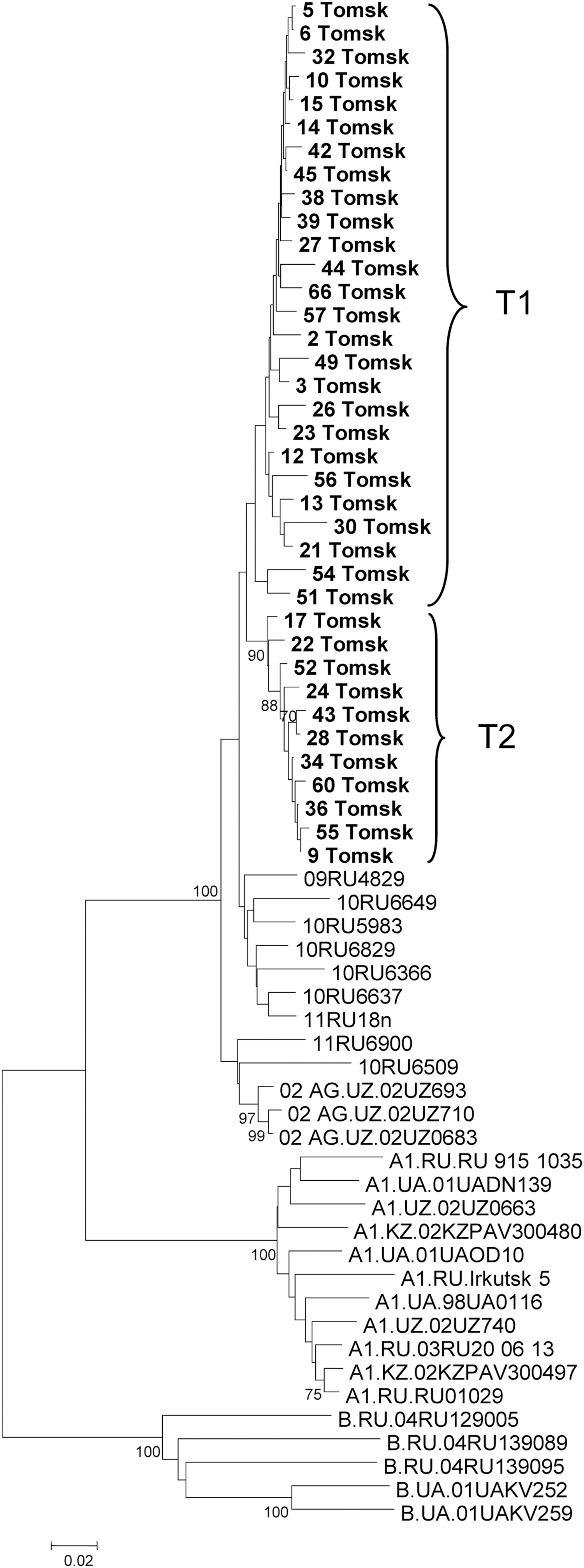
Phylogenetic trees of HIV-1 sequences of Tomsk samples. Tree of the env V3 region sequences. The samples from this study are in boldface type. Only bootstrap values ≥70% are shown. In subtype references, the country of sampling is indicated with the ISO two-letter code.
Note that the Tomsk samples of HIV-1 CRF63_02A1 in each phylogenetic tree constructed for the examined fragments (Figs. 1 and 2) with a bootstrap support >70% formed two separate clusters, designated T1 and T2. T1 in the PR phylogenetic tree contains 80% of the analyzed Tomsk CRF63_02A1 variants. In addition to the HIV-1 variants isolated from Tomsk residents, this group contains 2Tomsk, isolated from a former Moscow resident whose HIV infection was diagnosed there in May 2013.
Cluster T2 of PR comprises the HIV-1 variants isolated from Tomsk residents and the earlier described CRF63_02A1 variants isolated from residents of the Novosibirsk region. Note that the Tomsk variants of HIV recombinants mainly form a separate subcluster.
Of interest is that the HIV variants forming the T1 and T2 clusters according to PR do not completely correspond to the HIV variants of the T1 and T2 according to env (Figs. 1 and 2). Some variants from the PR T1 cluster move to the T2 cluster according to env (28Tomsk, 36Tomsk, 52Tomsk, and 60Tomsk); in one case (57Tomsk), the corresponding variant left PR T2 for env T1.
Comparative analysis of the clinical data shows differences between the patients infected with different HIV genovariants. Among three Tomsk cases infected with HIV-1 subtype A1, two were infected via a sexual route (virus load less than 400 RNA copies at the first examination) and one was infected via drug injections (virus load, 3.8 log copies/ml). For 49 patients infected by CRF63_02A1, the mean virus load was 5.3 log copies/ml (2.6–6.2 log); in four cases, the virus load exceeded 6.1 log; and in six cases, the virus load was low (<400 copies/ml).
CD4 counts for three persons infected with subtype A1 were 870 (786–969) cells/μl and for persons infected with CRF63_02A1 were 438 (152–1452) cells/μl.
Epidemiological characteristics (age, sex, infection route, risk group, and urban or rural residence) displayed no correlation with HIV-1 genetic clustering.
Analysis of HIV-1 genetic heterogeneity, drug resistance, and tropism
The tropism of Tomsk HIV-1 variants associated with CCR5/CXCR4 coreceptors was predicted by analyzing the env V3 region amino acid sequences deduced by Geno2pheno 2.5 and WebPSSM. All 40 HIV-1 variants with available env sequences were determined to be CCR5-tropic isolates.
To detect the mutations associated with HIV resistance to antiretrovirus preparations (DR), we analyzed all determined HIV-1 PR sequences using the Stanford HIV Drug Resistance Database (
Interestingly, characteristic of all the recombinant HIV variants belonging to subtype A1 only in their PR region (25Tomsk, 39Tomsk, and 45Tomsk) was mutation I13V, detected in the PR of 100% of the Tomsk HIV-1 CRF63_02A1 variants studied. Another mutation, K14R, was also present in the PR of 100% of the Tomsk HIV-1 CRF63_02A1 variants and mutation N37D was detected in 92% of HIV-1 variants. Note that almost all the CRF63_02A1 variants studied (94%) carried mutation I64M, characteristic of this genovariant, except for three HIV samples (2Tomsk, 35Tomsk, and 63Tomsk), one isolated from a former Moscow resident.
Discussion
A specific feature of the TR (Western Siberia; population exceeding 1 million; area, 316,900 km2) is a nonuniform population density associated with the geographic isolation of individual districts. Specific geographic and, consequently, socioeconomic features have influenced the specificity of the development of the HIV-1 epidemic in TR. Before 2010, HIV infection was observed only in individual administrative units. The major infection route in 2000–2003 was intravenous heroin use with a practice of joint injections. The high cost of this drug limited its accessibility. In 2004–2005, the HIV infection rates via heterosexual contact and intravenous heroin abuse were approximately equal. Since the beginning of the HIV epidemic in TR in January 2013, 1453 infection cases have been recorded. However, new HIV-1 cases in 2013 there reached 2020 and the first 2 months of 2014 brought an additional 478 patients. By March 1, 2014, 4480 cases of HIV infection were recorded in TR, with 81.3% resulting from intravenous drug injections. Analysis of the epidemic demonstrates that spreading of new synthetic drugs in TR causes an increase in the epidemic.
Synthetic drug abuse is associated with an extremely high risk for HIV infection. A specific feature of such drugs is an almost immediate addiction drastically changing behavior. Synthetic psychoactive substances increase sexual activity and decrease the concern for their safety; they frequently use a common syringe and display uncontrolled sexual behavior.
To study the circulating HIV genetic variants, clinical blood samples of 64 patients of the Tomsk Regional AIDS Center were collected during 2.5 months of 2014 (12.3% of all newly diagnosed HIV cases over this period).
Detection of DR mutations in TR HIV patients with ineffective antiretrovirus therapy before 2012 demonstrated the prevalence of subtype A1 there. 6 This subtype was the major genetic variant in this country in the early 2000s. 7 –11 The second wave of the HIV epidemic in Siberia started in 2008–2010 against the background of low HIV prevalence with intravenous drug injection as the major risk factor. 7,12 In 2008–2009, the epidemic rate in the Novosibirsk region increased severalfold and an outbreak of a new HIV-1 genetic variant, CRF63_02A1, was detected for the first time. 13 –15 This demonstrated that new HIV-1 genetic variants could emerge in Russia and spread rapidly in various areas with a severalfold acceleration of the epidemic and a high prevalence of drug abuse.
Phylogenetic analysis of HIV-1 nucleotide sequences has shown that the HIV genetic variant also changed in TR: subtype A1, which circulated in Russia with a prevalence of 95%, was detected in only three samples versus CRF63_02A1, which was detectable in over 90% of cases.
Unlike the homogeneous CRF63_02A1 population in other Siberian areas, 13 phylogenetic clustering of this recombinant form is observed in TR. At least 4.9% of the analyzed clinical samples contained unique HIV-1 recombinant variants, CRF63_02A1/A. This suggests a superinfection among the HIV-infected persons in TR, entailing both mixed infection and the emergence of new recombinant forms.
TR is the second region in Russia in which an outbreak of an HIV-1 epidemic coincided with replacement of the prevalent genetic variant. Note that the major pathogen was replaced over a short period with a severalfold acceleration in the epidemic rate.
We believe that this is a very important fact. Such a rapid spread of CRF63_02A1 is explainable by the fact that this particular genetic variant infected the high-risk group, the main contributor to spreading of the HIV-1 epidemic. The high behavioral risks of synthetic drug use enhance the spread of any HIV genetic variants circulating in the population as well as DR HIV-1 forms, emerging due to inadequate therapy for such persons.
Limited samples from the patients prevent a correct analysis of clinical data. Nonetheless, note the low virus load and CD4 counts of the persons recently infected by HIV-1 CRF63_02A1. This once again suggests that certain specific CRF63_02A1 biological features, described earlier, 13 may also be responsible for the rapid spread of this genetic variant in different Russian territories.
Taking into account that new accessible intravenous drugs continue to spread not only in Russia, but also in other countries, the threat of the emergence and distribution of new or previously less abundant HIV genetic variants is increasing in the world in the best case and of drug-resistant HIV forms in the worst case. This makes molecular biological studies of the current “hotspots” in the HIV epidemic most topical.
Sequence Data
Sequences were deposited in GenBank under accession numbers KM676133–KM676217.
Footnotes
Acknowledgment
This work was partially funded by the Ministry of Education and Science of the Russian Federation under the program for support of leading scientific schools (grant NSh-4713.2014.4).
Author Disclosure Statement
No competing financial interests exist.